'It's Not Dirt': Adult Eczema and the Hands Nobody Wants to Shake
Hand eczema gets read as poor hygiene or something catching, when the cruellest twist is the opposite: the people who wash most are often the ones whose hands crack worst.
Read the preview
What if the people with the cleanest hands are the ones whose hands crack worst? Hand eczema gets read as dirt — yet detergent damages skin more than alcohol rub does, so extra scrubbing deepens it. Almost a third of adults with eczema say others have dodged their handshake. So what should change at work? Pick up the Dermington Gazette for the full story.
The flinch across the desk
Hands are the most public skin an adult has. They pass coffee, sign forms, hold a partner's hand on a first date and reach across a desk to say hello. When those hands are red, scaly, split at the knuckles or dotted with tiny blisters, other people notice, and some of them pull back. A colleague who was about to share a pen suddenly has their own. A new partner glances down and goes quiet.
The assumption behind that small retreat usually comes in one of two forms. Either the skin looks dirty, as if the person has not been washing, or it looks infectious, as if it might spread. Both are wrong about eczema, and the first one is wrong in a particularly painful way, because many adults with hand eczema wash more than anyone else in the room. That is often how it started.
The distress this causes is not vanity. It is a reasonable reaction to being treated as unclean in public, repeatedly, for a condition that is neither unclean nor contagious. The research on how often it happens is now large enough to stop treating it as an occasional bad moment.
What 10,000 adults said about being avoided
The biggest dataset so far comes from 'Scars of Life', a European Academy of Dermatology and Venereology project presented as a congress abstract in 2024. It surveyed more than 30,000 adults across 27 countries, of whom 10,258 had current atopic eczema. Among them, 31.6% said other people had avoided shaking hands with them because of visible eczema. 29.1% reported discrimination at work, 28.5% said a partner had rejected them because of their eczema, and 28.1% said family or relatives had been ashamed of them. Almost four in ten described trying to hide it. Conference abstracts have not yet been through full peer review, so the exact figures could move, but the scale is hard to wave away.
Hand eczema in particular is not a niche problem. A 2021 meta-analysis pooling 66 studies and 568,100 people found a lifetime prevalence of 14.5% and a one-year prevalence of 9.1% in the general population. It was one and a half to two times more common in women, more than a third of cases were moderate or severe, about a third had a history of atopic eczema, and the average age at onset sat in the early to mid twenties, which is to say, right at the start of working life.
The working-life cost shows up clearly in clinic data. In a Swiss study of 199 adults with chronic hand eczema, lasting on average more than six years, 37.3% had taken sick leave because of it in the previous 12 months and 14.8% had changed or lost a job. Quality of life took a heavier hit when the backs of the hands were involved, where others are most likely to see, and when itching was intense.
Not dirt, not catching
Eczema is a barrier and immune condition. In atopic eczema the outer layer of the skin holds water and lipids poorly and lets irritants and allergens in too easily, and the immune system overreacts to what gets through. Hand eczema adds the outside world on top: irritants such as water, soap and solvents, and sometimes a genuine allergy to something handled at work, such as rubber accelerators in gloves, preservatives or hair dye. None of this involves an infection that passes from one person to another. The Questions library answers both halves of the assumption plainly, under whether eczema can be passed on and whether eczema means poor hygiene.
There is one honest wrinkle worth knowing, because it explains where the 'dirty' idea may come from. Eczema-damaged skin is far more likely to carry the bacterium Staphylococcus aureus. A 2016 meta-analysis of 95 studies found it on about 70% of eczema patches, compared with much lower rates in people without eczema. That is a consequence of the broken barrier, not of how often someone washes, and carrying a common skin bacterium is not the same as being contagious. What it does mean is that eczema that suddenly weeps, crusts yellow or breaks into clusters of painful punched-out sores may have become infected and should be seen promptly. That is a reason for care, not for anyone to keep their distance from ordinary eczema.
The washing trap
Here is the cruel loop. Hands look rough, so their owner scrubs them more, partly to feel clean and partly so nobody can say they are not. Every wash strips more lipid from a barrier that was already leaking. The skin gets drier, cracks open, stings, itches and looks worse. So it gets washed again.
The mechanism is not just intuition. A 2007 study in Contact Dermatitis applied an alcohol-based hand disinfectant, sodium lauryl sulfate (a common detergent), and plain water to healthy skin in a repeated test design. The alcohol rub caused minimal irritation, closer to water than to soap, while the detergent produced clearly stronger barrier damage, redness and dryness. For anyone with hand eczema whose job requires clean hands, that is a counterintuitive but practical point: when hands are not visibly dirty, an alcohol rub followed by moisturiser is often gentler than another soap-and-water wash. Rub can sting on cracked skin, which is its own signal that the barrier needs repair, and the Questions library covers when sanitiser helps and when it hurts.
The same logic explains why so many hand eczema stories begin with a job. Occupational health guidance commonly treats 'wet work' as having hands in water or in waterproof gloves for more than two hours a shift, or washing them more than about twenty times a shift. Nurses, hairdressers, cleaners, cooks and parents of small children hit those numbers easily. When hand-hygiene demands climbed during the COVID-19 pandemic, a Swedish survey of 6,060 workers found new hand eczema reported by 8.6% of frontline workers outside hospitals compared with 4.9% of IT staff.
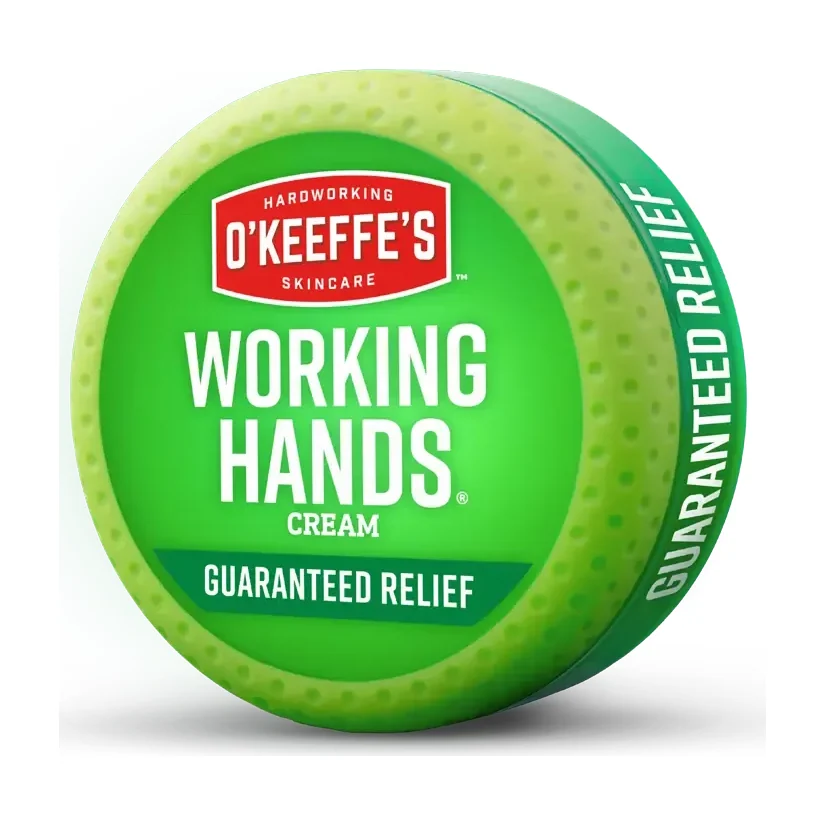
Repair looks unglamorous. A thick, fragrance-free moisturiser applied after every wash and before bed matters more than any single ingredient. Petrolatum seals in water, which is why an occlusive hand cream such as Aveeno Skin Relief Intense Moisture Hand Cream or a heavy balm at night does real work; ceramides in a cream like CeraVe Therapeutic Hand Cream supply lipids the barrier is short of; and glycerin pulls water into the outer layer, which is the backbone of a working-hands formula like O'Keeffe's Working Hands. Moisturiser alone does not settle active hand eczema, though. When it keeps cracking or blistering despite all of this, the hand and foot eczema pathway sets out the next steps, including patch testing for an allergy that no amount of cream will fix.
Telling an employer what helps
Many adults hide hand eczema at work because they fear being seen as unhygienic, a risk to food or patients, or simply difficult. The honest case for telling someone is that the most useful fixes are practical and cheap, and most of them need someone else's agreement. Gloves for wet tasks, with cotton liners underneath so sweat does not become its own wet work. Fragrance-free soap at the sink instead of the harsh dispenser product. Alcohol rub allowed in place of some washes where hygiene rules permit it. A tube of moisturiser that may live at the workstation. Rotating wet tasks so the same pair of hands is not in water all day.
A useful way to frame it is as a health and safety question rather than a personal favour: the job is affecting the skin, and these changes protect it. In many countries, a long-term skin condition that substantially affects daily life can also qualify for reasonable adjustments under disability or occupational health law, though the details vary and are worth checking locally. If the work itself seems to be the cause, keeping a record of tasks, products handled and flares makes a referral to occupational health or a dermatologist far more productive. The Questions library has the practical detail for hand eczema at work, which gloves suit wet work and documenting hand dermatitis caused by work.
There is evidence for workplace skin-care programmes, if modest. In a year-long cluster randomised trial on Dutch hospital wards, the Healthy Hands Project, cream dispensers with feedback on how often staff used them led to greater relative improvement in hand eczema severity than in control wards, although the primary outcome difference did not reach significance and many participants dropped out. That is a reasonable summary of the field: protection and moisturising help, the effect sizes are real but not dramatic, and they work best when the workplace makes them easy.
Partners, family and the reply that saves an evening
At home the stakes are different. A partner who flinches at a cracked hand is often worried about hurting it, or about catching something, more than they are repelled. Saying the plain facts first, before it becomes an awkward pause, usually goes better than waiting: "It's eczema. It's not catching and it's not dirt, it's my skin barrier. If it looks sore, it is, so gentle is good." For family members who have spent years suggesting more washing or a different soap, it can help to say directly that washing is part of what makes it worse. The Questions library has more ways to put it under what to say when people ask about your skin.
It is also worth tracking how it is going, not only for the clinician. Two tools here turn a vague sense of 'bad week' into something comparable over time: the Eczema Control check, which asks about the past week as a whole, and the Itch Scale, which records how intense the itch has been. Bringing those to an appointment, along with the parts of life eczema is costing, such as handshakes avoided, dates cancelled or a job considered, gives a clinician a fuller picture than the rash alone. The broader eczema pathway covers when body-wide eczema needs more than creams.
The person whose hand stays at their side in a meeting has usually done nothing wrong. They have a barrier that leaks, a job or a home that keeps it wet, and a public that has not yet learned the difference between red skin and dirty skin. The first two can often be improved. The third improves every time someone explains it calmly.
References
- Impact of Atopic Dermatitis Depends on Age of Onset: EADV 2024 (Scars of Life conference abstract) — EMJ Dermatology, 2024
- Prevalence, incidence, and severity of hand eczema in the general population - A systematic review and meta-analysis. — Contact Dermatitis, 2021
- Medical, psychological and socio-economic implications of chronic hand eczema: a cross-sectional study. — J Eur Acad Dermatol Venereol, 2016
- Prevalence and odds of Staphylococcus aureus carriage in atopic dermatitis: a systematic review and meta-analysis. — Br J Dermatol, 2016
- Effects of disinfectants and detergents on skin irritation. — Contact Dermatitis, 2007
- Water, soap, and hand-disinfectant exposure during the COVID-19 pandemic and self-reported hand eczema in frontline workers: A cross-sectional study. — Contact Dermatitis, 2024
- Effectiveness of a skin care programme for the prevention of contact dermatitis in healthcare workers (the Healthy Hands Project): A single-centre, cluster randomized controlled trial. — Contact Dermatitis, 2019
- Guidelines for diagnosis, prevention, and treatment of hand eczema. — Contact Dermatitis, 2022
Every cited link is verified to resolve to the paper named. Where a source could not be independently confirmed, it is listed without a link rather than pointing you somewhere wrong.
Frequently asked
Can someone catch hand eczema by shaking my hand?
No. Hand eczema comes from a leaky skin barrier, irritants and sometimes an allergy, and none of that passes between people. Only eczema that has become infected, weeping or crusting, needs extra care, and that is a reason to see a clinician rather than to avoid contact.
Why does my hand eczema get worse the more I wash?
Detergents strip lipids from a barrier that is already short of them, so each wash leaves the skin drier and more cracked. In lab testing, alcohol hand rub irritated skin less than a common detergent, so swapping some washes for rub plus moisturiser often helps.
Should I tell my employer about hand eczema?
It is your choice, but the most useful fixes, such as gloves with cotton liners, gentler soap, permission to use hand rub and moisturiser at your station, usually need the employer's agreement. Framing it as a health and safety issue tends to work better than asking for a favour.
Does eczema mean my skin is dirty because it carries bacteria?
No. Eczema patches often carry Staphylococcus aureus because the barrier is damaged, not because of poor hygiene, and more washing does not remove it. Carrying a common skin bacterium is not the same as being contagious.
When is hand eczema more than a moisturiser can handle?
If it keeps cracking, blistering or spreading despite regular thick moisturiser and gentler washing, it needs a clinician. Patch testing can reveal an allergy to something handled at work or home, which no cream will settle while the exposure continues.
Each shelf lists every product in the catalogue built on the ingredient, graded live against your profile — the shelf stays current when a single pick would not.
Products named in this piece
Independently reviewed, with a verdict per concern — the real products behind this piece.


- Therapy guide Hand & foot eczema next steps when hand eczema keeps cracking despite moisturiser, including patch testing
- Therapy guide Eczema when body-wide eczema needs more than creams
- Question Can eczema be passed to other people? the short answer on contagion
- Question Does having eczema mean my home or habits aren't clean? eczema is not a hygiene problem
- Question What helps hand eczema at work? practical detail for hand eczema at work
- Question What do I say when people ask about my skin? wording for when people ask
- Question Does hand sanitiser make hand dermatitis worse? when hand rub helps and when it stings
- Question Which gloves should I actually wear for wet work? glove choice for wet work
- Question What do I do if my job is causing my hand dermatitis? keeping a record when the job is the cause
Print it out
The Print RoomFree posters and handouts on the same ground, ready to print or share.

