Delgocitinib: The First JAK Approved for Chronic Hand Eczema
Hands have been treated with steroids and hope for decades. A topical pan-JAK inhibitor is the first drug approved specifically for the condition — and in a head-to-head it outperformed the oral alternative on both efficacy and side effects.
Read the preview
What comes after steroids for chronic hand eczema? Now, a cream built for exactly that — a topical JAK inhibitor, the first drug approved specifically for the condition. Against an oral treatment, it did better, with headaches in four percent of users instead of thirty-two. Yet in its main trials, success reached a minority. So where does it fit? The Dermington Gazette has it on hand.
Why hands are the hardest place to treat
Hand eczema gets discussed as a minor variant of eczema elsewhere, which badly undersells it. Palmar skin is thick, which blunts topical penetration exactly where you need it. Hands are washed constantly, so any product is removed within an hour of application and the barrier is stripped again with every wash. They are the part of the body that touches everything — detergents, solvents, food, metals, gloves, sanitiser — so irritant and allergic exposure is continuous rather than occasional. And fissures on a palm do not get a chance to close, because closing requires the skin not to flex, which is the one thing a hand cannot do.
The functional cost follows from that. The published description of the condition is characteristically dry: a fluctuating, inflammatory, pruritic, often painful disease of the hands and wrists that strongly impacts quality of life and occupational capability. Translated, it means people change jobs over this. It affects grip strength, typing, childcare, cooking, and whether you can shake someone's hand without wanting to explain first.
The treatment ladder has been short and old: emollients, irritant avoidance, topical corticosteroids, calcineurin inhibitors off-label, phototherapy where available, and oral alitretinoin for severe cases in the countries that license it. There was, until recently, no drug approved for chronic hand eczema as its own indication anywhere. Everything was borrowed from atopic dermatitis.
What a topical JAK inhibitor actually does
Janus kinases are the relay station inside a cell. When an inflammatory cytokine docks on a receptor at the cell surface, JAK enzymes carry that signal inward and switch on the genes that produce the inflammatory response. Blocking them interrupts the message before the cell acts on it, which is why JAK inhibitors work across a wide range of immune-mediated diseases.
Delgocitinib is a pan-JAK inhibitor — it targets JAK1, JAK2, JAK3 and tyrosine kinase 2 rather than selecting one. Breadth matters here because hand eczema is not driven by a single dominant cytokine the way some conditions are; it is a mixed picture of irritant, allergic and atopic inflammation, often in the same pair of hands.
The decisive design choice is that it is a cream. Oral JAK inhibitors carry boxed warnings covering serious infections, thrombosis, malignancy and cardiovascular events, which is a heavy price for a disease confined to two hands. A maximal-use study in patients with severe disease — the deliberate worst case, applying as much as the protocol allows — reported minimal systemic exposure. That result is the entire argument for the format. You get the mechanism on the tissue that needs it without committing the whole body to immune modulation. Whether you can actually get it depends on where you are and what you have already failed.
Reading the trial numbers honestly
DELTA 1 and DELTA 2, published in The Lancet in 2024, randomised adults with moderate-to-severe chronic hand eczema two-to-one to twice-daily delgocitinib cream or vehicle for sixteen weeks — 487 patients in one trial, 473 in the other. The primary endpoint was a stringent one: an investigator's global assessment of clear or almost clear, where almost clear means only barely perceptible redness.
At week 16, treatment success was reached by 20% on delgocitinib versus 10% on vehicle in DELTA 1, and 29% versus 7% in DELTA 2. Adverse event rates were essentially identical between drug and vehicle in both trials, with the most frequent events being COVID-19 and nasopharyngitis — that is, background illness rather than drug effect.
Both things in that paragraph are true and they pull in different directions. The separation from vehicle is real, consistent across two trials, and achieved on a hard endpoint. It is also a minority of patients reaching near-clearance, which means most people on this drug will improve without getting clear. Anyone told to expect clear hands in four months is being set up for disappointment, and disappointment is how people abandon treatments that are actually working.
The head-to-head is the more persuasive dataset. DELTA FORCE ran delgocitinib cream against oral alitretinoin — the existing systemic option for severe disease — in 513 patients over 24 weeks. The mean HECSI improvement at week 12 was −67.6 with delgocitinib against −51.5 with alitretinoin, a significant difference. Adverse events were reported by 49% of the delgocitinib group versus 76% on alitretinoin, and the gap was driven by exactly what you would expect from a retinoid: headache in 4% versus 32%, nausea in under 1% versus 6%. A topical beating an oral on efficacy is notable. Beating it on efficacy while causing a third of the headaches is the finding that changes prescribing.
Where it sits, and what still has to happen underneath
The approved indication is precise and worth quoting in spirit: moderate-to-severe chronic hand eczema in adults not adequately controlled by topical corticosteroids, or for whom those are not advisable. It sits after steroids, not instead of them. If you have not had a properly-dosed steroid course — correct potency, correct duration, actually applied in the quantities intended rather than sparingly — that is the conversation to have first, and the ftu-calculator will tell you what those quantities are for hands specifically. A trial of adolescents has since reported, so the age boundary is moving.
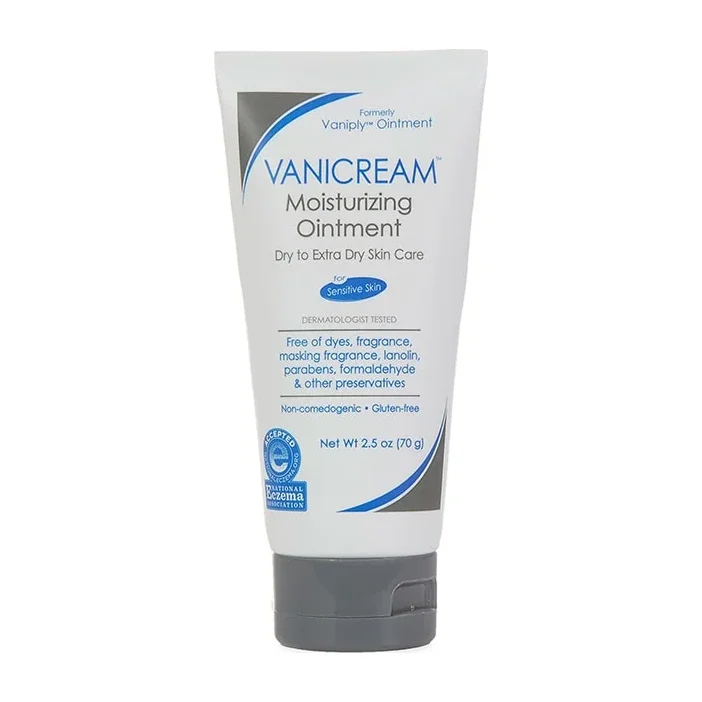
Everything underneath the prescription continues. The emollient layer is not optional and it is not decorative: an ointment carries better on fissured palms than a lotion does, which is why Aquaphor Healing Ointment, Vanicream Moisturizing Ointment and Cetaphil Healing Ointment all earn their place at night under cotton gloves. For daytime use where greasiness is impractical, CeraVe Therapeutic Hand Cream and Gold Bond Ultimate Healing Hand Cream absorb fast enough to reapply after every wash, which is the frequency that actually matters. Eucerin Eczema Relief Cream and La Roche-Posay Cicaplast Baume B5 cover the in-between. Our eczema moisturiser shortlist is filtered on exactly this kind of reapplication practicality.
Irritant control is the other half and it is unglamorous. Alcohol sanitiser is generally kinder to inflamed skin than repeated soap-and-water washing, which surprises people — the sanitiser question has a counterintuitive answer. Gloves for wet work, cotton liners under rubber, and lukewarm rather than hot water all do more than they sound like they should. And if the trigger is occupational, documenting it properly matters for both your treatment and your employment.
One diagnostic caveat before any of this: a proportion of chronic hand dermatitis is contact allergy rather than endogenous eczema, and no amount of anti-inflammatory treatment resolves an ongoing exposure. Patch testing comes before escalation, not after it. The contact dermatitis pathway covers when to push for it, and the eczema pathway sets out the full ladder that delgocitinib now has a rung on. Track severity with the eczema-severity and eczema-control tools rather than by memory — sixteen weeks is long enough that nobody accurately recalls where they started.
References
- Efficacy and safety of delgocitinib cream in adults with moderate to severe chronic hand eczema (DELTA 1 and DELTA 2): results from multicentre, randomised, controlled, double-blind, phase 3 trials — The Lancet, 2024
- Efficacy and safety of topical delgocitinib cream versus oral alitretinoin capsules in adults with severe chronic hand eczema (DELTA FORCE): a 24-week, randomised, head-to-head, phase 3 trial — The Lancet, 2025
- Minimal Systemic Exposure with Maximal Delgocitinib Cream Use in Patients with Severe Chronic Hand Eczema in the DELTA 2 Randomized, Vehicle-Controlled, Double-Blind, Phase 3 Trial — Dermatology and Therapy, 2026
- Delgocitinib cream for adolescents with moderate to severe chronic hand eczema (DELTA TEEN): a multicentre, double-blind, phase 3 randomised controlled trial — The Lancet Child & Adolescent Health, 2026
- Effect of Delgocitinib Cream on Health-Related Quality of Life in Patients With Moderate to Severe Chronic Hand Eczema — Contact Dermatitis, 2026
Every cited link is verified to resolve to the paper named. Where a source could not be independently confirmed, it is listed without a link rather than pointing you somewhere wrong.
Frequently asked
Is a topical JAK inhibitor as risky as the oral ones?
The evidence so far says no, and that is the point of the format. A maximal-use study in severe disease found minimal systemic exposure, and in the phase 3 trials adverse event rates were essentially the same as vehicle. The boxed warnings attached to oral JAK inhibitors reflect systemic drug levels this cream does not appear to produce.
What proportion of people get clear hands on it?
A minority, on the strict endpoint used. Treatment success at sixteen weeks was 20% versus 10% on vehicle in one trial and 29% versus 7% in the other, where success meant clear or almost clear. Most people improve without clearing, which is a real result — just not the one the word 'breakthrough' implies.
How does it compare to the oral option for severe hand eczema?
Favourably on both counts. In a 24-week head-to-head against oral alitretinoin, delgocitinib produced a greater mean severity improvement at week 12 and fewer adverse events overall — headache affected 4% of the cream group against 32% on the capsule.
Can I ask for it instead of a steroid?
Not usually. The approved indication covers moderate-to-severe disease not adequately controlled by topical corticosteroids, or where those are inadvisable. If you have not completed a properly dosed steroid course — right potency, right duration, right quantity — that is the step to complete or document first.
Do I still need to use emollients if I get the prescription?
Yes, and more than you think. Hands are washed constantly, so anything applied is removed within the hour. Reapplication after every wash, plus an ointment overnight under cotton gloves, is what keeps the barrier intact enough for the anti-inflammatory treatment to hold its gains.
Could my hand eczema actually be a contact allergy?
It is common enough that patch testing should come before escalating treatment. No anti-inflammatory clears a rash that is being re-triggered daily by an ongoing exposure — and if the exposure is occupational, identifying it changes both the treatment plan and your options at work.
Products named in this piece
Independently reviewed, with a verdict per concern — the real products behind this piece.



- Therapy guide Eczema The full ladder delgocitinib now occupies a rung on
- Therapy guide Contact dermatitis Patch testing comes before escalation, not after
- Ranked list Best Moisturizers for Eczema Filtered on reapplication practicality, which is what hands need
- Question What is delgocitinib and can I get it? Access depends on region and on what you have already failed
- Question Does hand sanitiser make hand dermatitis worse? The counterintuitive answer on sanitiser versus washing
- Question What do I do if my job is causing my hand dermatitis? Why occupational documentation affects treatment and employment