Eucerin, Read Properly: A Wool-Fat Invention, a Urea Workhorse, and a Brightener Its Maker Mostly Tested Itself
The plain white jar is a water-in-oil cream from another century, and the brand's newest science is promising, in-house, and still waiting for someone else to check it.
Read the preview
Why does a cream invented around 1900 still list a fat from sheep's wool? Because that ingredient is the invention — the trick that holds water inside oil. The same brand now sells a brightener found by testing fifty thousand molecules on a human enzyme. Who tested it on people is the interesting part. The Dermington Gazette lays it all out.
A cream turned inside out
Almost every moisturiser on a pharmacy shelf is a scatter of oil droplets suspended in water. That is why most creams feel cool, sink in quickly and rinse off a hand under the tap. Eucerin's founding product is built the other way round: tiny droplets of water held inside a continuous layer of oil. The difference is not cosmetic trivia. It decides how a cream feels, how long it lasts on skin, and which skin it suits.
A water-in-oil cream behaves like a thin ointment that happens to carry water. It spreads with a slight drag, leaves a shine, resists rinsing and keeps working long after a lotion would have evaporated. For a cracked knuckle or a patch of eczema that is exactly the point. For an oily forehead before makeup it is the opposite of what anyone wants.
The hard part, around 1900, was keeping that water from separating out. The emulsifier that solved it came from wool fat, and its descendant is still printed on the jar: Eucerin Original Healing Cream lists water, petroleum jelly, mineral oil, a wax called ceresin, lanolin alcohol and two preservatives, and nothing else. The lanolin alcohol is the emulsifier. The short history is on the brand's page in our Market; what matters here is that the idea never left the range.
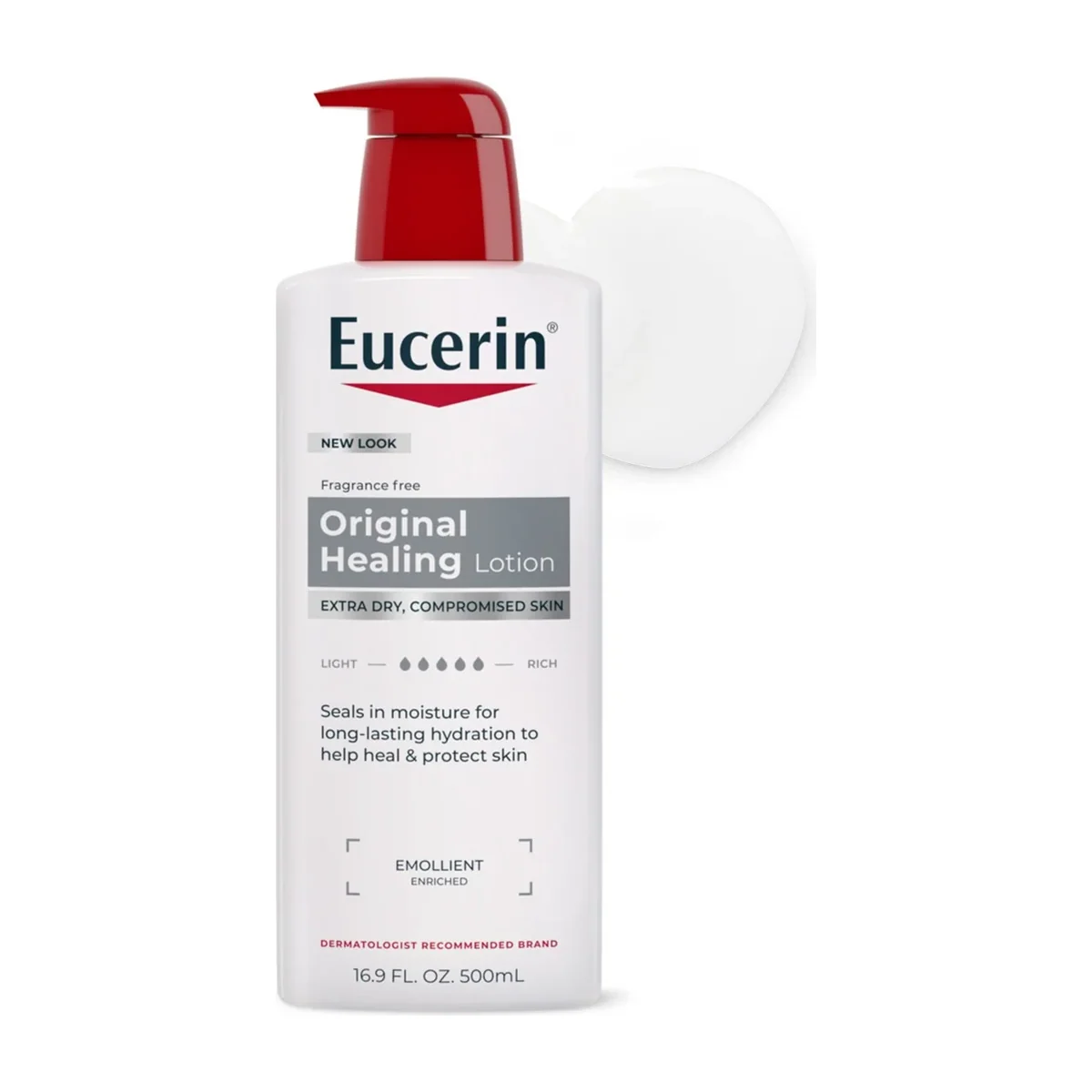
It also did not stay everywhere. Labels give the construction away if you know the tells. Lanolin alcohol, polyglyceryl esters with long names, and magnesium sulfate (a salt that steadies water-in-oil emulsions) point to the original architecture, and they turn up in Original Healing Lotion and the German-made UreaRepair Plus 10% Urea Lotion. Glyceryl stearate, cetearyl alcohol and PEG-type emulsifiers point to an ordinary oil-in-water cream, which is what Advanced Repair Cream and the eczema range are. Neither design is better in general. One is a protective film with water inside; the other is a lighter vehicle for actives. Knowing which one is in the jar explains most of the complaints people have about it.
The petroleum question, taken seriously
The commonest objection to the original jar is its first two oils. Petroleum jelly and mineral oil are cheap, they come from crude oil, and plenty of shoppers would simply rather not put them on their face. Cheap is true. Preference is legitimate. The rest of the worry deserves a straight answer.
The old picture of petrolatum as cling film on the skin turns out to be wrong in an instructive way. In a 1992 study in the Journal of the American Academy of Dermatology, researchers stripped the skin barrier with acetone and treated some sites with petroleum jelly. If it were a sealed plastic layer, barrier repair should have slowed, as it does under true occlusion. It sped up. Under the microscope the petrolatum had moved into the gaps between the cells of the outer skin layer, where it stood in for the missing lipids while the skin rebuilt its own. That is a better mechanism than the marketing usually claims for it.
Safety concerns centre on purity, and that part of the worry is reasonable: crude mineral oil contains aromatic compounds no one wants on skin. Cosmetic grades are refined specifically to remove them, and a 2019 review in the Journal of the European Academy of Dermatology and Venereology summarised decades of use, the purity specifications in European law, and the absence of measurable skin penetration of refined grades. The same review notes something easy to forget: mineral oils do not go rancid and are essentially non-allergenic, which is more than can be said for many plant oils sold as the natural alternative.
So the honest version is this. The original cream is unglamorous by design, and its two hydrocarbons are among the best-studied things anyone can put on very dry skin. If the texture or the origin puts you off, that is a real reason to choose something else. It is not a reason to believe the jar is doing harm. The Library's answer on whether petroleum jelly suffocates skin goes through the remaining myths one by one.
Urea, the quiet workhorse of the range
If the original cream is the brand's founding idea, urea is its everyday engine. The name puts people off; the molecule is synthetic, identical to one the outer skin layer already uses as part of its natural moisturising factor, and among the best-documented ingredients in dermatology. A 2013 systematic review in Dermatology Online Journal gathered 81 publications on topical urea across dry skin, eczema, ichthyosis, psoriasis and thickened nails, with mild stinging as the main side effect. A 2021 review in Dermatology and Therapy added the cell biology: urea does not only hold water, it also nudges skin cells towards building a better barrier.
Concentration changes the job. At around five percent urea mainly hydrates. Towards ten percent and beyond it also loosens the glue between dead cells, which is why it smooths rough, scaly patches rather than only softening them. The Library's answer on what different urea strengths actually do sets out the ladder; Eucerin sells several rungs of it.
Roughness Relief Lotion pairs five percent urea with lactic acid, a combination aimed squarely at shins, heels and the bumpy backs of upper arms. Advanced Repair Cream keeps urea at five percent but surrounds it with a ceramide and a long list of the amino acids and salts that make up skin's own water-holding system, a gentler, more barrier-minded build for everyday dry body skin. The UreaRepair Plus 10% lotion is the stronger rung, in that water-in-oil base, and the one to reach for when skin is genuinely scaly.
Two cautions travel with all of them. Urea stings on cracked or freshly shaved skin, sometimes sharply, for the first few days; a fissured heel is better served by an ointment first and urea once it has closed. And the bumpy-arm promise is partial: these lotions make keratosis pilaris feel smoother and look less rough, which is worth having, but they do not stop the bumps from forming.
The eczema shelf, and the 1950 idea about acidity
The eczema products are built on an older ingredient than people expect. Eczema Relief Cream declares one percent colloidal oatmeal as its active, a ready-made form of which first went on sale in 1945. In the US it is a recognised skin protectant under the FDA's over-the-counter monograph, finalised in 2003, and its preparation is standardised by the United States Pharmacopeia, which is more regulatory footing than most soothing ingredients ever get. The cream adds ceramide NP and licochalcone A from licorice root around it.
The evidence is respectable rather than dramatic. Oat starches and beta-glucan hold water, oat phenols calm itch and inflammation, and small trials support reduced itch; the Library's answer on whether oatmeal and ceramide products work puts it plainly, that neither beats generous, frequent plain emollient by a wide margin. The real work in eczema is still the habit: a lot of cream, often, on damp skin, alongside whatever treatment the flare needs. The eczema guide in our Clinic covers where a cream like this sits in that ladder and when it is not enough.
The other piece of heritage is the brand's interest in skin acidity, which dates to a 1950 pH5 ointment. The underlying idea has aged well. A 2006 multicentre study of 330 people in the International Journal of Cosmetic Science estimated natural skin surface pH at about 4.7, and found skin below pH 5 in better condition on barrier, hydration and scaling measures. Tap water and soap push it up for hours. The irony is that the cleanser carrying the pH5 name, pH5 Wash Lotion, also carries fragrance, which is exactly what reactive skin should avoid. A sound idea and a fragrance-free formula are separate questions, and the label answers the second one.
Thiamidol: the right enzyme, mostly the maker's trials
The most interesting thing Eucerin has done this century is a brightener, and its story starts with a mushroom. For decades many skin-lightening ingredients were screened against tyrosinase, the enzyme that starts melanin production, taken from mushrooms, because it is cheap and easy to obtain. The human enzyme behaves differently. In a 2018 paper in the Journal of Investigative Dermatology, Beiersdorf researchers screened a library of 50,000 compounds against recombinant human tyrosinase. Classic brighteners such as arbutin and kojic acid turned out to be weak against it. The strongest hit, now sold as Thiamidol, blocked the human enzyme about a hundred times more strongly than the mushroom one. The finding explains, after the fact, why so many mushroom-screened brighteners underwhelm on real faces.
Then come the people trials, and who ran them matters. In melasma the record now includes four randomised trials. Beiersdorf's own split-face study against hydroquinone found Thiamidol ahead after twelve weeks, and its 24-week vehicle-controlled trial with Nice University Hospital found it clearly better than the same creams without it; at a follow-up months after stopping, though, the difference from vehicle had gone. Two trials with no company authors listed point the same way. In Brazil, 50 women used 0.2 percent Thiamidol or four percent hydroquinone for 90 days: melasma severity fell 43 percent against 33 percent, a difference too small to call statistically, with two cases of allergic contact dermatitis on the Thiamidol side. A Thai trial found a 0.15 percent formula better than a hyaluronic acid comparator.
For patchy facial pigment more broadly, the largest trial to date enrolled 200 people in Bangkok, funded by the company: physician-graded improvement roughly doubled against the vehicle cream by twelve weeks. In the same trial, freckles and age spots did not improve more than with the vehicle, and neither did the participants' own assessment. Two 2025 case reports in Contact Dermatitis describe allergic reactions to Thiamidol itself.
Put together, the honest reading is promising rather than proven for melasma and post-acne marks, with independent replication still thin, and unproven for discrete age spots. It works only as long as it is used, and only with daily sunscreen. The melasma guide places it among the options, and the Library's answer on newer topical treatments sets it beside cysteamine and tranexamic acid. Of the products, the Radiant Tone Dual Serum (sold elsewhere under the Anti-Pigment name) is the more practical everyday form. The Anti-Pigment Spot Corrector is alcohol-first and better suited to a single mark than to a whole cheek of melasma.
The lanolin question
Any brand built on wool fat has to answer for lanolin allergy, and it deserves a careful answer rather than a reflex in either direction. In 2023 the American Contact Dermatitis Society named lanolin its Allergen of the Year. A review in Cutis that year describes the paradox at the heart of it: lanolin rarely sensitises healthy skin, yet people with long-standing inflamed skin, especially eczema, leg ulcers and damaged hands, react far more often. In North American patch-test clinics, about three in a hundred patients tested reacted; in a European sample of the general population the figure was well under one in a hundred.
That cuts uncomfortably close to the original cream's natural audience. The people most likely to reach for a heavy, protective jar are the people most likely to have been building a sensitivity for years. The Library's answer on becoming allergic to your own eczema cream describes the classic sign: eczema that stops improving, or creeps outwards from where the cream goes.
None of this makes the jar a bad product; it makes a small test sensible. Apply it to the same spot on the inner arm for several days before it goes on broken skin, and the site's patch-test tool walks through how. If eczema worsens on a cream that used to help, a clinician's patch testing is the reliable answer. Lanolin alcohol is the form most often used in patch testing, which is one more reason the first ingredient after the waxes deserves the attention.
Where Eucerin is worth starting, and where it is not
Read as a whole, this is a brand at its best when skin is very dry, itchy, rough or freshly irritated, and at its least distinctive when skin is oily and the goal is a weightless face routine. Its formulas tend to be plain, its textures functional, and its strongest science is either very old (the emulsion, the hydrocarbons, urea) or very new and mostly in-house (Thiamidol).
For cracked hands and eczema patches, Original Healing Cream is the purest expression of the original idea. For everyday dry body skin, Advanced Repair Cream is the gentler urea build; for rough, scaly or bumpy patches, Roughness Relief Lotion or the ten percent UreaRepair. For itchy, eczema-prone skin that wants an over-the-counter active on the label, the Eczema Relief family. For melasma or lingering post-acne marks, the Thiamidol range is a reasonable cosmetic option to try with daily sunscreen and patience, and a poor bet for sharply defined age spots. The Eucerin routine guide builds a whole dry-skin routine from the range, and the My Skin profile will tell you which of these fit your own profile.
The cautions are short. Check for fragrance if your skin is reactive, because parts of the range carry it. Patch test the lanolin products if you have long-term eczema. And treat the brightening claims as the early evidence they are. Our Brand Portrait episode on Eucerin is the four-minute version of this story; this is the long one, with the trials laid out.
References
- Effects of petrolatum on stratum corneum structure and function. — Journal of the American Academy of Dermatology, 1992
- Mineral oils and waxes in cosmetics: an overview mainly based on the current European regulations and the safety profile of these compounds. — Journal of the European Academy of Dermatology and Venereology, 2019
- Urea: a comprehensive review of the clinical literature. — Dermatology Online Journal, 2013
- Urea in Dermatology: A Review of its Emollient, Moisturizing, Keratolytic, Skin Barrier Enhancing and Antimicrobial Properties. — Dermatology and Therapy, 2021
- Colloidal oatmeal: history, chemistry and clinical properties. — Journal of Drugs in Dermatology, 2007
- Natural skin surface pH is on average below 5, which is beneficial for its resident flora. — International Journal of Cosmetic Science, 2006
- Inhibition of Human Tyrosinase Requires Molecular Motifs Distinctively Different from Mushroom Tyrosinase. — Journal of Investigative Dermatology, 2018
- Effective Tyrosinase Inhibition by Thiamidol Results in Significant Improvement of Mild to Moderate Melasma. — Journal of Investigative Dermatology, 2019
- Thiamidol® in moderate-to-severe melasma: 24-week, randomized, double-blind, vehicle-controlled clinical study with subsequent regression phase. — The Journal of Dermatology, 2021
- Efficacy and safety of topical isobutylamido thiazolyl resorcinol (Thiamidol) vs. 4% hydroquinone cream for facial melasma: an evaluator-blinded, randomized controlled trial. — Journal of the European Academy of Dermatology and Venereology, 2021
- Efficacy and safety of 0.15% isobutylamido thiazolyl resorcinol combined with hyaluronic acid vs 0.15% isobutylamido thiazolyl resorcinol or hyaluronic acid alone in melasma treatment: A randomized evaluator-blind trial. — Journal of Cosmetic Dermatology, 2021
- Efficacy and Tolerability of 0.2% Thiamidol Cream for Facial Hyperpigmentation: A Randomized, Double-Blind, and Vehicle-Controlled Study. — Dermatology and Therapy, 2026
- First Two Cases of Allergic Contact Dermatitis From Isobutylamido Thiazolyl Resorcinol ('Thiamidol') in Depigmenting Skin Care Routine. — Contact Dermatitis, 2025
- Allergic Contact Dermatitis to Isobutylamido Thiazolyl Resorcinol (Thiamidol). — Contact Dermatitis, 2025
- Lanolin: The 2023 American Contact Dermatitis Society Allergen of the Year. — Cutis, 2023
Every cited link is verified to resolve to the paper named. Where a source could not be independently confirmed, it is listed without a link rather than pointing you somewhere wrong.
Frequently asked
Is Eucerin Original Healing Cream just petroleum jelly in a jar?
No. It is a water-in-oil emulsion: water held inside petroleum jelly, mineral oil and wax by lanolin alcohol, so it carries water to the skin as well as slowing its loss. That is why it feels lighter than plain petroleum jelly but heavier and more water-resistant than an ordinary lotion.
Does Eucerin's Thiamidol actually work on melasma?
Four randomised trials say it helps, including one with no company authors that found it on par with 4% hydroquinone over 90 days. Most of the evidence is still company-run, the benefit faded after stopping in one trial, and it needs daily sunscreen, so promising rather than proven is the fair description.
Will Eucerin's Thiamidol range fade age spots?
The evidence is weakest here. In the largest vehicle-controlled trial, freckles and age spots improved no more with Thiamidol than with the plain cream, even though patchy pigment did. For sharply defined age spots it is a poor bet on current data.
Is the lanolin in Eucerin a problem for people with eczema?
It can be. Lanolin rarely sensitises healthy skin but reacts more often on skin that has been inflamed for years, which describes many people with chronic eczema. Testing the cream on one small patch of inner arm for several days before using it widely is sensible, and eczema that stops responding to a cream is a reason to ask about patch testing.
Which Eucerin urea product suits rough skin on the arms and legs?
Roughness Relief Lotion pairs 5% urea with lactic acid for bumpy, rough patches, and the 10% UreaRepair lotion is the stronger choice for genuinely scaly skin. Both can sting on cracked or freshly shaved skin for the first few days.
Each shelf lists every product in the catalogue built on the ingredient, graded live against your profile — the shelf stays current when a single pick would not.
- 206 products on the shelf Petrolatum (Petroleum Jelly) The original cream's main oil
- 101 products on the shelf Mineral Oil (Paraffinum Liquidum) The second hydrocarbon in the jar
- 198 products on the shelf Urea (Carbamide) The range's everyday workhorse
- 270 products on the shelf Colloidal Oatmeal The eczema line's declared active
- 13 products on the shelf Thiamidol (Isobutylamido Thiazolyl Resorcinol) Eucerin's in-house brightener
- 1 product on the shelf Hydroquinone The comparator in the Thiamidol melasma trials
- 39 products on the shelf Lanolin (Wool Wax) The wool-fat ingredient and its allergy question
Products mentioned
Independently reviewed, with a verdict per concern — the real products behind this piece.



- Therapy guide Eczema Where an oatmeal or ointment-style cream sits in eczema care
- Therapy guide Melasma Where Thiamidol sits among melasma options
- Routine Eucerin Routine Guide: Dry-Skin Repair, Cleanser to SPF A whole dry-skin routine built from the range
- Question Does petroleum jelly suffocate the skin or trap toxins? The petroleum myths, answered
- Question What do the different urea strengths actually do? The urea strength ladder
- Question Do colloidal oatmeal and ceramide products actually do anything? What oatmeal and ceramides add
- Question What are the newer topical options? Thiamidol beside cysteamine and tranexamic acid
- Question Can I become allergic to my own eczema cream? Lanolin and preservative allergy in eczema creams