The Hand Sanitiser You Blame Is Gentler Than the Soap You Trust
Hands take more water, more surfactant and more friction than any other skin you own — and the intervention that fixes them takes about ten seconds nobody spends.
Read the preview
Is hand sanitiser really harsher than soap? Not for nurses — over six weeks, dryness and irritation fell slightly on alcohol gel and rose substantially in the soap weeks. Hand eczema affects about one in ten people, nearer three in ten in wet-work jobs. After treatment, a urea cream pushed relapse from two days to twenty. Get a grip with the Dermington Gazette.
The trial that inverted the blame
Ask most people which is harsher on their hands, hand sanitiser or soap, and the answer is instant and wrong. Thirty-two nurses across three hospital wards were randomised in a crossover design over six weeks, alternating between soap-and-water hand washing and an alcoholic hand gel. Self-assessed irritation and dryness fell slightly during the gel weeks. During the soap-and-water weeks they rose substantially. Epidermal water content on the backs of the hands barely moved on the gel and dropped significantly with washing.
The mechanism is not mysterious once you separate the two things alcohol and detergent actually do. Alcohol denatures proteins on contact and then evaporates within seconds, leaving behind whatever emollient the formula carried. Surfactants do not evaporate. They solubilise the intercellular lipids that hold the stratum corneum together, swell and partially denature the corneocyte proteins, and they keep doing it while the water runs and while you rub. Add friction from a paper towel and heat from a dryer and the damage compounds. Alcohol stings on skin that is already cracked, which is what generates the belief — but the stinging is a symptom of damage already done by something else.
This is not an argument for sanitising instead of washing when hands are visibly soiled or after certain exposures; that is an infection-control question with its own answer. It is an argument about which step in your day is quietly costing you a barrier, and it is almost always the sink.
How common this actually gets
Hand eczema is not a niche occupational complaint. In general-population epidemiology it runs to a one-year prevalence of nearly 10%, a point prevalence around 4%, and a lifetime prevalence near 15%. In occupations with routine exposure to water, detergents and metalworking fluids, prevalence reaches approximately 30%. Wet-work exposure defined as having wet hands for a quarter to half the working day more than doubles the odds of developing it.
Those numbers describe nurses, chefs, hairdressers, cleaners, mechanics and parents of small children, which is to say a very large fraction of everyone. And the condition is disabling in a specific way that skin elsewhere is not: fissured fingertips make typing, buttoning and lifting genuinely painful, and hands cannot be rested the way a shin can. Quality-of-life scores in hand eczema trials climb sharply at relapse for exactly this reason.
What makes it worth writing about is that the trajectory is not fixed. Hand skin fails through a repeated, identifiable insult, which means it can be interrupted at a specific, identifiable moment — the ten seconds after the water stops.
Timing beats formula, and the evidence is unusually blunt about it
The single most useful trial in this area randomised 53 patients whose hand eczema had been successfully treated, then compared a barrier-strengthening moisturiser containing 5% urea against no treatment at all. Median time to relapse was 20 days on the moisturiser and 2 days on nothing. By 26 weeks, 90% of patients in both groups had relapsed and severity at relapse was no different — so the moisturiser did not prevent the disease. It bought a tenfold longer interval of usable hands.
Read that as the strongest available case for frequency over sophistication. A cream applied after every wash, for months, is doing work that no formulation applied twice a week can replicate. Which product matters far less than whether it is within reach of the sink, the desk, the car and the coat pocket — the practical answer is usually to own several cheap tubes rather than one good one.
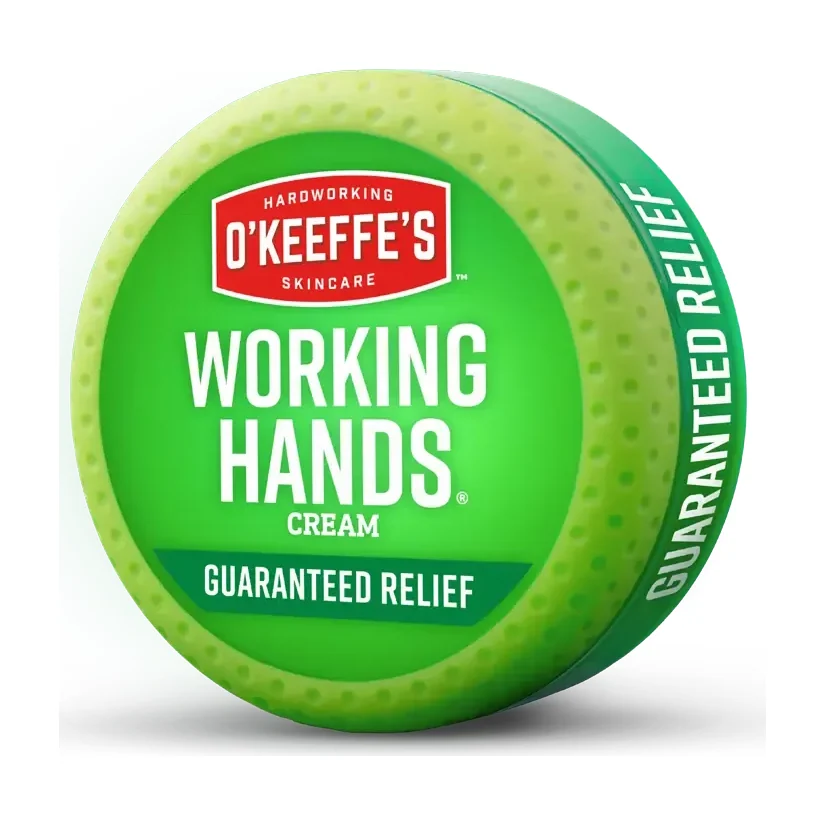
What the formula should contain is unglamorous: a humectant, a lipid, and an occlusive to hold both in. CeraVe Therapeutic Hand Cream is the archetype, built on ceramides with glycerin and a silicone-and-petrolatum seal; La Roche-Posay Cicaplast Mains adds panthenol and shea in a base designed to survive frequent washing; Neutrogena Norwegian Formula Fragrance-Free is a concentrated glycerin formula that has been doing this job since long before barrier science became a marketing category. For the fissured, working-hands end of the spectrum, O'Keeffe's Working Hands and plain Vaseline under cotton overnight both do more than anything that smells nice. Fragrance is worth avoiding here specifically because hands are the most common site of contact allergy — see our dryness ranking for the fragrance-free options we rate highest.
If you have ever wondered how much to actually squeeze out, the FTU Calculator converts fingertip units into per-area amounts and tells you how long a tube should last at that rate — which is also a fast way to discover you have been using about a third of what you need.
It delayed relapse; it did not stop it. By 26 weeks, 90% in both groups had relapsed, at the same severity. One small open trial of 53 people.
When it stops being dryness and starts being a diagnosis
There is a threshold past which moisturising is not the treatment, and continuing to moisturise is how people spend two years with a condition that had a twelve-week answer.
The signals are specific: fissures that bleed, vesicles along the sides of the fingers, thickened plaques with a defined edge, itch that wakes you, or any hand rash that clears on holiday and returns within a week of going back to work. Established hand dermatitis is an inflammatory condition, and in a double-blind randomised trial comparing a corticosteroid cream with a barrier-strengthening moisturiser, the two are complements rather than alternatives — the anti-inflammatory settles the flare, the moisturiser extends the interval afterwards. Using only the second half of that pair is the most common mistake in this whole area.
The other question that needs answering is whether something is causing it. Allergic contact dermatitis of the hands hides behind occupational and domestic exposures — rubber accelerators in gloves, methylisothiazolinone in liquid soaps, nickel, fragrance mix, hair dye components — and no cream resolves an ongoing exposure. The contact dermatitis pathway sets out how the diagnosis is actually made and when formal patch testing is warranted. Before that appointment, the Skin Flare Diary is worth two weeks of use: a day-by-day log of severity, itch and what your hands touched turns "it comes and goes" into a pattern a clinician can act on. For trialling a new product on already-irritable hands, the Patch Test Log runs the at-home protocol properly rather than the usual method of applying it everywhere and hoping.
Gloves have a dose, and most people exceed it
Protective gloves get recommended so casually that the qualification gets dropped, and the qualification is the important part: an occlusive glove is itself an exposure.
In a study of 30 patients with moderate-to-severe hand eczema, wearing occlusive gloves for around four and a half hours increased Staphylococcus aureus colony-forming units on eczematous skin by a factor of 1.72. On non-lesional skin on the backs of the same hands, there was no significant change — the impaired barrier is what lets the bacteria proliferate under occlusion. Sealed inside a glove, sweat cannot evaporate, the stratum corneum over-hydrates and swells, and a barrier that was already leaking gets a warm humid incubator laid over it.
The practical rules that follow are dull and rarely stated. Wear them for the task, not the shift. Past about ten minutes of continuous occlusive wear, a textile liner is recommended to absorb sweat — and because cotton saturates within roughly half an hour to an hour, a saturated liner has to be swapped for a dry one rather than tolerated. Keep gloves on for the ten minutes of washing up rather than the two hours of housework. And if you are using gloves because your hands are already broken, the glove is buying you protection from the detergent at the cost of a worse environment for the skin — which is a trade worth making only alongside actual treatment. SkinFix Eczema+ Hand Repair Cream is the kind of formulation worth pairing with that routine, built around colloidal oatmeal and a lipid blend rather than around a fragrance story.
The half of your hand nobody protects
Everything above concerns the barrier. The other failure on hands is cumulative ultraviolet exposure, and it is the one where the neglect is almost total.
In a study of beachgoers — people who by definition had sunscreen with them and had decided to use it — fewer than half applied any to the backs of their hands: 49% overall, splitting to 55% of women and 40% of men. That is at the beach. In ordinary life the dorsal hands take steering-wheel exposure, walking exposure and window-side desk exposure every day for decades, and receive sunscreen essentially never. The result is the pattern everyone recognises without naming: solar lentigines, thinning, crepey texture and easy bruising on the backs of the hands of people whose faces look a decade younger.
The reason it doesn't happen is mechanical rather than attitudinal. Sunscreen applied to hands is removed by the next wash, which on a normal day is within the hour, so the honest options are either reapplying with the same reflex as hand cream or using a product that combines both. Ducray Melascreen Anti-Spots Hand Cream SPF 50+ exists precisely for this problem — a hand cream carrying a high filter load, which turns two habits into one.
Our position on hands, stated plainly: the product choice is close to irrelevant and the timing is close to everything. Keep a fragrance-free cream at every sink you use, apply it while the skin is still slightly damp after every wash, treat inflammation as inflammation rather than as dryness, wear gloves for the wet task and take them off after, and put a filter on the backs of your hands with the same indifference you apply it to your face. That is a ten-second routine defending the skin you use for everything, and almost nobody does it.
References
- Skin irritation and dryness associated with two hand-hygiene regimens: soap-and-water hand washing versus hand antisepsis with an alcoholic hand gel — Infection Control and Hospital Epidemiology, 2000
- The epidemiology of hand eczema in the general population - prevalence and main findings — Contact Dermatitis, 2010
- Treatment with a barrier-strengthening moisturizer prevents relapse of hand-eczema. An open, randomized, prospective, parallel group study — Acta Dermato-Venereologica, 2010
- The effect of a corticosteroid cream and a barrier-strengthening moisturizer in hand eczema. A double-blind, randomized, prospective, parallel group clinical trial — Journal of the European Academy of Dermatology and Venereology, 2012
- Wearing Occlusive Gloves Increases the Density of Staphylococcus aureus in Patients with Hand Eczema — Acta Dermato-Venereologica, 2021
- Sunscreen Use on the Dorsal Hands at the Beach — Journal of Skin Cancer, 2013
- Effectiveness of a skin care programme for the prevention of contact dermatitis in healthcare workers (the Healthy Hands Project): A single-centre, cluster randomized controlled trial — Contact Dermatitis, 2019
Every cited link is verified to resolve to the paper named. Where a source could not be independently confirmed, it is listed without a link rather than pointing you somewhere wrong.
Frequently asked
Is hand sanitiser really less damaging than washing with soap?
In a randomised crossover trial in nurses, yes — dryness and irritation improved slightly on an alcohol gel regimen and worsened on soap and water. Alcohol evaporates in seconds and leaves any emollient behind, whereas surfactants dissolve barrier lipids for as long as the water runs. The sting on cracked skin is a sign of existing damage, not new damage.
How often should I actually be applying hand cream?
After every wash, which for most people means somewhere between six and twenty times a day. The trial evidence supports frequency over sophistication: a simple cream used constantly outperforms an elaborate one used occasionally. Keeping a tube at each sink, desk and coat pocket is the mechanism that makes it happen.
When is cracked-hand skin a condition rather than just dryness?
When there are fissures that bleed, vesicles along the finger sides, defined plaques, itch that disturbs sleep, or a rash that clears on holiday and returns at work. That pattern needs anti-inflammatory treatment and possibly patch testing — moisturiser alone extends the gaps between flares but does not settle one.
Do rubber gloves protect my hands or make things worse?
Both, depending on duration. They block the detergent, but occlusion over-hydrates the stratum corneum and, on already-eczematous skin, raised S. aureus density by a factor of 1.72 over about four and a half hours in one study. Wear them for the wet task, use a textile liner past ten minutes, and swap the liner once it is damp.
Is it worth putting sunscreen on the backs of my hands?
It is the single most neglected photoprotection habit — under half of people applied it there even at the beach. The dorsal hands accumulate driving, walking and window-side exposure for decades, which is why solar lentigines and crepey texture appear there first. The obstacle is that washing removes it, so a hand cream carrying a filter is the practical solution.
Each shelf lists every product in the catalogue built on the ingredient, graded live against your profile — the shelf stays current when a single pick would not.
- 198 products on the shelf Urea (Carbamide) The active in the moisturiser that produced the tenfold relapse-interval result.
- 1,814 products on the shelf Ceramides The lipid component of the barrier structure hand creams need to replace.
- 2,407 products on the shelf Glycerin The humectant doing most of the work in the simplest effective hand creams.
- 702 products on the shelf Cleansing Surfactants
- 206 products on the shelf Petrolatum (Petroleum Jelly)
- 270 products on the shelf Colloidal Oatmeal
- 1,614 products on the shelf Panthenol (Pro-Vitamin B5)
Products named in this piece
Independently reviewed, with a verdict per concern — the real products behind this piece.




Print it out
The Print RoomFree posters and handouts on the same ground, ready to print or share.


