Irritation Risk Is a Score, Not a Warning Label
A luxury LED eye mask posts a flawless irritation-risk score. So does an inexpensive cleanser that actually works. Only one of those facts tells you anything — and the difference is the whole point.
Read the preview
Why does an LED eye mask earn a flawless irritation-risk score? Because the score starts at the top and only deducts for flagged ingredients — a device with no formula has nothing to lose. Rinse-off products take about half the deduction, since contact time matters. So what does a perfect number tell you, and what doesn't it? The Dermington Gazette itemises the deductions.
Two flawless scores that mean opposite things
Lumin's Luminator LED Eye Mask is a premium-priced device, and it posts a flawless irritation-risk score. Its overall score is unremarkable.
The INKEY List's Glycerin Gentle Purifying Cleanser costs a fraction as much, posts the same flawless irritation-risk score, and sits near the top of its category overall.
The LED mask achieves its perfect safety result by the simple expedient of not being a formula. There is no ingredient list to flag, no fragrance to deduct for, no preservative system to assess. It cannot irritate you because there is nothing there to do the irritating. The score is correct and it is telling you almost nothing.
This is the most important thing to understand about the number: it is a subtraction. Every product starts at the top of the scale and loses points for specific, identified provocations found in its ingredient list. A formula with nothing flagged keeps its perfect result — whether that is because it was carefully built, or because it barely contains anything at all.
So the score answers one question well: how much flagged provocation is in here? It does not answer is this gentle enough for me, and it emphatically does not answer does this work. That last one is what the rest of the assessment is for.
What comes off the hundred, and why
The deductions are fixed, published, and applied identically to every product in the catalog.
Fragrance is the largest single item at −12 for a leave-on product, and it is the largest because contact allergy data keeps putting it near the top. The North American Contact Dermatitis Group's recent patch-test series report fragrance markers among the most commonly positive allergens tested, alongside nickel and the isothiazolinone preservatives — and the composition of those fragrance markers has been shifting, with hydroperoxides of linalool now appearing at rates above 10%.
After that: drying alcohol −6. Individually flagged irritants −3 each to a cap of −15. EU-declarable allergens −2 each to a cap of −10. Sensitising preservatives −8 each, capped at −12. Photosensitising ingredients −5. Aggressive actives −8 for unbuffered high strength, −6 for acids stacked with a retinoid. Inadequate preservation in a water-based formula −10. Fungal-acne triggers −3. Cleansers carry an additional harshness assessment worth up to −12, judged on the surfactant system.
Two of these are deliberately weak. The comedogenic signal deducts only −1.5 per item to a cap of −6 and is flagged for provenance, because the underlying data is not good enough to carry more weight than that. And pH: a known out-of-band value costs −4, while an unknown pH costs nothing and simply lowers the confidence band. Not knowing something is never converted into a penalty.
Contact time is the hidden variable
The same ingredient in two products does not carry the same risk, and the score reflects that.
Rinse-off products take roughly half the deduction of leave-on ones — fragrance costs −6 rather than −12, drying alcohol −3 rather than −6. The reasoning is straightforward: a cleanser is on your skin for forty seconds and then goes down the drain, while a serum stays for eight hours under whatever you layer on top.
This is one of the most useful things a shopper can internalise independently of any score. A fragranced body wash and a fragranced body lotion are not equivalent risks, and treating them as equivalent leads people to eliminate the wrong products. If you are trying to reduce total exposure, the leave-on layers are where the reduction actually happens.
It also explains a pattern that otherwise looks inconsistent: a cleanser can carry ingredients that would materially damage a serum's score and still land respectably. That is not leniency. It is the difference between forty seconds and eight hours, priced.
Popular products with real flags
The score is at its most useful when it disagrees with a product's reputation, so here are two that it does.
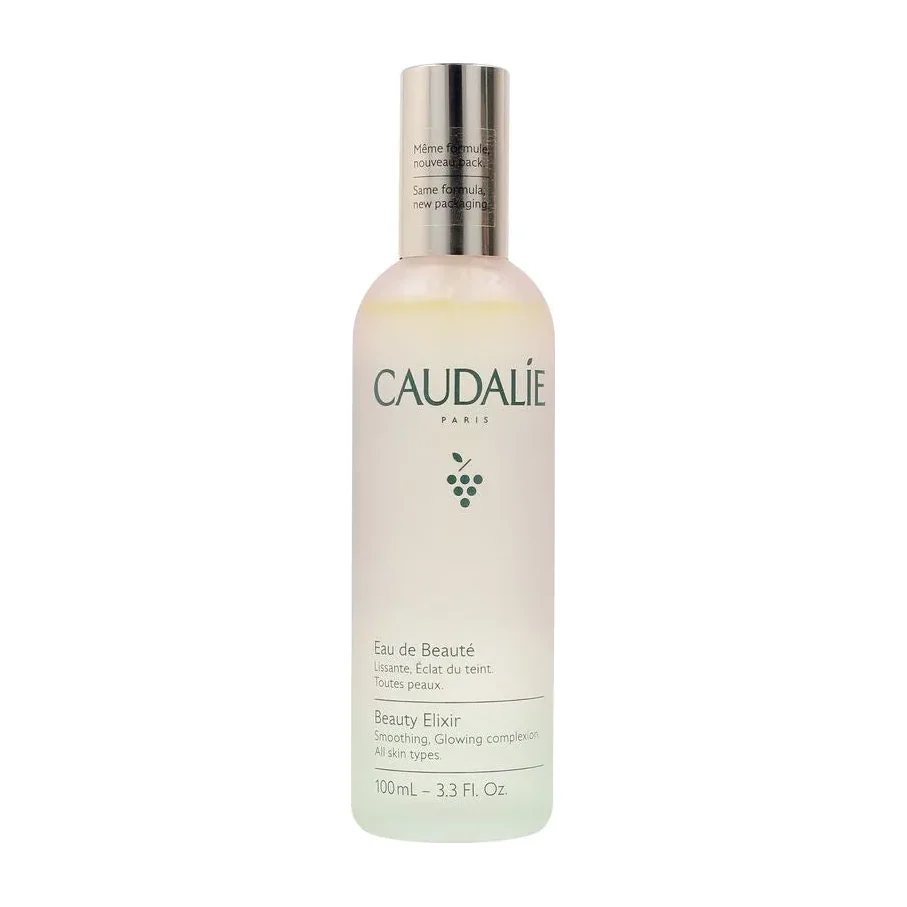
Caudalie's Beauty Elixir is a genuine cult object, and it sits close to the bottom of our irritation-risk range. The itemisation explains why with no editorialising required: the maximum fragrance deduction, triggered by peppermint extract, bitter orange peel oil and cinnamon leaf oil; a heavy irritant-load penalty that includes Myroxylon pereirae — Peru balsam, a long-standing fixture near the top of contact-allergy series; the declarable-allergen cap hit outright by benzyl benzoate, benzyl cinnamate, cinnamyl alcohol and cinnamal together; a photosensitisation deduction from the citrus peel oil; and a further penalty for preservation adequacy.
La Mer's The Resurfacing Treatment lands in the same territory from a luxury price point. Maximum fragrance deduction on eucalyptus oil, clove extract and declared fragrance; a drying-alcohol penalty; irritant load from eucalyptus, camphor and menthyl lactate; the allergen cap again; and photosensitisation from the acid blend.
Neither of those is a claim that these products are bad or that people who love them are wrong. Plenty of people use both without incident, and the sensory experience those essential oils create is the actual product for many buyers. What the score says is narrower and checkable: this formula contains a substantial number of things that provoke skin in a measurable share of the population, and if you are in that share, this is a predictable place to have trouble.
Contrast Vanicream's Enhanced Moisturizer, which loses almost nothing — a single small deduction for fungal-acne triggers and otherwise a clean sheet. That is what a high safety score looks like when it is earned by construction rather than by emptiness: a real formula, doing real work, with almost nothing in it that provokes skin.
Reading it in the right direction
Three misreadings account for nearly all the trouble.
"High score means gentle enough for me." It means few flagged provocations at population level. Individual sensitivity is individual — you can react to something with no flags at all, and tolerate a formula that scores in the fifties. A personal history overrides a general score every time, and the correct response to a new product on reactive skin is a structured patch test rather than a number.
"Low score means avoid." It means a formula carries identifiable provocations. If your skin is robust and you want that texture, that is a legitimate trade you are now making with your eyes open. The purpose of the number is to make the trade visible, not to make it for you.
"Score reflects quality." The LED mask settles this one. Irritation risk is a fifth of the overall score and deliberately independent of efficacy — because the alternative is a system that rewards products for doing nothing, and the inert-and-harmless category would quietly rise to the top of every ranking.
The honest limitation is that this is a documentary measure. It reads ingredient lists against flag rules; it does not test formulas on skin. It cannot see that a low concentration of something flagged is fine, or that an ingredient not on any list happens to be your particular trigger. Where a product's chemistry and real-world reports disagree, the reports are the more informative document — which is why tolerability complaints are counted separately, as a field check on exactly this prediction.
What makes the score usable rather than merely opinionated is that every deduction names its cause. If a product scores 54, you can see the five ingredients responsible and decide whether any of them is a problem for you — the ingredient decoder does the same job on any list you paste in, and if a specific reaction keeps recurring across products, the contact dermatitis pathway covers what formal patch testing can settle that guessing cannot.
References
- North American Contact Dermatitis Group Patch Test Results: 2021-2022 — Dermatitis, 2025
- North American Contact Dermatitis Group Patch Test Results: 2019-2020 — Dermatitis, 2023
- Positive patch-test reactions to propylene glycol: a retrospective cross-sectional analysis from the North American Contact Dermatitis Group, 1996 to 2006 — Dermatitis, 2009
Every cited link is verified to resolve to the paper named. Where a source could not be independently confirmed, it is listed without a link rather than pointing you somewhere wrong.
Frequently asked
Does a high irritation-risk score mean a product is gentle?
It means few flagged provocations were found in its ingredient list at population level. It does not mean gentle for you specifically, and it does not mean effective — a product with no formula at all would score 100. Personal reaction history overrides a general score every time.
Why do cleansers get smaller deductions than serums for the same ingredient?
Contact time. A rinse-off product takes roughly half the deduction of a leave-on one, because forty seconds on the skin is a genuinely different exposure from eight hours under other layers. It is also why reducing fragrance in your leave-on steps does more than eliminating it from your cleanser.
Is fragrance always penalised, even natural essential oils?
Yes, and essential oils are frequently the larger problem. Contact-allergy series consistently place fragrance markers among the most common positive patch tests, and botanical sources like Peru balsam and citrus peel oils carry their own well-documented reactivity. The flag is about what an ingredient does to skin, not where it came from.
What happens if a product doesn't disclose its pH?
Nothing is deducted, and the confidence band drops instead. A known out-of-range pH costs four points; an unknown one costs zero. Treating missing information as evidence of a problem would penalise brands for not publishing data rather than for formulating badly.
Why is the comedogenic deduction so small?
Because the underlying data does not support more. Published comedogenicity ratings come from ingredient-level testing that transfers poorly to finished formulas, so the deduction is capped at six points total and flagged for provenance — present as a signal, deliberately prevented from behaving like a verdict.
Each shelf lists every product in the catalogue built on the ingredient, graded live against your profile — the shelf stays current when a single pick would not.
Products named in this piece
Independently reviewed, with a verdict per concern — the real products behind this piece.



Print it out
The Print RoomFree posters and handouts on the same ground, ready to print or share.

