PGA×BSA: The Two-Minute Psoriasis Score You Can Actually Do at Home
Two numbers, one multiplication, and a correlation with the trial-standard index of around 0.90. It is the rare clinical measure a patient can run honestly on themselves — provided nobody has told you your palm is one percent of you.
Read the preview
How big is your palm, as a share of your whole body? Not one percent — closer to half. Use it as a one-percent unit and every psoriasis estimate doubles. Get that right, and two numbers multiplied, plaque severity times area, track the trial-standard score with a correlation near nine-tenths. But one habit matters more than any single reading. The Dermington Gazette lends a hand.
Why a simpler measure survived
The trial-standard index for psoriasis takes training, ten minutes and a cooperative patient. It exists because drug approvals need a consistent yardstick, and it does that job. It is a poor fit for a routine clinic appointment and an impossible fit for someone tracking their own disease between visits.
So a simpler composite gained ground: multiply a global judgement of severity by the percentage of body affected. Physician's Global Assessment times Body Surface Area — PGA×BSA. Two numbers, one multiplication.
The reason to take it seriously is that it holds up. In trial data comparing the two, correlation coefficients between change in PASI and change in PGA×BSA came out around 0.90, and the proportion of patients achieving a 75% improvement was similar whichever measure was used. A separate analysis across disease severities reached the same broad conclusion — not interchangeable with the older index, but sensitive to treatment response and practical enough to use.
There is also a body of work asking why trials report a global assessment and the full index when the two largely agree, which is a fair question given what the full index costs in clinician time.
For our purposes the relevant property is different: PGA×BSA is the only one of these you can run on yourself without lying to yourself, and repeat, and plot.
The palm rule is wrong in the direction that flatters you
Before the arithmetic, the correction that matters most — because almost everyone estimating their own body surface area gets this backwards.
The common instruction is "your palm is about 1% of your body." It is not. A meta-analysis of fourteen studies found that the whole hand, fingers included, is the unit that approximates 1% — and even that runs roughly 13% below the accepted figure in adults. The palm alone, fingers excluded, comes in nearer 0.5%.
So someone counting palm-sized patches as 1% each is overestimating by a factor of two before they start. Given that treatment thresholds in psoriasis are conventionally drawn around 3% and 10% involvement, that error is not academic — it can move someone from mild to moderate on paper without anything changing on their skin.
The meta-analysis found more that is worth knowing. The proportion varies: men run higher than women, children higher than adults, and the figure falls as BMI rises in adults. A single fixed rule applied to everybody is an approximation, and it is a rougher one than its confident phrasing suggests.
The practical fix is simple. Use your whole flat hand, fingers together, as one unit of roughly 1%. Count units. If you would rather not do arithmetic on your own arms, the body surface area painter lets you shade the affected regions on a map and returns the percentage, which removes the estimation step entirely.
The other half: judging how it looks
PGA is a single 0–4 judgement of how the plaques appear on average across your body, and it is deliberately holistic rather than itemised.
Roughly: 0 is clear. 1 is almost clear — faint residual discoloration, no real thickness or scale. 2 is mild — light pink, slight elevation, fine scale. 3 is moderate — clearly red, definite thickness, obvious scale. 4 is severe — deep colour, marked elevation, heavy scale.
Two things go wrong when patients do this themselves.
The worst-plaque bias. People grade using the plaque that bothers them most rather than the average across everything. That single substitution inflates the score consistently, and because it inflates it every time, it also corrupts the trend — which is the part you actually wanted.
Colour on darker skin. Erythema is harder to assess in deeply pigmented skin, where plaques may appear violet, grey or dark brown rather than red, and where a lower apparent redness does not mean less inflammation. Grading redness by how red something looks systematically under-scores skin of colour. Thickness and scale are the more reliable cues, and if you are unsure it is better to weight those.
The PGA×BSA tool walks both halves and does the multiplication; the point of using it monthly rather than occasionally is that a consistent bias becomes harmless as soon as you are comparing yourself to yourself.
Reading your own number
Multiply the two and you get a figure between 0 and 400. There is no universally fixed banding, but the practical reading is straightforward: a score under about 25 is generally mild territory, roughly 25 to 75 moderate, above that severe — and the direction of travel matters more than which side of a boundary you sit on.
What the number is genuinely good for is the two arguments you may need to make.
First, that a current treatment deserves more time. Topicals and systemics both take longer than patience does, and a score that has fallen from 60 to 40 across eight weeks is evidence of a working treatment that a bad fortnight would otherwise obscure.
Second, that it doesn't. A flat or rising score across a genuinely adherent trial is the strongest thing you can bring to a conversation about escalation — considerably stronger than "it doesn't seem to be helping," which is what most people arrive with. That conversation is mapped out on the psoriasis pathway, and knowing roughly where you sit tells you which rung is even on the table.
One honest caveat, in the same spirit as everything else here: a composite of appearance and area does not measure itch, does not care where the plaques are, and cannot see what the disease is costing you. Scalp, hands, nails and genitals carry very little area weight and enormous life weight. Record those separately — an itch score takes four seconds a day — because the number will not do it for you and no clinician can act on what nobody wrote down.
What you're applying between the numbers
A score you take monthly sits on top of daily maintenance, and the maintenance is where the score actually moves.
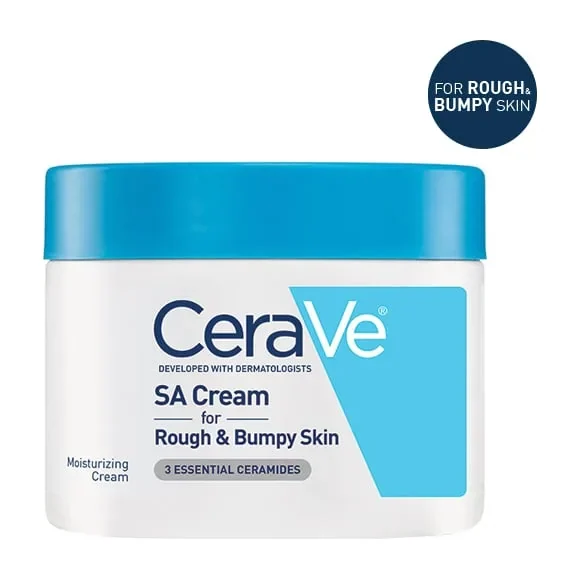
Descaling first. Thick scale physically blocks whatever goes on top of it, so a keratolytic is often the step that makes a prescription work rather than an addition to it — CeraVe's SA Smoothing Cream on smaller areas, or urea at a working percentage like Eucerin's Complete Repair 5% Urea where the area is larger. Both will lower the scale component of your PGA, which is a real improvement rather than a cosmetic one.
Then plain emollient volume. Gold Bond's Age Renew and Eucerin's Advanced Repair Cream are unglamorous, inexpensive and applied by the handful; they reduce the cracking and tightness that make plaques painful without touching the underlying inflammation at all.
And quantity, which is where topical psoriasis treatment most often fails silently. A prescription applied at a fraction of the intended dose for half the intended course is a treatment that was never tested — the fingertip-unit calculator converts the affected area into how much should actually be coming out of the tube, and the answer is usually more than people are using.
None of these are on the treatment ladder. All of them change what the ladder has to do.
Doing it consistently enough to mean something
The value of self-scoring comes entirely from repetition, so build it to be repeatable.
Score on the same day of the month, ideally at the same time of day, and never during or immediately after a flare you already know is unrepresentative. Photograph two or three fixed sites while you are at it — the progress tracker keeps distance and lighting consistent enough that two dates are genuinely comparable, which unaided phone photos are not.
Write the number down with the date. A single score is nearly meaningless; six scores across six months is a chart, and a chart is the thing that changes an appointment. Bring it, and bring the itch log alongside it.
The reframe worth carrying: you are not trying to produce the number a clinician would produce. You are producing your number, consistently, so that its movement is trustworthy even if its absolute value is a little off. A private, slightly biased, faithfully repeated measurement beats an accurate one taken twice a year — and it is the only kind you can actually get.
References
- PGA×BSA: A Measure of Psoriasis Severity Tested in Patients with Active Psoriatic Arthritis and Treated with Certolizumab Pegol — The Journal of Rheumatology, 2018
- PGAxBSA composite versus PASI: Comparison across disease severities and as therapeutic response measure for Cal/BD foam in plaque psoriasis — Journal of the American Academy of Dermatology, 2020
- Physician Global Assessment (PGA) and Psoriasis Area and Severity Index (PASI): why do both? A systematic analysis of randomized controlled trials of biologic agents for moderate to severe plaque psoriasis — Journal of the American Academy of Dermatology, 2012
- The surface area of the hand and the palm for estimating percentage of total body surface area: results of a meta-analysis — British Journal of Dermatology, 2013
Every cited link is verified to resolve to the paper named. Where a source could not be independently confirmed, it is listed without a link rather than pointing you somewhere wrong.
Frequently asked
Is my palm really 1% of my body surface area?
No — that figure belongs to the whole hand with fingers included, and even then a meta-analysis found it runs about 13% lower than 1% in adults. The palm alone is closer to 0.5%. Counting palm-sized patches as 1% each roughly doubles your estimate, which can shift you across a treatment threshold on paper alone.
How accurate is PGA×BSA compared with PASI?
Closely correlated on change — around 0.90 in trial data — with similar proportions of patients reaching a 75% improvement on either measure. It is not interchangeable with PASI and was never meant to be, but it is sensitive to treatment response and takes a fraction of the time.
Can I score my own psoriasis reliably?
Reliably enough to be useful, as long as you compare yourself to yourself. Self-assessment carries consistent biases — most people grade using their worst plaque rather than the average — but a consistent bias cancels out across repeated measurements, so the trend stays trustworthy even when the absolute value drifts.
Does grading redness work on darker skin?
Less well, and it is a known weakness. Plaques on deeply pigmented skin can appear violet, grey or brown rather than red, and lower apparent redness does not mean less inflammation. Weighting thickness and scale more heavily gives a more accurate grade than judging colour alone.
What score means I should ask about stronger treatment?
There is no single threshold, and the trend matters more than the value. A score that is flat or rising after a genuinely adherent trial of your current treatment is the strongest case for escalation — considerably more persuasive than describing it as not seeming to help.
Products named in this piece
Independently reviewed, with a verdict per concern — the real products behind this piece.