Vehicle Matters: Why Ointment, Cream, Gel, Foam and Lotion Aren't Interchangeable
The same corticosteroid molecule is meaningfully stronger in an ointment than in a cream — and the base it arrives in decides whether the prescription irritates you, and whether you finish the course at all.
Read the preview
Can the same steroid get stronger just by changing the tube? Yes — an ointment generally outdoes a cream of the same strength, because sealing skin drives absorption. Skin folds seal themselves. And the base brings its own ingredients: one common solvent triggered allergic reactions in about three and a half percent. Is asking for another base fussy? The Dermington Gazette squeezes the tube.
The same drug, at two different strengths
Two tubes. Identical molecule, identical percentage on the label, prescribed for the same rash. One is an ointment and one is a cream, and they will not do the same thing to your skin.
This is not a marketing distinction or a texture preference. Topical corticosteroids are classified in the United States across seven potency groups, and the standard clinical guidance notes something that surprises most patients: those class assignments shift with the formulation. An ointment is generally more potent than a cream or lotion of the same drug at the same concentration, because the ointment's occlusive base holds the skin hydrated and drives more of the active through it.
So the strength printed on the box is only half the dose. The other half is the base, and it is the half that never gets explained at the counter.
Once you see that, a whole category of treatment failure starts making sense — the prescription that worked on your arm and did nothing on your palms, the cream that was fine on your body and stung viciously on your eyelids, the tube that sat unused because using it meant ruining a shirt.
Occlusion is a dose, including the occlusion you didn't choose
The mechanism is unglamorous. The outermost layer of skin is a barrier optimised to keep water in and molecules out. Hydrate that layer and it becomes considerably more permeable. An ointment — essentially an anhydrous grease — seals the surface, traps transepidermal water beneath it, and the softened barrier lets more drug through. A lotion, mostly water, does close to the opposite: it evaporates, cools, and delivers less.
The practical consequences run in both directions. Bandaging a treated area, or covering it with cling film as some regimens deliberately do, can multiply absorption substantially — which is why occlusion is used on purpose for thick plaques and stubborn palmar disease, and why it is never done casually.
And some occlusion happens whether you plan it or not. Skin folds — armpits, groin, under the breasts, the gluteal cleft — are naturally occluded environments: two surfaces pressed together, warm and damp. Apply a mid-potency steroid there and it behaves like something stronger. That is the actual reason strong steroids are avoided in flexural sites and on the face, and why the standard advice is a lower-potency drug in a lighter base. It is not that the skin is delicate in some vague sense. It is that the site is doing the occluding for you, and adding a heavy vehicle on top stacks two amplifiers.
Getting quantity right belongs in the same conversation. Potency, vehicle and amount are three separate dials, and the fingertip-unit calculator is the only one of the three most people have never been shown how to set.
The site chooses the base
Match the vehicle to the terrain and most of the difficulty disappears.
Hairy skin — scalp, a bearded jaw, a man's chest — takes solutions, foams and sprays, because anything thicker sits on the hair rather than reaching the skin. An ointment prescribed for a scalp is a prescription that will not be used twice.
Folds take creams and lotions. They spread thinly, do not add occlusion to an already occluded site, and do not macerate skin that is already damp.
Palms and soles are the opposite problem: skin thick enough that penetration, not potency, is the limiting factor. Ointments earn their place here, and occlusion is often added deliberately.
Weeping, acutely inflamed lesions generally do better with creams or lotions; a heavy ointment on an oozing surface traps moisture where it is not wanted.
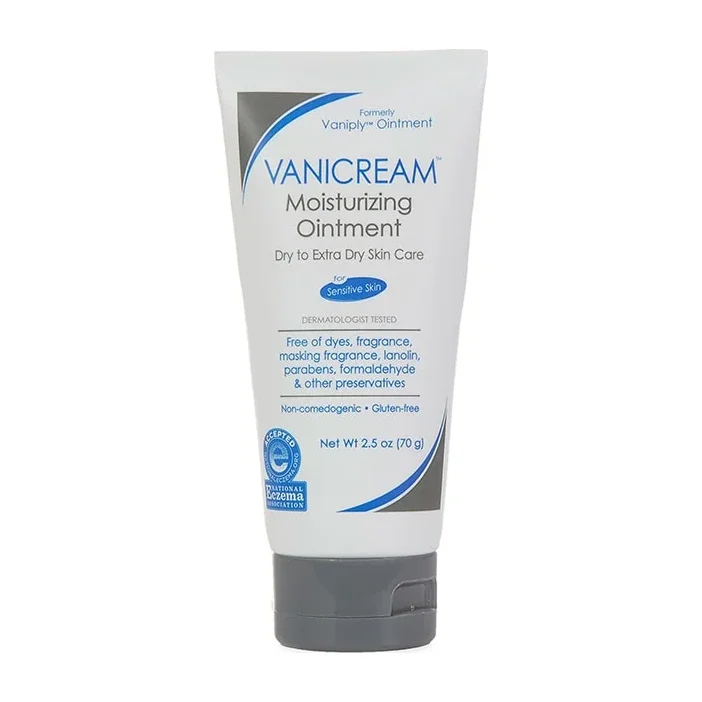
Dry, thickened, scaling plaques are exactly where an ointment does its best work — softening the scale it has to get through. On the body, a bland ointment like Vanicream's Moisturizing Ointment or Cetaphil Healing Ointment is often used alongside a prescription for this reason, sealing over a treated area between doses.
Large body areas need something you can physically get through — a pump lotion such as Eucerin Advanced Repair Lotion covers an entire back in the time an ointment covers a forearm, and coverage that actually happens beats a theoretically superior base that does not. This is where the psoriasis and eczema pathways get practical: the escalation ladder assumes the topical was applied correctly, and vehicle mismatch is one of the quietest ways that assumption fails.
The base has its own ingredient list
Here is the part that catches people out: when a topical treatment causes a rash, the drug is often not the culprit.
Creams, gels and lotions need solvents, emulsifiers and preservatives to exist as stable products. Propylene glycol is among the most common of those, and it is a genuine sensitiser. In a North American Contact Dermatitis Group analysis of more than 23,000 patch-tested patients, roughly 3.5% reacted to propylene glycol, and the overwhelming majority of those reactions were judged currently relevant. Personal care products were the leading source — and topical corticosteroids were the second, accounting for a meaningful share of relevant cases.
Sit with the irony of that. A steroid is prescribed for dermatitis. The vehicle carrying it sensitises the patient. The dermatitis does not clear, so the steroid is escalated, delivering more of the same vehicle. The treatment is the disease, and nothing on the tube tells you.
Other bases carry other passengers. Alcohol-based gels and solutions sting on fissured skin. Fragrance appears in some over-the-counter vehicles and in almost no prescription ones. Anhydrous ointments are the interesting exception: with no water, they need no preservative system at all, which is why an ointment list can run to fewer than ten ingredients — Vanicream's is seven — while a cream doing the same job needs twenty-five.
If a topical stopped working or started burning, run the full ingredient list through the ingredient decoder before assuming the active failed, and if the same pattern recurs across products, a formal patch test is the investigation that ends the guessing. The at-home patch test protocol is the right first step; it is not a substitute for the clinical version.
The vehicle people will actually use
There is a strand of dermatology research that treats patient preference as a clinical variable rather than a nicety, and it has been unusually consistent.
When psoriasis patients were asked to sample different vehicles and rate them, they favoured solutions and foams over traditional creams and ointments — the less messy options won, on ease of use, staining, odour and general disruption. Scalp treatments showed the same pattern. A later randomised study of topical preference found something more useful still: preferences are heterogeneous. There is no single best vehicle, and prescribing as though there were means guessing wrong for a substantial fraction of people.
This matters because topical treatment for chronic skin disease has a well-known adherence problem, and adherence is not a character trait. A greasy ointment prescribed twice daily to someone who leaves for work at seven and cannot arrive with stained clothing is not going to be applied twice daily. The molecule was correct. The prescription still failed.
So the honest hierarchy is: the most effective vehicle for a given site, among the ones you will genuinely use. Those two constraints usually overlap. When they do not, the second one is not the soft consideration — a mid-potency foam applied every day outperforms a high-potency ointment applied on Sundays, and no amount of pharmacology changes that arithmetic.
Asking for a different base
Most prescribers will change a vehicle without argument, because the request is a reasonable one and because most of these drugs exist in four or five formulations. Very few patients ask, largely because nobody tells them it is an option.
The phrasing that works is specific and non-negotiable in tone: this is on my scalp and the ointment sits on my hair — is there a foam or solution version? Or: this stings badly, is there a formulation without propylene glycol? Or simply: the drug seems right, the base isn't working — what else does it come in? Each of those is a clinical question with a clinical answer, and none of them reads as difficulty.
It is worth checking three things before you leave the pharmacy: the strength, the vehicle, and whether the quantity dispensed can plausibly cover the area you were told to treat for the duration you were told to treat it. A thirty-gram tube for a whole-body condition has already failed on the third count, whatever it says about the first two.
The underlying point is small and consequential. A topical prescription is two decisions, and patients are usually told about one of them. Knowing that the other one exists — and that it is adjustable — turns a treatment that did not work into a treatment that was not delivered.
References
- Topical Corticosteroids: Choice and Application — American Family Physician, 2021
- Positive patch-test reactions to propylene glycol: a retrospective cross-sectional analysis from the North American Contact Dermatitis Group, 1996 to 2006 — Dermatitis, 2009
- Propylene glycol: an often unrecognized cause of allergic contact dermatitis in patients using topical corticosteroids — Skin Therapy Letter, 2011
- Patients with psoriasis prefer solution and foam vehicles: a quantitative assessment of vehicle preference — Cutis, 2002
- Patients' vehicle preference for corticosteroid treatments of scalp psoriasis — American Journal of Clinical Dermatology, 2003
- Patients with psoriasis have different preferences for topical therapy, highlighting the importance of individualized treatment approaches: randomized phase IIIb PSO-INSIGHTFUL study — Journal of the European Academy of Dermatology and Venereology, 2017
- Assessing attributes of topical vehicles for the treatment of acne, atopic dermatitis, and plaque psoriasis — Cutis, 2014
Every cited link is verified to resolve to the paper named. Where a source could not be independently confirmed, it is listed without a link rather than pointing you somewhere wrong.
Frequently asked
Is an ointment version of my steroid stronger than the cream?
Generally yes, at the same molecule and concentration. Ointments occlude the skin, which hydrates the barrier and increases how much drug gets absorbed — enough that potency-class assignments can shift with formulation. It is the reason a prescriber may deliberately choose a cream for a fold and an ointment for a thick plaque.
Why does my prescription cream sting when the active is supposed to be soothing?
Stinging usually comes from the base rather than the drug. Solvents like propylene glycol and alcohol are common in creams, gels and solutions, and both can irritate compromised skin. If the same sting recurs across different actives, the vehicle is the common factor worth investigating.
Can I ask for my prescription in a different format?
Yes, and it is a routine request — most topical drugs exist in several vehicles. Say which site you are treating and what is going wrong with the current base. A foam or solution for a scalp, a cream instead of an ointment for a fold, or a preservative-light option after a reaction are all standard substitutions.
Does an ointment need to be avoided on oozing or weeping skin?
Usually. Heavy occlusion over an acutely weeping lesion traps moisture against skin that is already macerated, and creams or lotions tend to be more comfortable and more appropriate there. Ointments come into their own once the surface has dried and the problem becomes thickened, scaling skin.
Why do ointments have such short ingredient lists?
Because they contain no water. A water-based cream needs emulsifiers to hold oil and water together and preservatives to stop microbial growth; an anhydrous ointment needs neither. That is why some ointments run to under ten ingredients, and why they are often the safer option for people who react to vehicle components.
Products named in this piece
Independently reviewed, with a verdict per concern — the real products behind this piece.