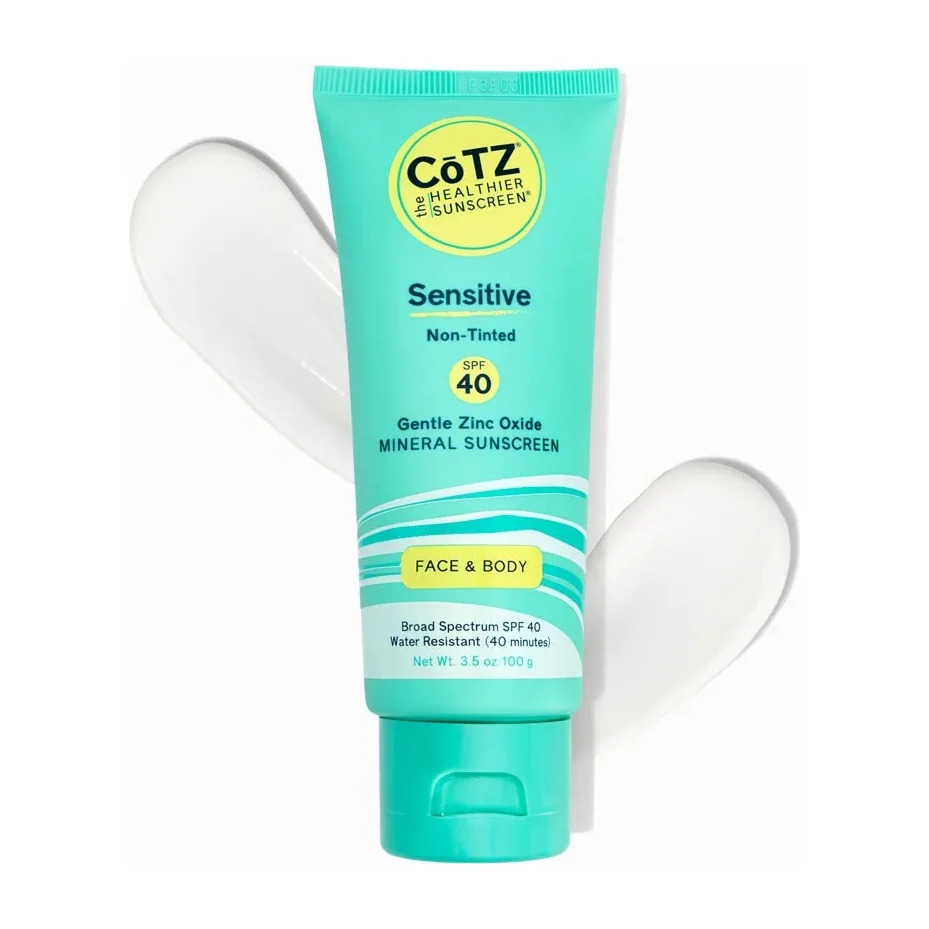
The word 'sensitive' on a sunscreen label has been devalued so thoroughly over the last decade that it barely means anything. Formulas marketed for sensitive skin routinely contain fragrance, essential oils, plant extracts, botanical actives, and chemical UV filters — ingredients that are fine for most people, including most people with 'sensitive skin,' but that reliably trigger reactions in users with actual contact dermatitis, fragrance allergy, or chemical filter intolerance. The people who most need a genuinely non-reactive sunscreen have the hardest time finding one, because the products labeled for them are often optimized for the middle of the sensitivity bell curve rather than for the users at the reactive end. Cotz Sensitive SPF 40 is one of the relatively few sunscreens that takes the word 'sensitive' seriously as a formulation constraint rather than as a marketing category, and that seriousness is what earns it a place in dermatology and allergist offices around the country.
The formula is stripped down to the minimum viable product. Ten percent zinc oxide and 3.5% titanium dioxide handle all UV protection, delivering a broad-spectrum SPF 40 without any chemical UV filters whatsoever. The inactive side is equally restrained — dimethicone and related silicones form the base, C12-15 alkyl benzoate and butyloctyl salicylate serve as cosmetic emollients to improve spread, tocopheryl acetate adds antioxidant support, phenoxyethanol preserves the formula, and disodium EDTA handles chelation. The remaining names are pure engineering: disteardimonium hectorite keeps the mineral particles evenly suspended rather than clumping, triethoxycaprylylsilane coats them so they disperse instead of grinding, and a styrene/acrylates copolymer holds the film together on skin. That's it. There's no fragrance. There are no essential oils. There's no denatured alcohol. There are no plant extracts, no botanical actives, no niacinamide, no peptides, no centella, no anything that could plausibly trigger a reaction in someone with genuine contact dermatitis. The formulation philosophy is 'add nothing that isn't structurally necessary,' and the result is one of the cleanest ingredient decks you'll find in a sunscreen meeting FDA SPF 40 standards. It is also, almost incidentally, fungal-acne safe — there is nothing here for Malassezia to eat.
Nor does that restraint cost anything in protection. The assumption that a sensitive-skin sunscreen must be a weaker sunscreen gets the logic backwards: this carries a full 13.5% mineral filter load, the same as plenty of mainstream mineral formulas. Tolerability was bought by removing triggers, not by removing filters.
The tradeoff for that minimalism is cosmetic. This is not an invisible sunscreen. It's not a tinted sunscreen. It's a thick white mineral lotion that leaves a noticeable cast on first application and takes 30 to 60 seconds of patient blending to settle into a more natural finish. On light and medium skin tones, the cast fades substantially within a few minutes of wear. On deeper skin tones, a faint ashy quality remains visible, which will be a dealbreaker for some users. If cast is your primary concern, this isn't your product — one of the tinted Cotz formulas with iron oxides will serve you better both cosmetically and for visible-light protection, which matters specifically for anyone managing melasma, since visible light drives pigment in a way an untinted mineral filter simply does not address. But if what you need is a sunscreen that reliably doesn't cause problems, the cosmetic compromise is usually worth it.
The practical advantage Sensitive SPF 40 has over Cotz's face-only formulas is the size. At 3 ounces, it's twice the size of the smaller face tubes, which makes it much more realistic to use as a combined face-and-body sunscreen. For users with reactive skin, having a single product that works on face, neck, chest, arms, and any other exposed areas simplifies a lot of daily decisions. Most users don't want to maintain one sunscreen for the face and a different one for the body, particularly when both need to meet the same tolerability standards. The 3 oz size lasts about four to six weeks of face-and-body use, which puts the per-month cost in a reasonable range for a dermatologist-tier mineral option.
Application and technique matter more with this formula than with thinner sunscreens. The correct dose for the face is a quarter-teaspoon, and for face plus neck and chest, closer to a half teaspoon. For body use, the standard is approximately one ounce — a shot glass worth — for full coverage. This is a substantial amount of product, and most users underapply body sunscreen by half or more. If you're buying Sensitive SPF 40 specifically to protect reactive skin from contact dermatitis flare-ups, committing to the full dose is essential. Underapplication reduces SPF proportionally and makes the whole exercise of choosing a well-tolerated formula pointless — which is also why the fretting over SPF 40 versus SPF 50 is misplaced. The gap between them is 97.5% and 98% of UVB blocked. The gap between a properly dosed sunscreen and a thinly smeared one is enormous. One of those numbers is worth arguing about; the other is worth changing your behaviour over.
The honest omission is water resistance: this formula does not claim it and does not have it. Swimmers and serious athletes need something built for the job.
For the contact dermatitis patient, the allergist's referral, the user whose skin has reacted to fragrance or essential oil-containing sunscreens in the past, the eczema-prone user looking for a face-and-body option that won't trigger flares, the post-procedure patient whose dermatologist has instructed them to use only the cleanest possible formula, Cotz Sensitive SPF 40 is a reliable, boring, dermatologist-approved choice — and its thousand-odd reviewers, averaging 4.4 stars, praise it in exactly those unglamorous terms: it does not sting, it does not flare anything, it goes on every morning. It is not going to win any beauty industry awards for texture or finish. It is going to quietly do its job of providing broad-spectrum UV protection without adding to the user's burden of managing their reactivity — which is exactly what it's supposed to do.