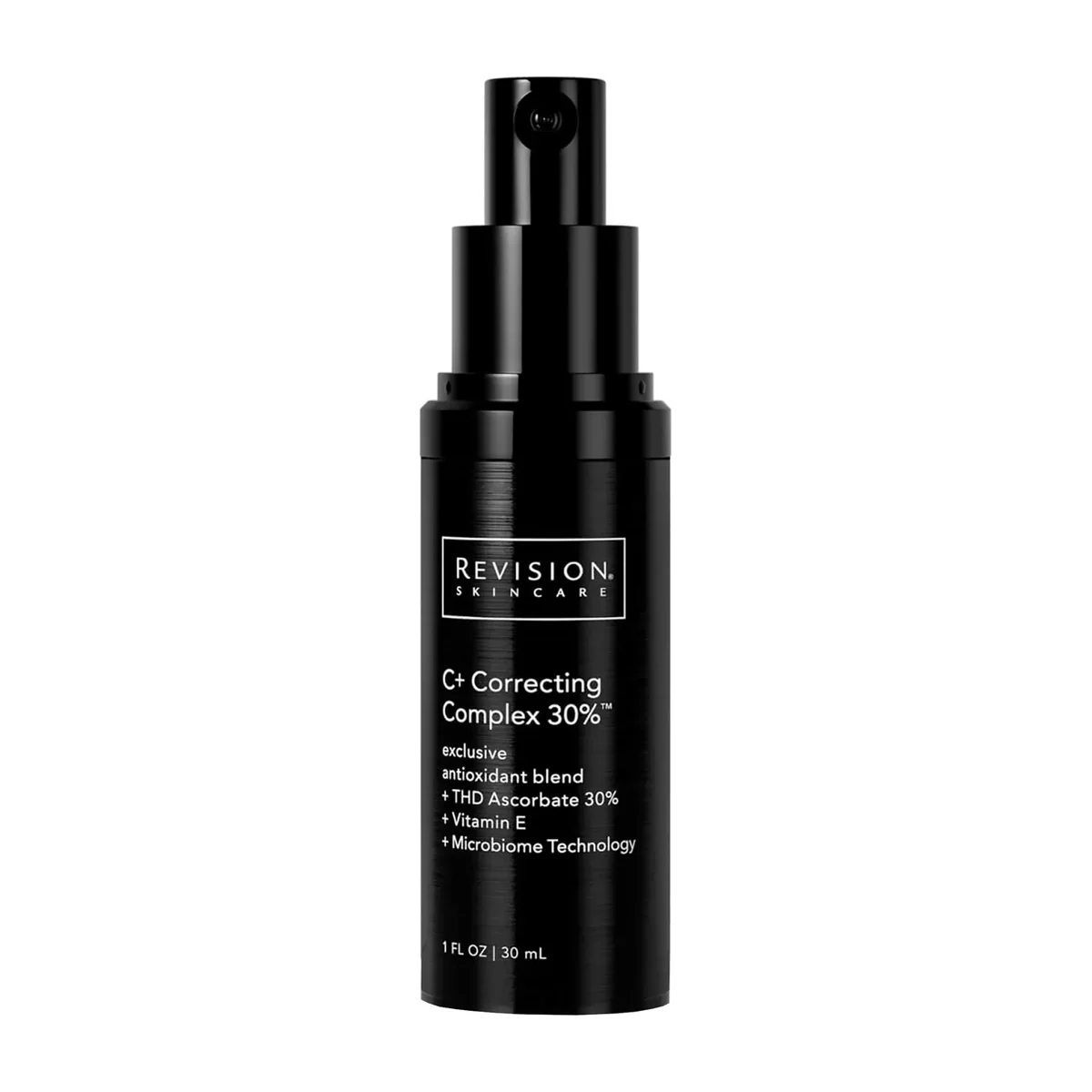
The vitamin C serum market has spent the past decade in a quiet civil war. On one side: L-ascorbic acid loyalists who point to SkinCeuticals' C E Ferulic and its three decades of clinical evidence as proof that the original water-soluble vitamin C remains the gold standard. On the other: derivative advocates who note that L-ascorbic's pH 2.5-3.5 requirement, oxidation sensitivity, and irritation profile make it impractical for most users — and that stable derivatives like THD ascorbate, sodium ascorbyl phosphate, and ethyl ascorbic acid have built their own clinical evidence base over the past decade. Glytone's Age-Defying C+ Advanced Antioxidant Serum lands squarely in the derivative camp, and the formulation choices around that core decision are what make this serum worth the $98 ask — or not, depending on what you're optimizing for.
The centerpiece active is tetrahexyldecyl ascorbate, the lipid-soluble vitamin C derivative most commonly used in clinical-tier formulations. Unlike L-ascorbic acid, THD ascorbate operates at skin-friendly pH (around 5-6), penetrates the lipid-rich stratum corneum more efficiently than water-soluble alternatives, and remains stable through normal storage and use cycles. The published evidence base supports THD ascorbate as comparable to L-ascorbic in collagen stimulation, melanin pathway inhibition, and antioxidant capacity — with better tolerability and a longer shelf life. Sitting at the third INCI position in this serum suggests meaningful concentration in the 5-10% range that's typical of professional THD formulations.
What distinguishes Glytone's approach from competing THD serums is the supporting antioxidant cast. Vitamin E (tocopheryl acetate) recreates the classic C+E synergy that vitamin C research established decades ago — vitamin E regenerates oxidized vitamin C, extending its antioxidant lifespan in the skin. Squalane provides a barrier-mimicking lipid base that's both stable and compatible with the lipid-soluble actives, an appropriate vehicle choice that some THD serums skip in favor of more conventional emulsions. Ergothioneine, an unusual mushroom-derived amino acid antioxidant, adds mitochondrial-targeting protection that traditional antioxidants can't reach. Kakadu plum extract contributes botanical vitamin C and ellagic-and-gallic acid polyphenols. Pomegranate seed, rhodiola, muscadine grape, uva ursi, and geranium round out a botanical antioxidant chorus that supports the marketing claim of a 20% antioxidant complex.
The whole stack is built into a fragrance-free, alcohol-free, silicone-free, vegan formulation that absorbs cleanly into a soft satin finish without the tackiness common to L-ascorbic serums. There's no first-week stinging, no need for a tolerance ramp-up, and no pH compromise required from the supporting routine. For users who have abandoned SkinCeuticals or Drunk Elephant C-Firma due to L-ascorbic stinging or barrier issues, the textural and tolerability differences are immediately noticeable.
In use, results build the way vitamin C results typically build — quietly. Week one is mostly textural and immediate-glow, with the squalane and humectant base providing instant smoothing while the antioxidants begin their cumulative work. By week three to four, visible brightening of dull patches and slight evening of overall tone becomes apparent in good light. Between weeks six and eight, post-inflammatory hyperpigmentation from old breakouts fades visibly, and the protective photoaging effect compounds with consistent SPF use to slow the visible accumulation of sun damage. The eight-to-twelve-week mark is where the cumulative payoff plateaus for most users running this serum as the AM antioxidant in a routine that also includes retinoid at night.
The price point is where the friendly skepticism cap belongs. At $98 for 30ml, this serum competes directly with SkinCeuticals C E Ferulic at $182, IS Clinical Pro-Heal Serum Advance+ at $158, Drunk Elephant C-Firma Fresh Day Serum at $80, and a small cluster of clinical-brand THD ascorbate serums in the $70-$120 range. On a per-ml basis it's actually a touch cheaper than SkinCeuticals' L-ascorbic flagship, but considerably more expensive than budget THD options like The Inkey List 15% Vitamin C and EGF at $25 for 30ml. The justification for the Glytone premium is the ergothioneine and kakadu plum inclusions, the multi-antioxidant stack approach, and the brand's clinical distribution credibility. Whether those differentiators justify a 4x markup over The Inkey List's THD serum is genuinely a personal calculation. For users running comprehensive dermatology-office anti-aging routines who appreciate the Pierre Fabre clinical heritage, the answer is probably yes. For users primarily focused on basic THD vitamin C delivery, the cheaper alternatives provide most of the benefit at a fraction of the cost.
Who actually wins from this serum? Mature anti-aging users in the 35-65 range with photoaging concerns, mild hyperpigmentation, and a tolerance for prestige skincare pricing. Sensitive users who have failed L-ascorbic acid serums and need a non-stinging antioxidant alternative. Users running comprehensive AM-antioxidant-plus-PM-retinoid routines who want a clinical-tier vitamin C that pairs cleanly with their retinoid program without cross-irritation. Dermatology-office shoppers who prefer purchasing within their clinic's product line.
Who should skip? Anyone shopping primarily on value, since the formulation can be largely replicated at one-quarter the price through The Ordinary, The Inkey List, or Naturium THD options. Anyone with severe melasma who needs prescription-tier brightening — vitamin C alone, regardless of derivative, won't shift it. Strict fungal-acne avoiders should also check the INCI, as a few of the supporting emollients sit at the borderline of Malassezia-feeding ingredients.
The honest assessment is that this is a well-formulated, multi-antioxidant THD ascorbate serum with genuine clinical credibility at a price that buys real ingredients rather than just brand premium. The ergothioneine and kakadu plum inclusions are not common in this price tier, and the Pierre Fabre clinical distribution heritage is legitimate. Whether it's worth $98 over a comparable $25 THD serum comes down to how much you value the multi-antioxidant stack, the dermatology-office context, and the formulation sophistication. For the right user it justifies the price. For the wrong user, it's a $73 premium for the kakadu plum and ergothioneine inclusions plus the prestige distribution context.