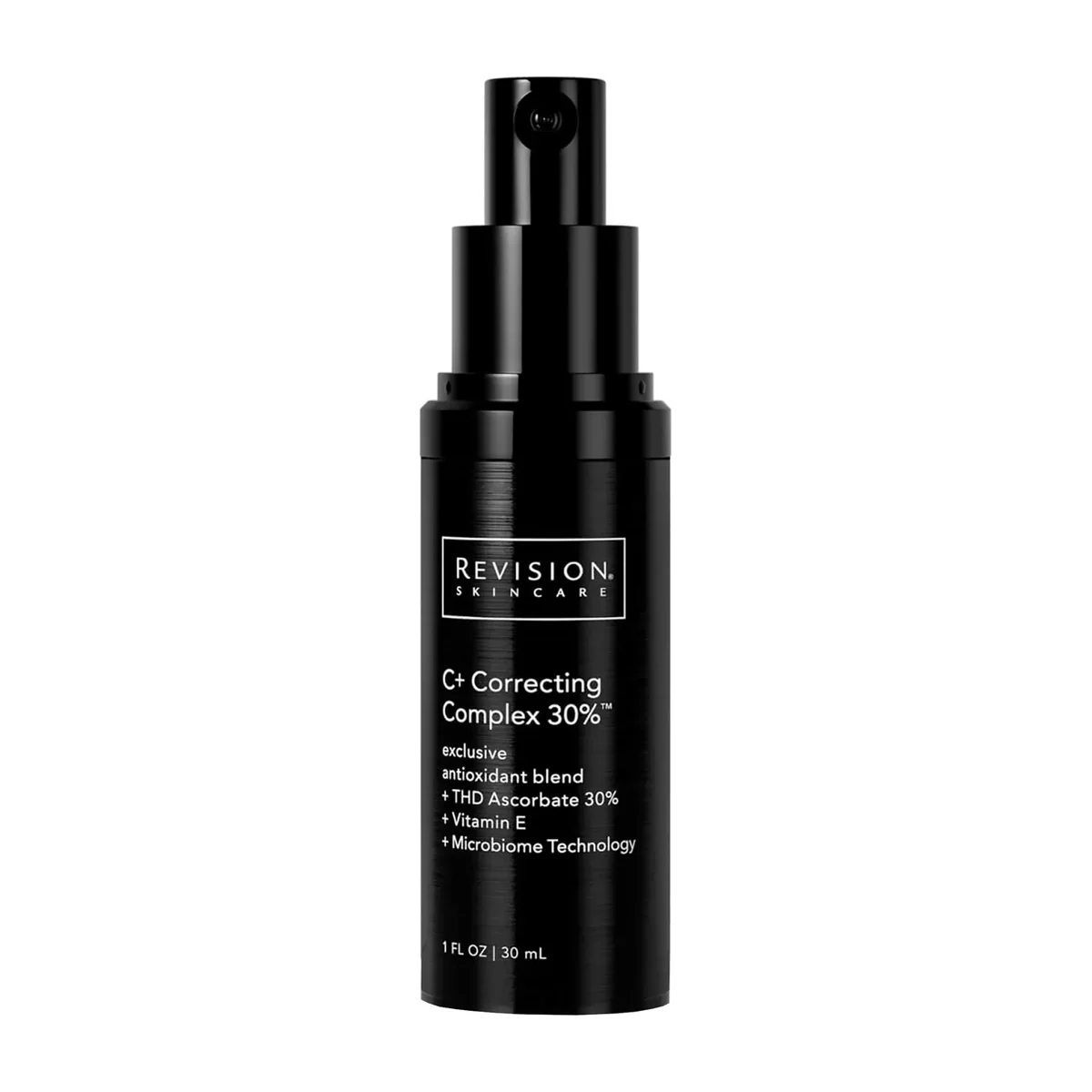
Revision Skincare C+ Correcting Complex 30% in a white airless pump bottle with clinical branding
Promising for Aging
What makes this different

At 30% THD ascorbate, this is one of the highest-concentration vitamin C serums available that does not sting, oxidize readily, or require refrigeration. The proprietary MelaPATH Technology combines acetyl zingerone and botanical extracts to specifically target blue light and pollution damage — a modern concern that most vitamin C formulas were not designed to address. The multi-antioxidant system (ergothioneine, CoQ10, tocopherol) creates redundant protection layers.

Revision Skincare

Revision Skincare C+ Correcting Complex 30% Review

Clinical Vitamin C Powerhouse Serums cream clinical Paraben free

Revision's C+ Correcting Complex 30% is what happens when a physician-dispensed brand spends years solving every complaint people have about vitamin C serums — irritation, oxidation, instability, stinging — and delivers 30% THD ascorbate in a cream-like format that sensitive skin can actually tolerate. The price is steep, but the formulation is genuinely best-in-class.

Price $166.00 1 fl oz (30 ml) · more sizes
On the market 2019 Made in United States
Buy at Amazon ♥
Verdicts

How well it fits each concern

One verdict per concern. Open a row for the reasoning; the receipt has every source.

The scaleRecommendedGoodSupportingEarly evidenceNot for thisAvoidhow it works

Promisingfor AgingVitamin C has trial evidence for aging, but not yet enough of it to support a recommendation — promising; the other actives here are at the same early stage.Receipt7 sources on the row · 30% declared · rule R9p, which decided 7,914 verdicts · open the receipt

The case for it

  1. Tetrahexyldecyl Ascorbate has trial evidence for this concern, but not yet enough of it to support a recommendation.
  2. It is present at a declared strength inside the studied range, or sits high in the ingredient list.
  3. The formula carries none of the triggers this concern is sensitive to.

Moderate evidenceGentle82 reviews read for this product (not concern-specific)

What would change this: More trial evidence for the active on this concern, such as a second consistent trial or a guideline naming it, would move this from a promising bet to a recommendation.

Same rule for everyone. “Promising” is the verdict on 7,914 of 36,954 concern verdicts across the catalog; rule R9p decided 7,914 of them. Unchanged since September 5, 2026, engine 6.6.0.

Brand or formulator? Disclose a concentration or correct a fact →

The full receipt: rule, row, sources, dates →All aging products →How aging is treated →

Promisingfor Dark spots & uneven toneVitamin C has trial evidence for hyperpigmentation, but not yet enough of it to support a recommendation — promising; nothing else here addresses it.Receipt8 sources on the row · 30% declared · rule R9p, which decided 7,914 verdicts · open the receipt

The case for it

  1. Tetrahexyldecyl Ascorbate has trial evidence for this concern, but not yet enough of it to support a recommendation.
  2. It is present at a declared strength inside the studied range, or sits high in the ingredient list.
  3. The formula carries none of the triggers this concern is sensitive to.

Moderate evidenceGentle82 reviews read for this product (not concern-specific)

What would change this: More trial evidence for the active on this concern, such as a second consistent trial or a guideline naming it, would move this from a promising bet to a recommendation.

Same rule for everyone. “Promising” is the verdict on 7,914 of 36,954 concern verdicts across the catalog; rule R9p decided 7,914 of them. Unchanged since September 5, 2026, engine 6.6.0.

Brand or formulator? Disclose a concentration or correct a fact →

The full receipt: rule, row, sources, dates →All dark spots & uneven tone products →How dark spots & uneven tone is treated →

Promisingfor Texture & dullnessVitamin C has trial evidence for rough texture, but not yet enough of it to support a recommendation — promising; the other actives here are not yet assessed for it.Receipt1 source on the row · 30% declared · rule R9p, which decided 7,914 verdicts · open the receipt

The case for it

  1. Tetrahexyldecyl Ascorbate has trial evidence for this concern, but not yet enough of it to support a recommendation.
  2. It is present at a declared strength inside the studied range, or sits high in the ingredient list.
  3. The formula carries none of the triggers this concern is sensitive to.

Moderate evidenceGentle82 reviews read for this product (not concern-specific)

What would change this: More trial evidence for the active on this concern, such as a second consistent trial or a guideline naming it, would move this from a promising bet to a recommendation.

Same rule for everyone. “Promising” is the verdict on 7,914 of 36,954 concern verdicts across the catalog; rule R9p decided 7,914 of them. As of November 10, 2026, engine 6.6.0.

Brand or formulator? Disclose a concentration or correct a fact →

The full receipt: rule, row, sources, dates →All texture & dullness products →How texture & dullness is treated →

Promisingfor Sun DamageVitamin C has trial evidence for sun damage, but not yet enough of it to support a recommendation — promising; nothing else here addresses it.Receipt5 sources on the row · 30% declared · row checked Jul 17, 2026 · rule R9p, which decided 7,914 verdicts · open the receipt

The case for it

  1. Tetrahexyldecyl Ascorbate has trial evidence for this concern, but not yet enough of it to support a recommendation.
  2. It is present at a declared strength inside the studied range, or sits high in the ingredient list.
  3. The formula carries none of the triggers this concern is sensitive to.

Moderate evidenceGentle82 reviews read for this product (not concern-specific)

What would change this: More trial evidence for the active on this concern, such as a second consistent trial or a guideline naming it, would move this from a promising bet to a recommendation.

Same rule for everyone. “Promising” is the verdict on 7,914 of 36,954 concern verdicts across the catalog; rule R9p decided 7,914 of them. Unchanged since September 5, 2026, engine 6.6.0.

Brand or formulator? Disclose a concentration or correct a fact →

The full receipt: rule, row, sources, dates →All sun damage products →

Where our review and the verdict differ. The review below was written on the formulation and the published trials; the verdicts above apply the stricter standing test in our methodology — an active earns a recommendation only with guideline or regulatory standing for the concern. Where the two disagree, the verdict is Dermington’s position.

A verdict is Dermington’s assessment of how well a product’s ingredients fit a concern — never a claim about what the product treats. Evidence dots and collected reviews sit beside it and are never blended in. Rules 0.10.0 · evidence table ev-2026.11c-r265 · engine 6.6.0 · how we decide · this product’s receipt

Reader poll · Town SquareQuestion 1 of up to 3

Have you used C+ Correcting Complex 30%?

One tap counts. A couple of optional follow-ups come next.

No account neededOne answer each, change it any timeCounted only in anonymous totalsHow the Square counts →
Assessment

Pros & cons

What it does well 8

  • 30% THD ascorbate — one of the highest vitamin C concentrations available in a non-irritating format
  • Zero stinging or irritation — suitable for sensitive skin types that cannot tolerate L-ascorbic acid
  • Exceptionally stable formula that resists oxidation and does not turn brown in the bottle
  • Multi-layered antioxidant system with ergothioneine, CoQ10, vitamin E, and acetyl zingerone
  • Fragrance-free with no common irritants or allergens
  • Cream-like texture layers beautifully under moisturizer and sunscreen
  • Airless pump packaging protects the formula from oxidation and contamination
  • Physician-dispensed quality with 30+ years of clinical brand credibility

Where it falls short 5

  • Very expensive at $166 for 1 oz — one of the priciest vitamin C serums on the market
  • Small bottle requires careful use to last 2-3 months
  • Cream texture may feel heavier than preferred by very oily skin types
  • Available primarily through physician offices and specialty retailers
  • Results for dark spots take 4-8 weeks of consistent daily use
Review

The full review

There is a particular frustration that unites a large segment of skincare consumers: the vitamin C paradox. You know vitamin C works — the research on antioxidant protection, collagen synthesis, and hyperpigmentation reduction is essentially irrefutable. You also know that every L-ascorbic acid serum you have tried has either stung like a paper cut in lemon juice, oxidized to a suspicious amber by week three, or both. Revision Skincare's C+ Correcting Complex 30% exists to resolve this paradox, and it does so with considerable sophistication.

The formula centers on tetrahexyldecyl ascorbate (THD) at 30% — a concentration that would be eye-watering in L-ascorbic acid but is perfectly comfortable here because THD operates under entirely different pharmacological rules. THD is oil-soluble, which means it crosses the skin's lipid bilayer more efficiently than water-soluble vitamin C forms. It does not require a low pH environment for stability, eliminating the acidic conditions that cause stinging. It does not readily oxidize, which means your $166 investment will not turn brown in the bottle. And research has demonstrated that THD is converted to active ascorbic acid intracellularly — inside the skin cells where it actually needs to work.

That last point is worth dwelling on, because the derivative-versus-pure debate has hardened into folklore. The received wisdom holds that a derivative must be a compromise, a diluted echo of the real molecule, and that the yellow tint and acidic bite of a traditional serum are proof of authenticity. The color is not evidence of potency — it is evidence of chemistry, and increasingly of oxidation. What determines whether vitamin C reaches a living keratinocyte is the form, the vehicle, and the concentration, not whether the bottle looks like lemonade or stings on contact.

The supporting antioxidant cast is where Revision's formulation depth really shows. Ergothioneine, sometimes called the 'longevity vitamin,' is a rare amino acid antioxidant found in mushrooms that the body actively transports into cells via a dedicated transporter (OCTN1). Ubiquinone (CoQ10) provides mitochondrial antioxidant support. Tocopherol and tocopheryl acetate deliver vitamin E's synergistic antioxidant partnership with vitamin C. Acetyl zingerone, a ginger-derived compound, was included specifically for its ability to neutralize free radicals generated by blue light and pollution — part of Revision's proprietary MelaPATH Technology.

The additional botanicals are carefully selected rather than decoratively sprinkled. Euterpe oleracea (açaí berry) extract provides polyphenolic antioxidants. Punica granatum (pomegranate) extract contributes ellagic acid, which has independent research supporting its tyrosinase-inhibiting properties. Plantago lanceolata leaf extract brings anti-inflammatory benefits. And diglucosyl gallic acid acts as an additional brightening agent. It's not a formula with one active and twenty-eight fillers — nearly every ingredient is doing purposeful work. Even the supporting cast has a job: hydrogenated lecithin and cetearyl glucoside build the emulsion that carries an oil-soluble active in a water-based cream, squalane smooths its path into the lipid matrix, sodium carboxymethyl beta-glucan adds a soothing hydrating film, and a radish root ferment filtrate shares preservation duty so the formula can stay as clean as its label claims.

The texture is a pleasant departure from the watery, sometimes oily consistency of traditional vitamin C serums. This applies like a lightweight cream — smooth, rich enough to feel nourishing, but not so heavy that it disrupts layering. It absorbs within about a minute, leaving a slightly dewy, luminous finish. The first time you apply it without experiencing any stinging or burning, there is an almost cognitive dissonance if you have spent years wincing through L-ascorbic acid applications. Very oily skin is the one constituency that may push back on the richness, and there is no lighter variant to offer them.

Placement in the routine is simple and matters. This belongs in the morning, after cleansing, under moisturizer and sunscreen — antioxidant defense is worth the most on the day it is actually being attacked by UV and pollution. It is comfortable alongside niacinamide, it does not fight with a hyaluronic acid layer, and it leaves the retinoid where it belongs, in the evening. Nothing in it demands a wait time or a pH-matched partner, which is the quiet luxury of a pH-independent active.

Results are both immediate and cumulative. The luminous finish is visible from day one — skin genuinely looks brighter after a single application. Over the first two weeks, a general radiance builds as the antioxidant protection accumulates. By four to eight weeks, users typically report meaningful fading of dark spots, sunspots, and post-inflammatory hyperpigmentation marks. The anti-aging collagen synthesis effects are slower to manifest visually but are supported by the established mechanism of action of intracellular ascorbic acid.

The airless pump packaging is a thoughtful detail that matters more than aesthetics. Vitamin C derivatives, even stable ones like THD, benefit from protection against air exposure. The airless pump delivers a consistent dose, prevents contamination, and keeps oxygen away from the remaining product. The opaque container protects against light-induced degradation. These packaging choices extend the product's effective life and justify part of the premium. They also enforce a discipline the price demands: one pump is the dose, and the thousand-odd reviewers who complain that the bottle empties quickly are, in the main, using two.

The honest conversation about this product is the price. At $166 for one ounce, used once daily, you are looking at roughly $55-80 per month in vitamin C serum. A 0.5 oz trial size is available for those who want to test before committing. The concentration and ingredient quality genuinely justify a premium, but the question of whether any single skincare product is worth this much is ultimately personal. What Revision delivers for that price is a formula that eliminates the compromises of traditional vitamin C — no irritation, no oxidation, no instability — while matching or exceeding the efficacy through a superior delivery mechanism. It is also worth noting where the money is not going: there is no fragrance, no decorative color, no marketing texture. Nearly the whole cost sits in the actives.

Revision Skincare built this product for a specific patient — the one sitting in a dermatologist's office who knows vitamin C belongs in the routine, and who has reacted to every version of it ever tried. The C+ Correcting Complex 30% is the answer to that specific frustration, delivered with clinical precision and priced accordingly.
The science

Tetrahexyldecyl ascorbate (THD), the formula's centerpiece at 30% concentration, has been the subject of increasing research attention. Unlike L-ascorbic acid, which requires a pH below 3.5 for stability and penetration, THD is oil-soluble and pH-independent. Work appearing in the Journal of Cosmetic Dermatology demonstrated that THD ascorbate penetrates the stratum corneum and epidermis more effectively than L-ascorbic acid due to its lipophilic nature, and is enzymatically converted to free ascorbic acid within the skin. This intracellular conversion means the active form of vitamin C is generated precisely where it needs to work — inside skin cells.

A paper published in the International Journal of Cosmetic Science has shown that THD ascorbate at concentrations of 7-30% promotes collagen synthesis, inhibits melanin production via tyrosinase inhibition, and provides significant antioxidant protection against UV-induced free radicals. The higher concentration in this formula (30%) places it at the upper end of studied efficacy.

Ergothioneine, a supporting antioxidant in this formula, has attracted attention from researchers studying skin longevity. Published in Free Radical Biology and Medicine, research demonstrates that ergothioneine accumulates in cells via a specific transporter (OCTN1), providing sustained intracellular antioxidant protection. Unlike many antioxidants that are consumed during free radical neutralization, ergothioneine can be recycled, providing longer-lasting protection.

Ubiquinone (CoQ10) supports mitochondrial electron transport and protects against lipid peroxidation. Research in BioFactors has demonstrated that topical CoQ10 reduces wrinkle depth and improves skin smoothness. The synergy between vitamin C, vitamin E (tocopherol), and CoQ10 in the same formula creates a 'network antioxidant' effect where each compound helps regenerate the others, maintaining a sustained antioxidant defense.

Acetyl zingerone, part of Revision's MelaPATH Technology, has been shown in in vitro studies to neutralize free radicals generated specifically by visible light (blue light) exposure — a relevant concern given increasing screen time. This represents a forward-looking formulation choice addressing a environmental stressor that older vitamin C formulas were not designed to combat.

The clinical view

Dermatologists who dispense this product frequently recommend it for patients who have failed traditional vitamin C serums due to irritation, sensitivity, or stability concerns. Most dermatologists observe that THD ascorbate at 30% represents one of the most bioavailable, stable, and tolerable vitamin C delivery systems available. The multi-antioxidant formulation with ergothioneine and CoQ10 reflects current dermatological understanding that comprehensive free radical defense requires multiple complementary antioxidant pathways. Dermatologists particularly value the fragrance-free, irritant-free profile that allows confident recommendation even for patients with rosacea or post-procedure sensitivity.

Formula

Key ingredients

  1. Tetrahexyldecyl Ascorbate (30%) 30%

    An oil-soluble, highly stable form of vitamin C at a remarkable 30% concentration. THD ascorbate penetrates the lipid bilayer of cell membranes more effectively than water-soluble L-ascorbic acid, providing potent antioxidant protection and collagen synthesis stimulation without the pH sensitivity, oxidation issues, or stinging associated with pure vitamin C. At this concentration, it delivers serious brightening and anti-aging effects.

    Plausible mechanism for Dullness
  2. Ergothioneine

    A rare amino acid antioxidant derived from mushrooms that has been called 'the longevity vitamin.' In this vitamin C-centric formula, ergothioneine provides a complementary antioxidant pathway that protects against oxidative stress through mechanisms distinct from vitamin C, extending the formula's overall free radical defense.

    Not yet assessed
  3. Ubiquinone (Coenzyme Q10)

    A mitochondrial antioxidant that supports cellular energy production in the skin. In this multi-antioxidant formula, CoQ10 works synergistically with vitamin C and ergothioneine to create a layered defense system — each antioxidant protecting against different types of free radicals and environmental stressors.

    Limited for Aging
  4. Squalane

    Provides lightweight lipid moisture that enhances the absorption of the oil-soluble THD ascorbate. Creates a non-greasy emollient base that helps the vitamin C derivative integrate into the skin's lipid matrix for optimal delivery and efficacy.

    Plausible mechanism for Dullness
  5. Acetyl Zingerone

    A novel antioxidant derived from ginger that provides specialized protection against pollution and blue light-induced free radicals. Part of Revision's MelaPATH Technology, it addresses the modern environmental stressors that traditional antioxidants were not specifically designed to combat.

    Not yet assessed
Full ingredient list 29 ingredients ShowHide

Water (Aqua), Tetrahexyldecyl Ascorbate, Pentylene Glycol, Hydrolyzed Eruca Sativa Leaf, Glycerin, Zea Mays (Corn) Starch, Cetearyl Glucoside, Hydrogenated Lecithin, Acetyl Zingerone, Palmitoyl Glycine, Cyclopentasiloxane, Glyceryl Caprylate, Plantago Lanceolata Leaf Extract, Diglucosyl Gallic Acid, Squalane, Sodium Carboxymethyl Beta-Glucan, Euterpe Oleracea Fruit Extract, Ergothioneine, Punica Granatum Extract, Tocopherol, Ubiquinone, Acrylates/C10-30 Alkyl Acrylate Crosspolymer, Triethanolamine, Tocopheryl Acetate, Leuconostoc/Radish Root Ferment Filtrate, Phenoxyethanol, Disodium EDTA, PPG-12/Smdi Copolymer, Xanthan Gum

Safety & formulation facts

  • Generally OK in pregnancy
  • Fragrance free
  • Alcohol free
  • Not oil free
  • Not silicone free
  • Paraben free
  • Sulfate free
  • Not fungal-acne safe
Compatibility

Skin types & routine

Routine step serum
Time of day Morning
Best season All year
Finish satin, dewy, non-greasy

Layering

Apply in the morning after cleansing and toning, before moisturizer and sunscreen. The cream-like consistency layers well under SPF. Allow a minute for absorption before the next step. Can also be used in the PM routine, though the antioxidant protection is most valuable during the day when skin faces UV and pollution exposure.

When to expect results

Immediate brightening glow and smooth, hydrated feel upon first application. Visible improvement in skin luminosity and radiance within 1-2 weeks. Significant reduction in dark spots and uneven tone over 4-8 weeks of consistent use. Continued firming and anti-aging benefits accumulate over months.

Pairs well with sunscreenretinol (PM)niacinamidehyaluronic acid serum

A routine built around it

Morning

  1. Gentle cleanser
  2. Toner
  3. Revision Skincare C+ Correcting Complex 30%this product
  4. Moisturizer
  5. Sunscreen SPF 30+

Night

  1. Double cleanse
  2. Retinol treatment
  3. Moisturizer
Guidance

How to use it, and who it's for

How to use

Apply one pump to clean skin in the morning after cleansing and toning. Spread evenly across face and neck. Allow 1-2 minutes for absorption before applying moisturizer and sunscreen. Use daily for cumulative antioxidant protection and brightening benefits. Can also be used in the evening, though morning use maximizes the antioxidant defense against daytime UV and pollution exposure. Store at room temperature away from direct sunlight.

Is it worth the price?

At $166 for 1 fl oz, this is undeniably a luxury investment. A 0.5 oz trial size is available for a lower entry point. The per-ounce cost is significantly higher than most vitamin C serums, including clinical brands. However, the value proposition includes: 30% THD ascorbate (one of the highest concentrations and most stable forms available), a sophisticated multi-antioxidant system, airless pump packaging, fragrance-free formulation, and the quality assurance of a 30-year physician-dispensed brand. For those who have wasted money on vitamin C serums that oxidized, irritated their skin, or produced no results, paying more for a formula that actually works may ultimately prove more cost-effective.

Who should buy it

Anyone serious about vitamin C but frustrated by the irritation, instability, or oxidation of traditional L-ascorbic acid serums. Ideal for sensitive skin types who need antioxidant protection and brightening without compromise. Perfect for those targeting sun damage, hyperpigmentation, and photoaging who want a physician-grade formula backed by clinical credibility.

Who should skip it

Budget-conscious consumers who cannot justify $166 for a single ounce of product. Those who are satisfied with their current L-ascorbic acid serum and do not experience irritation or stability issues. Anyone looking for a multi-tasking product that also addresses acne or exfoliation — this is purely an antioxidant and brightening treatment.

Ready to try it?Revision Skincare C+ Correcting Complex 30% · $166.00 · 1 fl oz (30 ml)
Details

The product, in detail

Texture
Rich, creamy serum with a smooth, almost lotion-like consistency. Heavier than typical vitamin C serums — applies like a lightweight moisturizer. Spreads easily and absorbs within a minute or two.
Scent
Fragrance-free — very faint natural ingredient scent that dissipates immediately.
Packaging
Airless pump bottle that protects the vitamin C from oxidation. The 1 fl oz size features an opaque container to prevent light degradation. A 0.5 oz trial size is also available.
How long it lasts
2-3 months with once-daily morning application
Once opened
Use within 12 months · track your toss-by date →
Size
1 fl oz (30 ml) · other sizes available
Made in
United States
Launched
2019

What the first two weeks feel like

The cream-like texture is immediately pleasant — no stinging, no tingling, no irritation. Skin looks noticeably more luminous after the first application. The lack of any acidic sensation is striking for users accustomed to L-ascorbic acid serums. The product layers smoothly under moisturizer and sunscreen.

The story behind it

Why it exists

Revision Skincare spent years developing the C+ Correcting Complex to address the limitations of traditional vitamin C serums — oxidation, instability, irritation, and the characteristic stinging of L-ascorbic acid. The 2019 launch introduced THD ascorbate at 30% in a format that physicians could confidently recommend to patients with sensitive skin. The MelaPATH Technology was specifically engineered to address blue light damage, reflecting emerging research on digital screen exposure and skin aging.

About Revision Skincare Legacy Brand (20+ years)

Revision Skincare has been a leading physician-dispensed skincare brand for over 30 years, sold exclusively through dermatologists and medical spas. The C+ Correcting Complex 30% features the brand's proprietary MelaPATH Technology and uses THD Ascorbate, one of the most stable and bioavailable forms of vitamin C.

Brand founded 1984 · This product since 2019

Tap a card to turn it

What people hear, and what holds up

FAQ

Questions people ask

Is Revision C+ Correcting Complex 30% worth the price?

At $166 for 1 oz, this is a premium investment. The value lies in the 30% THD ascorbate — one of the most stable, bioavailable, and non-irritating vitamin C forms available — plus a sophisticated multi-antioxidant system including ergothioneine and CoQ10. For users who have tried and failed with L-ascorbic acid serums due to irritation or oxidation, this offers a genuinely different experience. The physician-dispensed quality assurance and airless pump packaging add to the value proposition.

What is THD ascorbate and how is it different from regular vitamin C?

Tetrahexyldecyl ascorbate (THD) is an oil-soluble vitamin C derivative that penetrates the skin's lipid layers more effectively than water-soluble L-ascorbic acid. It's far more stable — resistant to oxidation, no need for low pH, and no yellowing. It converts to active ascorbic acid within the skin cells, delivering antioxidant and collagen-stimulating benefits without the stinging or irritation of traditional vitamin C.

Can I use Revision C+ Correcting Complex with retinol?

Yes — THD ascorbate does not have the pH sensitivity issues that make combining L-ascorbic acid with retinol complicated. You can use the C+ Complex in the morning for antioxidant protection and your retinol product in the evening for anti-aging benefits. This is actually an ideal combination for comprehensive skin aging management.

Does Revision C+ Correcting Complex 30% oxidize and turn brown?

No. Unlike L-ascorbic acid serums that notoriously oxidize and turn yellow-brown, THD ascorbate is significantly more stable. The airless pump packaging further protects against oxidation. The product should remain its original cream color throughout its shelf life when stored properly.

Will Revision C+ Correcting Complex sting or irritate sensitive skin?

This is one of the most well-tolerated vitamin C serums available. THD ascorbate does not require a low pH to be effective, eliminating the acidic stinging associated with L-ascorbic acid serums. Users with sensitive skin consistently report zero irritation, making this suitable for skin types that cannot tolerate traditional vitamin C.

Reviews

What shoppers tend to say

Recurring themes our editors read across retailer reviews — summaries in our words, not quotations, and not a substitute for a patch test.

Common praise

  • Noticeable brightening and glow within days
  • Does not sting or irritate like L-ascorbic acid serums
  • Cream texture is easier to apply than watery vitamin C serums
  • Significant improvement in sun spots and discoloration
  • Gentle enough for sensitive skin

Common complaints

  • Very expensive at $166 for 1 oz
  • Rich texture may feel heavy for very oily skin
  • Results take 4-8 weeks for significant dark spot fading
  • Small bottle requires careful dispensing to last
Notable endorsementsRecommended by dermatologists and plastic surgeonsSold through medical spas and physician offices
Next stepCheck it against what you already useClashes, spacing and the right order, with everything on your shelf.