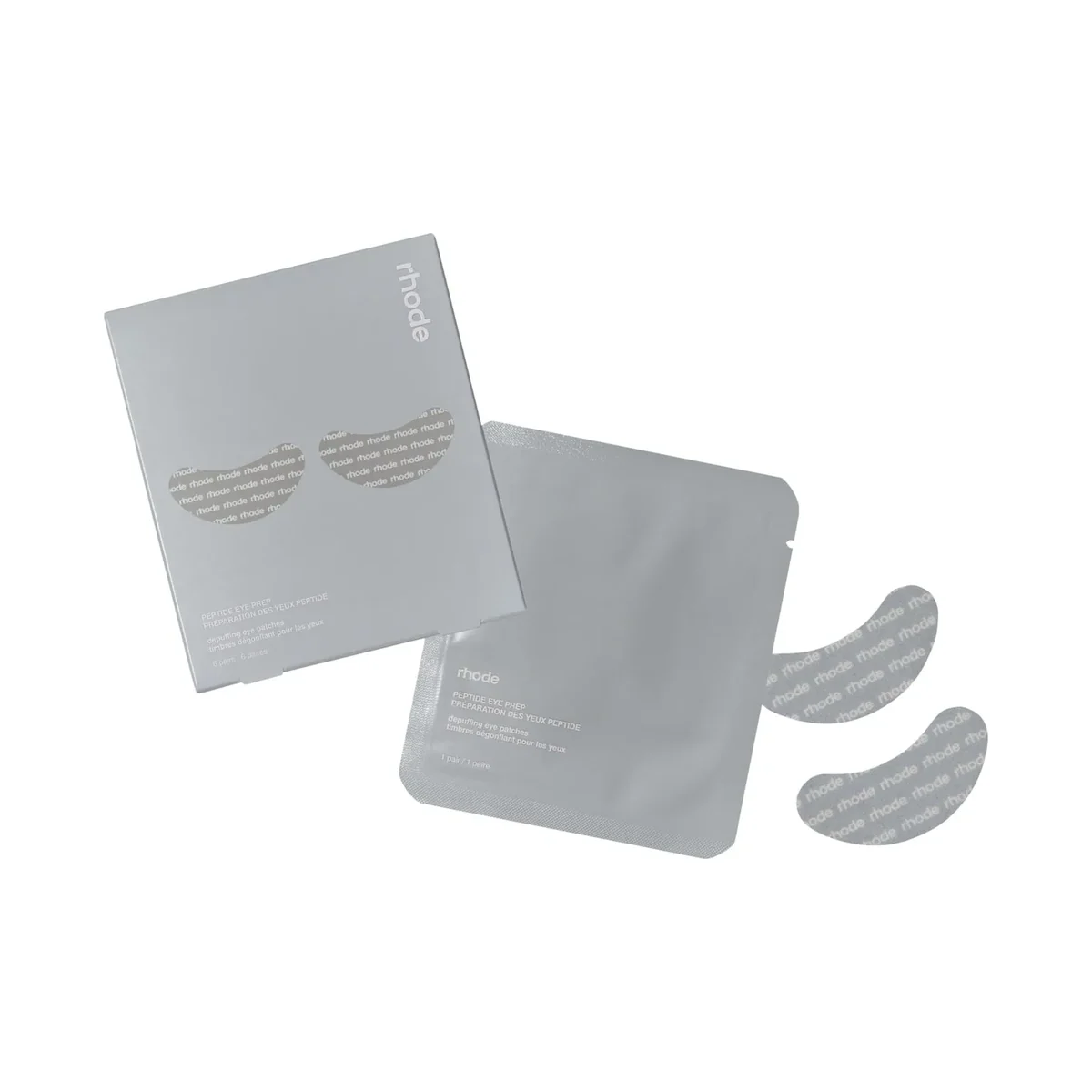
Rhode Peptide Eye Prep hydrogel depuffing eye patches in branded box
Supporting role for Dark Circles
What makes this different

Uses Acetyl Tetrapeptide-5 (Eyeseryl), a peptide specifically developed and studied for under-eye puffiness — not a generic peptide repurposed for the eye area. The hydrogel base uses natural marine gelling agents (carrageenan, chondrus crispus, agar) rather than synthetic polymers, providing a more skin-compatible delivery matrix.

Rhode

Rhode Peptide Eye Prep Review

Morning Depuffing Prep Eye Creams sheet-mask indie Paraben free Fungal-acne safe Cruelty free Vegan

Genuinely effective depuffing patches with a well-chosen Eyeseryl peptide and caffeine combination that delivers visible results in 15 minutes. The catch is the $4.17 per-use cost for temporary effects — these are a special-occasion prep tool, not a daily habit, and should be evaluated accordingly.

Price $25.00 6 pairs · more sizes
On the market 2025 launched
Buy at Amazon ♥
Verdicts

How well it fits each concern

This sheet mask launched in October 2025 with approximately 500 reviews on Sephora. Feedback is polarized — strong reviews from users who understand the temporary nature of patch treatments, and lower ratings from users who expected lasting results. Scoring reflects the well-chosen actives alongside the practical and economic limitations of the format.

One verdict per concern. Open a row for the reasoning; the receipt has every source.

The scaleRecommendedGoodSupportingEarly evidenceNot for thisAvoidhow it works

Supporting rolefor Dark CirclesPeptides has early evidence for dark circles, and hydration of the periorbital area is the recognised companion to treating it — a reasonable supporting choice, short of a recommendation.Receipt4 sources on the row · row checked Jul 17, 2026 · rule R8a, same reading on 1,764 products · open the receipt

The case for it

  1. Acetyl Tetrapeptide-5 has early or mechanistic evidence for this concern, not trial-backed standing.
  2. It is plausibly present at a working level, though the concentration is not declared.
  3. The formula carries none of the triggers this concern is sensitive to.

Limited evidenceGentleNo reviews read yet

What would change this: A declared concentration would move this to a firmer reading of the dose.

Same rule for everyone. “Supporting role” is the verdict on 7,294 of 45,446 concern verdicts across the catalog; rule R8a decided 1,764 of them. Unchanged since September 5, 2026, engine 6.0.0.

Brand or formulator? Disclose a concentration or correct a fact →

The full receipt: rule, row, sources, dates →All dark circles products →How dark circles is treated →

Good choicefor DehydrationSodium PCA is a reference standard by mechanism for dehydration; this sheet mask carries it high in the ingredient list.Receipt2 sources on the row · concentration not declared; studied range 0.2–4% · row checked Jul 17, 2026 · rule R5, same reading on 12,338 products · open the receipt

The case for it

  1. Sodium PCA is a reference standard by mechanism for this concern — an established physical action, not a trial result.
  2. It is present at an effective concentration, declared or high in the ingredient list.
  3. The formula carries none of the triggers this concern is sensitive to.

Limited evidenceGentleNo reviews read yet

Same rule for everyone. “Good choice” is the verdict on 12,824 of 45,446 concern verdicts across the catalog; rule R5 decided 12,338 of them. Unchanged since September 5, 2026, engine 6.0.0.

Brand or formulator? Disclose a concentration or correct a fact →

The full receipt: rule, row, sources, dates →All dehydration products →

Does the jobDoes what a eye cream is for: safe for eye skin, targets a real eye concern. Not measured from the label: hydrates without heaviness, stays where it's put.

A verdict is Dermington’s assessment of how well a product’s ingredients fit a concern — never a claim about what the product treats. Evidence dots and collected reviews sit beside it and are never blended in. Rules 0.6.0 · evidence table ev-2026.10-r259 · engine 6.0.0 · how we decide · this product’s receipt

Reader poll · Town SquareQuestion 1 of up to 3

Have you used Peptide Eye Prep?

One tap counts. A couple of optional follow-ups come next.

No account neededOne answer each, change it any timeCounted only in anonymous totalsHow the Square counts →
Assessment

Pros & cons

What it does well 6

  • Eyeseryl peptide is specifically developed and studied for under-eye depuffing, not a generic active
  • Dual-mechanism approach: caffeine for immediate vasoconstrictive depuffing, peptide for sustained effect
  • Natural marine gelling agents (carrageenan, agar, chondrus crispus) provide a skin-compatible hydrogel base
  • Patches adhere well without slipping and maintain moisture throughout wear time
  • Visible depuffing results within 10-15 minutes of application
  • Fragrance-free, vegan, Leaping Bunny certified, pregnancy-safe

Where it falls short 5

  • At $4.17 per use, cost-prohibitive as a daily habit
  • Results are temporary (4-8 hours) with no cumulative effect from repeated use
  • Minimal impact on pigmented or structural dark circles — primarily addresses puffiness
  • Single-use format generates non-recyclable waste with every application
  • Some users report patchy makeup application over the treated area
Review

The full review

Eye patches occupy an awkward space in skincare. They're the most photogenic step in any routine — perfectly positioned for a selfie, aesthetically satisfying in a way that no serum dropper can compete with — but they're also the step most likely to be doing nothing meaningful for your skin. The vast majority of hydrogel eye patches are hyaluronic acid in a jelly matrix: they hydrate, they feel nice, they look great on camera, and they deliver approximately the same benefit as pressing a damp cotton pad under your eyes for ten minutes.

Rhode's Peptide Eye Prep patches, launched in October 2025, attempt to be the exception. And to their credit, they largely succeed — not because the hydrogel format is revolutionary, but because the active ingredients are chosen to actually do what the product claims.

The star is Acetyl Tetrapeptide-5, commercially known as Eyeseryl. It's not a generic peptide repurposed for eye-area marketing. It was specifically developed for periorbital puffiness, with manufacturer-sponsored in-vivo studies showing that 95% of volunteers observed improvement in eye bag appearance. The mechanism targets vascular permeability — the leakiness of blood vessels under the eyes that allows fluid to accumulate in the tissue, creating the puffy, swollen look that greets you in the bathroom mirror after a short night of sleep or a long night of wine.

Caffeine provides the immediate-gratification layer. As a vasoconstrictor, it tightens dilated blood vessels under the thin periorbital skin, reducing both the visible discoloration from enlarged vessels and the fluid pooling that creates puffiness. The one-two combination — caffeine for immediate vasoconstrictive depuffing and Eyeseryl for sustained vascular permeability reduction — is a legitimate dual-mechanism approach that most competing patches don't offer.

Sodium PCA, a component of the skin's natural moisturizing factor, provides humectant hydration throughout the wear time. The hydrogel matrix itself uses natural marine gelling agents — chondrus crispus (Irish moss), carrageenan, and agar — rather than purely synthetic polymers. These botanical gelling agents create a more skin-compatible matrix that delivers actives consistently during the 10-15 minute wear time.

The user experience is pleasant and effective. The patches adhere smoothly to the under-eye area with a gentle, tacky grip that doesn't slip or shift. They feel immediately cooling — a welcome sensation first thing in the morning — and maintain moisture throughout the wear time without drying out or curling at the edges. After removal, the under-eye area looks visibly less puffy, brighter, and smoother. The depuffing is real and noticeable, not just a hydration trick.

But here's where the honest assessment diverges from the enthusiastic reviews. The results are temporary. Four to eight hours of visible improvement, depending on the severity of your puffiness and environmental factors. By the afternoon, you're back to baseline. There is no cumulative effect — using these daily for a month won't progressively reduce your puffiness. Each application is a reset, not a building block.

This temporal limitation is inherent to the product format, not a formulation failing. Topical caffeine's vasoconstrictive effect is pharmacologically temporary. The Eyeseryl peptide can reduce vascular permeability during and shortly after application, but it's not restructuring the tissue architecture that creates chronic eye bags. For that, you need professional interventions — hyaluronic acid fillers, radiofrequency treatments, or blepharoplasty for structural changes.

The price — $25 for six pairs, or $4.17 per use — makes this a special-occasion product by any reasonable math. At daily use, that's $125 per month for results that last half a day. As a twice-weekly morning prep before important meetings, dates, or events, the cost is more defensible at roughly $35-40 per month. The 12-pair set at $47 ($3.92 per use) offers slightly better per-patch value.

The single-use format also presents a sustainability concern. Each application generates a sachet wrapper and a pair of used hydrogel patches — neither recyclable. Rhode's recycling program covers their squeeze tubes and jars, but not disposable single-use products. For an environmentally conscious brand, this is an inherent tension.

Dark circles are the other promise that needs calibrating. These patches are effective for puffiness-related shadows — the kind caused by fluid retention and vascular dilation. They are not effective for pigmented dark circles (hereditary hyperpigmentation), structural dark circles (thin skin revealing the orbicularis oculi muscle), or hollow tear troughs (volume loss). If your dark circles are primarily genetic or structural, save your money for a vitamin C eye cream or a dermatologist consultation.

Rhode made a smart choice with Eyeseryl over a generic hyaluronic acid formula. The peptide gives these patches a specific, evidence-backed mechanism that justifies a higher price point than drugstore alternatives. But the product's value ultimately depends on how you use it. As an occasional morning-of-event prep tool that delivers genuinely visible depuffing within fifteen minutes, it works. As a daily habit at $4.17 per use for temporary results, the math doesn't hold. Know which category you fall into before you buy.
The science

Acetyl Tetrapeptide-5 (marketed as Eyeseryl) is a synthetic tetrapeptide designed to address periorbital edema — the fluid accumulation that causes under-eye puffiness. The peptide's mechanism targets angiotensin-converting enzyme (ACE) and vascular endothelial growth factor (VEGF) pathways, reducing vascular permeability and thereby decreasing the extravasation of fluid from capillaries into the periorbital tissue. Manufacturer-sponsored in-vivo studies report that 95% of subjects showed improvement in eye bag appearance after topical application.

Caffeine's depuffing action operates through a different mechanism: vasoconstriction. By inhibiting phosphodiesterase and increasing intracellular cAMP, caffeine constricts dilated blood vessels, reducing both the volume of blood in periorbital vessels and the associated fluid leakage. Multiple studies have demonstrated topical caffeine's ability to reduce periorbital edema and dark circles associated with vasodilation. The combination with Eyeseryl creates a dual-mechanism approach — immediate vasoconstrictive effects plus sustained vascular permeability reduction.

Sodium PCA is a hygroscopic component of the skin's natural moisturizing factor, providing humectant hydration that maintains the hydrogel's moisture delivery throughout the wear period. The marine-derived gelling agents — chondrus crispus (Irish moss), carrageenan, and agar — form a polysaccharide matrix that provides sustained contact and controlled release of actives, distinguishing this from simpler cellulose-based patch formats.

The clinical view

Clinicians view depuffing eye patches as a reasonable cosmetic solution for temporary periorbital edema, particularly in the morning after poor sleep or fluid-retentive meals. Dermatologists note that the Eyeseryl peptide has a more specific evidence base for depuffing than the generic hyaluronic acid found in most competing patches, making these a more targeted choice. However, dermatologists emphasize that no topical patch can address structural causes of under-eye bags (fat pad herniation, bone resorption with aging) or genetic dark circles, and patients with persistent concerns should be evaluated for professional interventions including fillers, laser treatments, or surgical options.

Formula

Key ingredients

  1. Acetyl Tetrapeptide-5 (Eyeseryl)

    A tetrapeptide specifically designed for the under-eye area that reduces puffiness by decreasing vascular permeability and fluid accumulation in the periorbital tissue. Manufacturer-sponsored in-vivo studies showed 95% of volunteers saw improvement in eye bag appearance. In these hydrogel patches, the peptide is delivered directly to the target area with sustained contact for maximum absorption.

    Limited for Dark Circles
  2. Caffeine

    A vasoconstrictor that reduces blood vessel dilation and fluid retention under the eyes. Works alongside the Eyeseryl peptide to provide both immediate depuffing (caffeine's vasoconstrictive action) and sustained anti-puff benefits (peptide's vascular permeability reduction).

    Limited for Dark Circles
  3. Sodium PCA

    A natural moisturizing factor (NMF) component that provides hygroscopic hydration to the delicate under-eye skin. In the hydrogel matrix, it maintains moisture delivery throughout the wear time, preventing the patches from drying out and ensuring consistent active delivery.

    Established mechanism for Dehydration · established mechanism
Full ingredient list 22 ingredients ShowHide

Water/Aqua/Eau, Glycerin, Sodium Polyacrylate, Polyvinyl Alcohol, Sodium PCA, Acetyl Tetrapeptide-5, Caffeine, Cocos Nucifera (Coconut) Oil, Tartaric Acid, Chondrus Crispus Powder, Ceratonia Siliqua (Carob) Gum, Hydroxyacetophenone, Carrageenan, Xanthan Gum, Agar, Polyglyceryl-3 Methylglucose Distearate, Polyacrylic Acid, Butylene Glycol, Potassium Chloride, Aluminum Glycinate, Sodium Phytate, Chlorphenesin

Safety & formulation facts

  • Pregnancy safe
  • Fragrance free
  • Alcohol free
  • Not oil free
  • Silicone free
  • Paraben free
  • Sulfate free
  • Cruelty free
  • Vegan
  • Fungal-acne safe
Potential irritants Chlorphenesin
Common allergens Cocos Nucifera (Coconut) Oil
Compatibility

Skin types & routine

Routine step treatment
Time of day Morning
Best season All year
Finish dewy, lightweight

Layering

Apply to clean, dry under-eye skin for 10-15 minutes before the rest of your routine. The hydrogel delivers actives during wear time. Follow with your regular morning routine including moisturizer and SPF. Best used as a morning prep step before makeup.

When to expect results

Immediate: cooling sensation and visible depuffing within 10-15 minutes of application. Under-eye area looks brighter and smoother. Results are temporary (4-8 hours) and not cumulative — these are a prep treatment, not a long-term solution for dark circles or structural eye bags.

Pairs well with Eye cream (after removal)MoisturizerSPF 30+Primer

A routine built around it

Morning

  1. Gentle cleanser
  2. THIS PRODUCT (10-15 min)
  3. Eye cream
  4. Moisturizer
  5. SPF 30+

Night

  1. Gentle cleanser
  2. Eye cream
  3. Moisturizer
Guidance

How to use it, and who it's for

How to use

Apply to clean, dry under-eye skin first thing in the morning. Press the patches gently into place and leave for 10-15 minutes. Remove, discard, and continue with your regular skincare routine (eye cream, moisturizer, SPF, makeup). For best results, use after refrigerating the patches for enhanced cooling. Pat any remaining serum into the skin after removal rather than wiping it off.

Is it worth the price?

At $25 for 6 pairs ($4.17 per use), these are firmly in splurge territory. A 12-pair set at $47 ($3.92 per use) offers marginal savings. The cost is justifiable as an occasional morning-of-event prep tool — 1-2 uses per week costs roughly $17-35 per month — but becomes prohibitive as a daily habit at $125+ per month. For daily under-eye depuffing, a caffeine-based eye cream at $25-40 for months of use offers dramatically better per-use value. The Eyeseryl peptide and premium hydrogel base justify a higher price than drugstore patches, but consumers should be realistic about the temporary nature of the results.

Who should buy it

Anyone who wants visible under-eye depuffing for special occasions, important mornings, or after-travel recovery. Best suited as a 1-2x per week prep treatment rather than a daily staple. Ideal for people whose puffiness is primarily fluid-retention-based (morning puffiness, post-salt, post-alcohol) rather than structural.

Who should skip it

Daily users who would quickly burn through the per-use cost, anyone expecting permanent or cumulative dark circle improvement, and eco-conscious consumers uncomfortable with single-use product waste. For daily depuffing, invest in a quality caffeine eye cream instead.

Ready to try it?Rhode Peptide Eye Prep · $25.00 · 6 pairs
Details

The product, in detail

Texture
Tacky, jelly-like hydrogel that adheres smoothly to the under-eye area without slipping. Not wet or drippy.
Scent
Completely fragrance-free with no noticeable scent
Packaging
Individually wrapped pairs in sachets within a branded box. Available in two design options (Rhode logo and R icon). Travel-friendly format.
How long it lasts
6 uses (one box)
Once opened
Use within 24 months · track your toss-by date →
Size
6 pairs · other sizes available
Launched
2025
Certifications
Leaping Bunny Certified · PETA Cruelty-Free · Vegan · Gluten-free

What the first two weeks feel like

The patches feel immediately cooling and hydrating when applied. They adhere well to the under-eye area and don't slip or shift during the 10-15 minute wear time. After removal, the under-eye area looks visibly less puffy and more awake. The effect is genuine but temporary — expect 4-8 hours of improvement before returning to baseline.

The story behind it

Why it exists

Rhode expanded from daily skincare staples into the eye treatment category with these patches in October 2025. The product addresses the morning puffiness that the 'glazed donut' aesthetic doesn't cover — puffy eyes undermine even the dewiest complexion. The choice to use a specific depuffing peptide rather than generic hydrating patches signals that Rhode treats each product category with ingredient-level intentionality.

About Rhode Emerging Brand (2–5 years)

Rhode was founded by Hailey Bieber in 2022 and acquired by e.l.f. Beauty in 2025 for approximately $1 billion. The Peptide Eye Prep patches use Acetyl Tetrapeptide-5 (Eyeseryl), a peptide with manufacturer-sponsored studies showing efficacy for under-eye puffiness. Leaping Bunny and PETA certified.

Brand founded 2022 · This product since 2025

Tap a card to turn it

What people hear, and what holds up

FAQ

Questions people ask

How long do you leave Rhode Peptide Eye Prep patches on?

Apply for 10-15 minutes in the morning on clean, dry under-eye skin. Leaving them on longer won't harm your skin, but the active ingredients are delivered within the first 15 minutes. Remove, discard, and continue with your regular morning routine.

Do Rhode eye patches work for dark circles?

They're more effective for puffiness than dark circles. The Eyeseryl peptide and caffeine target fluid retention and blood vessel dilation — the causes of puffiness. Dark circles caused by hyperpigmentation, thin skin, or genetics require different actives (vitamin C, retinol) or professional treatments.

Can I reuse Rhode Peptide Eye Prep patches?

No — these are single-use hydrogel patches. The actives are delivered during the initial wear, and the hydrogel begins to dry out after removal. Reusing would provide no additional benefit and risks introducing bacteria to the delicate eye area.

Are Rhode eye patches worth the price?

At $25 for 6 pairs ($4.17 per use), these are a splurge treatment rather than a daily staple. They're best reserved for mornings when you need to look your best — before events, photos, or after poor sleep. For daily depuffing, a caffeine-based eye cream offers more sustainable value.

Are Rhode Peptide Eye Prep patches pregnancy-safe?

Yes — the formula contains no retinoids, salicylic acid, or other pregnancy-contraindicated ingredients. The caffeine content is minimal and applied topically to a small area, posing no systemic concern.

Reviews

What shoppers tend to say

Recurring themes our editors read across retailer reviews — summaries in our words, not quotations, and not a substitute for a patch test.

Common praise

  • Effective depuffing visible within 10-15 minutes of application
  • Cooling, hydrating sensation that feels refreshing in the morning
  • Under-eye area looks brighter and smoother after removal
  • Patches stay in place without slipping during wear
  • Travel-friendly individually wrapped packaging

Common complaints

  • At $4.17 per use, too expensive for regular daily use
  • Results are temporary — depuffing effect lasts 4-8 hours, not cumulative
  • Limited impact on dark circles compared to puffiness
  • Single-use format creates unnecessary waste
  • Some users find makeup application patchy over the treated area
Notable endorsementsLeaping Bunny CertifiedPETA Cruelty-Free
Next stepCheck it against what you already useClashes, spacing and the right order, with everything on your shelf.