In the 1950s, at the University Clinic Bonn's dermatology ward, a young doctor named Heinz Maurer broke the rules. His eczema patients were forbidden from washing with soap — it destroyed the painstaking work of their treatment protocols. So Maurer, without authorization, tried something different: he washed them with acid tensides, cleansers formulated at the same pH as healthy skin. The results were striking. The crusting dissolved, irritation disappeared, and skin became receptive to treatment again. That unauthorized experiment became the founding principle of Sebamed: formulate everything at pH 5.5, match the skin's own acid mantle, and stop doing damage in the name of cleanliness.
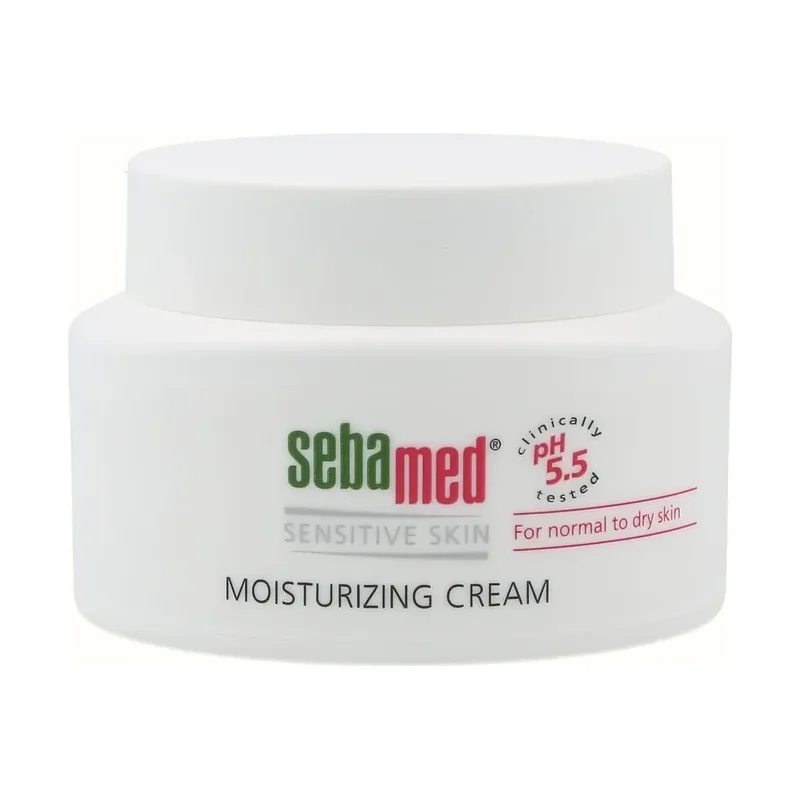
The Moisturizing Cream is perhaps the purest expression of that philosophy applied to hydration. Twelve ingredients. That is the entire formula. In an industry where a typical moisturizer contains thirty to forty components — peptides, botanical extracts, proprietary complexes, fragrance maskers for fragrance maskers — Sebamed's approach is so restrained it reads almost like a dare. Can a moisturizer with fewer ingredients than most people have fingers actually do its job?
The answer, for the skin types this cream targets, is a clear yes. The formula operates on foundational principles rather than ingredient fashion. Caprylic/capric triglyceride — a coconut-derived emollient so gentle it appears in infant formula — forms the lipid base, contributing to the cream's 26% total lipid content. Glycerin provides the humectant pull, drawing water into the stratum corneum. Tocopheryl acetate at a confirmed 2% concentration delivers meaningful antioxidant protection. Biosaccharide gum-1 adds a modern sustained-hydration component. Glyceryl stearate citrate and cetearyl alcohol serve as emulsifiers. Citric acid adjusts the pH to the precise 5.5 that Sebamed considers non-negotiable. Preservatives keep it safe. That is it.
The texture is pleasantly unremarkable. It is a cream that feels like a cream — not a gel-cream hybrid trying to seem innovative, not a whipped mousse trying to seem luxurious, not a jelly trying to seem fun. It spreads smoothly, absorbs within a minute or two, and leaves skin feeling soft and hydrated without greasiness or residue. Under makeup, it behaves. Under sunscreen, it cooperates. In a nighttime routine, it quietly does its job while your actives do theirs.
The pH 5.5 formulation deserves more than a marketing bullet point. The skin's acid mantle — a thin film of amino acids, fatty acids, and lactic acid on the skin surface — maintains a pH between 4.5 and 5.5. This slightly acidic environment inhibits pathogenic bacteria, supports the skin microbiome, and maintains the structural integrity of the intercellular lipid matrix. When you apply a product at a significantly different pH, you temporarily disrupt this environment. Most moisturizers do not disclose their pH, and many test alkaline. Sebamed's insistence on pH 5.5 across every product is not marketing theater — it is a dermatologically grounded design decision that particularly benefits sensitive and eczema-prone skin where the acid mantle is already compromised.
The 2% vitamin E concentration is worth highlighting because it stands in sharp contrast to how most brands use this ingredient. Vitamin E appears in thousands of moisturizers, but typically at concentrations below 0.5% — present for label appeal rather than clinical effect. At 2%, this cream delivers enough tocopheryl acetate to provide measurable antioxidant protection against UV-induced and environmental free radical damage. Research has demonstrated that topical vitamin E at 1-5% can reduce lipid peroxidation and support the skin's own antioxidant defenses. This is a cream that actually delivers what vitamin E promises rather than name-checking it.
And then there is the fragrance. It must be addressed because it is genuinely puzzling. Sebamed built an entire brand on the premise of protecting sensitive skin. They formulate at pH 5.5, they use twelve ingredients, they cut every corner that could cause a reaction — and then they add Parfum. The scent is mild, a clean floral note that most users find inoffensive. But fragrance remains the single most common cause of contact dermatitis in cosmetic products, and its presence in a cream marketed explicitly for sensitive skin is an inconsistency that costs Sebamed points it should not be losing. The brand offers other fragrance-free formulations, which makes this choice even harder to defend.
The value proposition, however, is nearly unassailable. At under fifteen dollars for 75 milliliters that last two to three months, this is one of the most affordable clinically-backed moisturizers available. You are paying for German pharmaceutical formulation, pH-controlled manufacturing, 2% vitamin E, and over 150 scientific studies backing the brand's approach — at a price point that makes most drugstore moisturizers look expensive by comparison. A 100-milliliter pump bottle is also available for those who prefer that format.
The limitations are the limitations of minimalism itself. This cream will not wow you with exotic ingredients or visible instant effects. It will not address hyperpigmentation, fine lines, or acne. It is not formulated to impress — it is formulated to work. For sensitive skin that has been burned by complicated formulas full of potential triggers, for eczema-prone skin that needs hydration without risk, for anyone who believes that the best skincare is the kind that does no harm, Sebamed's Moisturizing Cream is a quiet argument for doing less, better.