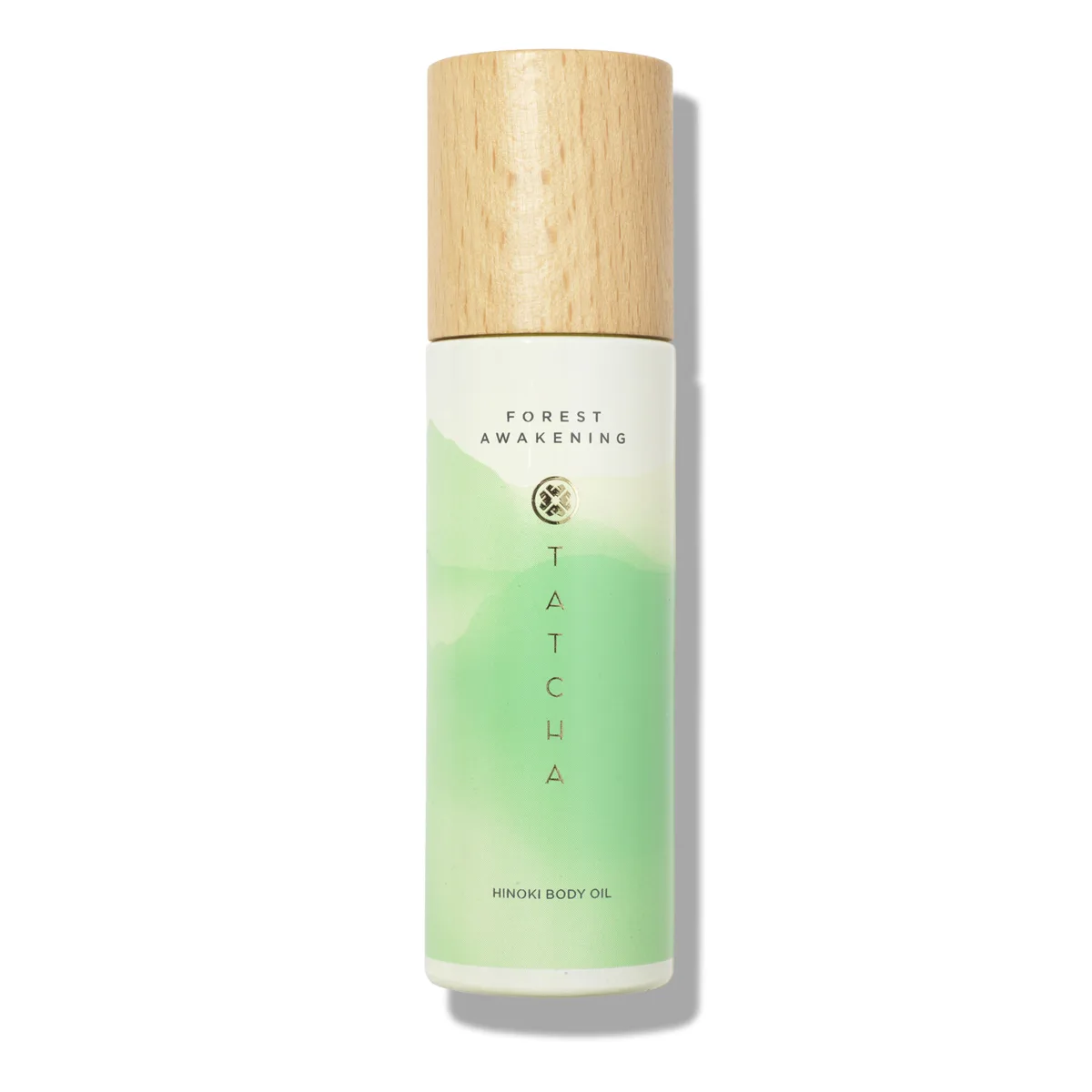
Tatcha Hinoki Body Oil glass bottle with pump dispenser in purple packaging
Good choice for Dryness
What makes this different

Most luxury body oils are either pure aromatherapy (scent-forward with minimal skincare benefit) or pure emollient (effective but boring). Tatcha Hinoki Body Oil bridges both — genuine Chamaecyparis obtusa wood oil with documented anxiolytic properties paired with ceramide NP for barrier repair, squalane for skin-identical moisture, and the proprietary Hadasei-3 complex for antioxidant and anti-inflammatory support. The inclusion of ceramide NP in a body oil is particularly unusual and elevates this beyond a simple moisturizing oil.

Tatcha

Tatcha Hinoki Body Oil Review

Japanese Forest Bathing in a Bottle Face Oils oil j beauty Paraben free Cruelty free Vegan

A genuinely luxurious body oil that earns its price through formulation depth, not just beautiful packaging. Tatcha Hinoki Body Oil combines traditional Japanese botanicals — rice bran oil, camellia seed oil, hinoki cypress — with ceramide NP and the proprietary Hadasei-3 complex to deliver skincare benefits that most body oils don't attempt. The forest bathing scent is transient but real, and the fast absorption is impressive. The $58 bottle disappears in three weeks, which is the only thing keeping this from being a perfect daily ritual.

Price $58.00 3.4 fl oz · more sizes
On the market 2022 Made in Japan
Best for drynormal
Buy at Amazon ♥
Verdicts

How well it fits each concern

Note: This oil has been available since 2022 with moderate review volume (~500-800 reviews). Our scoring reflects both ingredient analysis and growing real-world feedback. Individual ingredients are well-studied, but the specific product formulation lacks published clinical trials. Consider this a preliminary verdict, subject to change as evidence grows.

One verdict per concern. Open a row for the reasoning; the receipt has every source.

The scaleRecommendedGoodSupportingEarly evidenceNot for thisAvoidhow it works

Good choicefor DrynessSqualane is a reference standard by mechanism for dryness; this oil carries it.Receipt2 sources on the row · concentration not declared; studied range 1–100% · row checked Jul 17, 2026 · rule R5, same reading on 12,338 products · open the receipt

The case for it

  1. Squalane is a reference standard by mechanism for this concern — an established physical action, not a trial result.
  2. It is plausibly present at a working level, though the concentration is not declared.
  3. The formula carries no trigger this concern is sensitive to, with the cautions noted.

Limited evidenceStandard tolerabilityNo reviews read yet

Cautions: fragrance.

What would change this: A declared concentration would move this to a firmer reading of the dose.

Same rule for everyone. “Good choice” is the verdict on 12,824 of 45,446 concern verdicts across the catalog; rule R5 decided 12,338 of them. Unchanged since September 5, 2026, engine 6.0.0.

Brand or formulator? Disclose a concentration or correct a fact →

The full receipt: rule, row, sources, dates →All dryness products →

Good choicefor DehydrationCeramides is a reference standard by mechanism for dehydration; this oil carries it.Receipt1 source on the row · rule R5, same reading on 12,338 products · open the receipt

The case for it

  1. Ceramide NP is a reference standard by mechanism for this concern — an established physical action, not a trial result.
  2. It is plausibly present at a working level, though the concentration is not declared.
  3. The formula carries no trigger this concern is sensitive to, with the cautions noted.

Limited evidenceStandard tolerabilityNo reviews read yet

What would change this: A declared concentration would move this to a firmer reading of the dose.

Same rule for everyone. “Good choice” is the verdict on 12,824 of 45,446 concern verdicts across the catalog; rule R5 decided 12,338 of them. Unchanged since October 17, 2026, engine 6.0.0.

Brand or formulator? Disclose a concentration or correct a fact →

The full receipt: rule, row, sources, dates →All dehydration products →

Unprovenfor DullnessSqualane has early or mechanistic evidence for dullness — a reasonable bet, not a recommendation; nothing else here addresses it.Receipt1 source on the row · rule R9, same reading on 3,838 products · open the receipt

The case for it

  1. Squalane has early or mechanistic evidence for this concern, not trial-backed standing.
  2. It is plausibly present at a working level, though the concentration is not declared.
  3. The formula carries no trigger this concern is sensitive to, with the cautions noted.

Limited evidenceStandard tolerabilityNo reviews read yet

What would change this: A declared concentration would move this to a firmer reading of the dose.

Same rule for everyone. “Unproven” is the verdict on 3,838 of 45,446 concern verdicts across the catalog; rule R9 decided 3,838 of them. Unchanged since October 17, 2026, engine 6.0.0.

Brand or formulator? Disclose a concentration or correct a fact →

The full receipt: rule, row, sources, dates →All dullness products →How dullness is treated →

Good choicefor Winter SkinCeramides is a reference standard by mechanism for winter skin; this oil carries it.Receipt3 sources on the row · rule R5, same reading on 12,338 products · open the receipt

The case for it

  1. Ceramide NP is a reference standard by mechanism for this concern — an established physical action, not a trial result.
  2. It is plausibly present at a working level, though the concentration is not declared.
  3. The formula carries no trigger this concern is sensitive to, with the cautions noted.

Limited evidenceStandard tolerabilityNo reviews read yet

What would change this: A declared concentration would move this to a firmer reading of the dose.

Same rule for everyone. “Good choice” is the verdict on 12,824 of 45,446 concern verdicts across the catalog; rule R5 decided 12,338 of them. Unchanged since October 17, 2026, engine 6.0.0.

Brand or formulator? Disclose a concentration or correct a fact →

The full receipt: rule, row, sources, dates →All winter skin products →

Avoidfor Compromised Skin BarrierThis formula carries fragrance — a known trigger for compromised skin barrier — so it is not a fit however good its actives are.Receiptread from the ingredient list: fragrance · rule R1, same reading on 1,147 products · open the receipt

The case for it

  1. Ceramide NP is a reference standard by mechanism for this concern — an established physical action, not a trial result.
  2. It is plausibly present at a working level, though the concentration is not declared.
  3. The formula carries a known trigger for this concern, which decides the verdict before any efficacy question.

Limited evidenceCarries a triggerNo reviews read yet

What would change this: Removing the trigger named above would let the actives be judged on their own.

Same rule for everyone. “Avoid” is the verdict on 1,607 of 45,446 concern verdicts across the catalog; rule R1 decided 1,147 of them. Unchanged since September 5, 2026, engine 6.0.0.

Brand or formulator? Disclose a concentration or correct a fact →

The full receipt: rule, row, sources, dates →All compromised skin barrier products →

Also listed for Rough Texture — the actives here (Squalane, Rice Bran Oil, Ceramides, chamaecyparis obtusa wood oil) are in our research queue for that concern; there is no verdict until their evidence rows are written. That is a gap in our table, not a mark against the product.

As a oilNot judged: what a oil is for — fatty-acid profile, seals moisture, resists going rancid — cannot yet be measured from the ingredient list (only pore and malassezia risk can).

Where our review and the verdict differ. The review below was written on the formulation and the published trials; the verdicts above apply the stricter standing test in our methodology — an active earns a recommendation only with guideline or regulatory standing for the concern. Where the two disagree, the verdict is Dermington’s position.

A verdict is Dermington’s assessment of how well a product’s ingredients fit a concern — never a claim about what the product treats. Evidence dots and collected reviews sit beside it and are never blended in. Rules 0.6.0 · evidence table ev-2026.10-r259 · engine 6.0.0 · how we decide · this product’s receipt

Reader poll · Town SquareQuestion 1 of up to 3

Have you used Hinoki Body Oil?

One tap counts. A couple of optional follow-ups come next.

No account neededOne answer each, change it any timeCounted only in anonymous totalsHow the Square counts →
Assessment

Pros & cons

What it does well 6

  • Fast-absorbing multi-oil blend sinks into skin without greasy residue in 2-3 minutes
  • Ceramide NP inclusion is unusual for a body oil and adds genuine barrier-repair benefits
  • Authentic Chamaecyparis obtusa wood oil with research-backed calming properties
  • Hadasei-3 complex (fermented rice, green tea, Okinawa algae) adds antioxidant and anti-inflammatory depth
  • Rice bran oil base rich in gamma-oryzanol provides unique antioxidant profile
  • Elegant glass packaging and luxurious sensory experience elevate the daily body care routine

Where it falls short 5

  • Premium $58 price for a 3.4 oz bottle that lasts only 3-4 weeks with daily use
  • Hinoki forest scent fades within 30-60 minutes despite luxury aromatic positioning
  • Contains five EU-listed fragrance allergens unsuitable for fragrance-sensitive skin
  • Coconut oil and olive oil may be comedogenic for body acne-prone individuals
  • Similar moisturizing results achievable with significantly less expensive body oils
Review

The full review

The Japanese Ministry of Agriculture, Forestry, and Fisheries has funded research into shinrin-yoku since the 1980s. The practice — walking slowly through forests, breathing deeply, engaging all senses with the natural environment — has been documented to lower cortisol, reduce blood pressure, and enhance immune function. Chamaecyparis obtusa, the hinoki cypress, is one of the most prized trees in Japanese forest bathing, its wood oil carrying a complex, warm scent profile that research published in PLoS One (2015) confirmed produces measurable reductions in anxiety markers when inhaled.

Tatcha took this research seriously enough to build a body oil around it. Hinoki Body Oil — now part of the Forest Awakening collection alongside a body wash and body milk — uses actual Chamaecyparis obtusa wood oil and water as signature ingredients, not a synthetic fragrance approximation. The result is a product that smells like standing in a Japanese cypress grove after rain: woody, slightly citric, deeply calming, and completely unlike anything else in the luxury body care space.

But the scent, as beautiful as it is, is only the entry point. What separates this from aromatherapy oils with nice packaging is the formulation depth underneath. The base is rice bran oil — the first ingredient and the philosophical cornerstone of Tatcha's brand. Rice bran oil is one of the most nutritionally complex plant oils available for skincare, containing gamma-oryzanol (a potent antioxidant found almost exclusively in rice), naturally occurring squalene, phytosterols, and tocotrienols. It provides the lightweight, fast-absorbing base that prevents this multi-oil blend from feeling heavy.

Layered into the rice bran base are jojoba seed oil (structurally similar to human sebum), camellia japonica seed oil (the traditional Japanese beauty oil known as tsubaki), argan oil, and squalane. Each contributes a different lipid profile and absorption rate, creating a blend that delivers both immediate surface softness and sustained moisture over hours. The squalane, in particular, is what makes the fast-absorption claim credible — it's identical to the squalene naturally present in human skin sebum and sinks in almost instantly.

The genuinely unusual inclusion is ceramide NP. Ceramides are well-established barrier-repair ingredients in facial skincare, but they rarely appear in body oils. Ceramide NP is one of the key lipids in the skin's intercellular cement — the mortar between the brick-like cells of the stratum corneum that prevents moisture loss. By including it here, Tatcha elevates this oil from a surface-level emollient to a product that structurally supports the skin barrier's ability to hold moisture. For anyone with dry or dehydrated body skin, that distinction matters.

The Hadasei-3 complex — Tatcha's proprietary blend of fermented rice filtrate, green tea extract, and Okinawa algae extract — appears across most of the brand's products. The fermented rice filtrate provides amino acids, vitamins, and minerals from the Saccharomyces fermentation process. The green tea contributes EGCG, one of the most thoroughly studied topical antioxidants. The Okinawa mozuku algae delivers fucoidan, a sulfated polysaccharide with documented anti-inflammatory and moisturizing properties. Whether this complex delivers meaningful skincare benefits at the concentrations present in this oil is a fair question — the ingredients are listed well into the lower half of the INCI list — but they add genuine scientific substance to what could otherwise be a pure luxury play.

The application experience is where the product's design philosophy comes through. On damp post-shower skin, three to four pumps spread easily across the full body. The oil absorbs within two to three minutes — fast enough that you can dress without worry, which is the practical benchmark that most body oils fail. The finish is dewy and luminous without being greasy, and the hinoki scent envelops the bathroom in a moment of genuine calm. It is, for approximately sixty seconds, a credible approximation of standing in a hinoki forest.

The scent's transience is both a characteristic and a complaint. Most users report the forest-bathing fragrance fading within thirty to sixty minutes, which is fast for a luxury product marketed partly on its aromatic experience. The fragrance blend includes synthetic aromatic components alongside the natural hinoki oil, and EU-listed allergens (citronellol, geraniol, farnesol, limonene, linalool) are present at levels that would concern fragrance-sensitive individuals.

The value conversation is unavoidable. At $58 for 3.4 ounces, this is premium pricing for a body oil — and the bottle lasts approximately three weeks with daily full-body use. Annualized, that is roughly $1,000 in body oil. Tatcha's ingredient quality is genuine, the formulation is sophisticated, and the production in Japan adds legitimate cost. But other well-formulated body oils achieve excellent moisturization at a third of the price, and the ceramide NP and Hadasei-3 complex, while differentiating, are present at concentrations that may not justify a threefold price premium on their own.

A $28 mini at 1 fl oz is available and is the sensible trial option. If the scent, absorption speed, and next-day softness earn your devotion during that trial, the full size becomes a deliberate luxury purchase rather than an impulse one. And for the specific subset of consumers who want a body oil that combines genuine skincare actives with a culturally grounded aromatic experience, Tatcha Hinoki Body Oil is genuinely without equivalent.
The science

The centerpiece botanical — Chamaecyparis obtusa wood oil — has scientific backing beyond its aromatic appeal. One trial published in PLoS One (2015) demonstrated that inhalation of hinoki wood oil produced measurable physiological effects including reduced anxiety markers in human subjects, providing the evidence base for the product's shinrin-yoku positioning. Separately, a study in the Journal of Microbiology and Biotechnology (2016) documented broad-spectrum antimicrobial activity from Chamaecyparis obtusa essential oil, including activity against multi-drug-resistant bacterial strains.

The rice bran oil base brings its own evidence profile. One trial published in the Journal of Cosmetic Dermatology (2023) demonstrated anti-skin-aging activities of rice bran components in cultured skin cells. Rice bran oil contains gamma-oryzanol at concentrations significantly higher than any other plant oil — this compound has documented antioxidant activity that exceeds vitamin E in certain assays.

Ceramide NP's role in skin barrier function is extensively established. Ceramides constitute approximately 50% of the stratum corneum's intercellular lipid matrix, and depletion of ceramides is directly associated with barrier dysfunction, transepidermal water loss, and dry skin conditions. Supplementation studies, including research published in Nutrients (2022) on rice-derived ceramides, have demonstrated significant improvements in skin hydration, elasticity, and wrinkle severity.

The Hadasei-3 complex contributes three evidence-supported ingredients. The Saccharomyces/Rice Ferment Filtrate provides naturally occurring amino acids and B vitamins from the fermentation process. Camellia sinensis (green tea) delivers EGCG, with extensive published evidence for antioxidant, anti-inflammatory, and photoprotective properties. Cladosiphon okamuranus extract provides fucoidan, a sulfated polysaccharide with documented moisturizing and anti-inflammatory effects in dermatological literature.

References 3 ShowHide
  1. Effects of Essential Oil from Hinoki Cypress, Chamaecyparis obtusa, on Physiology and Behavior of Flies. — PLoS One (2015)
  2. Essential Oils and Non-volatile Compounds Derived from Chamaecyparis obtusa: Broad Spectrum Antimicrobial Activity against Infectious Bacteria and MDR(multidrug resistant) Strains. — Journal of Microbiology and Biotechnology (2016)
  3. Effect of Rice (Oryza sativa L.) Ceramides Supplementation on Improving Skin Barrier Functions and Depigmentation: An Open-Label Prospective Study. — Nutrients (2022)

The clinical view

Dermatologists recognize body oils as effective occlusive-emollient moisturizers, particularly when applied to damp skin to trap water against the skin surface. The inclusion of ceramide NP in this body oil aligns with dermatological recommendations for barrier repair — a principle well-established in facial skincare that is less commonly applied to body care. Practicing dermatologists have long observed that the multi-oil blend provides a favorable fatty acid profile for dry and dehydrated skin, and the absence of common irritants like mineral oil or synthetic silicones is consistent with clean formulation principles. However, dermatologists would flag the fragrance allergen content as a concern for patients with atopic dermatitis or contact dermatitis history, recommending patch testing before full-body application.

Formula

Key ingredients

  1. Rice Bran Oil

    The formula's primary emollient and the foundation of Tatcha's Japanese beauty philosophy. Rice bran oil is rich in gamma-oryzanol, a potent antioxidant unique to rice, plus naturally occurring squalene and vitamin E. In this multi-oil blend, it provides the lightweight base that allows the heavier oils (olive, castor) to spread without greasiness.

    Not yet assessed
  2. Chamaecyparis Obtusa (Hinoki) Wood Oil

    The signature ingredient that defines both this product's identity and its sensory experience. Extracted from Japanese hinoki cypress, this oil has documented antimicrobial properties and research-backed anxiolytic effects when inhaled — the scientific basis behind the shinrin-yoku (forest bathing) concept this product is built around.

    Not yet assessed
  3. Ceramide NP

    An unusual addition to a body oil that elevates this beyond simple moisture delivery. Ceramide NP helps repair and reinforce the skin barrier's lipid matrix, working alongside the botanical oils to not just soften skin topically but structurally support the barrier's ability to retain moisture long-term.

    Established mechanism for Dryness · established mechanism
  4. Squalane

    A plant-derived lipid identical to skin's own squalene, providing featherweight moisture that sinks in immediately. In this oil blend, squalane acts as the fast-absorbing component that prevents the richer oils from sitting on the skin surface, contributing to the non-greasy finish.

    Established mechanism for Dryness · established mechanism
  5. Hadasei-3 Complex (Rice Ferment Filtrate, Green Tea, Okinawa Algae)

    Tatcha's proprietary triple-extract complex: Saccharomyces/Rice Ferment Filtrate delivers amino acids and vitamins from fermentation, Camellia sinensis provides EGCG antioxidant protection, and Cladosiphon okamuranus (Okinawa mozuku algae) contributes fucoidan for anti-inflammatory and hydrating benefits. Together they form the skincare backbone of this aromatic body oil.

    Not yet assessed
Full ingredient list 29 ingredients ShowHide

Oryza Sativa (Rice) Bran Oil, Olea Europaea (Olive) Fruit Oil, Ricinus Communis (Castor) Seed Oil, Simmondsia Chinensis (Jojoba) Seed Oil, Cocos Nucifera (Coconut) Oil, Parfum/Fragrance, Camellia Japonica Seed Oil, Polyglyceryl-10 Pentaisostearate, Argania Spinosa Kernel Oil, Chamaecyparis Obtusa Wood Oil, Squalane, Chamaecyparis Obtusa Water, Saccharomyces/Rice Ferment Filtrate, Camellia Sinensis Leaf Extract, Cladosiphon Okamuranus Extract, Prunus Persica (Peach) Leaf Extract, Ceramide NP, Propanediol, Butylene Glycol, Tocopherol, Tremella Fuciformis Polysaccharide, Aqua/Water/Eau, Citronellol, Geraniol, Farnesol, Limonene, Linalool, Ethylhexylglycerin, Phenoxyethanol

Safety & formulation facts

  • Pregnancy safe
  • Not fragrance free
  • Alcohol free
  • Not oil free
  • Silicone free
  • Paraben free
  • Sulfate free
  • Cruelty free
  • Vegan
  • Not fungal-acne safe
Pore-clogging (comedogenic) Cocos Nucifera OilOlea Europaea Fruit Oil
Potential irritants Parfum/FragranceCitronellolGeraniolLimoneneLinaloolFarnesol
Common allergens CitronellolGeraniolFarnesolLimoneneLinalool
Compatibility

Skin types & routine

Routine step moisturizer
Time of day Morning & night
Best season fall & winter
Finish dewy, glowy, non-greasy

Layering

Apply to damp skin immediately after showering for best absorption and to lock in moisture. Can be used on dry skin throughout the day for targeted hydration on rough patches. A few drops go a long way — start with 3-4 pumps for full body coverage.

When to expect results

Immediate softness, glow, and aromatic experience upon application. Skin feels noticeably smoother and more hydrated within 2-3 days of daily use. The ceramide NP contributes to gradual barrier repair over 2-4 weeks of consistent application.

Pairs well with body lotion over top for extremely dry skinTatcha Forest Awakening body wash for a cohesive scent experience

A routine built around it

Morning

  1. Shower
  2. THIS PRODUCT on damp skin
  3. Allow to absorb before dressing

Night

  1. Bath or shower
  2. THIS PRODUCT on damp skin
  3. Body lotion over top for extra hydration (optional)
Guidance

How to use it, and who it's for

How to use

Apply 3-4 pumps to damp skin immediately after bathing for optimal absorption. Massage gently into skin using upward strokes. Allow 2-3 minutes to absorb before dressing. Can be applied to dry skin throughout the day for targeted hydration on rough or dry patches. For an enhanced experience, layer over Tatcha Forest Awakening Body Wash for a cohesive scent ritual. Store at room temperature away from direct sunlight.

Is it worth the price?

At $58 for 3.4 fl oz (roughly $17 per ounce), this is premium pricing that reflects Tatcha's luxury positioning, Japanese manufacturing, and the cost of genuine Chamaecyparis obtusa wood oil. A 1 fl oz mini at $28 provides a lower-commitment entry point. The formulation quality — ceramide NP, Hadasei-3 complex, multi-botanical oil blend — genuinely exceeds what most body oils at any price point offer. However, the core moisturizing function can be replicated at a fraction of the cost with simpler oil blends. The value here lies in the complete experience: the scent, the texture, the ritual, and the skincare depth. For consumers who view body care as self-care rather than utility, the price may be justified. For pure moisturization, it's a luxury premium.

Who should buy it

Dry and normal skin types who want a body oil that delivers genuine skincare benefits alongside a luxurious sensory experience. Anyone who appreciates Japanese beauty philosophy and aromatherapy. People who view their post-shower routine as a self-care ritual rather than a quick chore. Particularly well-suited for cold-weather months when body skin needs extra nourishment.

Who should skip it

Those with fragrance allergies or highly sensitive skin should avoid the significant fragrance allergen content. Oily or acne-prone body skin may find the coconut and olive oil base too occlusive. Budget-conscious shoppers will struggle with the $58 price for a product that lasts only 3-4 weeks. Anyone who primarily wants long-lasting fragrance will be disappointed by the scent's 30-60 minute lifespan.

Ready to try it?Tatcha Hinoki Body Oil · $58.00 · 3.4 fl oz
Details

The product, in detail

Texture
Lightweight, silky oil that absorbs quickly without leaving a greasy residue. Thinner than most body oils, with a fluid consistency that spreads easily across large areas of skin.
Scent
Forest-inspired blend of hinoki, cedar, and hiba woods with subtle citrus undertones. Evokes the calming experience of Japanese shinrin-yoku (forest bathing). Woody, warm, and meditative rather than sweet or floral.
Packaging
Elegant glass bottle with pump dispenser in Tatcha's signature purple/plum color scheme. Luxurious presentation suitable for display. Available in 3.4 fl oz (full) and 1 fl oz (mini) sizes.
How long it lasts
3-4 weeks with daily full-body application; longer if used sparingly on targeted dry areas
Once opened
Use within 6 months · track your toss-by date →
Size
3.4 fl oz · other sizes available
Made in
Japan
Launched
2022
Certifications
PETA Cruelty-Free Certified · Vegan

What the first two weeks feel like

The first pump releases a rich, woody hinoki scent that immediately transforms the application into a sensory ritual. The oil spreads easily on damp post-shower skin with 3-4 pumps providing full-body coverage. Absorption is noticeably faster than most body oils — skin feels soft and luminous within minutes, not greasy. The aromatherapeutic effect is real but transient, with the scent fading within 30-60 minutes.

The story behind it

Why it exists

Inspired by shinrin-yoku, the Japanese practice of forest bathing that has been studied for its stress-reducing physiological effects, this body oil uses actual hinoki cypress wood oil and water sourced from Chamaecyparis obtusa. Tatcha developed it as part of the Forest Awakening collection, extending the brand's Japanese cultural heritage into the body care category with a product designed to transform a post-shower routine into a meditative wellness ritual.

About Tatcha Established Brand (5–20 years)

Tatcha was founded in 2009 by Vicky Tsai, inspired by traditional Japanese geisha beauty rituals discovered during travels in Kyoto. The brand was acquired by Unilever in 2019 for approximately $500 million. Formulations center on the proprietary Hadasei-3 complex (fermented rice, green tea, Okinawa algae) with over 15 years of market presence.

Brand founded 2009 · This product since 2022

Tap a card to turn it

What people hear, and what holds up

FAQ

Questions people ask

Is Tatcha Hinoki Body Oil greasy?

No. Despite being a multi-oil blend with rice bran, olive, jojoba, and coconut oils, the formula absorbs remarkably quickly — especially when applied to damp post-shower skin. The squalane component helps the oil sink in without leaving a greasy film. Most users can dress within a few minutes of application.

What does Tatcha Hinoki Body Oil smell like?

A woody, calming blend of hinoki (Japanese cypress), cedar, and hiba essential oils with subtle citrus undertones. The scent is designed to evoke Japanese forest bathing and reads as warm, meditative, and spa-like. It fades within 30-60 minutes after application.

How long does a bottle of Tatcha Hinoki Body Oil last?

With daily full-body application using 3-4 pumps per session, the 3.4 fl oz bottle lasts approximately 3-4 weeks. Using it more sparingly on targeted dry areas will extend it. A 1 fl oz mini is available for $28 to trial before committing to the full size.

Does Tatcha Hinoki Body Oil contain ceramides?

Yes — it contains Ceramide NP, which is unusual for a body oil. Ceramide NP helps repair and reinforce the skin barrier, making this product go beyond simple surface-level moisture to structurally support the skin's ability to retain hydration long-term.

What is the Hadasei-3 complex in Tatcha products?

Hadasei-3 is Tatcha's proprietary blend of three Japanese superfoods: Saccharomyces/Rice Ferment Filtrate (amino acids and vitamins from fermented rice), Camellia sinensis (green tea EGCG antioxidants), and Cladosiphon okamuranus (Okinawa algae fucoidan for hydration and anti-inflammation). It appears across most Tatcha products.

Is Tatcha Hinoki Body Oil safe for sensitive skin?

The formula contains Parfum/Fragrance and five EU-listed fragrance allergens (citronellol, geraniol, farnesol, limonene, linalool), making it a poor choice for fragrance-sensitive or highly reactive skin. If you have known fragrance allergies, patch test first or consider a fragrance-free body oil.

Reviews

What shoppers tend to say

Recurring themes our editors read across retailer reviews — summaries in our words, not quotations, and not a substitute for a patch test.

Common praise

  • Fast-absorbing, non-greasy formula that sinks into skin remarkably quickly for an oil
  • Luxurious spa-like hinoki and cedar scent that evokes Japanese forest bathing
  • Leaves skin incredibly soft, smooth, and glowing
  • Beautiful packaging worthy of displaying in a bathroom
  • Hydration lasts well into the next day without reapplication
  • A few drops provide generous full-body coverage

Common complaints

  • Small bottle for $58 runs out in approximately three weeks with daily use
  • Scent dissipates faster than expected for a luxury aromatic product
  • Pump dispenser can be finicky and dribble when pumped too quickly
  • Similar moisturizing results achievable with much less expensive body oils
  • Fragrance allergen content is high for those with sensitivities
Notable endorsementsPETA Cruelty-Free Certified
Next stepCheck it against what you already useClashes, spacing and the right order, with everything on your shelf.