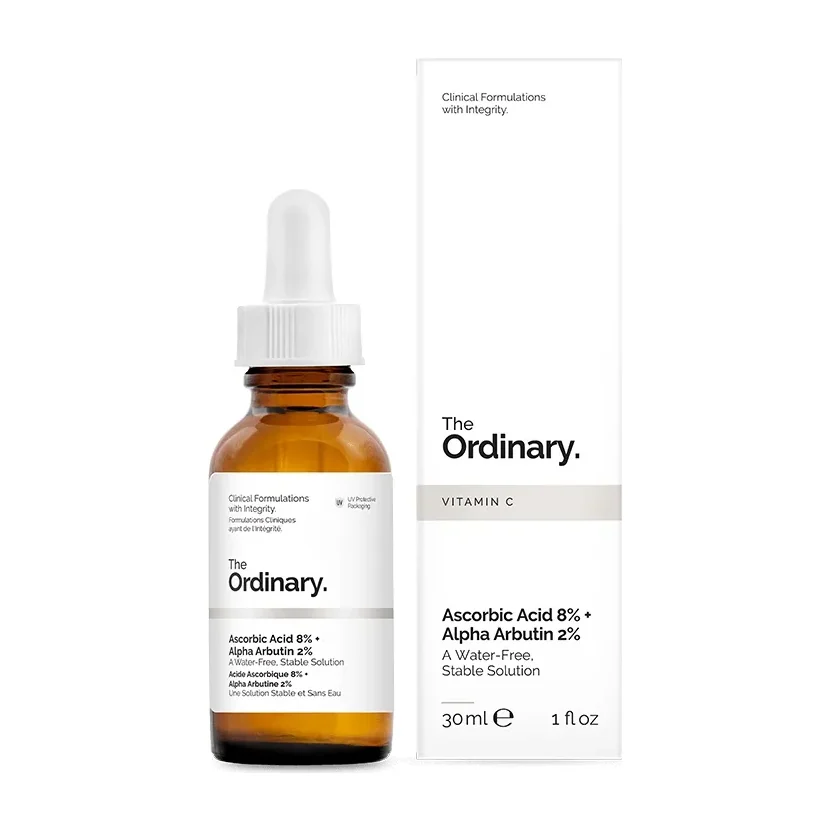
Most antioxidant serums arrive with ingredient lists that read like a chemistry final exam. Twenty, thirty, sometimes forty ingredients jostling for space on the back of a bottle, each one ostensibly there for a reason but many serving as stabilizers, emulsifiers, and texture enhancers for the handful of actives doing actual work. The Ordinary's Resveratrol 3% + Ferulic Acid 3% takes the opposite approach with a kind of aggressive simplicity: three ingredients, two actives, one solvent, done.
It is, in some ways, the logical endpoint of The Ordinary's philosophy. If the brand's founding premise was that consumers were overpaying for active ingredients buried in complex formulations, this product strips away everything that isn't directly serving the antioxidant mission. Propanediol dissolves and stabilizes. Resveratrol scavenges free radicals. Ferulic acid does the same through a complementary pathway while helping stabilize its botanical partner. There is nothing else here — no water, no preservatives, no emulsifiers, no fragrance.
That radical simplicity has real formulation advantages. Resveratrol is notoriously unstable. It degrades rapidly in water-based formulations and breaks down when exposed to light and air. By suspending it in anhydrous propanediol and housing it in a tinted glass bottle, The Ordinary sidesteps the stability challenges that plague more complex resveratrol products. The ferulic acid, meanwhile, pulls double duty — it provides its own antioxidant protection while acting as a stabilizing partner for the resveratrol, much the way it enhances vitamin C stability in other formulations.
The texture is where opinions diverge sharply. This isn't a serum in the way most people think of serums. It is closer to a lightweight oil — slippery, with a visible sheen that lingers on the skin for several minutes before propanediol absorbs. If you have oily skin or prefer matte finishes, this will test your patience. Two to three drops is the sweet spot for most faces; go beyond four and you risk looking like you fell asleep on a glazed donut. The trick many experienced users land on is mixing their drops directly into a moisturizer, which distributes the product more evenly and tempers the greasy feel.
There is no scent beyond the faintest medicinal whisper from the raw ingredients themselves, which dissipates almost immediately. The brown glass dropper functions well enough, though the pipette occasionally draws up more than you need — a minor irritation when the product itself is so inexpensive.
The Ordinary has been on the market since 2016, and this particular product has been available since approximately 2017, giving it a solid track record. The brand sits in an interesting position — not a dermatologist-developed legacy brand with decades of proprietary research, but a company that built its reputation on ingredient literacy and formulation transparency. They do not fund clinical trials on their specific products, but they formulate with ingredients at concentrations supported by published research elsewhere.
As for what this serum actually does on skin: the results are subtle and cumulative. There is no overnight transformation here. Some users report an immediate glow from the propanediol — a light-catching sheen that makes skin look healthier in the short term. The real antioxidant benefits build over weeks. By the four-to-eight-week mark, consistent nightly users tend to notice improved skin tone, reduced dullness, and a general look of skin that has been quietly defended against daily environmental damage. This is a prevention product more than a correction product — it is protecting your skin from future damage rather than reversing damage already done.
The six-month shelf life after opening is worth noting. It is shorter than most serums, and it matters. If resveratrol oxidizes, it loses its protective capacity. Watch the color — a gradual deepening is normal, but if the product turns significantly darker or develops an off smell, its useful life is over. At four drops a night, a 30ml bottle should last three to four months, which keeps you comfortably within the use-by window.
Honesty demands acknowledging the limitations. Propanediol is generally well-tolerated but not universally so — a small subset of users report sensitivity, redness, or irritation. The evidence base for topical resveratrol, while promising, is not as robust as for ingredients like retinoids or L-ascorbic acid. Most studies are in vitro or animal models, with a smaller body of human clinical data supporting its anti-aging claims specifically. Ferulic acid has stronger clinical backing, particularly in combination with other antioxidants, but the specific pairing of resveratrol and ferulic acid has not been extensively studied in human trials.
The value proposition, however, is nearly impossible to argue with. At $10.40 for 30ml of a formula that is essentially pure active ingredients in a stabilizing base, this undercuts comparable antioxidant serums by a factor of five to ten. You are not paying for an elaborate delivery system, a luxurious texture, or a marketing campaign — you are paying for two well-studied antioxidants and a solvent to dissolve them in.
This serum occupies a specific and valuable niche: it is a PM antioxidant booster for people who already have a routine and want to add a targeted layer of free-radical defense. It is not trying to be your only serum, your moisturizer, or your everything product. It does one thing — deliver antioxidants to your skin — and it does it with a purity of purpose that more expensive products should envy.