Green Tea's Best Molecule Is Also Its Most Fragile
EGCG has some of the strongest botanical evidence in skincare for calming, oil control, and sun-damage defense. It also falls apart in the bottle before it reaches your face.
Read the preview
Does drinking green tea do anything for your skin? Less than putting it on — a review found topical green tea beat the oral kind for clearing acne. Its star molecule, EGCG, cut oil and inflamed spots in an eight-week split-face trial. The catch is the bottle itself, and what happens before it ever reaches your face. The Dermington Gazette pours the whole cup.
The molecule doing the work isn't 'green tea'
Green tea turns up on dozens of labels, usually as an afterthought near the bottom of the ingredient list. That vagueness hides the real story. The benefit people are actually chasing comes from a single family of polyphenols called catechins, and one catechin in particular: epigallocatechin-3-gallate, or EGCG. It is the most abundant and most studied catechin in green tea, and it is responsible for nearly all of the skin claims the plant gets credit for.
This distinction matters because 'green tea extract' can mean almost anything. It might be a rich, freshly stabilized catechin complex, or it might be a lightly steeped botanical water with barely measurable actives, added mostly so the marketing team can put a leaf on the box. The plant is the same. The dose of the working molecule is not. When you understand that EGCG is the point, you start reading labels differently, and you stop treating a splash of tea water as if it were a treatment serum.
What EGCG actually does to oily, breakout-prone skin
Green tea earned its reputation on acne, and here the evidence is unusually good for a botanical. In an 8-week randomized, split-face clinical trial, researchers applied EGCG to one side of participants' faces and found reductions in both sebum and inflammatory lesions, with good tolerability. What made the study compelling was the mechanism: EGCG appeared to hit several of acne's drivers at once rather than a single target.
Sebum is the first. In lab studies on human sebocytes, the oil-producing cells of the skin, EGCG dialed down the AMPK-SREBP-1 signaling pathway that tells those cells to pump out lipids. Less signaling, less oil. On top of that, EGCG damps inflammation by quieting the NF-kB and AP-1 pathways, the same inflammatory switches that turn a clogged pore into an angry red bump, and it has activity against the bacteria implicated in acne. A humectant reduces one problem; EGCG nudges three.
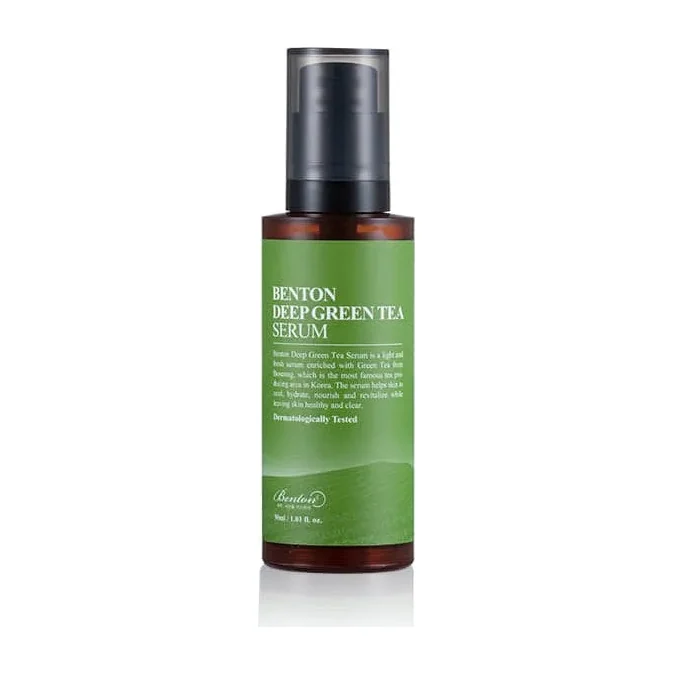
A 2021 systematic review and meta-analysis in Phytotherapy Research pooled the randomized trials and landed on a useful, slightly deflating conclusion. Topical green tea significantly reduced both inflammatory and non-inflammatory lesion counts, while oral green tea intake had minimal effect on the skin. In other words, the delivery route is not a rounding error. If you want green tea to help your face, it needs to go on your face, which is exactly why serums like Benton Deep Green Tea Serum and Isntree Green Tea Fresh Serum exist in the first place.
The sunscreen you can't wear as sunscreen
The second half of green tea's evidence file is about ultraviolet damage, and it is genuinely impressive as long as you read it precisely. When EGCG was applied to human skin before UV exposure, it markedly cut the UV-induced surge of hydrogen peroxide and nitric oxide in both the epidermis and dermis, and it protected the skin's own antioxidant defenses, including glutathione. A separate line of research on green tea polyphenols taken orally found measurable photoprotection over weeks: less UV-triggered redness and better skin microcirculation.
Here is the caveat that the marketing tends to skip. None of this makes green tea a sunscreen. It does not sit on the surface reflecting or absorbing UV photons the way zinc oxide or a modern organic filter does; it works from inside the tissue, mopping up the reactive molecules UV creates after the fact. That makes it a fine antioxidant partner to layer under an actual SPF in the morning, and a poor substitute for one. If you drop your sunscreen because your serum has antioxidants in it, you have misread the science badly. Think of EGCG as backup for the damage that gets past your defenses, not the defense itself.
Why the bottle betrays the biology
EGCG has a personality flaw: it is chemically unstable. In water, in light, and in the presence of oxygen and warmth, it oxidizes readily, turning brownish and losing potency. This is the quiet reason so many green tea products underdeliver. A formula can be built with a respectable dose of catechins and still arrive at your bathroom shelf as a shadow of what it was, especially if it ships in a clear jar that you dip your fingers into every morning.
This is where formulation stops being a footnote and becomes the whole game. Good green tea products protect the molecule: opaque or airless packaging, a supporting cast of stabilizers, a lower pH where catechins hold up better, and often a partner antioxidant to share the oxidative load. It is also why pairing green tea with other soothing, hydrating ingredients is so common. A formula like Beauty of Joseon Calming Serum: Green Tea + Panthenol leans on panthenol and other barrier-friendly humectants so the green tea is doing calming work rather than carrying the entire formula alone. If you want to see what is actually in a bottle rather than what the front label implies, run it through the ingredient-decoder tool and look at where the tea sits in the list and what is stabilizing it.
So who is green tea actually for?
Green tea is a strong supporting player and a weak lead. It shines for oily, easily-irritated, mildly breakout-prone skin that wants oil control and calm without the sting of a strong acid or the ramp-up of a retinoid. It is a sensible daytime antioxidant layer under sunscreen, and it plays nicely with almost everything, which is rare. What it is not is a wrinkle eraser or a replacement for the proven anti-acne heavy hitters. The trial data are about redness, oil, and lesion counts, not deep lines, and even those benefits are modest next to a prescription retinoid or benzoyl peroxide.
Buy it for what it is: a gentle, evidence-backed antioxidant and soother that happens to have real human data behind it, which is more than most botanicals can say. Just buy it fresh, in packaging that respects how fragile the active is, and stop expecting a cup of tea's worth of leaf water to do a serum's job. If you are unsure whether a green tea serum fits your routine or your skin type, the my-skin tool can match it against your profile and flag whether you would get more from a dedicated active instead. The plant is legitimate. The bottle is where it lives or dies.
Each shelf lists every product in the catalogue built on the ingredient, graded live against your profile — the shelf stays current when a single pick would not.
Products named in this piece
Independently reviewed, with a verdict per concern — the real products behind this piece.


References
- Epigallocatechin-3-gallate improves acne in humans by modulating intracellular molecular targets and inhibiting P. acnes — Journal of Investigative Dermatology, 2013
- The effects of green tea on acne vulgaris: A systematic review and meta-analysis of randomized clinical trials — Phytotherapy Research, 2021
- Green tea polyphenol (-)-epigallocatechin-3-gallate treatment of human skin inhibits ultraviolet radiation-induced oxidative stress — Carcinogenesis, 2001
- Green tea polyphenols provide photoprotection, increase microcirculation, and modulate skin properties of women — Journal of Nutrition, 2011
Every cited link is verified to resolve to the paper named. Where a source could not be independently confirmed, it is listed without a link rather than pointing you somewhere wrong.
Frequently asked
Does drinking green tea help your skin the way a green tea serum does?
Not in the same way. The 2021 meta-analysis found topical green tea significantly reduced acne lesions while oral intake had minimal effect on the skin. Drinking tea has its own general health merits, but for a targeted skin benefit the catechins need to be applied to the skin, not swallowed.
Can a green tea serum replace my sunscreen since it protects against UV damage?
No. EGCG works inside the skin by neutralizing the reactive molecules UV creates, but it does not block or absorb UV rays the way a sunscreen filter does. Use it as a morning antioxidant layer underneath a real broad-spectrum SPF, never instead of one.
Why does my green tea product turn brown or seem to stop working?
EGCG oxidizes quickly when exposed to water, light, air, and heat, which is exactly what causes that brownish tint and loss of potency. Choose formulas in opaque or airless packaging, store them away from sunlight, and don't expect a clear jar you dip into daily to hold its strength for long.
Is green tea strong enough to treat acne on its own?
For mild, oily, inflammation-prone skin it can genuinely help reduce oil and calm breakouts, and the trial data support that. But it is a supporting active, not a heavy hitter; moderate to severe acne still calls for proven treatments like retinoids or benzoyl peroxide, with green tea playing a soothing backup role.