Period-After-Opening: When Your Products Actually Expire
The open-jar symbol certifies that nothing will grow in the bottle. It makes no promise at all about whether the active inside still works — and those two clocks run at completely different speeds.
Read the preview
What does that little open-jar symbol actually promise? Only that nothing should grow in the bottle for that many months. It says nothing about whether the active still works — spoilage and oxidation run on separate clocks. And everyday handling contaminated about one in ten cleansing products in one study. So which date do you trust? The Dermington Gazette checks the use-by.
What the open jar is actually certifying
The symbol comes from European law, and the law is specific about what it replaces. Under Regulation 1223/2009, a cosmetic with a minimum durability of more than 30 months does not have to carry a date of minimum durability at all. Instead it carries the open-jar symbol followed by a period in months — an indication of how long, after first opening, the product remains safe to use without harm to the consumer.
Read that clause carefully. Safe. Not effective, not full-strength, not unchanged. The number behind that symbol is generated by preservative efficacy testing: the formula is deliberately seeded with standard organisms — staphylococci, pseudomonads, yeasts, moulds — and the lab measures how quickly the preservative system kills them off. Pass at the required log reductions and the formula is defensible for a stated in-use period. Nothing in that protocol looks at whether the retinol has degraded or the ascorbic acid has oxidised.
This is why the symbol feels so useless in practice. It is answering a question that most people are not asking. Nobody worries their moisturiser will give them a Pseudomonas infection; they worry it has quietly stopped working. The regulation was never designed to tell them.
Two clocks, running independently
The first clock is chemical. Some actives are thermodynamically eager to become something else, and the moment air and light get in they start. L-ascorbic acid is the textbook case: it oxidises to dehydroascorbic acid and onward to inert breakdown products, a cascade that accelerates with pH, warmth, metal ions and dissolved oxygen. This is a genuinely difficult formulation problem, which is why the field's most-cited fix exists at all. Work published in the Journal of Investigative Dermatology in 2005 showed that adding ferulic acid to a solution of 15% L-ascorbic acid and 1% alpha-tocopherol improved the chemical stability of both vitamins and doubled the photoprotection delivered to skin — from roughly four-fold to eight-fold against solar-simulated irradiation, measured by erythema and sunburn cell formation. The follow-up work confirmed the same architecture in other combinations. The point for a consumer is simpler than the chemistry: a well-stabilised vitamin C formula is a real engineering achievement, and it still has a finite life once opened.
The visible tell is reliable and underused. Fresh ascorbic acid serums run clear to pale straw. As oxidation proceeds they go yellow, then amber, then a distinctly unappealing orange-brown. By deep amber, a meaningful fraction of what you paid for is gone. The colour change is not cosmetic damage to be ignored — it is the reaction product announcing itself.
The second clock is microbiological, and it does not care about any of that. A perfectly preserved emulsion can hold its challenge-test performance for years while the active in it fades to nothing. And the reverse happens too: a formula whose actives are rock-stable can be overwhelmed by what you put into it after purchase.
Your fingers are the variable the lab didn't model
Challenge testing seeds a sterile sample under controlled conditions. Real use is a different experiment, run daily, in a warm humid room, by a hand that has just done something else.
An Italian group tested 91 cosmetics across three states — intact, in use, and near-empty — and found contamination in about 10.6% of the surfactant-based products sampled, with Staphylococcus warneri, Staphylococcus epidermidis and Pseudomonas putida among the isolates. Their conclusion was measured: contaminated products are relatively uncommon, but some formulas cannot suppress the growth of organisms introduced during use, and those represent a real hazard. That distinction is the whole story. The preservative system was adequate for the challenge test and not always adequate for a person.
The industry knows this, which is why packaging has become a preservation strategy in its own right. A large cross-industry commission spent years building a standardised method to classify how well a package protects its contents, testing over 800 packages and producing a six-tier classification — driven explicitly by consumer demand for low-preservative and preservative-free formulas, where the container has to do work the chemistry no longer does. If a brand is proud of having stripped its preservative system back, the container matters more, not less.
What the container is telling you
Four formats, four different real lifespans for the identical formula.
An airless pump is the strongest option: the product sits above a piston that rises as you dispense, so no air returns to the headspace and nothing touches the reservoir. This is why serious antioxidant serums increasingly arrive in one — Paula's Choice C15 Super Booster is built around exactly this problem, and Drunk Elephant C-Firma Fresh Day Serum goes further by keeping the ascorbic acid powder separate until you mix it, so the oxidation clock starts when you decide it does.
A tube is the underrated middle. It admits some air on each squeeze but never lets a finger reach the bulk, which is why it suits anything both fragile and frequently used — a prescription-strength retinoid such as La Roche-Posay Effaclar Adapalene Gel 0.1% ships this way for good reason.
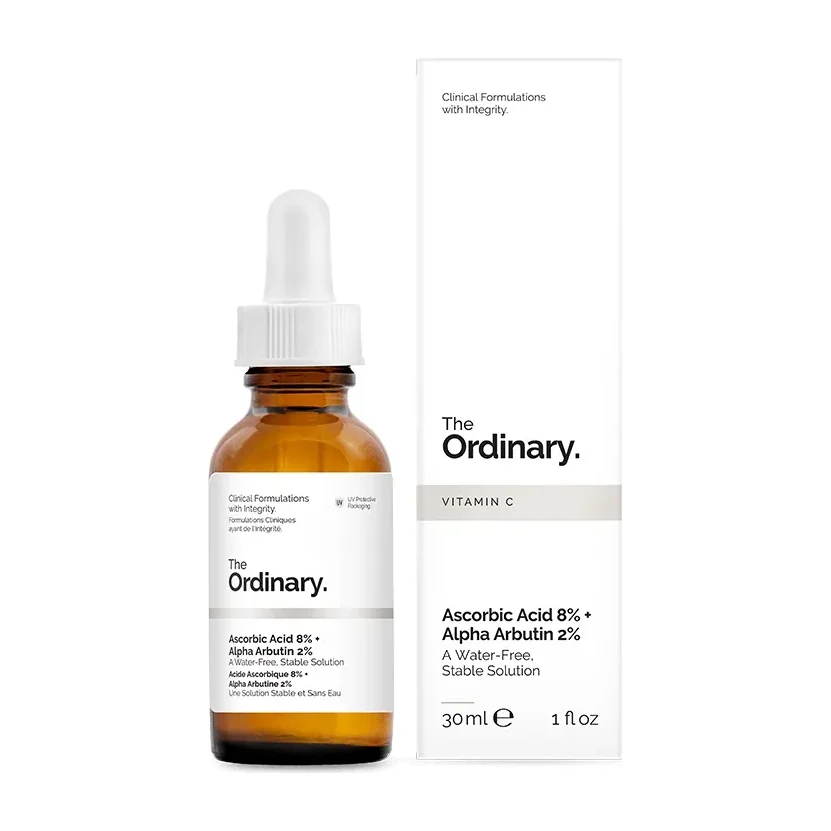
A dropper is the format most people misread. The pipette goes into the bottle, then onto skin, then back into the bottle — a small transfer every single day, plus a headspace that grows with each use. That is fine for a stable formula and actively bad for an unstable one. A suspension like The Ordinary Vitamin C Suspension 23% + HA Spheres 2% sidesteps it by keeping the ascorbic acid in an anhydrous base where there is no water for the reaction to happen in; a water-based one like The Ordinary Ascorbic Acid 8% + Alpha Arbutin 2% or Naturium Vitamin C Complex Serum is running a faster clock and should be used, not saved.
An open jar is the weakest for anything active and perfectly fine for what usually lives in one. A bland occlusive-and-humectant cream like CeraVe Moisturizing Cream has no fragile active to lose, so the only real question is contamination — which a clean spatula solves. Save jars for the boring products, which is where they mostly are anyway. The ingredient-decoder will tell you whether what you are storing has anything in it worth protecting.
Where an expired product actually costs you something
Most of the time, using a past-it moisturiser costs you nothing but the difference between a working product and a slightly less interesting one. Three categories are not like that.
Sunscreen is the serious one, because degradation is invisible and the consequence is a burn. US regulators treat it as a drug: every non-prescription product needs an expiration date unless the manufacturer's stability testing shows it will hold for at least three years, and the official consumer guidance is to consider an undated bottle expired three years after purchase. Heat accelerates everything, which is why the bottle that lived in a car boot all summer is the one to bin regardless of what the label says. A daily-wear formula like EltaMD UV Clear Broad-Spectrum SPF 46 or Supergoop! Unseen Sunscreen SPF 40 gets used up long before this matters. The beach bottle you open twice a year is the actual risk. A high-protection bottle like La Roche-Posay Anthelios Melt-In Milk Sunscreen deserves an honest look at its date before the trip rather than after.
Prescription and prescription-strength actives are the second. A retinoid or a peroxide that has lost potency does not announce it — you simply stop improving, conclude the treatment failed, and escalate to something stronger you did not need. That is an expensive misdiagnosis of your own routine.
The third is anything on compromised skin. The contamination risk that is negligible on intact skin is not negligible on an eczematous, fissured or post-procedure surface, where the barrier that normally makes a stray Pseudomonas irrelevant is not there. On broken skin, favour tubes and pumps and be unsentimental about dates. The question of whether silicone sheets expire runs on the same logic — reusable things that touch healing skin have a replacement schedule, not an indefinite one.
A shelf audit that takes ten minutes
Pick everything up and sort it into three piles by the question that actually applies to it.
Pile one: anything with an oxidisable active — vitamin C, retinoids, some plant polyphenols, benzoyl peroxide. Judge these by colour, smell and time since opening, not by the printed symbol. If a clear serum has gone amber, it is finished no matter what the jar icon says. Write the opening date on the bottle in marker the day you unbox it; this single habit removes most of the guesswork, and the shelf-life tool will do the arithmetic from there.
Pile two: emulsions and creams you dip into. Judge these on handling, not on age. Separation, a changed smell, a colour shift at the surface, or any visible growth means bin it. A twelve-month PAO assumes clean access; if you have been using fingers on a jar in a steamy bathroom, treat the number as optimistic.
Pile three: sunscreens, prescription tubes and anything going onto damaged skin. These get the strict reading of the date, full stop, because the failure mode is a burn or a failed treatment rather than a slightly dull serum.
One last habit worth building: buy sizes you will finish. The large economy bottle of an unstable active is a false saving, because the last third of it is chemically different from the first. And when you do open something fragile, use it daily rather than saving it for special occasions — the routine-level thinking behind the conflict-checker applies here too. Products do not reward being hoarded. They reward being used.
Each shelf lists every product in the catalogue built on the ingredient, graded live against your profile — the shelf stays current when a single pick would not.
Products named in this piece
Independently reviewed, with a verdict per concern — the real products behind this piece.



References
- Ferulic acid stabilizes a solution of vitamins C and E and doubles its photoprotection of skin — Journal of Investigative Dermatology, 2005
- A topical antioxidant solution containing vitamins C and E stabilized by ferulic acid provides protection for human skin against damage caused by ultraviolet irradiation — Journal of the American Academy of Dermatology, 2008
- Microbiological study of cosmetic products during their use by consumers: health risk and efficacy of preservative systems — Letters in Applied Microbiology, 2006
- Development of a standardized method to evaluate the protective efficiency of cosmetic packaging against microbial contamination — AMB Express, 2020
- Preservative efficacy of selected antimicrobials of natural origin in a cosmetic emulsion — International Journal of Cosmetic Science, 2018
Every cited link is verified to resolve to the paper named. Where a source could not be independently confirmed, it is listed without a link rather than pointing you somewhere wrong.
Frequently asked
Does the 12M symbol mean my serum stops working after a year?
No — it means the preservative system is defensible for twelve months of use. Potency is a separate question the symbol does not address. An unstable vitamin C can be past its useful life in weeks while still comfortably inside its stated period, and a bland moisturiser can be perfectly effective well beyond it.
My vitamin C serum has turned yellow. Is it ruined?
Pale straw is normal and usually fine. Distinct yellow means oxidation is underway; amber or orange-brown means a meaningful share of the ascorbic acid has already converted to inert breakdown products. Colour is the most reliable at-home indicator you have, because the reaction product is what you are seeing.
Is it really a problem to use my fingers in a jar?
It is the single biggest thing you control. In-use testing has found contamination in real consumer products that passed manufacturing standards, introduced by ordinary handling. A clean spatula, or choosing tube and pump formats for anything going on compromised skin, removes most of that risk without changing what you buy.
How seriously should I take a sunscreen expiration date?
Very. Sunscreens are regulated as drugs, and a date is required unless stability data support three years. Degradation is invisible and the consequence is a burn rather than a dull complexion. Heat accelerates it, so anything stored in a car should go regardless of the printed date.
Do preservative-free products go off faster?
They depend more heavily on their container. An entire industry method exists for classifying how well packaging protects low-preservative formulas, because the chemistry is no longer doing that job. A preservative-free product in an airless pump is well protected; the same formula in an open jar is not.
What should I write on a new bottle when I open it?
The date, in marker, on the bottle rather than the box. Every meaningful decision downstream — whether the serum is still worth applying, whether a jar has been open too long, whether to bin a sunscreen — depends on knowing when the clock started, and nobody remembers accurately after four months.