Escin (Aescin)
Products with Escin (Aescin)
 Instant Brightener
 Vitamin Bright Illuminating Eye Cream
An honest hybrid of skincare and makeup that brightens dark circles the instant you blend it in, thanks to tint and pearl pigments. The 2% vitamin K and circulation botanicals are a hopeful but unproven treatment bonus. Great as a quick optical fix if one of the two shades suits you, less so as a real dark-circle cure.
Key Vitamin K · Escin
 Morning Eye-Opener
 Mighty Patch for Tired Eyes patches
A genuinely refreshing morning de-puff step from a brand better known for pimple patches. The cooling hydrogel, escin, and triple hyaluronic acid leave tired under-eyes looking plumper and more awake right away, especially chilled. Just treat it as a temporary cosmetic pick-me-up, not a cure for pigment dark circles or structural bags, and accept that six single-use pairs is not cheap.
Key Escin · Niacinamide
 De-Puffing Multitasker
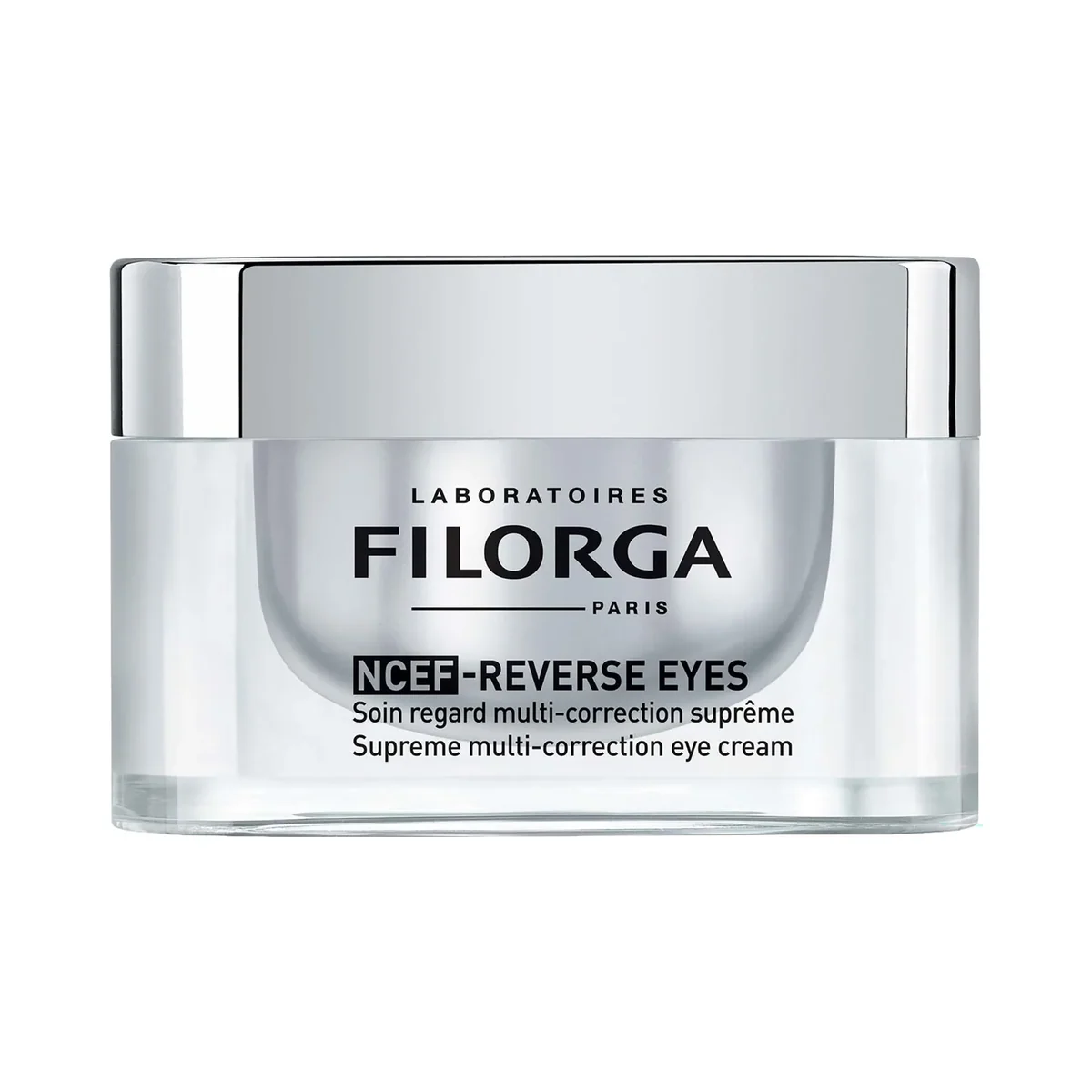
 NCEF-Reverse Eyes
NCEF-Reverse Eyes is a serious multi-correction eye cream that goes after puffiness, firmness, and dark circles on several fronts at once — caffeine and escin to decongest, eye-targeted peptides to firm, and Filorga's signature complex for nourishment. It genuinely de-puffs and feels lovely, but at $94 for 15 mL with added fragrance, it asks a premium that only buyers wanting an all-in-one luxe eye step will find easy to justify.
Key Caffeine · Escin
 Luxury Eye Area Firmer
 Total Eye Lift
A genuinely clever eye cream that pairs a novel Madagascan botanical with classic de-puffing actives. The harungana extract offers real retinol-like promise without retinoid irritation, and the immediate optical smoothing is a nice bonus. The price-to-volume ratio stings, and fragrance near the eyes is a head-scratcher at this level, but the science is more interesting than most luxury eye creams can claim.
Key Caffeine · Escin
 Prestige Hanbang Eye Cream
 Gongjinhyang Intensive Nutritive Eye Cream
The Gongjinhyang Intensive Nutritive Eye Cream brings Whoo's royal-herbal richness to the eye area, pairing a genuine ceramide barrier deck with de-puffing escin, niacinamide and a subtle optical brightener. It's a nourishing, pleasant, multi-tasking eye treatment that does real work, but the fragrance and alcohol so close to the eyes plus a steep luxury price are meaningful caveats — and no eye cream erases dark circles.
Key Cordyceps · Escin
 Honest $9 De-Puffer
 Caffeine 3% + Escin 1% Face Serum
The Ordinary's Caffeine 3% + Escin 1% Face Serum is a genuinely good, honest, and remarkably affordable ($9) de-puffing and energizing serum — just not the firming treatment its 'firm & define' marketing implies. It pairs 3% caffeine (an antioxidant that supports microcirculation and temporarily reduces puffiness) with 1% escin (from horse chestnut, complementing caffeine's de-puffing, circulation-boosting effect), plus a bacillus ferment and hydrators, all fragrance-free. So it genuinely reduces puffiness and gives skin a fresher, more radiant, temporarily-tightened look, especially when massaged in. The honest caveat: the 'firm & define facial structure' and 'lifted' language overstates a temporary de-puffing effect — it's not structural firming. But at $9, with real (if modest, temporary) benefits and a gentle formula, it's honest value.
Key Caffeine · Escin
The full escin (aescin) guide
Escin, also spelled aescin, is the soapy plant compound that gives horse chestnut seed extract its effect on blood vessels.
Taken by mouth, it's a long-used option for heavy, aching, swollen legs, because it helps tiny vessels leak less fluid into the surrounding tissue. In skincare it turns up in eye creams for morning puffiness, in leg gels and in bruise gels, usually beside caffeine. The catch is that almost all of its reputation comes from capsules, not creams.
How it's regulated in the US
FDA does not classify ingredients — it classifies products, by what they are sold to do. The same molecule can be a drug active in one product and a cosmetic ingredient in the next, and only the claim on the label decides which. What follows is a statement about that legal standing, not about whether it works — the evidence question is answered separately above.
Cosmetic Escin (Aescin) is a cosmetic ingredient in the US: no OTC monograph covers it and it is not an active in any FDA-approved drug, so a product built around it is a cosmetic rather than a drug.
Escin is mostly studied as part of horse chestnut extract taken by mouth for leg swelling and heaviness from weak veins, with a fair number of human studies and reviews. Lab work explains how it tightens leaky capillaries, calms inflammation in vessel walls and protects the support matrix around them. Applied to skin, the picture is far thinner: gels are sold for bruising in some countries, but cosmetic uses like under-eye puffiness and cellulite haven't been tested carefully. Whether enough crosses eyelid skin to matter is an open question.
How it works
The problem escin addresses is leaky capillaries. When small vessels become more permeable than they should be, fluid escapes into surrounding tissue and produces the heaviness, swelling and ache of venous insufficiency — and, on a much smaller scale, the puffiness that collects under the eyes. Escin works against that on several fronts at once. In endothelial cells it triggers a rapid burst of cholesterol synthesis followed by a loss of actin cytoskeleton integrity, which blunts the cells' response to inflammatory signalling: less migration, less permeability, suppressed NF-κB activation and reduced production of the downstream inflammatory proteins that follow. It inhibits hyaluronidase, protecting the hyaluronic acid scaffolding that forms the matrix around capillaries. It suppresses overexpression of aquaporin-1, a water channel that opens the floodgates when endothelium is inflamed. Newer work describes glucocorticoid-like activity, which would explain its anti-inflammatory reach. The net effect is tighter vessel walls, less fluid escaping, and reduced tissue swelling — anti-oedematous, anti-inflammatory and venotonic, exactly as the reviews describe. The unanswered question for skincare is delivery. Escin is a bulky triterpene saponin, far heavier than molecules that cross the stratum corneum easily, and whether a cosmetic concentration reaches the microvasculature beneath the eye in useful amounts has not been demonstrated.
Key benefits
- Helps tiny blood vessels hold on to their fluid
- A popular pick for the look of morning puffiness
- Often paired with caffeine in eye and leg gels
- Calms inflammation in the walls of small vessels
- Used in bruise gels in some countries
Concentration & usage
The meaningful dosing figure belongs to the oral form: standardized extracts delivering roughly 50 to 150 mg of escin daily, which is what the trials used and what supplement labels should state. Cosmetic products give no equivalent benchmark, because no topical dose-response has been worked out for any skin endpoint. On an INCI list you will see either escin itself or Aesculus hippocastanum seed extract, typically low in the order and usually alongside caffeine in eye and leg products. Where escin appears near the end of a long list, treat it as a supporting note. Standardization matters more than percentage in any case — horse chestnut preparations vary widely in saponin content, and an unstandardized extract tells you nothing about what you are getting.
Who it's for & who should be cautious
Who it's for
For heavy, aching, swollen legs from venous insufficiency, the oral standardized extract is a legitimate option with meaningful evidence, and worth discussing with a clinician alongside compression. Topically, it is a reasonable inclusion in eye products aimed at morning puffiness, where the target is fluid rather than pigment, and in gels for bruising. It suits people who want a mechanistically coherent botanical rather than one chosen for its name.
Who should be cautious
Anyone hoping this will address dark circles caused by pigment or by thin skin showing the vessels underneath is targeting the wrong mechanism — escin acts on fluid and vessel leakiness, not on melanin or dermal thickness, and those are the more common causes of persistent under-eye darkness. Saponins are surface-active by nature and can irritate, so the eye area deserves a cautious introduction. Oral horse chestnut is a different risk profile entirely: it belongs in a conversation about anticoagulants, kidney or liver disease, pregnancy and breastfeeding rather than in a self-directed supplement regimen, and only properly standardized preparations should be used. Persistent one-sided leg swelling is a medical sign, not a cosmetic complaint, and needs assessment rather than a botanical.
Pairs with & conflicts
Pairs well with: Caffeine, Horse Chestnut (Aescin), Vitamin C (L-Ascorbic Acid), Niacinamide (Vitamin B3), Peptides, Green Tea Extract
Myths & facts
Myth: Escin has strong clinical evidence, so an escin eye cream is well proven.
Reality: The seventeen trials in the Cochrane review tested capsules taken by mouth for leg symptoms in venous insufficiency. Swallowing a standardized dose that circulates to leg veins is not the same experiment as applying a large saponin molecule to eyelid skin. The pharmacology transfers as a hypothesis; the evidence does not transfer at all.
Myth: It gets rid of dark circles.
Reality: Under-eye darkness has several distinct causes — melanin deposition, thin skin revealing underlying vasculature, hollowing that casts a shadow, and fluid congestion. Escin only plausibly addresses the last. If your circles are pigmented or structural, no vessel-directed ingredient will change them, and identifying which type you have matters far more than which eye cream you buy.
Myth: Horse chestnut is a gentle herbal remedy you can take freely.
Reality: It is a pharmacologically active preparation with anticoagulant-adjacent effects and real interaction potential, which is why the trials used standardized extracts under supervision. Raw horse chestnut material is not something to prepare at home. The Cochrane reviewers found no new safety concerns for standardized products, which is a statement about those specific preparations, not about the plant generally.
Frequently asked questions
Does escin help under-eye puffiness?
It targets the right mechanism if your puffiness is fluid-based — morning swelling that settles as the day goes on. Escin reduces capillary permeability and limits fluid escaping into tissue. Whether enough of it crosses eyelid skin at cosmetic concentrations has not been shown, so treat it as mechanistically sensible rather than demonstrated.
Is topical escin as effective as taking horse chestnut capsules?
No comparison of that kind exists, and the evidence sits almost entirely on the oral side. For leg symptoms in venous insufficiency, capsules are what the randomized trials support. Topical gels are used for bruising and localised swelling in several markets, but the cosmetic applications are extrapolations from oral data.
What is the difference between escin and horse chestnut extract?
Escin is the active saponin mixture; horse chestnut seed extract is the plant material it comes from. Standardized extracts specify their escin content, which is the number the clinical trials were built around. An extract with no stated standardization could contain almost any amount, which makes comparing products essentially guesswork.
Can escin help with cellulite?
It appears in cellulite products on the reasoning that microcirculation and fluid retention contribute to the appearance. That reasoning is not unfounded, but cellulite is primarily a structural matter of fat lobules pressing against fibrous septa, and no topical has convincingly changed it. Expect a temporary smoothing at most.
Is escin safe to use around the eyes?
It appears in eye products routinely without a notable safety signal, but saponins are surface-active compounds that can sting, and eyelid skin is the thinnest on the body. Introduce it gradually and keep it off the lash line. Any burning that persists rather than settling is a reason to stop rather than push through.
Sources
- https://www.cochranelibrary.com/cdsr/doi/10.1002/14651858.CD003230.pub4/full
- https://pubmed.ncbi.nlm.nih.gov/23152216/
- https://www.tandfonline.com/doi/full/10.2147/DDDT.S207720
- https://journals.plos.org/plosone/article?id=10.1371%2Fjournal.pone.0164365
- https://www.ncbi.nlm.nih.gov/pmc/articles/PMC6487832/