Ethyl Ferulate
Products with Ethyl Ferulate
 Clean Beauty SPF Pick
 Squalane + Zinc Sheer Mineral Sunscreen SPF 30
A thoughtfully formulated mineral sunscreen that actually solves the problems mineral sunscreens are known for — the squalane-infused base delivers genuine hydration instead of chalky dryness, and the white cast is impressively controlled for 14% zinc oxide. Best for dry and sensitive skin types who want clean ingredients without compromising on wearability.
Key Zinc Oxide · Squalane
 Hydrating Chemical SPF Pick
 Hydrating Sunscreen Milk with Colloidal Oatmeal Broad Spectrum SPF 45
First Aid Beauty's Hydrating Sunscreen Milk delivers SPF 45 chemical filter protection in a lightweight hydrating format with the brand's signature colloidal oatmeal calming plus an antioxidant complex. Well-formulated for sensitive-skin chemical-sunscreen users. The 36-dollar price for 1.7oz is the main hesitation point versus comparable options.
Key Avobenzone · Colloidal Oatmeal
 Sunscreen Plus Antioxidants
 Solar Shade Chemical Sunscreen SPF 46
Solar Shade is a competent, lightweight chemical sunscreen that does the basics well, SPF 46, PA++++, no white cast, fragrance-free, and then adds something genuinely worthwhile: a real antioxidant complex of ethyl ferulate and astaxanthin-rich algae extracts as a second line of defense. It is a smart everyday option for normal to oily skin. Chemical filters mean very sensitive skin should consider Prequel's mineral version instead.
Key Avobenzone · Octocrylene
 Body Glow SPF
 Glowscreen Body SPF 40
Glowscreen Body is the sunscreen that makes you want to show more skin, not less. The luminous finish turns arms and shoulders into their most radiant versions, the triple-stabilized avobenzone is genuinely robust, and the bisabolol-enriched formula soothes even freshly shaved legs. The shimmer is prettier and more visible than marketed — which is either a feature or a bug depending on your tolerance for daytime sparkle.
Key Avobenzone · Octocrylene
 Beginner Retinol Eye Pick
 Retinol Eye Cream
A thoughtfully gentle entry into retinol for the eye area — the slow-release encapsulation system is smarter than the price suggests, and the antioxidant support from ethyl ferulate shows real formulation care. Just know that 0.09% retinol is a whisper, not a shout, and temper your expectations accordingly.
Key Retinol · Hyaluronic Acid
 Budget Mineral Shield
 Mineral UV Filters SPF 30 with Antioxidants
A discontinued mineral sunscreen that was, for its brief run, one of the best-value mineral SPFs ever made. The antioxidant blend was genuinely impressive, the mineral filters provided gentle broad-spectrum protection, and the under-0 price was unmatched. The white cast and thick texture were its undoing — cosmetic elegance matters, and this product lacked it.
Key Zinc Oxide · Titanium Dioxide
 Clean Beauty Sun Shield
 Guards Up Daily Mineral Sunscreen SPF 35
A thoughtfully formulated clean mineral sunscreen that achieves the near-impossible: comfortable daily wear without fragrance, silicones, or chemical UV filters. The peachy tint minimizes white cast, but deeper skin tones will need to test before committing.
Key Zinc Oxide · Bisabolol
 Hybrid SPF 50
 Make It Hybrid SPF 50
Black Girl Sunscreen Make It Hybrid SPF 50 combines chemical UV filters (homosalate 10%, octisalate 5%, octocrylene 5%) with zinc oxide 5% in a hybrid system, paired with aloe, shea butter, carrot seed oil, ethyl ferulate antioxidant, and a multi-botanical soothing layer. Light lavender essential oil scent at 18 dollars for 3oz.
Key Zinc Oxide · Shea Butter
 No-White-Cast Daily SPF
 Ultralight Face Fluid SPF30
A genuinely lightweight, no-white-cast chemical sunscreen with a skincare-grade base of ceramides and antioxidants, all for $18.99. The faint filter scent and touch of olive oil are minor quibbles, and oily skin should test it, but as an invisible daily SPF that works across skin tones and feels like skincare, it's an easy budget recommendation.
Key Avobenzone · Astaxanthin
 High-Protection Daily SPF
 Ultralight Face Fluid SPF50
The higher-protection sibling in Byoma's Ultralight line, delivering SPF 50 in the same featherlight, no-white-cast fluid with ceramides and antioxidants for $18.99. The faint filter scent and brief sheen are minor, and oily skin should test it, but for those wanting maximum daily protection without a heavy feel, it's a standout budget pick.
Key Avobenzone · Astaxanthin
 Beach Day Body SPF
 PLAY Antioxidant Body Mist SPF 50
A body sunscreen spray that genuinely solves the reapplication problem. Supergoop! PLAY Antioxidant Body Mist SPF 50 delivers broad-spectrum protection with 80-minute water resistance in a non-aerosol mist that works on wet skin, sprays at any angle, and throws in an antioxidant cocktail of vitamin C, green tea, and ferulic acid for good measure. The citrus essential oils and high alcohol content rule out sensitive skin types, but for everyone else heading outdoors, this is one of the most practical body SPFs available.
Key Avobenzone · Octocrylene
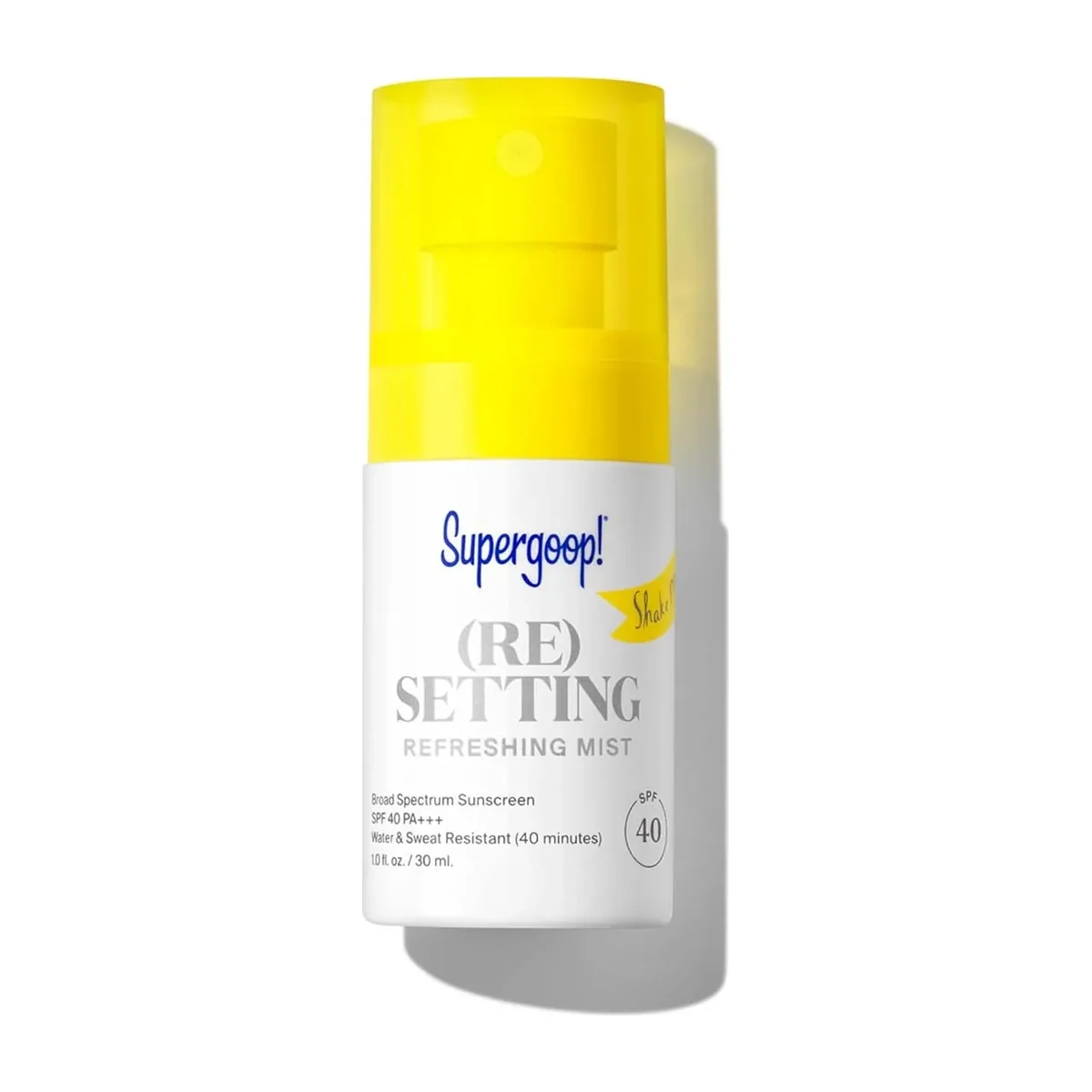 The Over-Makeup SPF Solution
 RE:SETTING Refreshing Mist SPF 40
The most practical solution to a problem every makeup wearer faces: how do you reapply sunscreen at 2 PM without redoing your entire face? Supergoop! RE:SETTING Refreshing Mist SPF 40 delivers a four-filter UV system in an ultrafine mist that settles over makeup without disturbing it, while oil-absorbing powders mattify and set. The triple avobenzone stabilization is genuinely sophisticated formulation chemistry. The alcohol and essential oils rule out sensitive skin, but for everyone else, this turns midday SPF reapplication from a fantasy into a fifteen-second habit.
Key Avobenzone · Antioxidants
 Multi-Active Overachiever
 Vitamin C Super Serum Plus
Naturium's Vitamin C Super Serum Plus is the maximalist's dream serum — five powerhouse actives in one $26 bottle that attempts to replace an entire shelf of treatments. When your skin can handle it, the results are genuinely impressive across brightening, anti-aging, and pore refinement. But that ambition comes with a real cost in irritation potential that makes this firmly a product for experienced, resilient skin.
Key Vitamin C · Retinol
 Beginner-Friendly Budget Retinol
 Retinol Face Serum
An affordable, gently-buffered retinol serum that delivers true retinol in a soothing, lotion-like base — a genuinely sensible, unintimidating entry point for retinol beginners on a budget. The trade-offs are an undisclosed (likely conservative) strength, added fragrance, and the usual retinol cautions, so results are gentle and gradual rather than dramatic.
Key Retinol · Squalane
 Pigmentation Protocol Pick
 Smart Tone Broad Spectrum SPF 50
Smart Tone SPF 50 is one of the more elegant tinted chemical sunscreens in the clinical space, with a well-stabilized UV filter system, a melanin-based self-adjusting tint that flatters a wider range of skin tones than most, and a genuine antioxidant support layer. The fragrance and the chemical filter base will rule it out for some users, but for pigmentation-prone skin that tolerates chemical filters, it earns its price tag.
Key Avobenzone · Homosalate
 Acne-Safe Mineral Shield
 Sunscreen SPF 30
A thoughtfully designed mineral sunscreen that solves the two biggest problems with zinc oxide formulas — white cast and heavy texture — while adding sophisticated antioxidant support that punches above its price class. Built for the acne-prone and prescription-active audience, but effective for anyone who wants a gentle daily mineral SPF.
Key Zinc Oxide · Ethyl Ferulate
 Post-Procedure Mineral Shield
 Mineral UV Barrier Protect Broad Spectrum SPF 40
A zinc-only sunscreen that behaves like a barrier cream, with three ceramides, cholesterol, squalane and an antioxidant pair in a sheer silicone lotion that peeled, lasered and retinoid-irritated skin can wear without complaint. It blends better than most minerals and feels genuinely hydrating; its 9.4 percent zinc reaches SPF 40 with help from a salicylate booster, which purists should know, and sixty-five dollars for a bottle that lasts five weeks at the right dose is a physician-shelf price.
Key Zinc Oxide · Ceramides
 Mineral Sunscreen Made Wearable
 ShadeDrops Mineral Milk Sunscreen SPF 30
A cosmetically elegant mineral sunscreen that makes zinc oxide genuinely wearable — milky texture, minimal white cast, and a beautiful finish. But the sole reliance on 9.4% zinc oxide raises real questions about UVA protection depth that the lovely texture cannot answer. Best suited as an everyday office SPF, not your beach day armor.
Key Zinc Oxide · Squalane
 Professional Post-Peel SPF
 Daily Defense Broad Spectrum SPF 50+
A thoughtfully over-engineered sunscreen that delivers beyond-basic UV protection with an antioxidant support system most competitors don't even attempt. The elegant, weightless wear makes daily compliance effortless — which is the only thing that actually matters with sunscreen.
Key Zinc Oxide · Ectoin
 Family-Friendly Clean Mineral Pick
 Mineral Sunscreen Broad Spectrum SPF 50
A genuinely elegant mineral sunscreen that solves the two biggest complaints about zinc oxide formulas — white cast and heavy texture — thanks to its biotech-derived squalane base. Not the cheapest option, but one of the most pleasant mineral sunscreens to actually wear daily, especially for sensitive or reactive skin.
Key Zinc Oxide · Squalane
 Derm-Grade Sun Shield
 Broad-Spectrum Sunscreen SPF 50
A clinic-grade mineral sunscreen that goes well beyond basic UV protection, combining high-concentration zinc oxide with HEV-blocking melanin and a multi-antioxidant complex. The texture defies mineral sunscreen stereotypes. The price, however, is strictly professional-channel territory.
Key Zinc Oxide · Titanium Dioxide
 Golden-Glow Mineral Screen
 Luminizing Facial SPF
A tinted, softly shimmering non-nano zinc sunscreen that does what most mineral screens promise and few deliver — no white cast on light-to-medium skin — and quietly does something better: its iron oxides add visible-light protection that plain zinc cannot. SPF 29+, fragrance-free, water resistant, lighter than its sibling. One shade limits it; the price is fair for what the formula does.
Key Zinc Oxide · Iron Oxides
 Gentle Retinal Gateway
 24 Carrot Retinal
A genuinely clever, gentle entry into retinaldehyde — a faster-acting vitamin A than retinol — at a price that undercuts most of the category. Oil-entrapped slow release and a soothing oil cushion make 0.05% retinal feel beginner-friendly, and it's fragrance-free to boot. Retinoid veterans may want more strength, and the fungal-acne crowd should steer clear.
Key Retinal · Beta-Carotene
The full ethyl ferulate guide
Ethyl ferulate is a tweaked form of ferulic acid, the plant antioxidant found in rice bran, wheat and oats that's famous for steadying vitamins C and E.
Swapping one small piece of the molecule for an ethyl group makes it more oil-loving, so it slips into the skin's outer layers more readily and even absorbs a little UV light. That's why it tends to turn up in sunscreens and antioxidant serums, sometimes tucked among the inactive ingredients of mineral sunscreens. Think of it as a daytime support player.
How it's regulated in the US
FDA does not classify ingredients — it classifies products, by what they are sold to do. The same molecule can be a drug active in one product and a cosmetic ingredient in the next, and only the claim on the label decides which. What follows is a statement about that legal standing, not about whether it works — the evidence question is answered separately above.
Cosmetic Ethyl Ferulate is a cosmetic ingredient in the US: no OTC monograph covers it and it is not an active in any FDA-approved drug, so a product built around it is a cosmetic rather than a drug.
Ethyl ferulate sits mostly in chemistry and lab work: how easily it passes into skin compared with ferulic acid, how it behaves as an antioxidant in test tubes and cells, and how much UV light it absorbs inside a formula. Some of it looks at how skin enzymes snip it back into ferulic acid once it's absorbed. Human studies on skin are few, and claims about brightening or guarding against sun damage haven't been tested much in people. How much it adds to a finished sunscreen, beyond the regulated filters, is still an open question.
How it works
Ferulic acid is a phenolic antioxidant that plants tuck into their cell walls — rice bran, wheat, oats all carry it — and it earned its skincare reputation by stabilizing vitamins C and E and quenching UV-driven free radicals. The ethyl ester version trades the carboxylic acid's hydrogen for an ethyl group, and that one swap shifts the molecule's behavior in two meaningful directions. The first is solubility. The ethyl group makes the molecule more lipophilic, so it partitions into the lipid-rich stratum corneum and crosses the barrier more readily than ferulic acid, which is fairly polar and tends to linger on the surface unless a formula is built to push it through. Skin-delivery studies bear this out: the ester showed the highest absorption of the derivatives tested. Once it's inside, esterase enzymes naturally present in tissue can snip the ester bond and release free ferulic acid, effectively creating a slow-release reservoir. The second shift is in how it handles free radicals. In cell-free assays it's a marginally weaker hydrogen donor than ferulic acid, but in leukocyte-based tests — closer to what happens in living tissue — it appears better at mopping up the reactive oxygen species that activated immune cells throw off, possibly because it reaches the relevant compartments more efficiently. Layered on top of all that, the molecule's cinnamate double bond absorbs some UVB and short-wave UVA light, which is the basis for its appearance in sun-care formulas as a supporting antioxidant.
Key benefits
- Adds daytime antioxidant care beneath sunscreen
- Slips into skin more easily than plain ferulic acid
- Absorbs a little UV light inside a formula
- A gentle, non-exfoliating choice for reactive skin
- Blends easily into creams and emulsions
Concentration & usage
In finished products it usually sits around 0.5–1%, with the broader range reaching roughly 2% in some formulas. It appears on an INCI list as ETHYL FERULATE. In US products it will not be listed as an active UV filter — even when its UV absorption is contributing — so it shows up among the inactive ingredients, which means its presence can slip past notice on "mineral" sunscreen labels. Skin-delivery data suggests it's delivered best from a near-neutral vehicle (around pH 6), and unlike low-pH acids it doesn't need an acidic environment to perform, which gives formulators flexibility.
Who it's for & who should be cautious
Who it's for
If you're building antioxidant defense into a daytime routine, ethyl ferulate is a sensible supporting player — especially in formulas where both oxidative-stress protection and a little UV absorption are the goal. It tends to suit reactive or easily-irritated skin because it doesn't lower skin pH or exfoliate the way direct acids do, and early safety signals are reassuring. Anyone who likes the idea of ferulic acid but has been put off by the characteristic smell of free-acid serums may find ester-based formulas more agreeable.
Who should be cautious
People with a known allergy to ferulic acid or other cinnamic-acid derivatives (a chemical family that includes some sunscreen filters like octinoxate) should patch-test carefully, since cross-reactivity within that class is plausible. Anyone counting on a product solely because it contains ethyl ferulate for sun protection should reconsider — it is not a regulated UV active in the US and carries no tested SPF value, so it should accompany a properly tested sunscreen rather than stand in for one. There's no specific documented concern for pregnancy, but those who prefer to be cautious with antioxidant esters can run it by a healthcare provider.
Pairs with & conflicts
Myths & facts
Myth: Ethyl ferulate is just ferulic acid with extra steps — basically the same ingredient.
Reality: The ester tweak changes how the molecule moves through skin and how it behaves in lab assays. It penetrates more readily than free ferulic acid (higher flux and deposition in controlled diffusion studies) and outperforms it at suppressing ROS from activated immune cells, even though it's a slightly weaker scavenger in cell-free tests. Related, but not interchangeable.
Myth: If a sunscreen says '100% mineral,' it can't contain anything that absorbs UV.
Reality: Ethyl ferulate is categorized as an inactive antioxidant in US sunscreen formulations rather than an active UV filter, even though its structure absorbs some UVB and short-wave UVA. That classification lets it appear in products marketed as '100% mineral' without showing up on the active-ingredient panel — a labeling quirk rather than evidence the ingredient is harmful.
Myth: Ethyl ferulate is a brand-new ingredient with barely any safety data.
Reality: It's a naturally occurring compound in plant cell walls and has been studied in cosmetic and pharmaceutical contexts for well over a decade. Skin-delivery research reported no irritation over 24-hour application, and its safety profile in those studies has been described as satisfactory. What's genuinely thin is human efficacy data for skincare claims — not basic safety.
Frequently asked questions
Is ethyl ferulate basically the same as ferulic acid, or does the difference actually matter for skin?
They share a parent molecule and overlapping antioxidant benefits, but the ester form behaves differently where it counts. Ethyl ferulate is more oil-soluble, so it crosses the stratum corneum more readily, and skin enzymes can release free ferulic acid from it gradually. The two are more complementary than redundant — some formulas use both for layered delivery.
Why does ethyl ferulate turn up in sunscreens labeled '100% mineral'?
Its structure absorbs some UVB and short-wave UVA, but in the US it's classified as an inactive antioxidant rather than an active UV filter — so it can sit in a '100% mineral' formula without appearing on the active-ingredient panel. The ingredient itself isn't a safety concern, but whether that labeling practice is fully transparent is a fair thing to question.
How much ethyl ferulate counts as enough, and can I tell from the label?
Commercial use tends to cluster around 0.5–1%, occasionally up to about 2%. Because US rules don't require disclosing inactive-ingredient percentages, you usually can't confirm the dose from a box. As a rough proxy, ethyl ferulate appearing earlier on a mid-length INCI list — ahead of thickeners and emollients — suggests it's toward the higher end.
Could ethyl ferulate stand in for a dedicated vitamin C serum?
Not on its own. Ascorbic acid works through different pathways and has a far deeper human evidence base for photoprotection and brightening. Ethyl ferulate is better understood as a penetration-friendly, stabilizing antioxidant that complements vitamin C and vitamin E rather than replacing them — the familiar C + E + ferulic synergy applies here too.
Does ethyl ferulate fade hyperpigmentation?
The biology is plausible — ferulic acid derivatives can influence endothelin-1 signaling, which is involved in UV-triggered melanocyte activity — but published human data specifically on ethyl ferulate for pigmentation is sparse. Treat it as a possible contributor inside a multi-ingredient brightening formula, not a primary brightener the way niacinamide or alpha-arbutin are better known to be.
Is ethyl ferulate gentle enough for sensitive or rosacea-prone skin?
Early signs are encouraging: skin-delivery studies reported no irritation over 24-hour application, and unlike direct acids it doesn't lower skin pH or cause exfoliation. The main caveat is cinnamic-acid sensitivity — a subset of fragrance allergy — so anyone in that group should patch-test, since the chemical class carries some cross-reactivity potential.