Sulfates (SLS / SLES)
Products with Sulfates (SLS / SLES)
 Luxury Foam, Sulfate Inside
 Advanced Night Cleansing Gel with 15 Amino Acids
A luxuriously foaming jelly cleanser whose actual cleansing agent is sodium laureth sulfate, softened by a betaine and glycerin and dressed in fifteen amino acids, hyaluronate and a fruit-and-ferment roster that rinse away with the foam. On normal, combination and oily skin it feels lovely and cleans thoroughly; on dry or reactive skin the sulfate, lavender oil and dyes show, and thirty-five dollars buys the Advanced Night Repair name on a base most drugstore gels share.
Key Sulfates · Amino Acids
 Sulfate Foam in Natural Clothing
 Coconut & Honey Hydrating Foaming Cleanser
A twelve-dollar sulfate foaming wash wearing a coconut-and-honey costume. It cleans oily skin thoroughly and lathers like a shampoo, because it is built like one; the 'hydrating, non-stripping' promise on the front is contradicted by the second and third ingredients on the back. Fine for oily skin on a budget, wrong for anyone who bought it for gentleness.
Key Sulfates · Cocamidopropyl Betaine
 Cream-Oil Wash, Drugstore Price
 Nourishing Care Body Wash with Nourishing Serum
A properly engineered cream-oil body wash that puts soybean oil ahead of its sulfates and backs it with four more oils, panthenol, glycerin and a set of skin fatty acids, so dry skin rinses conditioned instead of tight, for about seven dollars per twenty ounces. It is still a fragranced sulfate wash and it leaves a film oily skin will dislike, but as a daily wash for dry limbs, and as a shaving cream, it is one of the better bargains in the drugstore aisle.
Key Soybean · Sulfates
 The Renamed Coriander Wash
 Antithesis Intense Body Cleanser
The Coriander Seed Body Cleanser under a new name, a conventional sodium laureth sulfate and hydroxysultaine gel whose only unusual feature is a bracing black pepper, coriander seed and patchouli accord that obliges the label to declare a dozen terpenes. It cleans like any sulfate wash and smells like nothing else on the shelf; it is the most allergen-heavy body wash Aesop makes, wrong for dry or reactive skin, and at fifty-nine dollars for 500 mL a pure indulgence for the people who love the scent.
Key Sulfates · Cocamidopropyl Betaine
 The 1998 Bathroom Fixture
 Geranium Leaf Body Cleanser
A fifteen-ingredient sulfate body wash, sodium laureth sulfate softened with coco-betaine and a little glycerin, whose entire reason for existing is a green geranium, bergamot and mandarin accord good enough to have kept it in Aesop's range since 1998. It cleans thoroughly and smells wonderful; it is also ordinary shower-gel chemistry with four declared fragrance allergens at fifty-nine dollars a bottle, wrong for dry or reactive skin and a pure indulgence for everyone else.
Key Sulfates · Cocamidopropyl Betaine
 Cold Shower in a Bottle
 MEN Cool Body Wash
A cheap, fun sensation wash that does exactly what fifteen thousand reviewers bought it for: a sharp menthol chill under a yuzu scent, a dense lather and a clean rinse for about a dollar a week. Its formula is the harsher end of the NIVEA MEN range, with laureth sulfate, two citrus allergens and two dyes, so it belongs on oily, resilient skin in summer and nowhere near a face, a fresh shave or anyone with eczema.
Key Menthol · Sulfates
 Cologne-Forward Shower Gel
 MEN Energy Body Wash
The loudest-smelling wash in the NIVEA MEN range, with fragrance placed above its humectant and its menthol, a cedarwood-mint accord that outlasts its siblings and a mild wake-up tingle on a standard laureth sulfate base. It cleans oily skin well and cheaply when you can find it at a chain price, carries four declared fragrance allergens and a dye, and has quietly slipped off most US shelves, so check the price before you pay a marketplace mark-up for a scent.
Key Fragrance · Menthol
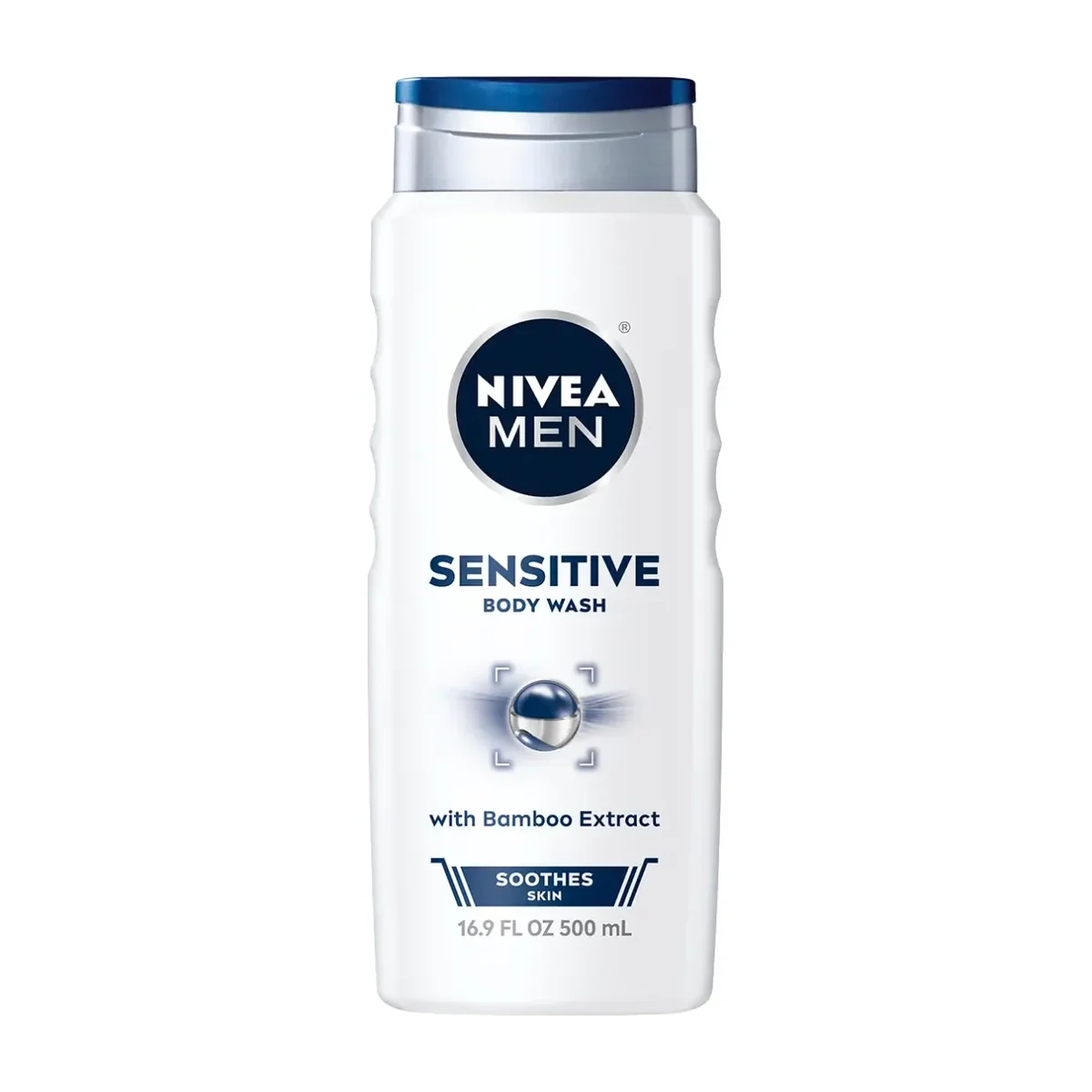 Sensitive in Name, Sulfate in Fact
 MEN Sensitive Body Wash
A reliable, inexpensive daily body wash with a milder-than-average sulfate system, a supporting glucoside and a light scent, which is why more than ten thousand reviewers with easily irritated skin rate it highly. It is not sulfate-free or fragrance-free, its bamboo is decoration and its advertised almond oil is not in the bottle; buy it as a gentle-enough wash for reactive skin, not as a treatment for a skin condition.
Key Sulfates · Cleansing Surfactants
The full sulfates (sls / sles) guide
Sulfates are the cleansing agents behind most classic foaming washes and shampoos, with sodium lauryl sulfate and its milder cousin, sodium laureth sulfate, leading the family.
They grab oil and lift it away in rinse water, and they foam generously, which is how lather came to feel like the sign of a proper clean. Here's the twist: labs use the harshest one on purpose when they need to irritate skin for a study. That's a fair reason for caution, though the family isn't all equally rough.
How it's regulated in the US
FDA does not classify ingredients — it classifies products, by what they are sold to do. The same molecule can be a drug active in one product and a cosmetic ingredient in the next, and only the claim on the label decides which. What follows is a statement about that legal standing, not about whether it works — the evidence question is answered separately above.
Cosmetic Sulfates (SLS / SLES) is a cosmetic ingredient in the US: no OTC monograph covers it and it is not an active in any FDA-approved drug, so a product built around it is a cosmetic rather than a drug.
Sulfates have been studied mostly for what they do to the skin barrier: how much water escapes after washing, how much redness follows, and how long skin takes to recover. Sodium lauryl sulfate is so reliably irritating that labs use it to create barrier damage on purpose, which is why so much is known about its effects. Comparison work matters here too, because the gentler laureth form most shampoos use behaves very differently from its harsher sibling. Contact time is another thread, since a quick rinse is a very different exposure from a product left on skin. Formulators also study how blending in milder cleansers softens the effect.
How it works
A surfactant molecule has a water-loving head and an oil-loving tail, which lets it surround grease and lift it into rinse water. Sulfates do this exceptionally well and cheaply, and they foam generously, which is why they have dominated cleansers for decades — the lather people read as cleanliness is largely a sulfate signature. The problem is that skin lipids are also grease. The same tails that grip sebum grip the ceramides, cholesterol and fatty acids cementing your stratum corneum together, and above a certain concentration and contact time they start removing structural lipid alongside the dirt. Sulfates also bind and denature keratin proteins, which is a second, separate route to damage. What follows is measurable rather than theoretical: water escapes faster through the compromised barrier, the tight feeling after washing is that loss, and the skin's repair machinery switches on — with altered expression of the differentiation proteins that build the barrier in the first place. The ethoxylated version changes the arithmetic. Adding ether groups to make sodium laureth sulfate produces a bulkier, gentler molecule that lifts oil with much less lipid stripping, which is why comparative testing separates the two so clearly. Concentration, contact time and whether the product is rinsed off matter as much as which sulfate is named.
Key benefits
- Lifts oil, silicones and heavy product buildup with ease
- Rich lather that makes cleansing feel thorough
- Keeps basic cleansers and shampoos affordable
- Copes well with hard water where milder cleansers struggle
- A handy occasional clarifying wash for oily scalps
Concentration & usage
The names to look for sit high on an INCI list, usually second or third after water: Sodium Lauryl Sulfate, Sodium Laureth Sulfate, Ammonium Lauryl Sulfate, Ammonium Laureth Sulfate. Position matters more here than with most ingredients — a surfactant listed second is the bulk of what the product is. Two label traps are worth knowing. First, sulfate-free products very often use Sodium Coco-Sulfate, which is chemically close to SLS but escapes the claim because it is derived from coconut oil rather than named as lauryl sulfate; if you react to SLS, read past the front of the pack. Second, Sodium Cocoyl Isethionate and the glucosides are genuinely different chemistry, not renamed sulfates. Formulators also blend sulfates with amphoteric co-surfactants such as cocamidopropyl betaine specifically to reduce irritancy, so a well-built SLES cleanser can be far milder than its ingredient list suggests in isolation.
Who it's for & who should be cautious
Who it's for
Normal, resilient, genuinely oily skin and scalps that get greasy within a day often do well with sulfates and may find gentler surfactants leave a residue. They are the practical choice for removing heavy silicone buildup, styling product, or sunscreen that a mild cleanser leaves behind, and a clarifying wash every week or two has a real role even in an otherwise gentle routine. As a brief rinse-off on the scalp, where contact time is short and hair takes most of the exposure, the irritation data are far less alarming than the patch-test literature makes them sound.
Who should be cautious
If your face feels tight and squeaky after washing, that sensation is the barrier disruption these studies measure, and switching cleansers is a reasonable response to it rather than an overreaction. Avoid sulfates outright with eczema, atopic dermatitis, rosacea, seborrheic dermatitis or any actively compromised barrier — SLS is used experimentally to induce exactly the defect those conditions already have, and the recovery data show elevated water loss persisting for days after a single exposure. The same applies while using retinoids, benzoyl peroxide or acids, where the barrier is already working hard. People with color-treated or curly and coily hair have a separate, legitimate case: sulfates strip more thoroughly than fine, dry hair textures can afford. Skip them in any leave-on product, where contact time removes the main mitigating factor, and note that SLS in toothpaste has been associated with aphthous ulcers in susceptible people. If you have reacted specifically to SLS, check for Sodium Coco-Sulfate before trusting a sulfate-free label. The alternatives worth naming are Sodium Cocoyl Isethionate, decyl and coco-glucoside, and sodium methyl cocoyl taurate — with the caveat that cocamidopropyl betaine, the most common replacement co-surfactant, is itself a recognised contact allergen for a small number of people.
Pairs with & conflicts
Pairs well with: Cocamidopropyl Betaine (CAPB), Coco-Glucoside, Glycerin
Myths & facts
Myth: Sodium lauryl sulfate causes cancer.
Reality: This is the one genuinely baseless claim in the sulfate argument, and it has been circulating in chain emails since the 1990s. No credible body classifies SLS as a carcinogen. There is a narrower and more legitimate manufacturing question about 1,4-dioxane, a trace byproduct that can form during the ethoxylation used to make sodium laureth sulfate — not SLS — and which manufacturers remove by vacuum stripping and regulators monitor. Conflating a controlled process contaminant in one sulfate with carcinogenicity of the whole family is how a real, small issue became a false, large one.
Myth: All sulfates are equally harsh, so sulfate-free is always gentler.
Reality: Comparative irritant patch testing found a pronounced reaction to sodium lauryl sulfate and a far milder one to sodium laureth sulfate, the version in most shampoos. And 'sulfate-free' guarantees only the absence of the named sulfates — sodium coco-sulfate is chemically close to SLS and appears in plenty of products carrying the claim. Formulation, concentration and contact time decide how harsh a cleanser is; the presence or absence of one word does not.
Myth: The squeaky-clean feeling means the cleanser is working properly.
Reality: That sensation is stripped lipid and rising transepidermal water loss — the exact endpoint irritation studies quantify after SLS exposure. A cleanser has done its job when makeup, sunscreen and sebum are gone and skin feels comfortable, not tight. Squeakiness is a signal the wash went past the dirt and into the barrier, and on facial skin it tends to be repaid later with dryness or reactive oiliness.
Frequently asked questions
Is sodium laureth sulfate really gentler than sodium lauryl sulfate?
Yes, and measurably so. A comparative irritant patch study of the two alongside alkyl polyglucoside found a pronounced skin reaction to SLS and a far milder one to SLES. Adding ether groups makes a bulkier molecule that lifts oil with less lipid stripping. It is the difference between the reference irritant used in research and the surfactant in most commercial shampoos.
Are sulfates a problem in shampoo the way they are in face wash?
Much less so. Scalp exposure is brief, most of the product contacts hair rather than skin, and it is rinsed thoroughly — contact time is one of the main variables driving irritation. The stronger case against sulfate shampoo concerns the hair itself: color-treated, curly and coily textures lose more moisture and colour to aggressive stripping than they can comfortably spare.
Why does my skin get oilier after switching to a foaming sulfate cleanser?
Stripping lipid aggressively leaves the barrier compromised and the skin uncomfortable, and the common response is to over-cleanse further, which compounds it. Whether sebum production genuinely rebounds is debated, but the dehydrated-yet-greasy state is a familiar clinical picture. A gentler surfactant usually settles it within a few weeks.
Does my profile's sulfate filter catch every sulfate?
It targets the ones people mean by the word — sodium and ammonium lauryl, laureth and myreth sulfates — which covers the surfactants in question. It will not flag sodium coco-sulfate, a related coconut-derived surfactant that many sulfate-free products use, so if your reaction is specifically to SLS it is worth reading the full ingredient list rather than relying on the filter alone.
What should I use instead of a sulfate cleanser?
Sodium cocoyl isethionate gives a creamy lather with much less stripping and is common in syndet bars; decyl glucoside and coco-glucoside are mild non-ionic options; sodium methyl cocoyl taurate performs well in hard water. Cocamidopropyl betaine appears in most gentle formulas as a co-surfactant, though a small number of people are allergic to it — worth knowing if a 'gentle' cleanser still causes trouble.