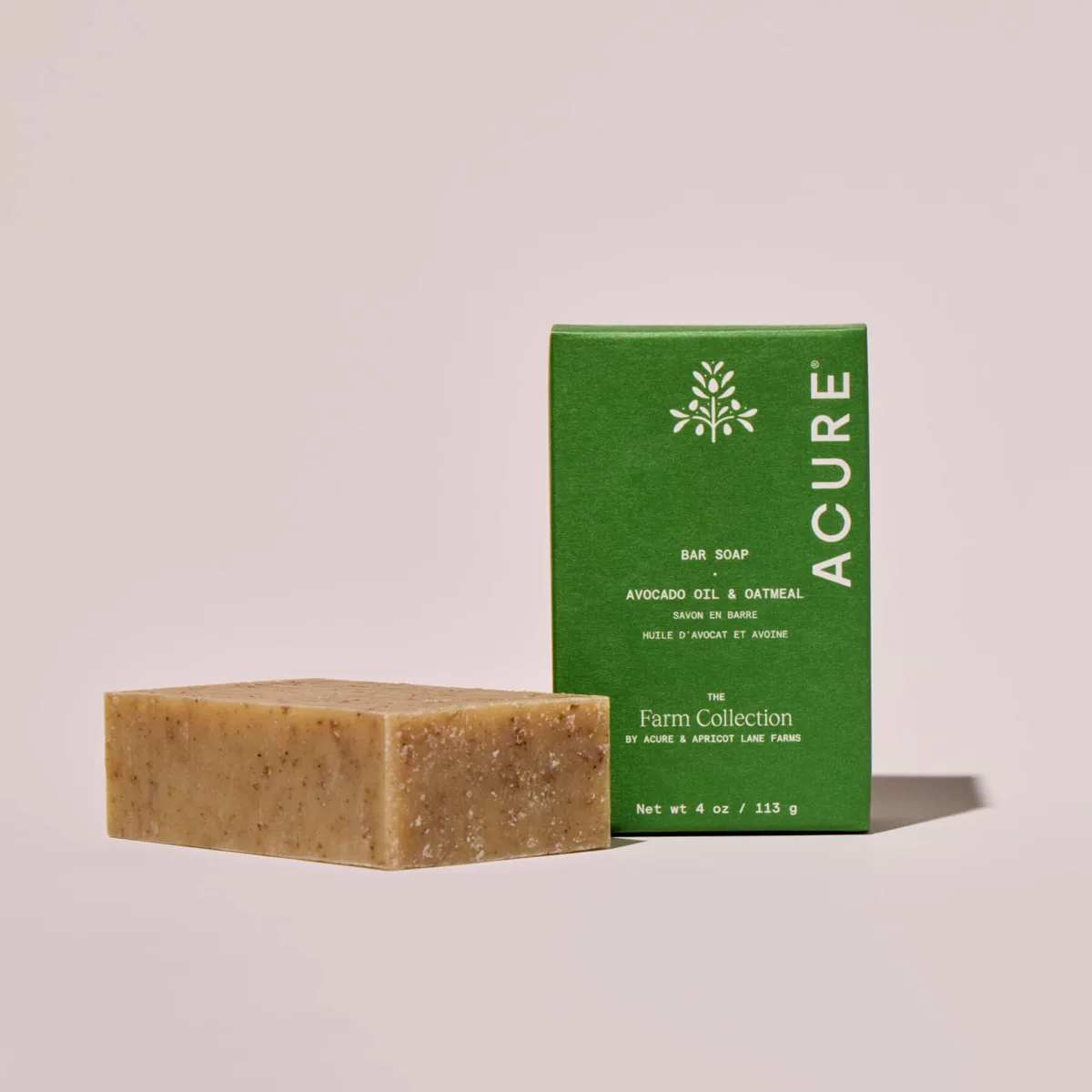
Acure Farm Collection Avocado Oil & Oatmeal Bar Soap 113 g flecked sand-coloured bar beside its green paper box
What makes this different

Among oatmeal bars, which are almost always positioned as the plain, fragrance-free option, this one is the outlier: a cold-process sunflower-coconut-palm loaf with whole oat and ground clove for grain, superfatted with a single-origin regenerative avocado oil, and scented with clove bud and cassia oils rather than left unscented. It is the warmest-smelling oat bar on the shelf and, for exactly that reason, the least suited to the eczema-prone skin its own copy invites.

Acure

Acure Oatmeal Bar Soap Review

Spiced Farmhouse Oat Bar Body Care bar clean beauty Paraben free Cruelty free Vegan

A well-made cold-process oat bar, hard, creamy-lathering, superfatted with farm avocado oil and priced fairly, that smells of clove and cinnamon rather than of nothing. That scent is the whole story: it makes the bar a pleasure for resilient skin in a cold month and the wrong choice for the eczema-prone skin and children Acure's own guide points it at. Buy it as a spiced natural bar, not as a sensitive-skin one.

Price $7.99 4 oz / 113 g
Shopper rating 4.8 ★★★★★ 65 reviews
On the market 2025 Made in USA
Buy at Amazon ♥
Verdicts

How well it fits each concern

Just over a year on sale and around sixty-five reviews on Acure's site, seemingly pooled across the four Farm Collection soaps, leave this bar with a thin real-world record. The assessment rests instead on a ten-ingredient list published identically by Acure and by the farm's shop, and on the long literature around cold-process soap, oat and the two spice oils; where users have spoken, the recurring theme is the scent, not the skin.

No concern verdicts yet.

The scaleRecommendedGoodSupportingEarly evidenceNot for thisAvoidhow it works

As a body productNot judged: what a body product is for — real substance, not just slip, realistic to use daily — cannot yet be measured from the ingredient list (only fragrance load can).

A verdict is Dermington’s assessment of how well a product’s ingredients fit a concern — never a claim about what the product treats. Evidence dots and collected reviews sit beside it and are never blended in. Rules 0.5.1 · evidence table ev-2026.10-r231 · engine 5.2.0 · how we decide · this product’s receipt

Reader poll · Town SquareQuestion 1 of up to 3

Have you used Oatmeal Bar Soap?

One tap counts. A couple of optional follow-ups come next.

No account neededOne answer each, change it any timeCounted only in anonymous totalsHow the Square counts →
Assessment

Pros & cons

What it does well 6

  • Genuine cold-process sunflower, coconut and palm soap, ten readable ingredients
  • Dense, creamy lather with a fine oat and clove polish
  • Hard, slow-wearing loaf that lasts four to six weeks in the shower
  • Farm avocado oil superfat softens the alkaline squeak
  • Warm clove-cassia scent that suits a cold-weather shower
  • Eight dollars, certified vegan, paper box

Where it falls short 5

  • Clove bud and cassia oils are documented contact allergens, at odds with the eczema-prone positioning
  • Spice scent is strong and surprises anyone expecting a plain oat bar
  • True alkaline soap leaves dry skin tight without a follow-up lotion
  • Whole ground oat in a rinse-off bar delivers little of oat's soothing benefit
  • Contains palm oil, which the front of the box does not mention
Review

The full review

Oatmeal soap has a reputation to live up to, and it is a quiet one: the plain bar, the one with no smell, the one a pharmacist points a parent toward when a child's shins are rough and itchy. Acure's own guide to its four Farm Collection bars leans on exactly that reputation, recommending the oatmeal loaf for daily use, for eczema-prone skin, for children and adults alike. Then you read the ingredient list, which Acure and Apricot Lane Farms publish identically, and find clove bud oil and cassia oil sitting sixth and seventh, between the oats and the ground clove. Eugenol and cinnamaldehyde, in other words, two of the fragrance materials with the longest records in the patch-test literature, in the bar sold as the gentle one. The bar is not bad. It is simply not what its own positioning says it is, and the review has to start there.

What it actually is turns out to be rather good. The base is a classic three-oil cold-process soap: sunflower oil for a mild, conditioning lather, coconut oil for the bubbles and the cleaning power, palm oil for a hard loaf that does not dissolve in the dish, all three saponified with lye and, per the double asterisks, made with organic oils. Whole oats and ground clove are stirred through for grain, the farm's cold-pressed avocado oil is added late enough to survive as a superfat, and a little rosemary extract keeps the oils from going rancid. That is ten ingredients, every one of them legible, and it produces a sand-coloured, brown-flecked bar that looks handmade because in the relevant sense it is.

In the shower it behaves like a good natural bar. The lather is dense and creamy rather than the thin foam a cheap vegetable soap gives, the oat and clove grains offer a fine polish on elbows and hands that is closer to a washcloth than a scrub, and the rinse is clean with the faint squeak that tells you it is true soap rather than a synthetic detergent bar. The avocado superfat takes the edge off that squeak; on normal skin the aftermath is simply clean, not stripped. On dry skin, especially in a heated winter house, the tightness builds over the first week the way it does with any alkaline bar, and a lotion on damp skin is not optional.

The scent is the surprise, and how it lands depends entirely on what you wanted. Clove bud and cassia together smell of mulled wine, of a spice cupboard opened in December, warm and sweet and unmistakable, and in a steamy shower they fill the room for a few minutes before fading to almost nothing on the skin within the hour. As a seasonal bar for a cold morning it is genuinely lovely. As the neutral oat bar the box implies, it is a bait-and-switch, and among the small pool of reviews the recurring note from disappointed buyers is exactly that: they wanted plain and got Christmas.

The question that matters more than taste is who should be using it, and here the two spice oils are not a matter of preference. Eugenol from clove and cinnamaldehyde from cassia are both on the list of fragrance allergens that regulators in Europe require to be named on a label precisely because they sensitise people at meaningful rates; cinnamal in particular is a standing member of the fragrance mix used in patch testing. A person with intact, resilient skin can wash with them daily for years and never react. A person with eczema, whose barrier already lets more through and whose immune system is already inclined to overreact, is the person most likely to become sensitised, and a rinse-off product reduces that risk but does not remove it. Add the alkaline pH of a true soap, which removes more of the skin's own lipid than a syndet bar formulated near pH five, and the oatmeal bar is the one in the collection an eczema clinic would most want to see left on the shelf, whatever the guide says. The same logic applies to small children, whose skin is thinner and who cannot tell you a bar stings.

What about the oat itself, the reason the bar exists? Oat has a real record. Colloidal oatmeal is a recognised skin protectant, its avenanthramides calm itch in leave-on creams, and its beta-glucan holds water at the skin surface. The oat in this bar is whole ground grain, not the micronised colloidal grade, and it is in a soap that is on the skin for perhaps twenty seconds before rinsing, so what it contributes here is mostly texture and a faintly cereal note beneath the spice. It is not doing nothing, but it is not doing what the word oatmeal on a box makes people imagine, and it certainly is not offsetting the clove and cassia.

At eight dollars for a four-ounce loaf the price is above drugstore soap and well below artisan bars, and because the palm-hardened bar lasts four to six weeks in daily showers, the cost per wash is low. You are paying for a genuinely cold-process bar with a real superfat, actual essential oils rather than a synthetic accord, a paper box and the farm's story. The story changes nothing on the skin, and it is worth saying that Acure's regenerative-agriculture framing, admirable as farming, is not a skincare claim and should not be read as one.

So the recommendation splits cleanly. If your skin is normal, combination or oily and untroubled, and you like a hard natural bar with a warm spice scent for the cold half of the year, this is a good one, honest in its construction and fair in its price. If you are buying an oatmeal bar because someone in the house has eczema, dermatitis, a fragrance allergy or is very small, this is the wrong oatmeal bar, and the plain, fragrance-free syndet bar you had in mind is still the right answer. Acure makes a good soap here; it has just put it in the wrong box.
The science

Cold-process soap is the sodium salt of the fatty acids in its oils, and the oil blend fixes the bar's character: coconut's lauric acid makes a soluble soap that foams hard and cleans aggressively, sunflower's oleic and linoleic acids make a softer, less stripping salt, and palm's palmitic acid gives a bar that stays hard and wears slowly. The lye reaction leaves the finished bar at a pH of roughly nine to ten, and the well-replicated finding on alkaline cleansers is that they raise skin surface pH for hours after washing and remove more of the stratum corneum's own lipid than synthetic detergent bars formulated near pH five, which is the mechanistic basis for the standing dermatological preference for syndet bars on dry and eczematous skin. Superfatting, leaving a fraction of oil unsaponified, as the late-added avocado oil does here, deposits a little oleic-rich lipid back on the skin and measurably reduces the post-wash tightness, without changing the pH.

Oat's reputation rests mainly on colloidal oatmeal in leave-on products, where its avenanthramides have anti-itch and anti-inflammatory activity and its beta-glucan and starch fraction form a water-holding film; it is listed as an OTC skin protectant active in that form. Whole ground oat in a rinse-off bar contributes the same molecules at a fraction of the exposure, and the honest summary is that the oat here is a mechanical exfoliant with a soothing pedigree it has little opportunity to act on.

The clove bud and cassia oils matter more than either. Clove bud oil is roughly three-quarters eugenol, and cassia oil is predominantly cinnamaldehyde; both compounds appear on the European Union's list of fragrance allergens requiring individual labelling, cinnamaldehyde is a component of the fragrance mix used in standard patch-test series, and eugenol is a recognised sensitiser in the same literature. Rinse-off use lowers exposure and rates of reaction, which is why scented soaps are tolerated by most people, but sensitisation risk rises with barrier impairment, which is precisely the state of eczematous skin. Nothing in this formula is unusual for a spiced artisan bar; what is unusual is the audience it is recommended to.

The clinical view

Clinicians assessing this bar would separate the soap from the scent and object to both for the audience on the box. The standing guidance for atopic and dry skin is a synthetic detergent bar or wash at or near skin pH, fragrance-free, followed by an emollient on damp skin; a true soap at pH nine or ten sits outside that guidance regardless of what is stirred into it, and the oat does not change its chemistry. The clove bud and cassia oils are the sharper concern: eugenol and cinnamaldehyde are among the fragrance materials most frequently positive on patch testing, and a compromised barrier is the condition under which sensitisation is most likely, so recommending a bar containing both to eczema-prone skin and to children runs against ordinary contact-dermatitis prevention. For a healthy adult with resilient skin and no history of fragrance reactions, a superfatted cold-process bar used on the body is a reasonable cleanser, and the advice would be limited to keeping it off the face, moisturising afterwards in winter, and stopping if any redness or itch develops where the bar is used.

Formula

Key ingredients

  1. Avena Sativa (Oats), whole ground

    Ground whole oat, not the micronised colloidal grade of the eczema creams, so in this bar it is chiefly a soft exfoliating grain and a source of the flecks in the loaf; the avenanthramides and beta-glucan that make oat soothing are present but in a rinse-off alkaline bar their contact time is seconds. It gives the bar its texture and its name more than its gentleness.

    Not yet assessed
  2. Sodium Sunflowerate, Sodium Cocoate and Sodium Palmate

    The bar itself: sunflower, coconut and palm oils saponified with lye into true soap. Sunflower's oleic and linoleic acids give a mild, conditioning lather, coconut's lauric acid gives the bubbles and the cleaning power, and palm's palmitic acid makes the bar hard enough to survive a wet dish. There is no synthetic surfactant, and the trade is a pH near nine or ten.

    Not yet assessed
  3. Eugenia Caryophyllata (Clove Bud) Oil and Cinnamomum Cassia (Cassia) Oil

    The scent, and the part of this bar that argues with its label: clove bud oil is mostly eugenol and cassia oil is mostly cinnamaldehyde, two of the fragrance allergens named on every regulatory disclosure list, and they turn a plain oat bar into something that smells like a spice cupboard in December. On resilient skin they are a pleasant warmth; on the eczema-prone skin the bar is marketed to, they are the reason to hesitate.

    Not yet assessed
  4. Persea Gratissima (Avocado) Oil from Apricot Lane Farms

    Ninth on the list and left unsaponified, which makes it the superfat: a little free oil carried through the lather that stays on the skin after rinsing and blunts the tightness an alkaline bar leaves. Its regenerative single-origin provenance is the collection's selling point; its job in the bar is a small cushion of oleic acid.

    Not yet assessed
  5. Syzygium Aromaticum (Clove) Powder

    Ground clove, the brown speckles in the loaf and a second, milder grain alongside the oats; it also carries a trace of eugenol of its own. Decorative and textural rather than functional, it is why the bar looks flecked and smells of clove even after the oil's top note fades.

    Not yet assessed
Full ingredient list 10 ingredients ShowHide

Sodium Sunflowerate**, Sodium Cocoate**, Water / Aqua / Eau, Sodium Palmate**, Avena Sativa (Oats)*, Eugenia Caryophyllata (Clove Bud) Oil, Cinnamomum Cassia (Cassia) Oil, Syzygium Aromaticum (Clove) Powder*, Persea Gratissima (Avocado) Oil, Rosmarinus Officinalis (Rosemary) Leaf Extract (*Organic; **Made with Organic Oils)

Safety & formulation facts

  • Pregnancy safe
  • Not fragrance free
  • Alcohol free
  • Not oil free
  • Silicone free
  • Paraben free
  • Sulfate free
  • Cruelty free
  • Vegan
  • Not fungal-acne safe
Potential irritants Sodium CocoateEugenia Caryophyllata (Clove Bud) OilCinnamomum Cassia (Cassia) OilSyzygium Aromaticum (Clove) Powder
Common allergens Eugenia Caryophyllata (Clove Bud) Oil (eugenol)Cinnamomum Cassia (Cassia) Oil (cinnamaldehyde)
Compatibility

Skin types & routine

Routine step cleanser
Time of day Morning & night
Best season fall & winter
Finish non-greasy

Layering

Use it on the body and hands as the wash step, letting the oat flecks do a light polish on elbows and knees, then put a lotion on while the skin is still damp because a true soap cleans more thoroughly than it moisturises. Anyone with eczema, a cracked winter hand or a known spice allergy should treat it as a hand bar for the kitchen sink at most, not a daily body wash, and it has no place on the face.

When to expect results

It cleans and lightly polishes from the first wash and the spice scent lingers in the bathroom for a few minutes. Nothing accumulates: normal skin feels the same on day thirty as on day one, dry skin notices a growing tightness within the first week that a lotion on damp skin corrects, and anyone sensitised to clove or cinnamon may see redness within a few uses rather than after months.

Pairs well with shea-butterglycerincolloidal-oatmealceramides

A routine built around it

Morning

  1. THIS PRODUCT in the shower or at the sink
  2. Body lotion on damp skin
  3. Hand cream after washing

Night

  1. THIS PRODUCT in the shower
  2. A richer body cream on damp skin
Guidance

How to use it, and who it's for

How to use

Wet the skin and the bar, work up a lather in the hands or on a cloth, wash the body and hands, and rinse well; the oat and clove grains give a light polish if the bar is rubbed directly on elbows, knees and heels. Follow with a lotion or body cream while the skin is still damp, particularly in winter and on the shins, since a true soap cleans thoroughly and leaves nothing behind. Keep it away from the face and from any patch of eczema, cracked skin or a fresh shave. Store it on a draining dish out of standing water so the loaf stays firm. If clove, cinnamon or spiced products have ever caused a rash, patch test on the inner forearm for a few days before using it in the shower.

Is it worth the price?

Eight dollars for four ounces is fair for what is in the box: a properly cold-processed three-oil bar with a genuine superfat, real essential oils, ground oat and clove for texture, and a paper carton, at a price below most artisan bars and above a drugstore loaf. Because it is palm-hardened it wears slowly, four to six weeks of daily showers or a couple of months at a sink, so the cost per wash is modest, and the four-bar quartet is the better buy for a household that will use all four scents. The value collapses only if the bar is bought for the wrong reason: a person with eczema or a child with sensitive skin gets a worse cleanser than a three-dollar fragrance-free syndet bar, and no amount of farm provenance offsets that. For normal, resilient skin that likes a spiced natural bar, the money is well spent.

Who should buy it

Adults with normal, combination or oily skin who want a hard, creamy, genuinely natural bar with a warm clove-and-cinnamon scent for the cold months, a light oat polish and a paper box, and who keep a body lotion by the shower. It suits fans of the Farm Collection and anyone who prefers saponified oils to synthetic detergent bars as a matter of principle.

Who should skip it

Anyone buying an oatmeal bar for eczema, dermatitis, a fragrance allergy or a small child: the clove bud and cassia oils and the alkaline base make it the wrong bar for those skins, whatever the guide suggests. People who want an unscented oat bar, anyone avoiding palm oil, and anyone looking for a facial cleanser should also pass.

Ready to try it?Acure Oatmeal Bar Soap · $7.99 · 4 oz / 113 g
Details

The product, in detail

Texture
A hard, sand-coloured loaf flecked with brown clove and pale oat, whose surface gives a fine, cushioned scrub as it lathers into a dense, creamy foam that rinses clean and slightly squeaky
Scent
Warm clove and sweet cinnamon, like mulled spice, riding on the faintly cereal smell of oat; strong in a steamy shower and mostly gone from the skin within the hour
Packaging
Green paper box carrying the Farm Collection's olive-branch mark and the bilingual English-French label; no plastic, no wrapper
How long it lasts
Roughly four to six weeks as a daily shower bar, or two to three months at a bathroom sink
Once opened
Use within 24 months · track your toss-by date →
Size
4 oz / 113 g
Made in
USA
Launched
2025
Certifications
Certified vegan · Leaping Bunny (cruelty-free)

What the first two weeks feel like

The first shower tells you almost everything: a generous, creamy lather for a natural bar, a scrub from the oat and clove grains that is more pleasant than abrasive, and a clove-and-cassia scent that surprises anyone who expected the neutral smell of an oatmeal bar. Normal skin feels clean and unremarkable afterwards; dry skin is tight by the second or third day and wants lotion; the bar stays firm on a draining dish and turns to paste if left in the soap-dish puddle.

The story behind it

Why it exists

Acure launched the Farm Collection in August 2025 with Apricot Lane Farms, the regenerative farm in Moorpark, California that The Biggest Little Farm made famous, and the four bar soaps, oatmeal, peppermint, thyme and lavender, are its most rustic products, made with the farm's cold-pressed avocado oil and sold singly or as a quartet. Acure's own bar-soap guide points the oatmeal bar at eczema-prone skin, children and daily use, a positioning inherited from the oat bar's traditional reputation rather than from this particular spiced formula.

About Acure Established Brand (5–20 years)

Founded in 2009 and sold through Target, Whole Foods and the natural grocers, Acure built its name on certified-vegan, Leaping Bunny formulas with plain ingredient decks rather than on clinical testing. The Farm Collection, launched in August 2025 with Apricot Lane Farms, is its first single-origin line; this bar's ten-ingredient list is published identically on Acure's site and on the farm's own shop.

Brand founded 2009 · This product since 2025

Myth vs. reality

What people get wrong about it

MythAn oatmeal soap is automatically the safe choice for eczema.

RealityOat itself earns that reputation, and colloidal oatmeal is an FDA-recognised skin protectant in leave-on creams. In this bar the oat is a ground grain in an alkaline soap that is rinsed off in seconds, and it shares the loaf with clove bud and cassia oils, whose eugenol and cinnamaldehyde are among the fragrance allergens most often implicated in contact dermatitis. For eczema-prone skin the sensible oatmeal choice is a fragrance-free syndet bar or a leave-on colloidal oat cream, not a spiced true soap.

MythTen ingredients means it is gentler than a long-list body wash.

RealityA short list is easier to read, not easier on the skin. Three of these ten are saponified oils that sit at a pH of around nine or ten, and two are essential oils that regulators require to be disclosed by name because of their allergy record. A thirty-ingredient syndet wash formulated at pH five with no fragrance is gentler by every measure that matters to a compromised barrier.

FAQ

Questions people ask

What is in Acure Oatmeal Bar Soap?

Ten ingredients, published identically on Acure's site and on Apricot Lane Farms' shop: saponified sunflower, coconut and palm oils, water, whole oats, clove bud oil, cassia oil, ground clove, the farm's avocado oil and rosemary leaf extract. It is a true cold-process soap with no synthetic detergent and no added glycerin beyond what saponification leaves behind.

Is Acure Oatmeal Bar Soap fragrance-free?

No, and this is the thing to know before buying it for sensitive skin. It is scented with clove bud oil and cassia oil, which smell of mulled spice and contain eugenol and cinnamaldehyde, two of the fragrance allergens that cosmetics regulators require to be declared. An oatmeal bar is usually the unscented option; this one is the exception.

Is Acure Oatmeal Bar Soap good for eczema?

Acure suggests it for eczema-prone skin, and the oat is genuinely soothing in leave-on form, but a true alkaline soap scented with clove and cassia is a poor match for eczema on two counts: its pH strips more lipid than a synthetic bar, and its two spice oils are well-documented contact allergens. A fragrance-free syndet bar is the safer daily cleanser for eczema; this bar is better kept for resilient skin.

Can children use Acure Oatmeal Bar Soap?

Acure's guide says it suits children and adults, and for a robust school-age child with normal skin a scented natural bar is fine for hands and body. For a baby, a toddler, or any child with eczema, the clove and cassia oils and the alkaline base make it a worse choice than a fragrance-free wash, so it is not the bar to reach for on a rash-prone child.

Does Acure Oatmeal Bar Soap exfoliate?

Lightly. Whole ground oat and ground clove give the loaf a fine grain that polishes elbows, knees and hands as it lathers, gentler than a salt or sugar scrub and closer to a washcloth. It is not a resurfacing product and does nothing for keratosis pilaris beyond the mechanical rub.

How long does a bar of Acure Oatmeal Bar Soap last?

About four to six weeks of daily showering, or two to three months at a sink, provided it drains between uses. The palm oil in the base makes it a hard, slow-wearing loaf; left sitting in water it softens to paste like any true soap.

Can I use Acure Oatmeal Bar Soap on my face?

It is better kept below the neck. Facial skin objects to alkaline soap more than the body does, and clove and cassia oils are more fragrance than a face needs, particularly around the eyes. Acure sells facial cleansers formulated closer to skin pH for that job.

Reviews

What shoppers tend to say

Recurring themes our editors read across retailer reviews — summaries in our words, not quotations, and not a substitute for a patch test.

Common praise

  • Creamy lather with a gentle oat grain
  • Warm clove-cinnamon scent that feels seasonal
  • Hard bar that lasts through weeks of showers
  • Simple, readable ingredient list

Common complaints

  • Spice scent is stronger than expected for an oatmeal bar
  • Tight, squeaky feel on dry skin
  • Scent is polarising for people who wanted something plain
  • Pricey for a bar of soap
Notable endorsementsPart of the Acure x Apricot Lane Farms Farm Collection, the regenerative farm of The Biggest Little FarmCertified vegan and Leaping Bunny, sold in a paper box
Next stepCheck it against what you already useClashes, spacing and the right order, with everything on your shelf.