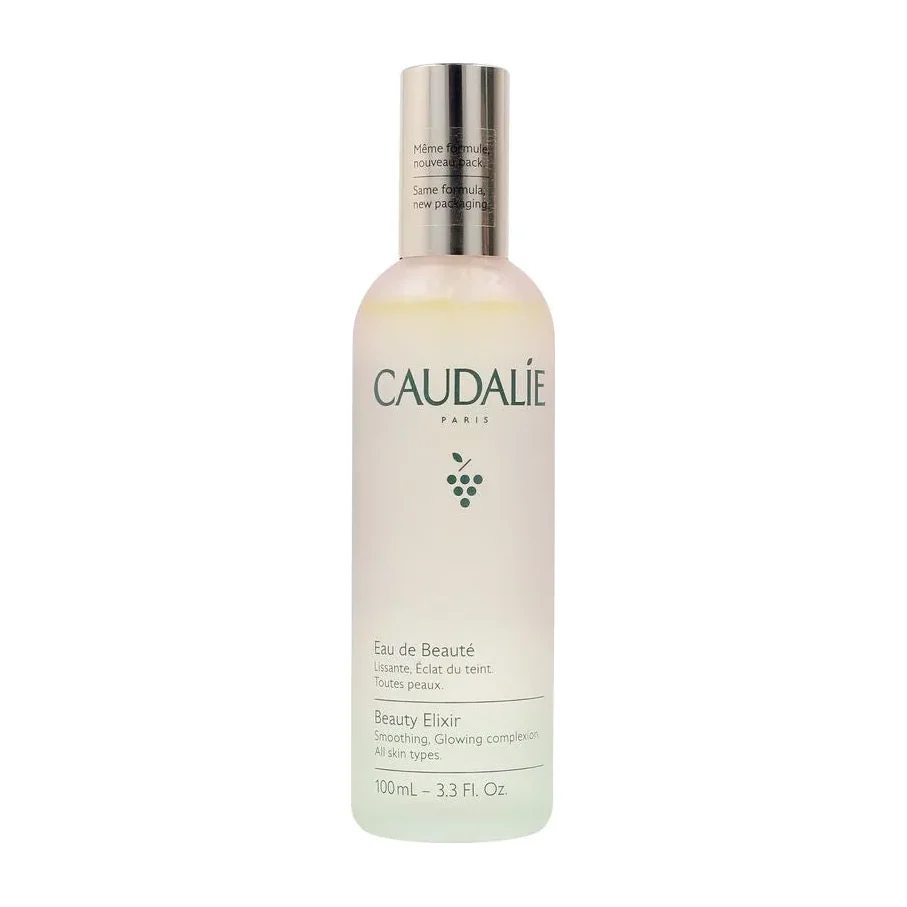
Caudalie Beauty Elixir blue glass spray bottle
Unproven for Dullness
What makes this different

This is arguably the most famous face mist in modern Western skincare — the product that reportedly sits on Victoria Beckham's airplane tray and gets name-checked in a generation of fashion magazines. What makes it genuinely distinctive is the aromatherapy-inspired formula and the historical tie-back to medieval beauty recipes that Caudalie's co-founder referenced when building it. It is almost entirely a sensory and aesthetic product, not a treatment.

Caudalie

Caudalie Beauty Elixir Review

Sensory Cult Classic Toners mist clean beauty Paraben free Cruelty free Vegan

A beloved sensory ritual in a blue bottle — Caudalie's most famous product is essentially a scented aromatic mist that became a cult classic on the strength of its cooling peppermint hit, its Queen-of-Hungary-water origin story, and its status as a celebrity travel companion. As skincare, it's mostly fragrance and ritual; as a mood product, it's legitimate. The gap between those two things is the problem.

Price $49.00 100ml · more sizes
Shopper rating 4.4 ★★★★★ 25,000 reviews
On the market 1997 Made in France
Best for oilynormal
Buy at Amazon ♥
Verdicts

How well it fits each concern

One verdict per concern. Open a row for the reasoning; the receipt has every source.

The scaleRecommendedGoodSupportingEarly evidenceNot for thisAvoidhow it works

Unprovenfor DullnessGlycerin has early or mechanistic evidence for dullness — a reasonable bet, not a recommendation; the other actives here are not yet assessed for it.Receipt1 source on the row · concentration not declared; studied range 2–20% · row checked Jul 17, 2026 · rule R9, same reading on 4,156 products · open the receipt

The case for it

  1. Glycerin has early or mechanistic evidence for this concern, not trial-backed standing.
  2. It is present at an effective concentration, declared or high in the ingredient list.
  3. The formula carries no trigger this concern is sensitive to, with the cautions noted.

Limited evidenceStandard tolerabilityNo reviews read yet

What would change this: Trial evidence for the active on this concern would move this from a bet to a recommendation.

Same rule for everyone. “Unproven” is the verdict on 4,156 of 45,446 concern verdicts across the catalog; rule R9 decided 4,156 of them. Unchanged since October 9, 2026, engine 5.2.0.

Brand or formulator? Disclose a concentration or correct a fact →

The full receipt: rule, row, sources, dates →All dullness products →How dullness is treated →

Does the jobDoes what a toner is for: adds something real. Not measured from the label: restores skin pH, plays well with what follows.

A verdict is Dermington’s assessment of how well a product’s ingredients fit a concern — never a claim about what the product treats. Evidence dots and collected reviews sit beside it and are never blended in. Rules 0.5.1 · evidence table ev-2026.10-r231 · engine 5.2.0 · how we decide · this product’s receipt

Reader poll · Town SquareQuestion 1 of up to 3

Have you used Beauty Elixir?

One tap counts. A couple of optional follow-ups come next.

No account neededOne answer each, change it any timeCounted only in anonymous totalsHow the Square counts →
Assessment

Pros & cons

What it does well 5

  • Distinctive and genuinely beloved scent profile
  • Instant cooling sensation from peppermint and alcohol evaporation
  • Long cultural history and cult-status brand mythology
  • Beautiful blue glass packaging that photographs well
  • Works reasonably as a makeup refresh or setting mist

Where it falls short 6

  • Extensive fragrance allergen list — eleven declared allergens
  • Alcohol as the second ingredient can be drying
  • Expensive for what is essentially an aromatic water
  • Minimal documented skincare benefits
  • Unsuitable for sensitive, rosacea-prone, or compromised barrier skin
  • Sold with treatment-product claims it cannot support
Review

The full review

You apply this elixir and feel as refreshed as someone who has just stepped into a first-class lounge after a red-eye — which is, in fact, exactly the context it's most famous for being used in. The Beauty Elixir has spent the better part of three decades being photographed on fashion editors' desks and tucked into Victoria Beckham's in-flight skincare routine, and that association is inseparable from what you're actually buying. This is a product that sells an atmosphere as much as a formulation, and once you accept that framing the price and ingredient list start to make a different kind of sense.

The origin story is legitimate and unusual. Mathilde Thomas, Caudalie's co-founder — who with Bertrand Thomas built the brand in 1995 on grape-polyphenol research out of Bordeaux — built the elixir by adapting a recipe from a 16th-century medicinal text for the 'Queen of Hungary water,' a distillation of rose, rosemary, and aromatic oils that was prized in medieval and early modern Europe as a beauty restorative. Thomas refined it into a modern spray-able mist in 1997, long before the face mist category existed as we know it today. Every other face mist currently on the market, in some sense, owes its existence to this one getting there first. That matters for the product's cultural position, even if it doesn't change what's in the bottle.

What is in the bottle is, essentially, water, alcohol, glycerin, and an aromatic bouquet of essential oils — rose, rosemary, peppermint, orange peel, cinnamon leaf, balsam of Peru, benzoin resin, myrrh, and several more. The fragrance allergen declarations at the end of the INCI run through eleven separate compounds: cinnamal, eugenol, linalool, limonene, geraniol, citral, citronellol, farnesol, benzyl benzoate, benzyl cinnamate, and balsam of Peru itself. That is one of the most extensive allergen lists in any mainstream skincare product, and it is the single biggest reason dermatologists tend to be quietly exasperated when asked about this elixir. If you have any meaningful skin sensitivity, any history of fragrance reactions, or any rosacea or eczema tendency, this product is a minefield. The same essential-oil load makes it a sensible one to run past a doctor during pregnancy, and it has no business anywhere near a face mid-retinoid-adjustment or on an exfoliating-acid day.

The actual skincare function is close to negligible. Glycerin provides a small amount of humectant pull; alcohol provides the cooling evaporation that makes the spray feel instantly refreshing; peppermint oil contributes the characteristic tingle. There are no documented meaningful benefits to sebum regulation, hyperpigmentation, barrier support, or aging that any peer-reviewed dermatology literature attributes to this formulation. It doesn't set makeup in the technical sense — there's no polymer in it. It doesn't tone in the modern sense — there's no acid or niacinamide, though the mist itself is buffered to a skin-neutral 5.5. What it does is feel like something, and smell like something, and make the person using it briefly enjoy the process.

Here's where the review gets honest about what it's for. As a midday refresh for someone commuting in summer, as an airplane ritual on a long flight, as a mist you reach for when your makeup is feeling dry, as the kind of product that sits on a shelf and gets used four times a day because it smells beautiful — it works. Held twenty centimeters from a closed-eyed face, the fine spray delivers its cold thirty-second theater on demand, and a bottle used that way lasts around three months. That is a real category of skincare purchase, and pretending otherwise would be dishonest. The tens of thousands of reviews it has gathered — still averaging comfortably above four stars after nearly three decades — agree on the split: the scent and the cooling hit are the praise, and 'expensive for what it is' leads the complaints, followed closely by the fragrance overwhelming sensitive noses and skins. The problem is that Caudalie sells it as if it were a treatment product, and priced it accordingly, and lets decades of magazine coverage imply that spraying it will make your skin glow. It won't. It will make your face feel cold for thirty seconds and smell like a 16th-century apothecary for a few minutes.

The value calculation depends entirely on what you're buying it for. At around fifty dollars for a 100ml bottle, the per-use cost is reasonable for a sensory ritual product and terrible for anything that could be called treatment; the 30ml travel size is the more defensible way in, both financially and because travel is where this product genuinely earns its keep. If the ritual matters to you, and you aren't sensitive to essential oils or alcohol, and you understand that you're buying an aromatherapy mist with a French skincare brand logo, it's a defensible purchase. If you're new to skincare and tempted by the mythology, save your money — a hydrating essence from any mid-tier Korean brand will do something measurable to your face for a fraction of the price. And if you have even mild sensitivity, this is the single easiest 'no' in Caudalie's entire range.
The science

The ingredients in the Beauty Elixir have limited published support for meaningful skincare outcomes at the concentrations used in a water-based face mist. Glycerin is well-documented as a humectant and is the only ingredient with a real skin-level mechanism in this formula. Rosemary and rose extract have in vitro antioxidant activity, but the concentration delivered in a mist format — where product sits on skin for seconds before evaporating — is orders of magnitude below anything that would produce documented effect. Peppermint oil's cooling sensation is mediated through TRPM8 receptor activation and is purely sensory. The extensive essential oil content is a documented source of contact dermatitis in susceptible individuals; dermatology literature on fragrance sensitization consistently lists several of the compounds in this formula (balsam of Peru, cinnamal, eugenol) among the most common causes of contact allergy in patch test populations. There are no peer-reviewed clinical trials of the Beauty Elixir formulation itself demonstrating benefit beyond subjective user experience. This doesn't mean the product is useless — sensory skincare has real psychological value — but it does mean the product should be understood on those terms rather than as a treatment product.

The clinical view

Dermatologists are generally diplomatic about Beauty Elixir but typically do not recommend it. Most dermatologists highlight that the fragrance allergen profile is among the most concerning in mainstream skincare and that the alcohol content is inappropriate for compromised or dehydrated skin. Derms will commonly suggest that patients who love the sensory experience keep it as a scented mist and not rely on it for any treatment benefit. For patients with any history of contact allergy, rosacea, perioral dermatitis, or sensitive skin, this product is typically on the 'avoid' list.

Formula

Key ingredients

  1. Rose Water

    Acts as the cosmetic carrier and adds a mild astringent, fragrant note — in this elixir the rose water's main role is olfactory and sensory rather than delivering any meaningful skin activity.

    Not yet assessed
  2. Rosemary Extract

    Contributes antioxidant polyphenols and a characteristic herbal note — alongside the balm of gilead and benzoin this is part of the elixir's historical aromatherapy-inspired identity, but the concentration delivered in a spray format is too low for meaningful skin benefits.

    Not yet assessed
  3. Peppermint Oil

    Creates the signature cooling tingle when sprayed on skin — this is the sensory hook of the product, and the reason people describe the elixir as 'refreshing' rather than any barrier or hydration function.

    Not yet assessed
  4. Glycerin

    Provides the only meaningful humectant effect in the formula — a minor skin-level benefit in a product that is primarily a fragrance-and-sensation experience.

    Plausible mechanism for Dullness
Full ingredient list 26 ingredients · pH 5.5 ShowHide

Aqua (Water), Alcohol, Glycerin, Rosa Damascena Flower Water, Benzoin, Styrax Tonkinensis Resin Extract, Rosmarinus Officinalis (Rosemary) Leaf Extract, Mentha Piperita (Peppermint) Leaf Extract, Boswellia Carterii Oil, Melissa Officinalis Leaf Extract, Citrus Aurantium Dulcis (Orange) Peel Oil, Cinnamomum Cassia Leaf Oil, Myrtus Communis Oil, Myroxylon Pereirae (Balsam Peru) Oil, Styrax Benzoin Resin Extract, Benzyl Benzoate, Benzyl Cinnamate, Cinnamyl Alcohol, Cinnamal, Linalool, Limonene, Geraniol, Citral, Eugenol, Farnesol, Citronellol

Safety & formulation facts

  • Pregnancy safety unverified
  • Not fragrance free
  • Not alcohol free
  • Not oil free
  • Silicone free
  • Paraben free
  • Sulfate free
  • Cruelty free
  • Vegan
  • Not fungal-acne safe
Potential irritants alcoholpeppermint oilcinnamaleugenollinaloollimonenegeraniolcitral
Common allergens cinnamaleugenollinaloollimonenegeraniolcitralcitronellolfarnesolbenzyl benzoatebenzyl cinnamatebalsam peru
Compatibility

Skin types & routine

Routine step toner
Time of day Morning & night
Best season spring & summer
Finish invisible

Layering

Best used as a midday refresh mist over makeup or as a setting spray. Not suitable as a treatment-layer toner for most skin types.

When to expect results

Immediate cooling and refreshing sensation. No meaningful long-term skin improvements documented.

Pairs well with makeup settingtravel refresh
Don't combine with active retinoid routinesexfoliating acid dayscompromised barriers

A routine built around it

Morning

  1. Cleanser
  2. Serum
  3. Moisturiser
  4. SPF
  5. THIS PRODUCT as midday refresh

Night

  1. Cleanser
  2. Treatment
  3. Moisturiser
Guidance

How to use it, and who it's for

How to use

Close your eyes and spray a fine mist from about 20cm away. Use as a midday refresh, after makeup application as a setting step, during travel, or whenever you want the sensory experience. Avoid around the eye area. Do not substitute for a proper hydrating toner, essence, or serum step in your routine.

Is it worth the price?

At around $49 for 100ml, the Beauty Elixir is priced in prestige-sensory-product territory rather than effective-treatment territory. A 30ml travel size is typically available at lower cost and is the more defensible entry point. The brand heritage and cultural position justify the premium for buyers who want the ritual; the formulation does not justify the premium for buyers evaluating on merit. Caudalie is an established French brand with decades of presence, which slightly softens the premium-price concern — but the specific product here is one where hype has substantially outrun formula.

Who should buy it

Users who already love Caudalie's brand aesthetic, prize ritual and scent in their routines, travel frequently, and have resilient non-sensitive skin. Anyone who buys skincare partly as a sensory experience and wants one of the most famous face mists in the category.

Who should skip it

Sensitive, rosacea-prone, eczema-prone, or barrier-compromised skin. Anyone with a known fragrance allergy or a history of contact dermatitis. Users looking for a treatment-grade toner or essence — this isn't one. Anyone new to skincare and tempted by celebrity endorsements alone.

Ready to try it?Caudalie Beauty Elixir · $49.00 · 100ml
Details

The product, in detail

Texture
Clear, water-thin liquid delivered as a fine mist
Scent
Strong herbal, rose, balsam, and peppermint — the signature scent the product is famous for
Packaging
Distinctive blue glass bottle with spray pump
How long it lasts
About 3 months with daily midday refresh use
Once opened
Use within 12 months · track your toss-by date →
Size
100ml · other sizes available
Made in
France
Launched
1997
Certifications
vegan

What the first two weeks feel like

A cool, almost astringent tingle on first spray from the peppermint and alcohol. The scent hits immediately and is the reason most people either love or hate this product at first use.

The story behind it

Why it exists

Mathilde Thomas, Caudalie's co-founder, based the Beauty Elixir on a recipe in a 16th-century medicinal text she came across during the brand's early research — the so-called 'Queen of Hungary water,' a distillation of rose, rosemary, and aromatic oils that was prized in its era. She refined the formulation into a modern face mist in 1997, and it has been one of Caudalie's defining products ever since, long before face mists became a category.

About Caudalie Established Brand (5–20 years)

Caudalie was founded in 1995 in France by Mathilde and Bertrand Thomas, building on grape-polyphenol and resveratrol research from Bordeaux's Vineyard and pharmacy school connections. The brand has been established in French pharmacies and international retail for nearly three decades with moderate clinical backing.

Brand founded 1995 · This product since 1997

Myth vs. reality

What people get wrong about it

MythThe Beauty Elixir is a treatment product that improves skin over time.

RealityIt's essentially a scented alcohol-and-glycerin mist with trace plant extracts. Any skin improvement users experience is from the sensory ritual and cooling effect, not from meaningful active skincare ingredients.

FAQ

Questions people ask

Is Beauty Elixir worth the price?

As a functional skincare product, no — the formula is an alcohol-based aromatic mist with minimal actives and an extensive fragrance allergen list. As a sensory-ritual product and cult classic, the price becomes a personal judgment about what you value. Most dermatologists would not recommend it for its claimed skincare benefits.

Can it replace a toner?

No. Most modern toners deliver actual hydrating or exfoliating actives, and this product delivers neither in meaningful amounts. Treat it as a refreshing mist or setting spray, not a treatment step.

Why does it feel cold when I spray it?

The peppermint oil and alcohol content create an immediate evaporative cooling sensation. This is the product's signature sensory hook and the reason it became popular as a midday refresh.

Can sensitive skin tolerate Beauty Elixir?

Almost certainly not. The fragrance allergen list is one of the longest in any Caudalie product — cinnamal, eugenol, linalool, limonene, geraniol, citral, citronellol, farnesol, balsam of Peru, benzyl benzoate, and benzyl cinnamate are all present. Sensitive or rosacea-prone skin should strictly avoid it.

Is there alcohol in it?

Yes — ethanol is the second ingredient. This is drying for compromised or dehydrated skin, though it's part of what delivers the instant cooling effect.

Can I spray it over makeup?

Yes, and this is arguably the best use for it. As a setting spray or midday refresh over finished makeup, it delivers the sensory benefit without trying to replace a treatment step.

Reviews

What shoppers tend to say

Recurring themes our editors read across retailer reviews — summaries in our words, not quotations, and not a substitute for a patch test.

Common praise

  • refreshing scent and cooling sensation
  • great as a setting mist
  • luxurious travel companion

Common complaints

  • expensive for what it is
  • strong fragrance can be overwhelming
  • not suitable for sensitive skin
  • alcohol-based formulation
Notable endorsementsVictoria Beckham publicly endorsedlong-running beauty press coveragefrequent cult classic lists
Related conditions Dullness
Related ingredients glycerin
Next stepCheck it against what you already useClashes, spacing and the right order, with everything on your shelf.