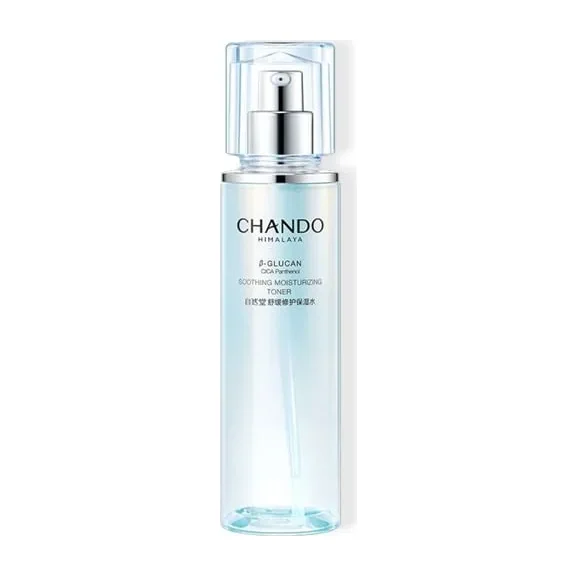
Chando Himalaya Soothing Moisturizing Toner in a pale blue 150 ml bottle with a clear-capped pump
Good choice for Dehydration
What makes this different

It is a humectant toner that leans on diglycerin and a water-soluble silicone rather than on a wall of glycerin, which gives it a genuinely watery, non-tacky feel that is rare in hydrating toners at this price. The panthenol dose is real; the cica and beta-glucan on the front label are present at lower levels than the marketing suggests.

Chando

Chando Soothing Moisturizing Toner Review

Feels-Like-Water Hydrator Toners liquid c beauty Paraben free Fungal-acne safe Not cruelty free

A watery, non-tacky humectant toner that hydrates modestly, layers under anything, and carries a real dose of panthenol — the honest reason it soothes. The cica and beta-glucan on the label are further down than the marketing implies, and there is a light fragrance in a product sold for sensitive skin. A pleasant, low-risk hydrating step rather than a calming treatment.

Price — 150 ml
On the market 2024 Made in China
Buy at Amazon ♥
Verdicts

How well it fits each concern

Without any independent, product-level reviews outside China and with only a 2025 export listing, this assessment relies on the ingredient list and on the extensive published record of glycol, glycerin and panthenol hydrators rather than on tracked user outcomes. Chando's own domestic feedback exists in volume but cannot be verified and has not influenced the score.

One verdict per concern. Open a row for the reasoning; the receipt has every source.

The scaleRecommendedGoodSupportingEarly evidenceNot for thisAvoidhow it works

Good choicefor DehydrationPanthenol (Vitamin B5) is a reference standard by mechanism for dehydration; this liquid carries it high in the ingredient list.Receipt1 source on the row · concentration not declared; studied range 2.5% · row checked Jul 17, 2026 · rule R5, same reading on 9,843 products · open the receipt

The case for it

  1. Panthenol is a reference standard by mechanism for this concern — an established physical action, not a trial result.
  2. It is present at an effective concentration, declared or high in the ingredient list.
  3. The formula carries no trigger this concern is sensitive to, with the cautions noted.

Limited evidenceStandard tolerabilityNo reviews read yet

Same rule for everyone. “Good choice” is the verdict on 10,340 of 45,446 concern verdicts across the catalog; rule R5 decided 9,843 of them. Unchanged since September 25, 2026, engine 5.2.0.

Brand or formulator? Disclose a concentration or correct a fact →

The full receipt: rule, row, sources, dates →All dehydration products →

Does the jobDoes what a toner is for: not alcohol-driven, adds something real. Not measured from the label: restores skin pH, plays well with what follows.

A verdict is Dermington’s assessment of how well a product’s ingredients fit a concern — never a claim about what the product treats. Evidence dots and collected reviews sit beside it and are never blended in. Rules 0.5.1 · evidence table ev-2026.10-r231 · engine 5.2.0 · how we decide · this product’s receipt

Reader poll · Town SquareQuestion 1 of up to 3

Have you used Soothing Moisturizing Toner?

One tap counts. A couple of optional follow-ups come next.

No account neededOne answer each, change it any timeCounted only in anonymous totalsHow the Square counts →
Assessment

Pros & cons

What it does well 7

  • Four-humectant base with diglycerin gives real hydration without tackiness
  • Panthenol placed sixth is a genuinely useful dose for calming post-cleanse redness
  • Alcohol-free, acid-free and free of drying astringents
  • Water-soluble silicone makes it layer under serums without pilling
  • Feels like water and absorbs in seconds on all skin types
  • Pump-and-cap bottle keeps the formula hygienic and doses precisely
  • Safe partner under retinoids and exfoliating acids

Where it falls short 6

  • Centella extract is second-to-last, behind the fragrance
  • Beta-glucan and hyaluronate sit behind the thickener, suggesting modest levels
  • Contains parfum despite the sensitive-skin positioning
  • Too light to hydrate dry skin on its own
  • Not silicone-free, which some readers avoid
  • No independent international review record yet
Review

The full review

The front of the bottle lists three things in small capitals: beta-glucan, cica, panthenol. It is a confident little manifesto for a sensitive-skin toner, and it is worth turning the bottle round straight away, because the back tells the story in a different order. Panthenol is sixth, high enough to matter. Beta-glucan is fifteenth, just behind sodium hyaluronate and just after the carbomer that thickens the water. Centella asiatica extract — the cica — is twentieth of twenty-one, behind the fragrance. What the front promises is a calming trio. What the back delivers is a well-made humectant toner with one genuinely useful soothing ingredient and two that are mostly along for the story.

That is not a complaint about the toner so much as a correction to its marketing, because judged as a hydrating toner it is quietly good. The first seven ingredients after water are almost all humectants — butylene glycol, propanediol, glycerin, then a water-soluble silicone, then panthenol, diglycerin and dipropylene glycol — and the choice of diglycerin alongside ordinary glycerin is the formulator's tell. Glycerin at high levels gets tacky; diglycerin holds water almost as well without the drag, and using both lets the toner deliver real humectancy while feeling like slightly silky water. Betaine, another gentle osmolyte humectant, follows. On skin the effect is immediate and undramatic: press it in after cleansing and the tightness goes, the surface feels damp and comfortable, and thirty seconds later there is nothing left to feel except that the next product spreads better than it would on bare skin. That is precisely what a hydrating toner is for, and this one does it without stickiness, without alcohol and without any of the tingling that toners with acids or astringents bring.

The silicone deserves a note because it surprises people. Bis-PEG-15 methyl ether dimethicone is a water-soluble silicone, placed fifth, and it is the reason the toner has that faint slip and layers so cleanly under serums without pilling. It also means the toner is not silicone-free, which will matter to a small group of readers and to nobody's skin; water-soluble silicones of this kind do not sit on the skin as a film the way dimethicone does, and they rinse off completely.

Panthenol is the soothing ingredient that earns its place on the front. At position six in a leave-on it is present at a level where its well-documented effects — reducing transepidermal water loss, calming post-irritation redness, supporting barrier recovery — are plausible, and it is the most likely reason that people using this toner after a stripping cleanse or an acid find their skin settles faster. Beta-glucan and sodium hyaluronate, mid-list, add a whisper of film-forming hydration. The centella, at the level implied by its position, adds consistency with the rest of the Soothing Moisturizing line and very little else. If you were buying this toner specifically for cica, the honest advice is that the brand's essence and creams in the same range are where that ingredient is more likely to be doing work.

The one real misstep for a sensitive-skin product is the parfum, listed nineteenth. It is a light, clean, almost soapy scent that fades within a minute, and most people will never think about it. But fragrance is the first thing a dermatologist strikes from the routine of a patient with eczema, rosacea or a history of contact allergy, and a brand that names its line 'Soothing' and prints 'cica' on the front has invited exactly that reader to pick up the bottle. For them, this toner is a near miss: alcohol-free, acid-free, humectant-led and calm, but scented. For everyone else, it is a non-issue.

In practice the toner is very easy to live with. The frosted pale-blue bottle looks clinical in a pleasant way, and the pump under its clear cap gives a fine, controllable dose that keeps fingers out of the formula — a small hygiene point that matters more in a toner used twice daily than in a cream. Three or four pumps pressed into damp skin covers the face; on very dehydrated skin it can be layered two or three times without any risk, since there is nothing in it to overload. It suits normal, combination and oily skin best, where its light, complete absorption is a virtue; dry skin can use it happily but will find it disappears too quickly to feel hydrating on its own and will need an emulsion or cream promptly on top. It is also a sensible partner under retinoids and exfoliating acids, adding humectants and panthenol beneath them without adding to the exfoliant load.

Chando itself is a large and long-established company — founded in Shanghai in 2001, top of the Chinese women's skincare market by 2015, with an in-house research centre and a catalogue running to hundreds of products — and the competence of this formula is consistent with that scale. What the toner does not yet have is an independent, English-language track record. It reached an authorized international retailer only recently and there is no product-level review pool outside China to check the ingredient reading against, so this assessment is of the formula and of the well-known behaviour of its components rather than of many months of use across many skin types.

The summary is simple. This is a good, watery, alcohol-free hydrating toner with a real dose of panthenol and a texture that makes it a pleasure to layer, sold with a front label that overstates the role of its two most fashionable ingredients and a fragrance that its target reader might prefer it did not have. Bought as a comfortable daily hydration step, it is easy to recommend. Bought as a cica treatment, it will underdeliver, and the back of the bottle already says so.
The science

A hydrating toner works by depositing humectants at the stratum corneum surface, where they bind water from the deeper skin and, in humid conditions, from the air; the practical benefit is increased short-term surface hydration and improved spreading of subsequent products. This formula stacks four small humectants — butylene glycol, propanediol, glycerin and diglycerin — plus dipropylene glycol and betaine, an osmolyte with evidence for supporting keratinocyte water balance under osmotic stress. Glycerin has the strongest evidence base of any topical humectant, with controlled studies showing improved corneocyte hydration and barrier recovery; diglycerin behaves similarly with lower tack, which is a formulation rather than an efficacy distinction.

Panthenol, the provitamin of pantothenic acid, is the ingredient with the best-supported soothing claim in the list. In leave-on formulations at the low single-digit percentages its sixth-place position suggests, panthenol has been shown in controlled studies to reduce transepidermal water loss, accelerate recovery after surfactant-induced irritation, and reduce erythema, effects attributed to its humectancy and to pantothenic acid's role in epidermal lipid synthesis. Beta-glucan, a branched polysaccharide, has in-vitro data for fibroblast stimulation and small clinical studies for hydration and reduced irritation, though its high molecular weight limits penetration and its position here behind the carbomer implies a low concentration. Sodium hyaluronate in a toner provides surface film hydration; its effect is transient and depends on an occlusive step on top.

Centella asiatica extract carries the triterpenes madecassoside, asiaticoside and asiatic acid, which have credible wound-healing and anti-inflammatory evidence in leave-on formulations at meaningful concentrations. At the second-to-last position in this list, behind parfum, the expected contribution is minimal. Bis-PEG-15 methyl ether dimethicone is a water-dispersible silicone used as a slip agent and spreading aid; it does not form an occlusive film. The formula contains no ethanol, no exfoliating acids and no known photosensitisers, and the only component with a documented sensitisation risk is the fragrance. Overall, the evidence supports a mild, effective surface hydrator with a plausible panthenol-driven soothing effect, and does not support the stronger cica and beta-glucan claims implied by the front label.

The clinical view

Hydrating toners occupy a modest but legitimate place in dermatological routines: clinicians treating dry, dehydrated or retinoid-irritated skin often recommend an alcohol-free humectant layer applied to damp skin before moisturizer, precisely because it raises surface hydration and reduces the sting of subsequent actives. A formula built on glycols, glycerin and panthenol, with no ethanol and no acids, fits that recommendation well, and panthenol in particular is a frequent clinical suggestion for skin recovering from surfactant or procedural irritation. The reservation a dermatologist would raise is the fragrance: for patients with atopic dermatitis, rosacea or documented contact allergy, standard advice is to keep every leave-on product unscented, and a toner marketed for sensitive skin that lists parfum would usually be swapped for a fragrance-free equivalent. Clinicians also tend to remind patients that a toner is a supporting step, and that centella-based calming claims are better sought in serums or creams where the extract is present at working concentrations.

Formula

Key ingredients

  1. Humectant Base (Butylene Glycol, Propanediol, Glycerin, Diglycerin)

    Four humectants stacked at positions two through seven — this is a glycol-and-glycerin toner first and everything else second, and the diglycerin in particular is chosen because it holds water without the tackiness that plain glycerin brings at high levels, which is why the toner feels almost like water on the skin.

    Established mechanism for Dehydration · established mechanism
  2. Panthenol

    Listed sixth and named on the front of the bottle, panthenol is the one calming ingredient here that is high enough in the formula to matter in a leave-on; it converts to pantothenic acid in the skin and has solid data for reducing transepidermal water loss and post-irritation redness.

    Established mechanism for Dehydration · established mechanism
  3. Bis-PEG-15 Methyl Ether Dimethicone

    An unusual choice at position five — a water-soluble silicone that gives the toner a faint slip and helps the humectants spread evenly without a film; it is why the toner layers cleanly under serums and is the reason it is not silicone-free despite feeling like water.

    Not yet assessed
  4. Beta-Glucan + Sodium Hyaluronate

    The two large-molecule humectants that sit mid-list and carry the 'soothing' part of the name: beta-glucan forms a light film with reasonable data for calming and hydration, and hyaluronate holds water at the surface, though both are placed behind the carbomer, which suggests modest levels.

    Not yet assessed
  5. Centella Asiatica Extract

    The 'cica' of the label, and the second-to-last ingredient, behind the fragrance — a leave-on placement low enough that its triterpenes contribute little beyond keeping the toner consistent with the rest of the Soothing Moisturizing line's story.

    Not yet assessed
Full ingredient list 21 ingredients ShowHide

Water, Butylene Glycol, Propanediol, Glycerin, Bis-PEG-15 Methyl Ether Dimethicone, Panthenol, Diglycerin, Dipropylene Glycol, Betaine, Phenoxyethanol, Hydroxyacetophenone, PEG-40 Hydrogenated Castor Oil, Carbomer, Sodium Hyaluronate, Beta-Glucan, Potassium Hydroxide, Sodium Polyacrylate, Disodium EDTA, Parfum, Centella Asiatica Extract, Ethylhexylglycerin

Safety & formulation facts

  • Pregnancy safe
  • Not fragrance free
  • Alcohol free
  • Oil free
  • Not silicone free
  • Paraben free
  • Sulfate free
  • Not cruelty free
  • Not vegan
  • Fungal-acne safe
Potential irritants Parfum
Common allergens Fragrance
Compatibility

Skin types & routine

Routine step toner
Time of day Morning & night
Best season All year
Finish lightweight, fast-absorbing, natural

Layering

Press a few pumps into damp skin straight after cleansing and let it absorb for thirty seconds before serum; it can also be layered two or three times on very dehydrated skin since it has no actives to overload.

When to expect results

Skin feels damp and comfortable immediately; the humectant plumping is visible within a few days of twice-daily use, and any calming of post-cleanse redness from the panthenol shows over one to two weeks, with no further change beyond that.

Pairs well with serummoisturizersunscreenretinoidexfoliant

A routine built around it

Morning

  1. Cleanser
  2. Chando Soothing Moisturizing Tonerthis product
  3. Serum
  4. Moisturizer
  5. Sunscreen

Night

  1. Cleanser
  2. Chando Soothing Moisturizing Tonerthis product
  3. Treatment or serum
  4. Moisturizer
Guidance

How to use it, and who it's for

How to use

After cleansing, while the skin is still slightly damp, dispense three or four pumps into the palms or directly onto the face and press — rather than rub — over the cheeks, forehead, nose and chin. Allow twenty to thirty seconds for it to absorb, then follow with serum and moisturizer, and sunscreen in the morning. On very dehydrated skin, apply a second and third layer, letting each absorb before the next. It can also be used to dampen a cotton pad for a brief compress on tight, post-cleanse skin. Use morning and evening; there is nothing in the formula that limits frequency. Keep the clear cap on the pump between uses.

Is it worth the price?

In China the toner is priced in the accessible middle of Chando's range, in line with the pharmacy-brand hydrating toners it competes with, and a 150 ml pump lasting about two months at twice a day makes the monthly cost modest. What you pay for is a well-balanced humectant base, a useful panthenol dose and a pleasing texture; what you do not get is a meaningful amount of the cica and beta-glucan the front label sells, so the value rests on the toner being a good hydrator rather than a calming treatment. Outside China it is stocked by an authorized international retailer and by import shops with widely varying markups, and at the top of that range it costs as much as fragrance-free panthenol toners from brands with far more international validation. At a fair export price it is reasonable value; at a reseller premium, the unscented alternatives win.

Who should buy it

Normal, combination and oily skin that wants a light, alcohol-free hydration step that absorbs instantly and layers cleanly under serums, and anyone using retinoids or acids who wants a panthenol-rich buffer beneath them. It suits people building a Chando Soothing Moisturizing routine who are not bothered by a light scent.

Who should skip it

Anyone with eczema, rosacea or a fragrance allergy should choose an unscented hydrating toner, since parfum is listed here. Very dry skin looking for a toner that hydrates on its own, and anyone buying specifically for a strong cica or beta-glucan effect, will be underwhelmed.

Ready to try it?Chando Soothing Moisturizing Toner · 150 ml
Details

The product, in detail

Texture
A clear, water-thin liquid with the faintest slip from the water-soluble silicone; it spreads instantly and disappears into damp skin without residue.
Scent
A light, clean fragrance from a listed parfum — soft and fleeting, but present.
Packaging
A frosted pale-blue 150 ml bottle with a spray-style pump under a clear cap, matching the rest of the Soothing Moisturizing line; the pump gives a fine, controllable dose and keeps fingers out of the product.
How long it lasts
Roughly two months of twice-daily use at three to four pumps, or three months used once a day.
Once opened
Use within 12 months · track your toss-by date →
Size
150 ml
Made in
China
Launched
2024

What the first two weeks feel like

Nothing to acclimatise to: it feels like slightly silky water, absorbs in seconds and leaves skin damp and calm rather than tacky. Very dry skin may find it disappears too fast to feel hydrating on its own until a serum or emulsion goes on top. No tingling, purging or adjustment period.

The story behind it

Why it exists

The Soothing Moisturizing line is Chando's answer to the sensitive-skin category that has grown fastest in China over the past few years, built around a beta-glucan, centella and panthenol trio and a pale-blue, clinical-looking aesthetic. The toner is the entry step of that routine and is designed to sit under the line's essence, emulsion and creams.

About Chando Legacy Brand (20+ years)

Chando, founded in Shanghai in 2001 and China's top-selling women's skincare brand by 2015, develops its products through an in-house research centre under CHANDO Group. The Soothing Moisturizing range is its sensitive-skin line; its calming claims are supported by company testing and a very large domestic customer base rather than by independent English-language clinical publication.

Brand founded 2001 · This product since 2024

Myth vs. reality

What people get wrong about it

MythA cica toner calms irritated skin as effectively as a cica cream.

RealityCentella asiatica extract is the second-to-last ingredient in this toner, behind the fragrance. The calming that users notice comes mostly from the panthenol, listed sixth, and from the humectants; the cica is a label ingredient at this position.

MythToners that feel like water do nothing.

RealityThis one is built on butylene glycol, propanediol, glycerin and diglycerin, which draw and hold water at the skin surface even though the texture is thin; it hydrates modestly and improves how the next step spreads, which is exactly what a hydrating toner is for.

FAQ

Questions people ask

Is the Chando Soothing Moisturizing Toner alcohol-free?

Yes. There is no ethanol or denatured alcohol in the formula; the base is water with butylene glycol, propanediol, glycerin and diglycerin, so it hydrates rather than degreases.

Does the Chando Soothing Moisturizing Toner contain fragrance?

It does — parfum is listed near the end. The scent is light and fades quickly, but for anyone avoiding fragrance on medical advice it is a reason to choose an unscented hydrating toner instead.

Can I use this Chando toner with retinol or exfoliating acids?

Yes, and it is a good partner for them: it has no actives of its own, so it adds a layer of humectants and panthenol under a retinoid or acid without increasing the exfoliant load, which helps buffer the dryness those steps cause.

Is the Chando toner enough moisture on its own for oily skin?

For oily skin in warm weather it can be, since a few pumps leave skin comfortable and the water-soluble silicone stops it feeling tight. Combination and dry skin will still want an emulsion or cream over it.

What does the beta-glucan in the Chando Soothing Moisturizing Toner do?

Beta-glucan is a large humectant polysaccharide with reasonable evidence for hydration and soothing in leave-on products. In this toner it sits mid-list behind the carbomer, so expect a light film-forming and comfort benefit rather than a strong calming effect.

Reviews

What shoppers tend to say

Recurring themes our editors read across retailer reviews — summaries in our words, not quotations, and not a substitute for a patch test.

Common praise

  • Feels like water and absorbs instantly
  • Pump bottle is tidy and hygienic
  • Calms post-cleanse tightness without stickiness

Common complaints

  • Light fragrance in a product marketed for sensitive skin
  • Hydration is modest without a serum on top
  • No independent review pool outside China
Next stepCheck it against what you already useClashes, spacing and the right order, with everything on your shelf.