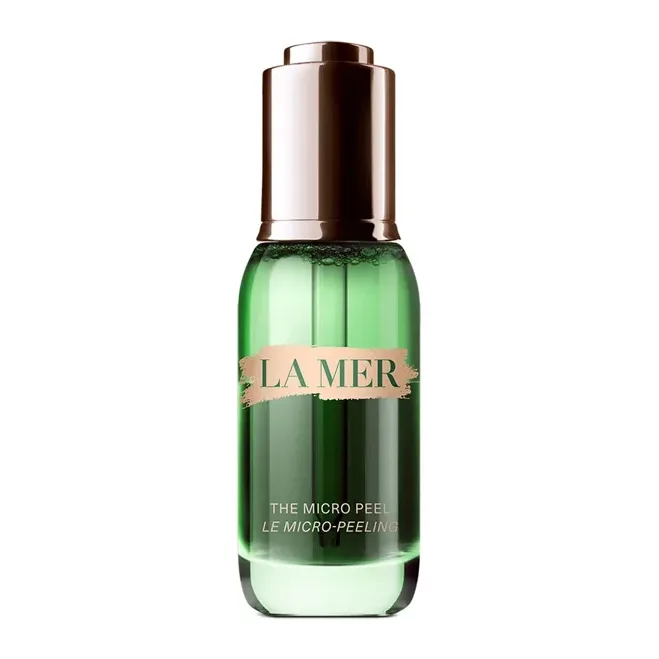
La Mer built its whole reputation on the opposite of a peel. The Crème de la Mer promise was soothing, sealing, a kelp broth pressed into skin that had been burned or stressed, and for most of the brand's history it left exfoliating acids to other houses. The Micro Peel, launched in 2022, is the moment La Mer decided to peel after all, and the way it went about it is the most revealing thing in the bottle. Glycolic acid sits eighth, a genuine leave-on dose, buffered by citrate and hydroxide further down, with gluconolactone, lactic, salicylic and phytic acids behind it for a multi-acid label; that part is competent and conventional. The second ingredient, above every oil, ferment and acid, is denatured alcohol, and near the end of the list come a fragrance with five declared allergens, clove flower extract, camphor, the broth's eucalyptus oil and four synthetic dyes. A brand that spent fifty years selling barrier comfort built its first acid product on exactly the ingredients acid users are told to avoid.
What the peel does, it does well. A thin layer on clean skin at night gives a cool alcohol flash and a tingle that builds for a minute and fades over a few more, and the meadowfoam, jojoba, almond and sesame oils, with a triglyceride and dimethicone, turn what would be a stinging liquid into a cushioned emulsion that sets to a soft, dewy film and can be left on until morning. The morning is the point: smoother, brighter, slightly tighter skin, the reliable overnight effect of a buffered glycolic acid on the stratum corneum, which is what La Mer's perception panel measured when ninety-odd percent of women said their skin felt replenished and clearer. Over two to four weeks of one-to-three-night use, texture, dullness and pore appearance improve, as they do with any regular AHA, and fine lines soften modestly. The Miracle Broth at seventeenth, a Lactobacillus ferment at ninth, a deep-sea Thermus ferment, the gluconate minerals and a long roster of sea fennel, samphire, spirulina, myrrh and plum extracts supply the barrier-strengthening vocabulary, generously placed, evidenced in vitro, unmeasured on faces. A peptide, a vitamin C ester and caffeine near the end are decoration.
The tolerance problem is structural rather than incidental. Glycolic acid opens the stratum corneum; that is its job. Denatured alcohol at second dries and further permeabilises skin the acid has opened, and a second alcohol appears near the end. Then the sensitisers arrive on that opened skin: limonene, hexyl cinnamal, benzyl salicylate, linalool and eugenol from the parfum, eugenol again from the clove extract, camphor, eucalyptus oil, and Blue 1, Red 4, Yellow 5 and Green 6 for a tint nobody needed. Every dermatology guide to leave-on acids says fragrance-free and alcohol-free for a reason, and the few dozen reviews the peel has gathered in four years include the expected reports of stinging and dryness on sensitive skin beside the expected reports of glow on resilient skin. The oils cushion the acid; they do not cushion the clove.
Used sensibly, one to three nights a week on normal or combination skin that tolerates fragrance, never with a retinoid or another acid, always with sunscreen the next day, it is a pleasant and effective overnight peel, and the small bottle lasts three to four months at that cadence. Oily skin may find the oil tier heavy overnight; dry skin will want a plain moisturizer on top; sensitive, rosacea-prone and barrier-compromised skin should not go near it, whatever the broth promises.
Then the price, which for an ounce is three hundred and ten dollars. A buffered glycolic leave-on with a polyhydroxy acid and a few trace acids is the construction of fifteen-to-forty-dollar serums that, almost without exception, leave out the alcohol, the fragrance and the dyes; the drugstore version of this peel is both cheaper and kinder. What La Mer adds is the oils, the broth, the ferments, the extract roster, the green dropper bottle and the name, and the early buyers plainly value them. Estée Lauder, which has owned the brand since 1995, has the research capacity to have made a fragrance-free version, and did not.
One practical note on cadence, because the dropper invites overuse. A tingle that fades in minutes is the acid working; a sting that lasts, or a cheek that is pink at breakfast, is the alcohol and the fragrance winning, and the answer is a week off rather than a lighter layer. Kept to two nights a week on skin that tolerates it, with a bland moisturizer over the top and sunscreen every morning, the peel is at its best; pushed nightly it becomes the most expensive way to strip a barrier that this brand exists to protect.
So take the second ingredient as the verdict on the first acid. This is a good glycolic peel in an expensive emulsion, sold by a soothing brand that formulated it as though soothing were someone else's job, and the customer it suits is resilient, fragrance-tolerant, and paying for the ritual rather than the result. Everyone else can peel for a fraction of the price and wake up with fewer things on their face to react to.