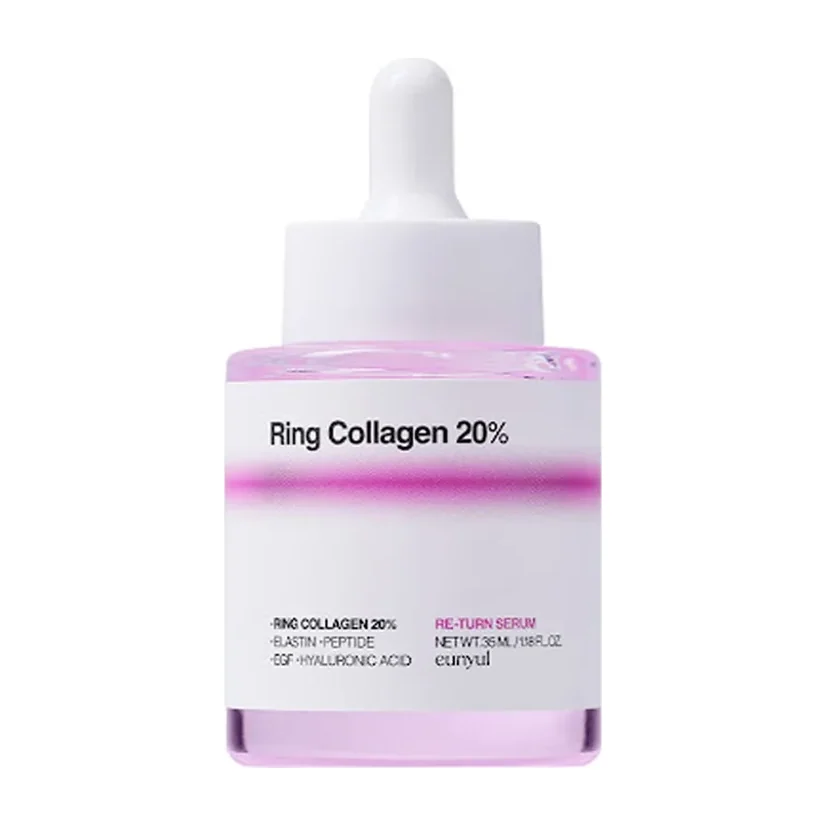
The dirty secret of most collagen serums is that the collagen is the least important ingredient in the bottle. Collagen molecules are large. The dermal layer where collagen lives and functions is deep. The gap between applying collagen to your face and having it integrate into your skin's structural network is roughly the gap between placing a brick on a house and having it become part of the foundation. The collagen sits on top. It hydrates. It smooths. It does not rebuild.
Peter Thomas Roth's FIRMx Collagen Serum appears to understand this, even if the marketing leads with the more glamorous word. Look past the branding and you find a genuinely sophisticated peptide serum, with three distinct signal peptides working through different biological pathways to persuade your skin to build collagen of its own. The topical collagen is the opening act. The peptides are the headliner.
The formulation takes a belt-and-suspenders approach to the surface layer. Three forms of collagen — vegetable, soluble and hydrolyzed — operate at different molecular weights. Vegetable collagen, listed first, forms a film that smooths and blurs on contact. Soluble collagen hydrates the outer layers. Hydrolyzed collagen, broken into smaller fragments, has the best shot at penetrating slightly deeper, though even that is humectant work rather than structural. None of them are rebuilding your dermal matrix. What they do is create surface conditions that make skin look and feel plumper while the real business happens underneath.
That business belongs to the peptides. Palmitoyl Tripeptide-5 — sold as Syn-Coll — stimulates transforming growth factor beta, one of the body's primary triggers for collagen biosynthesis. The palmitoyl group is a fatty acid chain that gives the molecule the lipophilicity it needs to get through the skin's lipid barrier at all, which is the difference between a peptide that works and a peptide that merely appears on a label. Manufacturer studies report wrinkle reduction in the range of seven to twelve percent across eighty-four days of twice-daily use — modest, measurable, and worth treating with the healthy skepticism any brand-sponsored figure deserves.
The second peptide, Palmitoyl Dipeptide-5 Diaminobutyroyl Hydroxythreonine (Uplevity), attacks the problem from the opposite end. Rather than only stimulating new collagen, it inhibits the matrix metalloproteinases that dismantle the collagen and elastin you already have. Building and defending at once is pharmacologically sound reasoning, and at the claimed two percent this is a real dose rather than a label decoration. Acetyl Tetrapeptide-2 completes the trio, targeting overall firmness and density signaling. Three peptides through three mechanisms is genuinely more considered than the single-peptide approach most serums settle for, and it is the honest strength of this formula.
The support cast is well chosen. Squalane mimics the skin's own lipids, limiting water loss while providing exactly the lipid environment those palmitoyl-conjugated peptides need to slip through the stratum corneum — it's a delivery system disguised as an emollient. Sodium hyaluronate binds water in the upper epidermis for immediate plump. Caffeine contributes a temporary vasoconstrictive tightening, which is the thing you actually feel within minutes and which quietly buys patience for the peptides that need months. A radish root ferment filtrate handles part of the preservation load, and a whisper of mica supplies the soft-focus luminosity.
Texture is where this serum wins people over on day one. The dimethicone and polysilicone-11 base creates a silky, almost velvety slip that fills fine lines on contact. It feels expensive, because it is. Skin looks instantly smoother and faintly lit. It layers under makeup without pilling, which matters enormously for something you're meant to apply every morning. The finish is satin rather than dewy — enough glow to read as healthy, not enough to read as oily.
That silicone base is also the formula's clearest limitation. Dimethicone sits third, making it a structural component rather than a trace addition. If silicones congest you, or you avoid them on principle, this is not a serum you'll enjoy, and no amount of peptide sophistication changes that.
At ninety-nine dollars for a single ounce — six to eight weeks at the recommended twice-daily use — this asks you to take peptide science on faith and invest with patience. That's a significant ask. The immediate smoothing and tightening are pleasant, and also achievable far more cheaply. The peptide benefits need eight to twelve weeks before they can be honestly assessed, and even then the change may be subtle enough to leave you squinting at old photos. That is the central bargain of peptide skincare: the mechanism is real, the effect size is incremental, and the price demands a confidence the biology cannot quite supply.
Application technique is worth respecting. Three or four drops onto slightly damp skin, pressed in with upward motions rather than rubbed — peptides are fragile molecules and there's no reason to abuse them. Sunscreen in the morning is non-negotiable, because UV degrades collagen faster than any serum can encourage it, and skipping SPF while paying for a collagen serum is simply setting money on fire in an elegant bottle.
The vegan and cruelty-free certifications deserve credit in a category where animal-derived collagen is the norm. Vegetable collagen and plant-derived peptides deliver the concept without the ethical asterisk.
This is a well-made serum for people who understand what peptides can and cannot do, who hold realistic timelines, and who genuinely enjoy a texture that turns daily application into a pleasure rather than a chore. It is not the collagen that justifies considering it. It's the three-peptide system doing the quiet, incremental work of supporting the structure your skin is already trying to maintain.