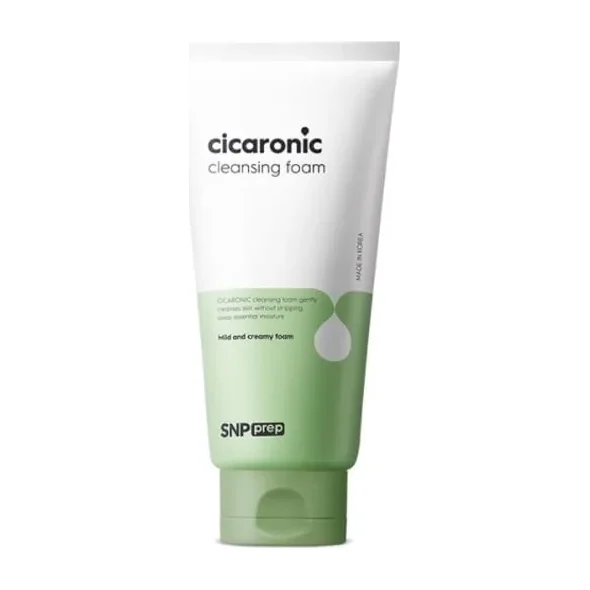
Read the first handful of ingredients on this tube as a chemistry equation and the product explains itself. Water, myristic acid, glycerin, potassium hydroxide, stearic acid, palmitic acid. Fatty acids plus a strong alkali make soap, and that is exactly what forms inside the tube: a potassium soap paste that whips into a thick, meringue-like foam. It is the same basic system that has powered Korean foam cleansers for decades, and it is what defines the SNP Cicaronic Cleansing Foam far more than the centella leaf on the label.
That matters because of what soaps do to skin. Soap-based cleansers usually sit at an alkaline pH, often somewhere around 9 to 10, well above the slightly acidic surface of healthy skin. Alkaline cleansing tends to lift more lipids from the outer layer, disturb the enzymes that keep the barrier in shape and leave the squeaky, tight feeling many people mistake for cleanliness. SNP does not publish the pH of this foam, so the exact figure is unknown, but the formula design makes a low-pH result very unlikely.
None of this makes the foam bad. It makes it a particular kind of product, one that suits some skin better than others. The soap system is balanced with glycerin in third position, sorbitol and butylene glycol as humectants, glyceryl stearate as a mild emollient, and cocamidopropyl betaine as a softer co-surfactant. Polyquaternium-7, a conditioning polymer, helps the skin feel less stripped after rinsing. Together, these components produce a foam that cleans thoroughly without being as harsh as an old-fashioned bar.
Then come the Cicaronic extras. The formula includes two centella extracts, madecassoside, panthenol, neem leaf and flower, Japanese goldthread, wild strawberry leaf, cocoa, rose of Jericho, three forms of hyaluronic acid and a seven-herb complex featuring lavender, thyme, sage and rosemary. It is a long list, but almost all of it sits below the preservatives, and all of it is rinsed off within a minute. Centella and madecassoside have real evidence for calming and supporting skin repair, but that evidence comes from leave-on use. In a face wash, contact time is too short for much benefit, and the extracts serve mainly to connect the cleanser to the rest of the Cicaronic family.
In use, a pea-sized amount is enough. Worked between wet palms, the paste turns into a dense, springy foam that feels luxurious and rinses away completely. The fragrance is light and clean, with a faint herbal note that does not linger. After rinsing, oily and combination skin tends to feel fresh and matte, with no residue. Dry or sensitive skin, on the other hand, often feels tight within minutes, and that tightness is a signal worth heeding.
The best role for this cleanser is as the second step of an evening double cleanse. After an oil or balm has dissolved sunscreen and makeup, the soap foam removes the oily residue efficiently. Used this way, once a day, oily skin generally handles it well. Used twice daily on drier or more reactive skin, it is more likely to leave the barrier stressed, especially in winter or alongside retinoids and exfoliating acids.
It is also worth addressing the branding. The green tube, the word 'cica', and the product family's sensitive-skin positioning all imply gentleness. The formula tells a different story: an alkaline soap base, fragrance and herb extracts known to trigger reactions in some people. For people with rosacea, eczema or a compromised barrier, standard advice points toward non-soap, low-pH, fragrance-free cleansers, and this foam does not meet those criteria. That does not make it dangerous; it makes it mismatched with the audience the packaging courts.
There are some genuine positives beyond the lather. The foam is sulfate-free, silicone-free and contains no drying alcohol. Its large 180ml tube lasts a long time, because very little product is needed per wash. The rinse is clean, making it good for anyone who dislikes the slippery after-feel of some milky cleansers. And the price, around $16 from a US distributor, is reasonable for the volume.
A practical tip makes a real difference with soap foams: technique. Lathering the paste fully in the hands before it touches the face, keeping contact to well under a minute, and rinsing with lukewarm rather than hot water all reduce how much lipid the foam takes with it. Following within a minute or two with a hydrating toner helps the skin's surface return to its usual slightly acidic state more quickly. None of this turns a soap into a syndet, but it narrows the gap enough that combination skin can often use it comfortably through the summer.
Availability is mixed. Some major retailers list it as out of stock, while distributors and Asian pharmacy chains still carry it. Shoppers who find it at a normal price will get a competent soap foam; those who find it only at inflated marketplace prices should look for alternatives.
SNP is a well-established mass-market brand, and this cleanser reflects its strengths and blind spots. It is pleasant to use, affordable and well made, but its marketing leans harder on the cica story than the formula can support.
The conclusion is simple. For oily or combination skin that likes a squeaky, rich-lather cleanse in the evening, this is a solid, affordable choice. For sensitive, dry, rosacea-prone or eczema-prone skin, the green tube is misleading, and a gentler non-soap cleanser will serve better.