Phloretin
Products with Phloretin
 Gentle Melasma-Minded Brightener
 ClariBright Radiance Brightening Lotion
Obagi's first brightener built to current standards: niacinamide at a working dose, liposomal tranexamic acid for the melasma pathway hydroquinone cannot reach, silymarin, phloretin and a peptide, in a fragrance-free, sulfate-free lotion that reactive skin genuinely tolerates. It brightens and calms within weeks and works slowly on melasma over months; the percentages are secret, the bottle empties in six weeks at the labelled dose, and one hundred and seventy-eight dollars buys ingredients that cheaper serums now carry.
Key Niacinamide · Tranexamic Acid
 Ceramide Toner in Panthenol's Clothing
 Soybean Panthenol Toner
A fragrance-free milky toner built on a real barrier-lipid set, ceramide NP and AP, cholesterol, stearic acid and a phytosphingosine derivative in a meadowfoam emulsion, that calms tight, stripped or reactive skin at the toner step better than a water toner can. Its half-percent black soybean is honest, its panthenol is declared at a twentieth of a working dose, its lipids and a pepper-derived enhancer make it wrong for oily and fungal-acne-prone faces, and it is months old with no record; for dry and sensitive skin at $25 for 200 ml, a well-made lipid toner with a misleading name.
Key Ceramides · Soybean
 Overpriced Eye Moisturizer
 Prime Advancer Eye Cream
A pleasant, hydrating eye moisturizer wearing a luxury anti-aging price tag it cannot justify. The formula is a fragranced blend of antioxidant botanicals, beta-glucan and squalane with a soft-focus glow — no retinoid, peptide, adenosine or caffeine, the actives the category and the price imply. It feels nice and brightens momentarily, but you are paying treatment money for moisturizer chemistry, with fragrance beside the eyes as a bonus risk.
Key Beta-Glucan · Phloretin
 Prestige Barrier Lotion
 Prime Advancer Emulsion Lotion
A respectable prestige emulsion that, unlike O Hui's bottom-loaded flagship cream, puts a genuine adenosine dose and a ceramide barrier cluster at functional positions. It hydrates and firms gradually in a lightweight lotion. The sticking points are a premium price and a heavier-than-usual fragrance system carrying four declared allergens, which pushes it away from sensitive skin.
Key Adenosine · Ceramides
 Phloretin CF for the Eyes, at a Price
 AOX+ Eye Gel
The only way to get SkinCeuticals' peer-reviewed vitamin C, ferulic acid and phloretin chemistry onto the eye area, dosed down to 5, 0.5 and 1 percent and topped with caffeine and butcher's broom for morning eyes. It protects, brightens a little and de-puffs briefly. It also stings if it wanders, dries rather than hydrates, needs an eye cream over it, and costs $110 for 15 ml; the middling reviews are the honest verdict of people who expected an eye cream and got an antioxidant serum.
Key Vitamin C · Phloretin
 Gen Z Glow Getter
 Float On Soothing Facial Oil
A refreshingly simple facial oil that punches above its $19 price tag with quality botanicals like prickly pear and buriti oil, plus a clever penetration enhancer that most affordable oils skip entirely. Best suited for dry-to-normal skin types looking for an uncomplicated glow without the luxury markup.
Key Safflower Oil · Prickly Pear
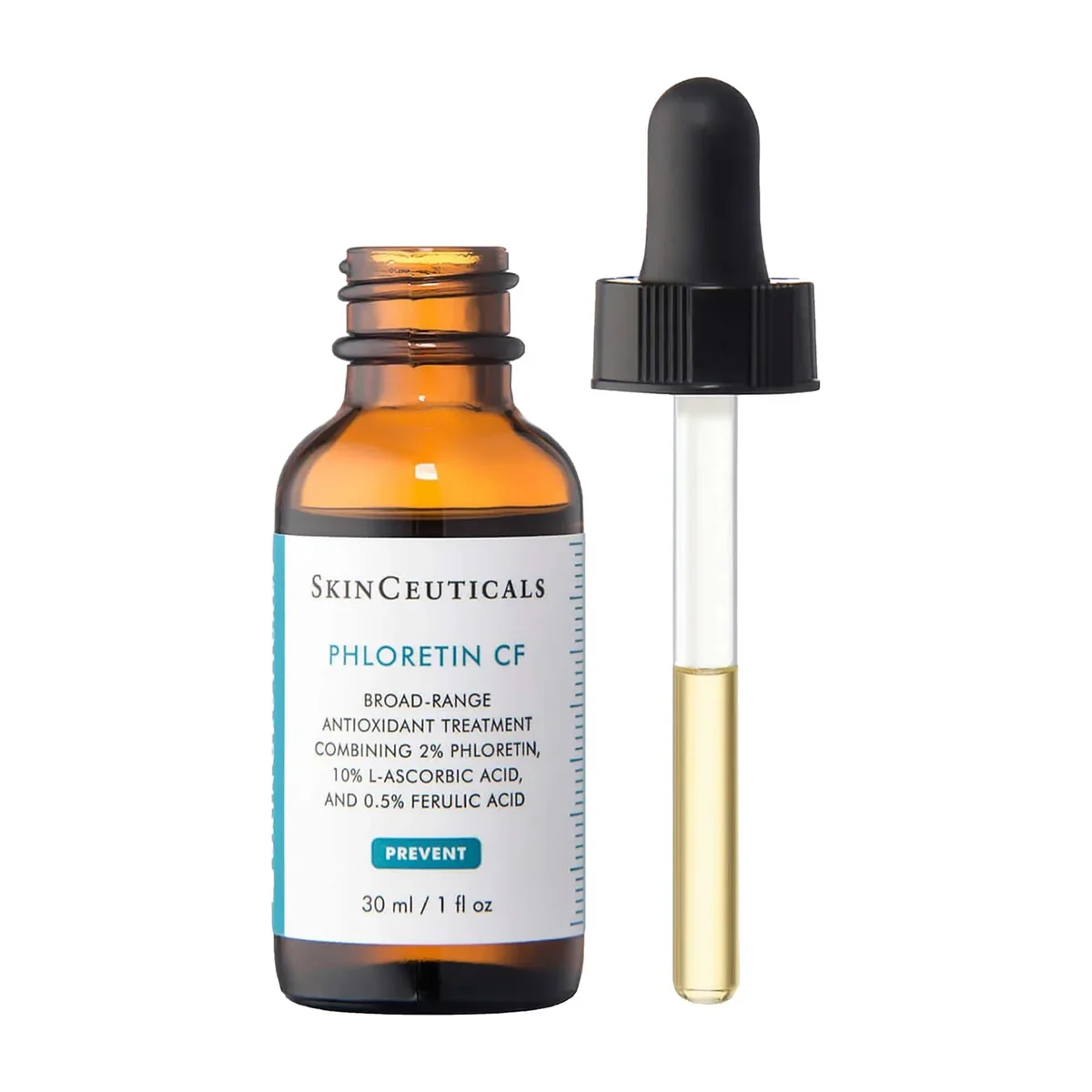 Derm Office Gold Standard
 Phloretin CF
Phloretin CF is SkinCeuticals' 10% L-ascorbic acid antioxidant serum designed for oily, combination, and hyperpigmentation-focused skin. Built on the Duke antioxidant patent and stabilized with ferulic and phloretin instead of vitamin E, it is one of the most clinically validated vitamin C serums on the market — and one of the most expensive. For the right skin type, it earns the price.
Key Vitamin C · Phloretin
 Antioxidant Triad, Matte Gel
 Phloretin CF Gel
SkinCeuticals' peer-reviewed antioxidant triad, ten percent L-ascorbic acid with two percent phloretin and half a percent ferulic acid, in a matte silicone gel that oily, combination and acne-prone skin will actually wear under sunscreen every morning. The chemistry is among the best documented in skincare, the vehicle is genuinely useful, and a hundred and eighty-five dollars for 30 millilitres buys the same actives as the serum plus a texture.
Key Vitamin C · Phloretin
 Beginner Vitamin C
 C-Luma Hydrabright Gentle Vitamin C Serum
A thoughtfully built gentle vitamin C serum that swaps stinging L-ascorbic acid for a 10% blend of two stable derivatives, backed by a glutathione-and-phloretin antioxidant complex and real hydration from squalane and HA. It's genuinely sting-free, fragrance-free, and ideal for sensitive skin or vitamin C beginners — just expect gradual, subtle brightening rather than a high-potency punch, and a clean-beauty price.
Key Vitamin C · Glutathione
The full phloretin guide
Phloretin is an antioxidant from apples, found in the fruit, the skin and the bark of apple and pear trees, and its best trick may be what it does for its neighbors.
On its own it mops up the free radicals that sunlight and pollution create, and it nudges gently on the enzyme that makes pigment. In a formula, it also seems to help steady vitamin C and ferulic acid and get more of them into the skin. It's the supporting actor that makes the leads look good.
How it's regulated in the US
FDA does not classify ingredients — it classifies products, by what they are sold to do. The same molecule can be a drug active in one product and a cosmetic ingredient in the next, and only the claim on the label decides which. What follows is a statement about that legal standing, not about whether it works — the evidence question is answered separately above.
Cosmetic Phloretin is a cosmetic ingredient in the US: no OTC monograph covers it and it is not an active in any FDA-approved drug, so a product built around it is a cosmetic rather than a drug.
Phloretin is mostly studied as part of a team rather than on its own. The main human work looks at a serum combining it with vitamin C and ferulic acid, measuring how skin copes with ultraviolet stress. Lab and volunteer studies on a related form track sun damage inside skin cells. On pigment, lab work shows it acts on the enzyme that makes pigment, though more gently than dedicated brighteners. Much of the marketing data comes from manufacturers' own testing, and phloretin alone, outside that classic trio, has had much less attention.
How it works
Phloretin is a dihydrochalcone, a flavonoid found in apples and in the bark of apple, pear and grapefruit trees, and it works on at least three fronts that happen to complement one another. The first is straightforward radical scavenging. Ultraviolet light and pollution generate reactive oxygen species in skin, and phloretin donates electrons to neutralise them before they oxidise membrane lipids or damage DNA — the derivative work showing reduced pyrimidine dimer formation and preserved glutathione is that protection measured directly. The second is its effect on the other ingredients. Vitamin C in its active L-ascorbic acid form is notoriously unstable, oxidising in the bottle and losing potency; phloretin appears to help stabilise it and ferulic acid, and to increase how much of both becomes available in skin. Part of this is antioxidant chemistry sparing them from oxidation, and part is that phloretin is a known permeation enhancer — it interacts with membranes in ways that ease passage. The third is pigment. Phloretin binds tyrosinase, the enzyme that starts melanin synthesis, as a reversible mixed-type inhibitor. Curiously it also acts as a substrate for the same enzyme, which complicates the picture and is one reason its brightening contribution is best understood as modest and supportive rather than headline.
Key benefits
- Helps neutralize free radicals from sun and pollution
- Helps keep vitamin C and ferulic acid fresh and stable
- Helps its serum partners sink into skin
- Gently brightens the look of a dull, uneven complexion
- A natural partner for a morning sunscreen routine
Concentration & usage
The reference formulation uses 2% phloretin alongside 10% L-ascorbic acid and 0.5% ferulic acid, and that trio is the combination the human photoprotection study examined — so a product matching it is standing on the actual evidence rather than borrowing it. Phloretin listed without a meaningful vitamin C alongside is a weaker proposition, since much of its documented value is as a stabiliser and enhancer. Like other L-ascorbic acid systems, these formulas are low-pH, air-sensitive and light-sensitive: an opaque bottle and an air-restrictive dispenser are functional requirements, not packaging flourishes, and a serum that has darkened to amber has oxidised and should be replaced. Apply in the morning, on clean dry skin, before sunscreen.
Who it's for & who should be cautious
Who it's for
It makes sense for anyone building an antioxidant step for photoprotection and uneven tone, particularly people whose main concerns are dullness, blotchy pigment and the cumulative effects of sun and city air. Because the evidence is for the combination, it suits someone who wants a well-constructed vitamin C serum rather than someone hunting phloretin as a standalone. Oily and combination skin often prefer these lighter, aqueous, low-pH serums to the oil-based antioxidant formats.
Who should be cautious
Anyone treating melasma or long-standing hyperpigmentation should not expect this to carry the load — the tyrosinase inhibition is real but modest, and hydroquinone, azelaic acid, tranexamic acid and thiamidol all have substantially better endpoint evidence. Very sensitive, rosacea-prone or barrier-compromised skin may struggle with the low pH these vitamin C systems require, and the ferulic acid and ascorbic acid rather than the phloretin are usually what stings. Skip it if you will not commit to daily sunscreen, since an antioxidant serum is a supplement to photoprotection and never a replacement for it. Note also that phloretin's permeation-enhancing property cuts both ways: it can increase penetration of whatever else is in the formula, which is helpful for actives and less helpful for irritants. And be wary of paying a premium for a serum where phloretin appears near the end of the list without a real vitamin C concentration in front of it.
Pairs with & conflicts
Myths & facts
Myth: Phloretin is a powerful brightening agent for dark spots.
Reality: It inhibits tyrosinase reversibly, with an IC50 around 169 micromolar, which is meaningful activity but well short of the dedicated depigmenting agents. It is also, oddly, a substrate for the same enzyme. Its contribution to a more even tone is real and supportive; it is not a treatment for melasma or long-standing pigment, and a product leaning on phloretin for that claim is asking one ingredient to do a job the evidence gives to others.
Myth: The clinical results quoted for phloretin serums are independent proof it works.
Reality: The evenness, radiance and discoloration percentages that appear in marketing come from the manufacturer's own testing of its own formula. That is normal in cosmetics and is not the same as independent replication. There is genuine peer-reviewed support here — a published study of the vitamin C, ferulic acid and phloretin mixture against UV photodamage in human skin — and it is worth citing that rather than the percentages on the box.
Myth: Any product containing phloretin gives you the benefits shown in the research.
Reality: The human photoprotection evidence is for a specific combination — phloretin with L-ascorbic acid and ferulic acid at defined levels — and much of phloretin's documented usefulness is in stabilising and delivering those partners. Isolated in a formula with no meaningful vitamin C, it is an antioxidant with thin standalone evidence. Combination evidence does not transfer to the individual components.
Frequently asked questions
What does phloretin add to a vitamin C serum?
Three things: its own antioxidant activity, a stabilising effect that helps L-ascorbic acid and ferulic acid survive longer and reach the skin in greater amounts, and a modest tyrosinase-inhibiting contribution to evenness of tone. The published human photoprotection work studied all three ingredients together, so the combination is the evidence-backed unit.
Should I use phloretin in the morning or at night?
Morning, before sunscreen. Its main documented role is protecting skin against ultraviolet and pollution damage as it happens, which is a daytime job. Applying it at night is not harmful, simply a poorer match to the mechanism. Let it absorb on clean dry skin before layering moisturizer and SPF.
How is phloretin different from ferulic acid?
Both are plant polyphenols that stabilise vitamin C, but they are structurally distinct and are used together rather than interchangeably — ferulic acid is a hydroxycinnamic acid, phloretin a dihydrochalcone from apple. Phloretin additionally enhances permeation and inhibits tyrosinase, which ferulic acid does not meaningfully do. The reference formula uses both deliberately.
Will it sting or irritate?
If it does, the low pH required by L-ascorbic acid is usually responsible rather than the phloretin itself. Sensitive and rosacea-prone skin often struggles with these serums for that reason. Applying to fully dry skin, starting every other morning, and buffering with moisturizer underneath all help; if stinging persists, a vitamin C derivative at neutral pH is the better route.
How do I tell if my serum has gone off?
Colour. These formulas start pale and turn yellow then amber or brown as the ascorbic acid oxidises, and a dark serum has lost potency regardless of the date on the box. Keep it capped, out of light and heat, and treat opaque air-restrictive packaging as a functional feature. Most are best used within a few months of opening.