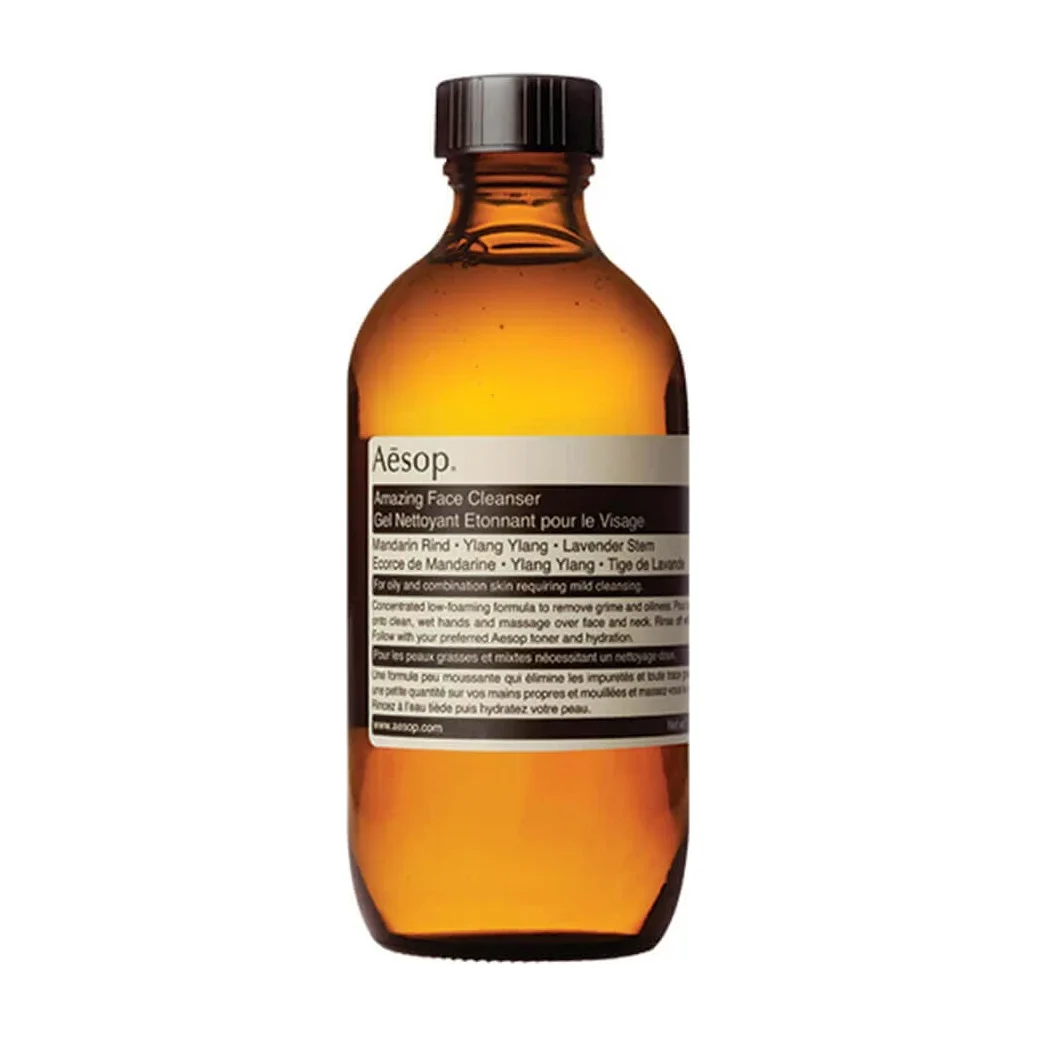
Aesop is one of the few skincare brands that has managed to convince intelligent, budget-conscious people to pay $39 for a 100ml bottle of face wash, and the Amazing Face Cleanser is the product that does most of that convincing. It sits in the amber glass bottle with the beige Century Gothic label, it smells like a very expensive herb garden, and it lives in bathrooms where the towels have been chosen with the same seriousness as the skincare. The question isn't whether this cleanser is good — it is, on its own terms. The question is what exactly you are paying for, and whether that trade is the right one for you specifically.
Separate the two axes. As a cleanser, this is a well-formulated, genuinely mild surfactant-based gel wash. The primary cleansing agents are sodium methyl cocoyl taurate and cocamidopropyl betaine — among the gentler anionic and amphoteric surfactants in common use — supported by PEG-7 glyceryl cocoate and a little decyl glucoside. Collectively that's a low-irritation system producing a soft, low-volume lather that rinses without the squeaky tightness harsher sulfate washes leave behind. Glycerin and panthenol cushion the wash; allantoin and aloe calm it further; betaine and sodium lactate quietly hold water in the stratum corneum on the way out; hydrolyzed wheat protein leaves a faint conditioned film. Hand this INCI to a formulation chemist with the brand hidden and they'd call it a good middle-tier mild gel cleanser. Not groundbreaking. Not clinically novel. Solidly built.
There's also a small dose of lactic acid alongside citric acid, and it's worth being precise about what that does. In a leave-on treatment at 5–10%, lactic acid measurably reshapes the stratum corneum. In a cleanser, with under a minute of contact before it goes down the drain, it's mostly a pH adjuster with a faint refining nudge. It is not a substitute for an acid toner or a treatment serum, and anyone buying this cleanser as an exfoliation step has misread the label.
As a sensory object, it operates in an entirely different category. The fragrance is the hook — herbaceous, slightly citrusy, unmistakably the house signature. People who love it call it aromatherapy at the sink. People who don't call it overpowering. Both reactions are legitimate. Aesop uses real essential oils plus synthetic fragrance components, which is why the list openly declares linalool, limonene, geraniol and citronellol — the EU's required-disclosure fragrance allergens. In most skin those trace amounts pass without incident. In reactive skin, rosacea, eczema, or any history of fragrance sensitivity, they don't, and no amount of surfactant gentleness compensates for a perfume your face has already decided it dislikes.
Real-world performance is predictable in the best way. Skin feels refreshed rather than stripped, light-to-medium makeup rinses cleanly, and the post-wash feel is soft enough that a brief delay before moisturizer isn't a crisis (apply it anyway). Heavier makeup and sunscreen want a first cleanse with an oil or balm — this formula has no solvent power to speak of, which is the most frequent complaint reviewers raise and a fair one. Oily, combination and normal skin will all find it pleasantly mild. Dry skin can use it but will probably want something creamier. Genuinely sensitive skin should look elsewhere entirely.
The botanical quartet — cucumber, aloe, green tea, chamomile — is the part that most reviews take at face value and shouldn't. Each has a small body of research behind mild anti-inflammatory or antioxidant activity, but at extract-level concentrations, in a product that spends forty seconds on your face, their contribution is sensory and brand-signaling rather than pharmacological. That's not a knock on Aesop specifically; it's true of nearly every cleanser that lists plants. The actual work here is being done by the surfactants and the humectants standing behind them.
Then there is the elephant in the amber glass bottle. $39 for 100ml is a great deal of money for something you rinse off, and the formula contains nothing that justifies that on clinical grounds. Pharmacy-aisle gentle gel cleansers deliver the same non-stripping wash for a third of the price, and the fragrance-free ones do it with less risk. If skincare value is your only metric, that's the honest comparison, and Aesop loses it decisively.
But Aesop isn't competing on price-to-quality ratio. It's competing on the bathroom shelf, on the ritual of washing your face, on the small daily pleasure of handling an object that was designed with care. Those aren't trivial things. People stay consistent with routines they enjoy, and a cleanser you reach for every single day because you like it is worth more than a cheaper one you keep forgetting. The honest question is whether *you* get that pleasure here. Plenty of people do, use it for years, and consider the money well spent. Plenty of others discover after two bottles that the novelty has worn off and quietly drift back to the drugstore aisle. Both outcomes are common; neither is embarrassing.
A few practicalities. One pump into damp hands, thirty to sixty seconds of massage, rinse with lukewarm water. Larger refill sizes exist and improve the per-milliliter maths meaningfully, which is the single easiest way to soften the price. The pump tends to clog as the bottle empties — a small, persistent annoyance in packaging that is otherwise the whole point. Expect no dramatic long-term transformation; expect a wash step that doesn't undermine everything you apply afterward, which is genuinely all a cleanser owes you.
Know which camp you're in before committing. If the ritual matters and the scent makes your morning better, this is a defensible purchase and the formula won't let you down. If you're evaluating on pure skincare merit, thirty-nine dollars spent on a treatment serum instead will do far more for your face than any cleanser ever will — including this one.