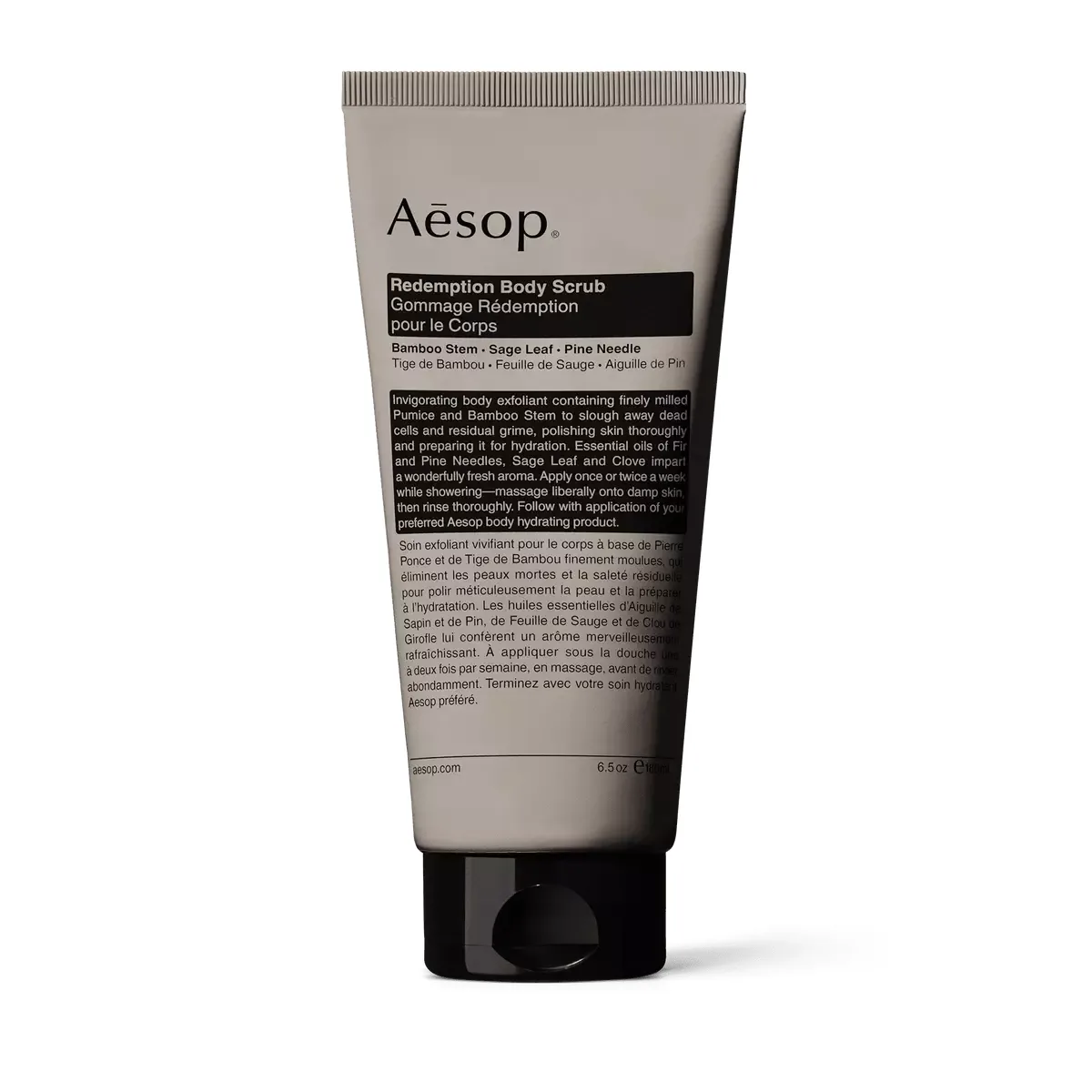
Aesop Redemption Body Scrub taupe-grey tube with black flip cap, 180 mL
Not yet assessed for Rough Texture
What makes this different

It is the same coarse pumice, quartz and bamboo abrasive on the same mild amphoteric-taurate base as Aesop's Geranium Leaf scrub, scented instead with Siberian fir, Scots pine, sage, rosemary, cedar and clove in a fresh, camphoraceous accord that reads as an alpine forest rather than a garden. The choice between the two is one of aroma; the exfoliation and the surfactants are identical, and both are the rare luxury scrubs that pair a heavy abrasive with a gentle cleanser.

Aesop

Aesop Redemption Body Scrub Review

The Alpine Pumice Scrub Body Care gel luxury Paraben free Fungal-acne safe Cruelty free Vegan

Aesop's coarse pumice, quartz and bamboo scrub on its mild amphoteric-taurate base, identical in exfoliation and surfactants to the Geranium Leaf version and scented instead with fir, pine, sage, cedar and clove in a fresh, camphoraceous accord. It polishes rough shins and arms genuinely, rinses clean, and is well built for what it is; it is too coarse and, with eugenol and limonene reaching abraded skin, too fragranced for reactive skin, and fifty-two dollars for 180 mL is a fragrance price for grit.

Price $52.00 6.1 fl oz / 180 mL
Shopper rating 5 ★★★★★ 2 reviews
Buy at Amazon ♥
Verdicts

How well it fits each concern

The scrub's formula is fully disclosed and shares its abrasive and surfactant base with a product the brand has sold for years, but the brand's site shows only two reviews and no testing has been published, so how it wears over months, and how often its clove-and-pine accord on abraded skin troubles reactive users, is inferred from the ingredients and the sibling scrub's record rather than from measured feedback.

One verdict per concern. Open a row for the reasoning; the receipt has every source.

The scaleRecommendedGoodSupportingEarly evidenceNot for thisAvoidhow it works

Supporting rolefor Keratosis PilarisNothing here targets keratosis pilaris directly; emollient hydration is the recognised companion to treating it, and this gel does that without known triggers.ReceiptPumice: no evidence row for this concern yet · rule R8, same reading on 3,793 products · open the receipt

The case for it

  1. Pumice has no evidence row yet for this concern — it is in the research queue.
  2. The formula carries no trigger this concern is sensitive to, with the cautions noted.

Not from a trial rowStandard tolerabilityNo reviews read yet

What would change this: A researched evidence row for the lead active would replace this with a verdict.

Same rule for everyone. “Supporting role” is the verdict on 7,796 of 45,446 concern verdicts across the catalog; rule R8 decided 3,793 of them. Unchanged since September 25, 2026, engine 5.2.0.

Brand or formulator? Disclose a concentration or correct a fact →

The full receipt: rule, row, sources, dates →All keratosis pilaris products →How keratosis pilaris is treated →

Also listed for Rough Texture and Dullness — the actives here (Physical Exfoliants, Cleansing Surfactants, Bamboo, Essential Oils) are in our research queue for those concerns; there is no verdict until their evidence rows are written. That is a gap in our table, not a mark against the product.

As a body productNot judged: what a body product is for — real substance, not just slip, realistic to use daily — cannot yet be measured from the ingredient list (only fragrance load can).

A verdict is Dermington’s assessment of how well a product’s ingredients fit a concern — never a claim about what the product treats. Evidence dots and collected reviews sit beside it and are never blended in. Rules 0.5.1 · evidence table ev-2026.10-r231 · engine 5.2.0 · how we decide · this product’s receipt

Reader poll · Town SquareQuestion 1 of up to 3

Have you used Redemption Body Scrub?

One tap counts. A couple of optional follow-ups come next.

No account neededOne answer each, change it any timeCounted only in anonymous totalsHow the Square counts →
Assessment

Pros & cons

What it does well 7

  • Pumice second on the list gives genuine exfoliation
  • Mild amphoteric-taurate surfactant base, sulfate-free
  • Bamboo stem softens the particle blend on thinner skin
  • Fresh, resinous fir, pine and sage accord unlike the rest of the range
  • Rinses clean with no oily film on skin or shower floor
  • Shorter declared-allergen line than the geranium version
  • Vegan, oil-free and free of plastic microbeads

Where it falls short 6

  • Fifty-two dollars for 180 mL of gritty gel
  • Too coarse for sensitive, eczema-prone or freshly shaved skin
  • Clove-derived eugenol reaches skin the pumice has just abraded
  • Camphoraceous scent is not to every taste
  • Single size, and the tube goes quickly with full-body use
  • Only two reviews to go on
Review

The full review

Set the ingredient lists of Aesop's two body scrubs side by side and they diverge only at the eleventh line. Water, pumice, sodium lauroamphoacetate, sodium methyl cocoyl taurate, an acrylate gel, salt, coco-betaine, preservatives, citric acid and bamboo stem extract are common to both; then Geranium Leaf turns to bergamot, mandarin and geranium, and Redemption turns to Siberian fir, Scots pine, rosemary, cedarwood, clove and sage. That is not a criticism. A brand that has built a good scrub is entitled to offer it in two scents, and the base is a good one; it does mean that most of what there is to say about this tube has already been said about its green sibling, and that the decision between them is a decision about smell.

The base first, briefly, because it matters. Pumice is second on the list, behind only water, which makes this a scrub with real grit rather than a wash with a few grains for show; quartz lower down adds bite and bamboo stem extract adds a softer, rounder particle that keeps the whole from feeling like sandpaper across the chest and inner arms. The surfactants are the brand's mild amphoteric-taurate system, the one it uses in its hand washes and pointedly does not use in its sulfate body gels, and pairing a heavy abrasive with a gentle cleanser is exactly the right call, since a scrub already asks the barrier to tolerate friction and a harsh detergent on top is how scrubs earn their reputation for rawness. The gel lathers low, rinses to nothing, leaves no oil on the shower floor, and used twice a week with a light hand leaves shins, elbows, heels and the backs of the upper arms visibly smoother and a body balm absorbing faster. Used harder, or a third time in a week, it shows up as tightness and red streaks; freshly shaved or waxed skin should be left alone entirely, and keratosis pilaris, the reason most people buy a scrub this coarse, is smoothed on the surface for a day or two and treated only by the urea or lactic acid lotion that should follow.

The scent is what the money is for, and it is the more interesting of the two. Siberian fir and Scots pine oils lead, resinous and cold, with rosemary and sage sharpening them into something almost medicinal, cedarwood underneath and a warm trace of clove at the base; the effect is an alpine forest after rain rather than a garden, cleaner and more austere than the geranium and, to many noses, more grown-up. It is strong in the steam of a shower and fades to a trace on the skin, which suits a rinse-off. The allergen line is shorter than the geranium scrub's, limonene and eugenol only, but the eugenol is the clove and it is one of the stronger fragrance sensitisers on the patch-test tray, and it is arriving on skin the pumice has just abraded, which is a different proposition from meeting it in a hand cream. That is the scrub's honest limitation for reactive skin: the barrier is opened by the grit and the oils walk straight in. Eczema-prone, psoriatic or fragrance-allergic skin should not be scrubbing with pumice in the first place, and the accord only underlines it.

There is almost nothing else to go on. Two reviews on the brand's site, both five stars, are not a record; the formula's behaviour is easy to predict from a base the brand has sold for years, and the prediction is that most healthy skin will like it and use it too often at first. The taupe tube, beside the geranium version's olive, is the only visual cue to which forest one has bought, and more than one household has ended up with both. Fifty-two dollars for a single 180 mL tube is the same steep price as the geranium version, several times what an equally effective pumice scrub costs elsewhere, and the tube goes fast if the whole body is scrubbed; used on the rough patches only, it lasts about three months and the arithmetic becomes merely indulgent. The stand-up tube with its flip cap is, like its sibling's, one of the brand's few containers that puts function before the shelf.

So the review of Redemption is the review of Geranium Leaf with a different forest: a well-judged coarse scrub on a gentle base, used twice a week by healthy skin that wants its shins smooth, priced for the aroma rather than the pumice, and wrong for anyone whose skin reacts to fragrance or to friction. The alpine accord is worth choosing over the geranium for people who want their bathroom to smell of pine rather than a garden, and worth nothing at all to skin that should not be scrubbed.

The science

Physical exfoliation removes the loosely attached outermost corneocytes that have not yet shed, reducing surface roughness and briefly improving penetration of whatever is applied next; the effect is transient, since the corneum regenerates within days, and it is non-selective, so pressure or frequency beyond what the loose cells require abrades intact corneum and provokes irritation. This scrub's abrasive is milled pumice at second position, angular volcanic glass, with quartz and a softer Bambusa arundinacea stem powder, and it rides on the brand's mild surfactant system of sodium lauroamphoacetate, sodium methyl cocoyl taurate and coco-betaine, low-irritancy surfactants that bind less to corneum protein and extract less lipid than sulfates, which is the appropriate pairing for a product that already stresses the barrier mechanically.

The aromatic phase is Siberian fir, Scots pine leaf, rosemary, cedarwood bark, clove flower and sage oils, with limonene and eugenol declared above labelling thresholds. Eugenol is a component of the standard fragrance mix used in patch testing and a well-established contact sensitiser; limonene forms hydroperoxides on air exposure that are more sensitising than the parent terpene, a consideration for a tube that lives in a warm bathroom. The question of how botanical essential oils relate to fragrance allergy in practice, whether a patient sensitised to a constituent such as eugenol or limonene needs to avoid the whole oils that contain them, was reviewed in 2026 in Contact Dermatitis, and the practical conclusion for an abrasive rinse-off is straightforward: the scrub opens the barrier before the oils arrive, so a sensitised person's exposure is greater than the rinse-off format suggests, and the product should be avoided by anyone with a relevant patch-test result or atopic tendency. The gel is thickened with an acrylates copolymer and sodium chloride, preserved with 1,2-hexanediol, phenoxyethanol, sodium benzoate and ethylhexylglycerin, and contains no oils beyond the aromatics, no plastic microbeads, sulfates, silicones or parabens; Aesop states all its products are vegan, and no study of the scrub has been published.

References 1 ShowHide
  1. To Avoid or Not to Avoid: Cross-Reactivity Between Fragrance and Common Botanicals — Contact Dermatitis (2026)

The clinical view

Clinically this is the same product as Aesop's Geranium Leaf scrub with a different aroma, and the same view applies: a coarse pumice scrub on a mild surfactant base is a harmless way for healthy skin to smooth rough shins, elbows and arms once or twice a week with light pressure, and the choice of an amphoteric rather than a sulfate base is a detail dermatologists would approve of. The cautions are also the same and are sharpened slightly by the accord: not on the face, not on freshly shaved, waxed or sunburned skin, not on eczema, psoriasis or any compromised barrier, and not as a treatment for keratosis pilaris, where a urea or lactic acid lotion does the work and the scrub is at most a cosmetic step beforehand. Eugenol from the clove oil is the ingredient that most concerns clinicians here, since it is a strong sensitiser arriving on skin the pumice has just abraded, and anyone with a fragrance allergy or a positive patch test should reserve this scrub for intact skin they have tested it on or, more sensibly, choose an unscented chemical exfoliant.

Formula

Key ingredients

  1. Pumice

    Second on the list, behind only water, the milled volcanic pumice makes this a coarse scrub in fact and not just in name; with quartz lower down and bamboo stem for a rounder particle, it buffs shins, elbows, heels and the backs of the arms in a way that sugar-and-oil scrubs cannot, and its density is why the brand limits it to once or twice a week.

    Not yet assessed
  2. Sodium Lauroamphoacetate (Amphoteric Surfactant)

    The lead cleanser, a mild amphoteric of the baby-wash class paired with a coconut taurate and coco-betaine, so that the abrasive rides on the gentlest surfactant system the brand uses rather than the sulfates of its body gels; on a product that already stresses the barrier mechanically, that is the right choice and the reason the scrub does not leave skin stripped.

    Not yet assessed
  3. Bamboo Stem Extract (Bambusa Arundinacea)

    The softer, plant-derived particle that rounds off the pumice and quartz, giving the gel a polishing rather than sanding feel across the chest, stomach and inner arms; it is the one botanical the brand lists among the key ingredients that is doing a physical job rather than an aromatic one.

    Not yet assessed
  4. Siberian Fir Essential Oil (Abies Sibirica)

    The alpine top of the Redemption accord, placed just after the bamboo with Scots pine needle behind it, then rosemary, cedarwood, clove and sage; the blend is fresh, resinous and camphoraceous, unlike anything else in the brand's body range, and the limonene and eugenol declared at the list's end are its allergen cost.

    Not yet assessed
  5. Clove Flower Oil (Eugenia Caryophyllus)

    The warm spice under the pine and fir, and the source of the eugenol declared on the label, a potent fragrance sensitiser; on a scrub that abrades the skin before the oils reach it, clove is the ingredient that most limits who should use this, however small its share of the formula.

    Not yet assessed
Full ingredient list 24 ingredients ShowHide

Water (Aqua), Pumice, Sodium Lauroamphoacetate, Sodium Methyl Cocoyl Taurate, Acrylates Copolymer, 1,2-Hexanediol, Sodium Chloride, Coco-Betaine, Phenoxyethanol, Citric Acid, Bambusa Arundinacea Stem Extract, Abies Sibirica Oil, Pinus Sylvestris Leaf Oil, Coconut Acid, Sodium Benzoate, Rosmarinus Officinalis (Rosemary) Leaf Oil, Ethylhexylglycerin, Cedrus Atlantica (Cedarwood) Bark Oil, Eugenia Caryophyllus (Clove) Flower Oil, Quartz, Salvia Officinalis (Sage) Oil, Limonene, Eugenol

Safety & formulation facts

  • Pregnancy safe
  • Not fragrance free
  • Alcohol free
  • Oil free
  • Silicone free
  • Paraben free
  • Sulfate free
  • Cruelty free
  • Vegan
  • Fungal-acne safe
Potential irritants PumiceQuartzLimoneneEugenolSalvia Officinalis (Sage) OilPinus Sylvestris Leaf Oil
Common allergens LimoneneEugenol
Compatibility

Skin types & routine

Routine step treatment
Time of day Morning & night
Best season All year
Finish non-greasy

Layering

Once or twice a week in the shower, on soaked skin from the neck down, in place of or before the body wash, then rinsed well and followed with a body balm while damp; never on the face, on freshly shaved or waxed skin, or on sunburn. It pairs with a urea or lactic acid lotion for keratosis pilaris, with the scrub smoothing the surface and the lotion working on the follicle, and its alpine accord sits well before the brand's woodier balms.

When to expect results

Visibly smoother, brighter skin from the first use on shins, elbows and upper arms, and a moisturiser that absorbs better straight after; with twice-weekly use over a few weeks, rough patches and the surface of mild keratosis pilaris soften, though a keratolytic lotion does the lasting work. Overuse shows as redness and tightness within days.

Pairs well with urealactic-acidglycerinshea-butter
Don't combine with retinoidsaha-bha

A routine built around it

Morning

  1. Body Wash
  2. Body Balm

Night

  1. THIS PRODUCT (1-2x weekly, in place of body wash)
  2. Body Balm or Urea Lotion
Guidance

How to use it, and who it's for

How to use

Reserve it for one or two showers a week: on thoroughly soaked skin, squeeze a walnut-sized amount into the palm and massage in light circles from the neck down, giving shins, knees, elbows, heels and the backs of the upper arms the most attention and using very little pressure across the chest, stomach and inner arms; the pumice works without force. Rinse completely, avoid the face, and skip any area that has been shaved or waxed that day or is sunburned or broken. Follow while the skin is still damp with a body balm or, for keratosis pilaris, a urea or lactic acid lotion. Drop to once a week if redness or tightness appears. Stand the tube on its cap in the shower and keep it out of direct sun, since the limonene in the accord becomes a stronger sensitiser as it oxidises.

Is it worth the price?

Fifty-two dollars for a single 180 mL tube is at the top of the body-scrub market and several times the cost of an equally effective pumice or salt scrub from a pharmacy; the per-use cost depends on whether it is used over the whole body, where a tube lasts a month or two, or on shins, elbows, heels and arms only, where it lasts about three months and the price becomes tolerable. The premium buys the alpine fir-and-pine accord, the brand, the stand-up tube and, less visibly, a well-judged pairing of coarse abrasive and mild surfactant that cheaper scrubs often get wrong; it does not buy any exfoliation the geranium version or a pharmacy pumice scrub lacks. Fair value for someone who wants the brand's scrub in a resinous scent and uses it where it counts; poor value as a weekly full-body habit, and no value for skin that should not be scrubbed.

Who should buy it

People with healthy, normal-to-oily skin and rough shins, elbows, heels or upper arms who want a scrub coarse enough to feel it working, in a fresh alpine scent rather than the brand's geranium; Aesop customers who prefer the resinous, camphoraceous end of the range, and anyone prepping skin for a moisturiser or self-tanner who wants a sulfate-free, oil-free scrub that rinses clean.

Who should skip it

Skin that is sensitive, eczema-prone, psoriatic or barrier-compromised, anyone with a fragrance allergy or a positive patch test to eugenol or limonene, and anyone hoping a scrub will treat keratosis pilaris rather than smooth it. People who dislike camphoraceous, pine-forest scents should take the geranium version instead, and anyone who scrubs daily will find the price of the habit hard to justify.

Ready to try it?Aesop Redemption Body Scrub · $52.00 · 6.1 fl oz / 180 mL
Details

The product, in detail

Texture
An opaque, thick gel densely loaded with fine pumice and quartz grains and softer bamboo particles, gritty on the palm, that spreads over wet skin with a low, creamy lather and a firm buffing feel before rinsing away completely.
Scent
Fresh, alpine and camphoraceous: Siberian fir and Scots pine in front, rosemary and sage sharpening them, cedarwood and a warm trace of clove underneath; clean and resinous rather than sweet, strong in the shower and faint on the skin afterward.
Packaging
A taupe-grey plastic stand-up tube with a black flip-top cap and Aesop's black-banded apothecary label printed on it, 6.1 fl oz / 180 mL, the only size offered; it stands on its cap in the shower and opens with wet hands.
How long it lasts
About three months at twice-weekly use on the rough patches; a month or two used over the whole body.
Once opened
Use within 12 months · track your toss-by date →
Size
6.1 fl oz / 180 mL
Made in
Australia
Certifications
Vegan

What the first two weeks feel like

The first use registers as a real scrub, fine but abundant grit that feels closer to a pumice stone than a sugar polish on the shins and upper arms, with a modest lather and a clean rinse; the pine-and-fir scent fills the shower and fades to a trace. Skin comes out smooth and faintly pink where the pressure was firm, and a balm sinks in noticeably faster afterward. Anyone who scrubs hard, or scrubs freshly shaved legs, learns within a use to ease off.

The story behind it

Why it exists

Redemption is one of Aesop's older body-care names, an alpine, resinous accord that predates the brand's L'Oréal era and has been applied to a body scrub built on the pumice-and-bamboo system the brand also uses in its Geranium Leaf scrub and Reverence hand wash; it exists for customers who want the brand's exfoliant without the green geranium that the better-known version carries. It has stayed a single-size tube, quietly stocked and barely reviewed, the connoisseur's alternative rather than the shelf favourite.

About Aesop Legacy Brand (20+ years)

Aesop, founded in Melbourne in 1987 and owned by L'Oréal since 2023, formulates around botanical extracts and essential-oil accords with full ingredient disclosure and a vegan policy, and publishes no clinical studies; the Redemption scrub shares its abrasive and surfactant base with the brand's other pumice products and is assessed on that disclosed formula and the brand's long record rather than on testing.

Brand founded 1987

Myth vs. reality

What people get wrong about it

MythPine, fir and sage oils are antiseptic, so the scrub purifies the skin.

RealityThe oils are the aroma; cleaning is done by the surfactants and exfoliation by the pumice, and the resinous oils have no useful antiseptic effect at fragrance levels in a rinse-off. What they do contribute is limonene and eugenol on skin that has just been abraded, which is the opposite of purifying for anyone sensitised to them.

MythA coarse scrub every day is the fastest route to smooth skin.

RealityPhysical exfoliation removes the loose outer cells that make skin rough, and once they are gone further scrubbing abrades intact skin and causes redness, tightness and micro-tears; with pumice this dense, once or twice a week with light pressure does the job and daily use undoes it.

FAQ

Questions people ask

What is the difference between Aesop Redemption and Geranium Leaf body scrubs?

The exfoliant and the surfactants are identical, pumice, quartz and bamboo stem on a mild amphoteric-taurate base; the difference is the accord. Geranium Leaf is green geranium with bergamot and mandarin, while Redemption is Siberian fir, Scots pine, sage, rosemary, cedar and clove, fresh and camphoraceous. Choose by scent, since both are used the same way.

How often should I use Aesop Redemption Body Scrub?

Once or twice a week, as the brand advises; pumice is the second ingredient and the grit is coarse enough that more frequent use, or firm pressure, leaves skin red and tight. Light circular pressure on soaked skin from the neck down is enough.

What does Aesop Redemption Body Scrub smell like?

An alpine forest: Siberian fir and Scots pine in front, sharpened by rosemary and sage, with cedarwood and a warm trace of clove underneath; fresh, resinous and slightly camphoraceous rather than sweet or floral, strong in the shower and faint on the skin afterward.

Is Aesop Redemption Body Scrub suitable for sensitive skin?

For most sensitive skin, no; the abrasive load is high and the accord declares eugenol and limonene, which reach skin the scrub has just abraded. Eczema-prone, reactive or barrier-compromised skin should use a gentle chemical exfoliant or a fragrance-free lotion instead. The surfactant base, at least, is the brand's mild one.

Does Aesop Redemption Body Scrub help keratosis pilaris?

It smooths the rough surface on the upper arms and thighs for a day or two but does not clear the keratin plugs in the follicles; a urea, lactic acid or salicylic acid lotion applied after the scrub does that work over weeks, and the two together are a sensible routine.

Can I use Aesop Redemption Body Scrub on my face?

No; it is a coarse pumice-and-quartz body scrub with a heavy essential-oil accord, far too abrasive and too fragranced for facial skin, and Aesop makes separate facial exfoliants for that purpose.

Reviews

What shoppers tend to say

Recurring themes our editors read across retailer reviews — summaries in our words, not quotations, and not a substitute for a patch test.

Common praise

  • Skin feels polished and soft after one use
  • Fresh, pine-forest scent that reads as clean rather than sweet
  • Rinses away with no oily film
  • A small amount goes a long way on rough patches

Common complaints

  • Fifty-two dollars for 180 mL
  • Grit is harsh if overused or used on shaved skin
  • Camphoraceous scent is not for everyone
  • Almost no reviews to go on
Next stepCheck it against what you already useClashes, spacing and the right order, with everything on your shelf.