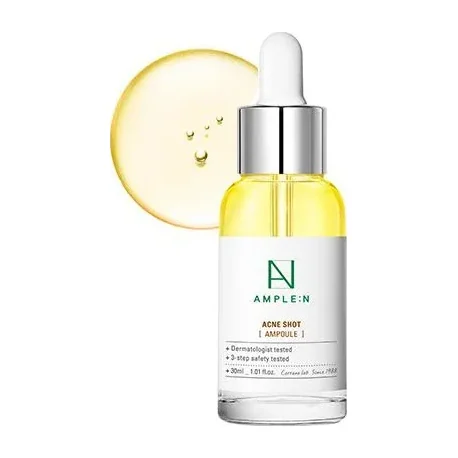
Ample:N Acne Shot Ampoule bottle
Strong choice for Acne
What makes this different

It leads with propolis and pairs a gentle salicylic-acid derivative with tea tree and a heavy dose of centella and soothing botanicals — a calm-the-breakout ampoule for inflamed, sensitive acne rather than a stinging, stripping spot treatment.

Ample:N

Ample:N Acne Shot Ampoule Review

Calming Acne Ampoule Serums ampoule k beauty Paraben free Fungal-acne safe Not cruelty free

A gentle, soothing-first acne ampoule that leads with propolis and pairs a mild salicylic-acid derivative with tea tree and a heavy dose of centella. It calms and clears inflamed, breakout-prone skin without the sting of harsher treatments, at a low price. The propolis and tea tree are genuine allergen and irritant considerations, and it isn't vegan.

Price $14.99 30ml · more sizes
Shopper rating 4.3 ★★★★★ 450 reviews
Buy at Amazon ♥
Verdicts

How well it fits each concern

The transparent ingredient list shows a coherent calm-and-clear acne formula led by propolis with a gentle salicylic-acid derivative and heavy plant soothing, and pricing is verifiable at K-beauty retailers despite inflated MSRPs. The acne logic is sound; this medium-confidence rating reflects undisclosed actives concentrations and the allergen profile — propolis and tea tree in particular — which makes individual tolerance the main variable.

One verdict per concern. Open a row for the reasoning; the receipt has every source.

The scaleRecommendedGoodSupportingEarly evidenceNot for thisAvoidhow it works

Strong choicefor AcneSalicylic Acid is an approved or monograph active for acne; this ampoule carries it, though the concentration is not declared.Receipt§ 333.310 Acne active ingredients. (opened Jul 27, 2026) · concentration not declared; studied range 0.5–2% · row checked Jul 27, 2026 · rule R3, same reading on 570 products · open the receipt

The case for it

  1. Capryloyl Salicylic Acid is an approved or monograph active for this concern.
  2. It is plausibly present at a working level, though the concentration is not declared.
  3. The formula carries no trigger this concern is sensitive to, with the cautions noted.

Moderate evidenceStandard tolerabilityNo reviews read yet

Cautions: fragrance.

What would change this: A declared concentration would move this to a firmer reading of the dose.

Same rule for everyone. “Strong choice” is the verdict on 1,475 of 45,446 concern verdicts across the catalog; rule R3 decided 570 of them. Unchanged since September 5, 2026, engine 5.2.0.

Brand or formulator? Disclose a concentration or correct a fact →

The full receipt: rule, row, sources, dates →All acne products →How acne is treated →

Promisingfor Excess OilinessSalicylic Acid has trial-level evidence for excess oiliness but no guideline or regulatory standing yet — promising, short of a recommendation; the other actives here are not yet assessed for it.Receipt6 sources on the row · rule R9p, same reading on 4,872 products · open the receipt

The case for it

  1. Capryloyl Salicylic Acid has at least one trial behind it for this concern but no guideline or regulatory standing yet.
  2. It is plausibly present at a working level, though the concentration is not declared.
  3. The formula carries no trigger this concern is sensitive to, with the cautions noted.

Moderate evidenceStandard tolerabilityNo reviews read yet

What would change this: A declared concentration would move this to a firmer reading of the dose.

Same rule for everyone. “Promising” is the verdict on 4,872 of 45,446 concern verdicts across the catalog; rule R9p decided 4,872 of them. Unchanged since September 5, 2026, engine 5.2.0.

Brand or formulator? Disclose a concentration or correct a fact →

The full receipt: rule, row, sources, dates →All excess oiliness products →

Strong choicefor BlackheadsSalicylic Acid is an approved or monograph active for blackheads; this ampoule carries it, though the concentration is not declared.Receipt21 CFR § 333.350 - Labeling of acne drug products. (opened Jul 27, 2026) · concentration not declared; studied range 0.5–2% · row checked Jul 27, 2026 · rule R3, same reading on 570 products · open the receipt

The case for it

  1. Capryloyl Salicylic Acid is an approved or monograph active for this concern.
  2. It is plausibly present at a working level, though the concentration is not declared.
  3. The formula carries no trigger this concern is sensitive to, with the cautions noted.

Moderate evidenceStandard tolerabilityNo reviews read yet

What would change this: A declared concentration would move this to a firmer reading of the dose.

Same rule for everyone. “Strong choice” is the verdict on 1,475 of 45,446 concern verdicts across the catalog; rule R3 decided 570 of them. Unchanged since September 5, 2026, engine 5.2.0.

Brand or formulator? Disclose a concentration or correct a fact →

The full receipt: rule, row, sources, dates →All blackheads products →How blackheads is treated →

Avoidfor SensitivityThis formula carries fragrance — the kind of thing reactive skin flags first.Receiptread from the ingredient list: fragrance · rule F1, same reading on 605 products · open the receipt

The case for it

  1. Propolis Extract has no evidence row yet for this concern — it is in the research queue.
  2. The formula carries a known trigger for this concern, which decides the verdict before any efficacy question.

Not from a trial rowCarries a triggerNo reviews read yet

What would change this: Removing the trigger named above would let the actives be judged on their own.

Same rule for everyone. “Avoid” is the verdict on 1,912 of 45,446 concern verdicts across the catalog; rule F1 decided 605 of them. Unchanged since September 5, 2026, engine 5.2.0.

Brand or formulator? Disclose a concentration or correct a fact →

The full receipt: rule, row, sources, dates →All sensitivity products →

A verdict is Dermington’s assessment of how well a product’s ingredients fit a concern — never a claim about what the product treats. Evidence dots and collected reviews sit beside it and are never blended in. Rules 0.5.1 · evidence table ev-2026.10-r231 · engine 5.2.0 · how we decide · this product’s receipt

Reader poll · Town SquareQuestion 1 of up to 3

Have you used Acne Shot Ampoule?

One tap counts. A couple of optional follow-ups come next.

No account neededOne answer each, change it any timeCounted only in anonymous totalsHow the Square counts →
Assessment

Pros & cons

What it does well 6

  • Propolis and tea tree provide gentle antibacterial action
  • Capryloyl salicylic acid clears pores without stinging
  • Heavy centella and licorice soothing calms breakout redness
  • Fragrance-free and reads fungal-acne friendly
  • Gentle enough for inflamed, sensitive acne
  • Affordable, with a better-value jumbo size

Where it falls short 5

  • Propolis is a relatively common contact allergen
  • Tea tree and wintergreen can irritate some skin
  • Gentle rather than strong — not for severe acne
  • Contains propolis (bee-derived) and chitosan (shellfish-derived)
  • Actives concentrations are undisclosed
Review

The full review

Most acne products are built on the old, mistaken premise that breakouts respond to punishment: strip the oil, dry the skin, make it sting, and surely the acne gives up. Ample:N's Acne Shot Ampoule takes the more modern, gentler view, and that philosophy is the most useful lens for understanding it. It's a calm-and-clear ampoule, not a sting-and-strip one, and for inflamed, sensitive, breakout-prone skin that's often exactly the right approach.

The formula leads, unusually, with propolis — bee propolis sits first on the list, bringing antibacterial and soothing properties that have made it a K-beauty favorite for troubled skin. The active exfoliation comes from capryloyl salicylic acid, a lipophilic salicylic-acid derivative that works inside the pore to clear and prevent congestion, but more gently and with less stinging than straight salicylic acid. Around those two sit a genuinely heavy soothing contingent: centella and purified madecassoside, licorice, chamomile, soybean sprout, plus tea tree for additional antibacterial action. It's a coherent design — tackle the bacteria and the clogged pores, but cushion the whole thing in anti-inflammatories so it calms rather than aggravates.

In use it lives up to that. The texture is a light, slightly viscous ampoule that sinks into a soft, non-greasy finish with only a faint herbal scent from the tea tree. It doesn't sting or tighten the way benzoyl peroxide or high-percentage acids can, and over a few weeks it helps keep pores clearer and breakouts calmer. It's fragrance-free in the sense of no added perfume, reads as fungal-acne friendly with no problematic oils, and the soothing actives make it tolerable even for the sensitive, easily-irritated acne that can't handle stronger products.

Its caveats cluster around two ingredients. Propolis, for all its benefits, is a relatively common contact allergen — bee-product sensitivities are real, and putting propolis first means there's a meaningful amount here — so a patch test is genuinely warranted, especially if you've reacted to honey or bee products before. Tea tree and wintergreen extracts add antibacterial and astringent value but are themselves potential sensitizers for a minority. And the formula isn't vegan: propolis is bee-derived, and the hydrolyzed chitosan is typically sourced from shellfish, which is also worth noting for shellfish allergies. None of this makes it a bad product; it makes it one to introduce carefully.

It's also worth setting the strength expectation. This is a gentle, mild-to-moderate acne ampoule and a soothing support, not a heavy-hitter. For occasional breakouts, congestion, and the inflamed, sensitive acne that harsher routines make worse, it's well-judged. For stubborn, cystic, or severe acne, it's better as the calming layer alongside dermatologist-guided treatment than as a standalone fix.

The brand-and-data picture is the established-K-beauty one: Coreana is an experienced manufacturer, the Ample:N line is well-reviewed, and the ingredient list is transparent, though actives concentrations aren't disclosed and there's no independent study of the finished product. The score rests on a sensible, verifiable formula.

Value is good. At around fifteen dollars for the 30ml at its real selling price — with a 100ml jumbo for better per-milliliter value — a propolis-and-salicylic ampoule with this much soothing support is a lot of formula for the money, and it undercuts plenty of single-purpose acne serums. As across the line, MSRPs are inflated and the products sell well below sticker, so buy on the everyday discount.

The propolis angle deserves a little extra context, because it's both the formula's identity and its main risk. Propolis has become a K-beauty staple for troubled skin precisely because it pairs antibacterial activity with a soothing, almost balmy character that harsher acne actives lack, and putting it first here signals the brand means it as the star, not a token drop. That's genuinely appealing for the inflamed, sensitized acne that so often gets worse under benzoyl peroxide or high-strength acids. But propolis is bee-derived, and bee-product allergies are real and not rare; someone who reacts to honey or has had a propolis reaction before should treat this with caution rather than curiosity. The supporting acid here, capryloyl salicylic acid, is a thoughtful pick too — it's the lipophilic, gentler cousin of plain salicylic acid, so it works inside oily pores without the sting, which keeps the whole formula in its calm-and-clear lane. The result is an acne ampoule that feels more like skincare than medicine, with the trade-off that it's a supporter, not a heavy hitter.

The bottom line: a gentle, well-formulated acne ampoule that clears and calms inflamed, breakout-prone skin without the harshness so many acne products inflict, at a friendly price. For mild-to-moderate or sensitive acne, it's an easy recommendation — provided you patch test for the propolis and tea tree, and note that it isn't vegan. For severe acne or those with bee-product allergies, look elsewhere or use it only as a soothing adjunct.
The science

This ampoule pairs antibacterial and keratolytic actives with substantial anti-inflammatory support. Propolis, the lead ingredient, has documented antibacterial and soothing properties relevant to acne-prone skin, though it is also a recognized contact allergen. Capryloyl salicylic acid is a lipophilic derivative of salicylic acid that penetrates sebum to exfoliate within the follicle, generally with better tolerability than free salicylic acid, addressing comedonal congestion. Tea tree (Melaleuca alternifolia) leaf extract contributes additional antibacterial activity with supportive evidence in mild-to-moderate acne, while Centella asiatica with purified madecassoside, licorice-derived dipotassium glycyrrhizate, chamomile and soybean sprout provide well-regarded anti-inflammatory and barrier-soothing effects, and adenosine adds skin-conditioning support. The design rationale — combining gentle antibacterial and exfoliating action with strong soothing — aligns with the evidence that barrier-friendly acne care is often better tolerated and more sustainable than harsh, drying regimens. Limitations include undisclosed concentrations, the allergenic potential of propolis and tea tree, and non-vegan inclusions (propolis, shellfish-derived chitosan). Overall the actives are appropriate and evidence-aligned for mild-to-moderate, inflamed, or sensitive acne, with realistic benefit being gradual clearing and calming rather than rapid resolution.

The clinical view

Clinically, a gentle approach combining a lipophilic salicylic-acid derivative with antibacterial and anti-inflammatory botanicals is reasonable for mild-to-moderate, inflamed, or sensitive acne, particularly in patients whose skin is aggravated by stronger agents like benzoyl peroxide or high-strength acids. Capryloyl salicylic acid offers follicular exfoliation with good tolerability, and the heavy centella-and-licorice soothing supports the barrier. The principal cautions are allergenic: propolis is a notable contact sensitizer, especially in those with bee-product allergy, and tea tree can sensitize a minority, so patch testing is advisable. It is not a substitute for prescription therapy in moderate-to-severe or cystic acne, where it is best positioned as a soothing adjunct. Used by appropriate patients with daily sunscreen and spacing from other strong actives, it is a sensible, well-tolerated option.

Formula

Key ingredients

  1. Propolis Extract

    The lead ingredient — bee propolis brings antibacterial and soothing properties that calm inflamed, breakout-prone skin, the gentle 'control without stripping' foundation the whole ampoule is built on.

    Not yet assessed
  2. Capryloyl Salicylic Acid

    A lipophilic salicylic-acid derivative that gently exfoliates inside the pore to clear and prevent congestion — milder and less stinging than straight salicylic acid, which fits this ampoule's soothing-first intent.

    Regulator-recognised for Acne · emerging certainty
  3. Tea Tree + Centella (Madecassoside)

    Tea tree leaf extract adds further antibacterial action while centella and purified madecassoside calm redness, together targeting both the bacteria and the inflammation of active breakouts.

    Not yet assessed
  4. Adenosine

    Placed high, adenosine adds a soothing, skin-conditioning signal that supports recovery, helping the ampoule calm and smooth as it treats — useful for the marks and texture breakouts leave behind.

    Not yet assessed
Full ingredient list 25 ingredients ShowHide

Propolis Extract, Water, Glycerin, Butylene Glycol, Propanediol, Octyldodeceth-16, Adenosine, Glycyrrhiza Glabra Root Extract, Centella Asiatica Extract, Chamomilla Recutita Flower Extract, Arginine, Glycine Soja Sprout Extract, Dipotassium Glycyrrhizate, Madecassoside, Capryloyl Salicylic Acid, Melia Azadirachta Flower Extract, Curcuma Longa Root Extract, Melaleuca Alternifolia (Tea Tree) Leaf Extract, Ocimum Sanctum Leaf Extract, Corallina Officinalis Extract, Gaultheria Procumbens (Wintergreen) Leaf Extract, Sodium Metaphosphate, 1,2-Hexanediol, Hydrolyzed Chitosan

Safety & formulation facts

  • Pregnancy safety unverified
  • Fragrance free
  • Alcohol free
  • Oil free
  • Silicone free
  • Paraben free
  • Sulfate free
  • Not cruelty free
  • Not vegan
  • Fungal-acne safe
Potential irritants Melaleuca Alternifolia (Tea Tree) Leaf ExtractGaultheria Procumbens (Wintergreen) Leaf Extract
Common allergens Propolis ExtractMelaleuca Alternifolia (Tea Tree) Leaf Extract
Compatibility

Skin types & routine

Routine step treatment
Time of day Morning & night
Best season All year
Finish non-greasy, soft, fresh

Layering

Use it after toner, ahead of moisturizer; it pairs well with niacinamide and is gentle enough for daily use, but patch test first given the propolis and tea tree, and don't stack it with strong acids the same session.

When to expect results

Redness around breakouts calms within days; clearer pores and fewer breakouts build over 3-6 weeks of consistent use thanks to the gentle salicylic-acid derivative.

Pairs well with niacinamidecentella-asiaticahyaluronic-acid
Don't combine with retinol

A routine built around it

Morning

  1. Gentle cleanser
  2. Toner
  3. Acne Shot Ampoulethis product
  4. Oil-free moisturizer
  5. Sunscreen

Night

  1. Gentle cleanser
  2. Toner
  3. Acne Shot Ampoulethis product
  4. Lightweight moisturizer
Guidance

How to use it, and who it's for

How to use

After cleansing and toner, apply a few drops over the breakout-prone areas or whole face, morning and night, then follow with a lightweight moisturizer; wear sunscreen daily. It pairs well with niacinamide. Because it contains a salicylic-acid derivative, avoid layering it with strong acids or a retinoid in the same session — alternate them instead — and keep the rest of the routine gentle. Patch test on the inner arm first, given the propolis and tea tree.

Is it worth the price?

At roughly $15 for the 30ml at its real selling price, with a 100ml jumbo for better cost-per-milliliter, this is good value for a propolis-and-salicylic acne ampoule carrying substantial soothing support — more formula than many single-purpose acne serums at the price. As with the rest of the Ample:N line, MSRPs are heavily inflated and the products routinely sell for far less, so buy at the everyday discounted price. The main value consideration is fit: it's an excellent gentle option for sensitive or mild-to-moderate acne, but those with severe acne, or with propolis or shellfish sensitivities, may get little from it, so its worth depends on matching it to the right skin.

Who should buy it

Consider it if you have oily, combination, or sensitive skin with mild-to-moderate or inflamed breakouts and want a gentle ampoule that clears and calms without stinging or stripping. It's a good fit for people whose acne is aggravated by harsher treatments, as long as they're not allergic to bee products.

Who should skip it

Steer clear if you have a propolis or bee-product allergy, or a shellfish allergy (it contains chitosan), or if you want a vegan formula. Those with severe or cystic acne needing stronger, dermatologist-guided treatment, or anyone highly reactive to tea tree, should also look elsewhere or use it only as a soothing adjunct.

Ready to try it?Ample:N Acne Shot Ampoule · $14.99 · 30ml
Details

The product, in detail

Texture
A light, slightly viscous ampoule that absorbs to a soft, non-greasy finish.
Scent
Fragrance-free, with a faint herbal note from the tea tree and plant extracts.
Packaging
A 30ml dropper bottle; also offered in a 100ml jumbo size.
How long it lasts
About 1-2 months with daily use from the 30ml size, longer from the 100ml.
Once opened
Use within 12 months · track your toss-by date →
Size
30ml · other sizes available
Made in
South Korea

What the first two weeks feel like

Goes on light and sinks in to a soft, comfortable finish with a faint herbal scent from the tea tree. It calms rather than stings, unlike harsher acne treatments; those allergic to propolis or sensitive to tea tree should patch test before regular use.

The story behind it

Why it exists

Ample:N's Shot Ampoule line targets one concern per 'shot'; the Acne Shot focuses on blemish care, choosing propolis and gentle plant actives to control breakouts while soothing the redness that comes with them.

About Ample:N Established Brand (5–20 years)

Ample:N is Coreana's ampoule-focused line, from a Korean cosmetics company with decades of formulation experience. The Acne Shot is its blemish 'shot,' built around propolis and a gentle salicylic-acid derivative with heavy plant soothing — a calm-the-breakout approach rather than an aggressive exfoliant, transparently listed but without independent trials.

Brand founded 2016

Myth vs. reality

What people get wrong about it

MythAcne treatments have to sting and dry out skin to work.

RealityThey don't — and this ampoule is built on the opposite idea. It uses a mild, lipophilic salicylic-acid derivative (capryloyl salicylic acid) plus antibacterial propolis and tea tree and calming centella, aiming to clear pores and reduce bacteria while soothing rather than stripping. Harsh, drying treatments often backfire by damaging the barrier; a gentle, soothing approach is frequently better tolerated and more sustainable for inflamed, breakout-prone skin.

FAQ

Questions people ask

What does Ample:N Acne Shot Ampoule do?

It's a gentle, soothing-first acne ampoule. Propolis and tea tree provide antibacterial action, a mild salicylic-acid derivative (capryloyl salicylic acid) gently clears and prevents pore congestion, and a heavy dose of centella, madecassoside, licorice and chamomile calms the redness of breakouts. It aims to control acne without the stinging and stripping of harsher treatments.

Is it strong enough for stubborn acne?

It's gentle by design, so it's best for mild-to-moderate, inflamed, or sensitive breakout-prone skin rather than severe or cystic acne. The capryloyl salicylic acid is milder than straight salicylic acid, and the focus is on calming and prevention. For stubborn or severe acne, it works better as a soothing support alongside stronger, dermatologist-guided treatments.

Can people with allergies use it?

Patch test first. The lead ingredient is propolis, a bee-derived ingredient and a relatively common contact allergen, and it also contains tea tree and wintergreen extracts, which can sensitize some people. If you have a known bee-product or fragrance-extract allergy, this isn't the right choice; otherwise, a patch test on the inner arm is sensible before daily use.

Is it fragrance-free, vegan, or fungal-acne safe?

It's fragrance-free (no added perfume, though tea tree gives a faint herbal scent) and reads as fungal-acne friendly, with no malassezia-feeding oils. It is not vegan — it contains propolis (bee-derived) and hydrolyzed chitosan (typically shellfish-derived), the latter also worth noting for shellfish allergies.

How do I use it with other actives?

Apply it after toner and before moisturizer, and it pairs well with niacinamide. Because it contains a salicylic-acid derivative, avoid stacking it with strong acids or a retinoid in the same session to prevent over-irritation; alternate them instead. Keep the rest of the routine gentle and hydrating, and wear sunscreen daily.

Reviews

What shoppers tend to say

Recurring themes our editors read across retailer reviews — summaries in our words, not quotations, and not a substitute for a patch test.

Common praise

  • Calms breakouts without drying
  • Gentle on inflamed skin
  • Helps clear congestion
  • Affordable acne option

Common complaints

  • Propolis can trigger allergies
  • Tea tree may irritate some
  • Gentle rather than fast-acting
  • Not vegan
Next stepCheck it against what you already useClashes, spacing and the right order, with everything on your shelf.