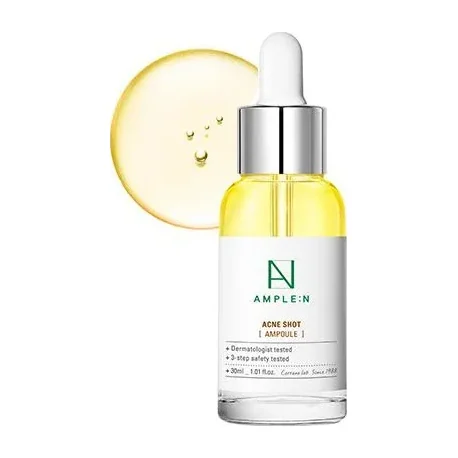
Acne serums used to be simple negotiations: a little salicylic acid, some niacinamide, done. The current K-beauty approach treats a breakout-prone face more like a multi-front campaign, attacking oil, congestion, inflammation, and barrier weakness all at once. This serum from a long-established Korean brand is a tidy specimen of that philosophy, cramming an unusual number of cooperating actives into a thirty-milliliter bottle aimed at skin that is oily, congested, and tired of being either ignored or scorched.
Niacinamide anchors the formula at the fifth INCI position, present at a concentration substantial enough to do real work on barrier function, tone, and oil regulation, and it carries the strongest evidence in the bottle. Layered onto that is sh-Oligopeptide-1, an EGF-equivalent peptide that gives the brand's 'EGF Blue' line its name, contributing promising cellular signaling support meant to help skin recover and renew. The exfoliating job falls to capryloyl salicylic acid, or LHA, an oil-soluble salicylic derivative that works gently within the pore lining rather than blitzing the surface, making it a softer route to decongestion. Then comes the botanical artillery: tea tree oil alongside neem, holy basil, houttuynia, turmeric, centella, and aloe, a multi-plant pool of traditional antimicrobials and soothers backing up the anti-acne positioning. A calming antioxidant trio of malachite extract, guaiazulene, the active blue-tinted component drawn from chamomile, and rutin adds further soothing, while a comprehensive pool of amino acids and adenosine handles skin-feel and a quiet anti-aging signal. It is, frankly, a lot of formula for the money.
The interplay between these actives is what makes the formula more than a checklist. Niacinamide and the LHA are a natural pairing for breakout-prone skin, because the acid clears congestion while the niacinamide calms inflammation and reins in the oil that feeds it, and the EGF-equivalent peptide is positioned to support the recovery side of that cycle, the renewal that breakouts and exfoliation both tax. The botanical pool, traditional antimicrobials like tea tree, houttuynia, and neem, is the kind of thing that reads as folk wisdom but has a plausible supporting role in nudging down the bacterial and inflammatory load on acne-prone skin. None of these botanicals is a heavy hitter on its own, and the smart way to read them is as a chorus reinforcing the niacinamide and acid rather than as standalone treatments, which is exactly how the formula seems to intend them.
The texture is a clean, lightweight serum that absorbs smoothly, and despite being labeled fragrance-free it carries a natural tea tree aromatic note that some will find medicinal and others reassuring. For oily and combination skin working through active acne, blackheads, and the inflammation that rides along with them, it is a well-considered single step that can replace a couple of more specialized ones. A sensible approach is to introduce it slowly, perhaps every other evening at first, to confirm your skin tolerates the tea tree and the acid before committing to nightly use. As with all acne treatment, patience is the price of admission; cumulative improvement in breakouts and congestion typically shows over four to eight weeks of steady use, not days, and pushing harder or faster tends to backfire into irritation.
The trade-offs come from the very ingredients that make it interesting. Tea tree oil, soothing for many, is a known sensitizer for some and can tip reactive skin into irritation. The LHA, while gentle, is still a salicylic derivative, which means this is not a serum for pregnancy without an obstetrician's sign-off. As a 2024 launch it carries less long-term independent data than the brand's older staples, so the medium data-confidence rating is honest rather than damning. And the sheer multi-active complexity, a feature for ingredient enthusiasts, may feel like overkill to anyone who just wants a straightforward acne serum without seven supporting players.
The brand context softens some of those caveats. This is one of the longer-established K-beauty houses with broad market reach, and the serum extends its existing EGF Blue line into the acne-prone niche rather than being a one-off experiment, so the formulation choices read as considered rather than scattershot. The flip side is the 2024 launch date, which means the medium data-confidence rating is fair; there is solid early feedback in the few hundred reviews available, but not yet the deep, years-long record that would let anyone speak with total certainty about how it performs across thousands of different complexions over time. For an ingredient-curious buyer that uncertainty is part of the appeal, and for a cautious one it is a reason to patch-test and ramp up slowly rather than dive in nightly from day one.
Value is genuinely strong here. This is an established, broadly distributed K-beauty brand putting an ambitious, fragrance-free, vegan formula on the shelf at twenty-eight dollars, and the scores reflect that with ingredient quality and value both landing in the mid-eighties, held back mainly by an irritation-risk figure that the tea tree and LHA earn fairly. Buy it if you have oily or combination, acne-prone skin, you appreciate a layered multi-mechanism approach, and your barrier can handle a touch of tea tree and a mild acid. Skip it if you are pregnant, prone to reacting to essential oils, or you simply want the leanest possible acne serum with one active and no botanical chorus. For the resilient, breakout-fighting routine, though, it delivers a remarkable amount of considered chemistry for the price.