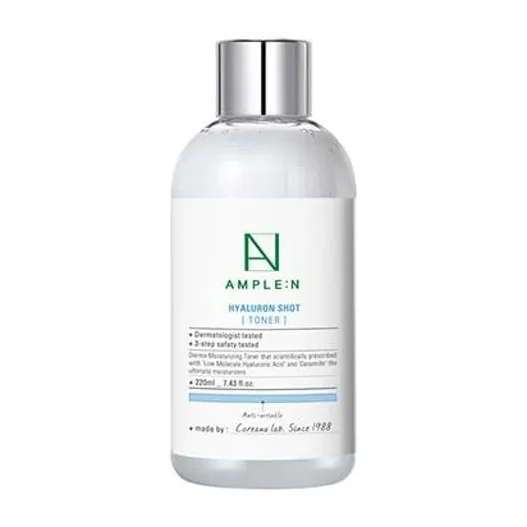
There is a small irony sitting fourth on the ingredient list of Ample:N's Hyaluron Shot Toner, and it is worth confronting head-on: a toner sold entirely on hydration places denatured alcohol high enough to be a defining feature. Alcohol in skincare is not automatically villainous — it gives a fast, weightless, quick-penetrating finish that oily skin often loves, and plenty of well-liked toners use it for exactly that. But a product named 'Hyaluron Shot,' marketed on moisture, putting a drying ingredient above its hydrating ones is a genuine internal contradiction, and it shapes the entire verdict.
The frustrating part is that the hydrating actives underneath are genuinely good. There is hyaluronic acid and sodium hyaluronate, as the name promises, but also saccharide isomerate — a plant-derived, skin-identical humectant (often sold as Pentavitin) that binds to the skin for long-lasting hydration well beyond a surface splash. Trehalose, glycerin and betaine round out a humectant base that, on paper, should make for a seriously hydrating toner. The line's signature extras are here too: adenosine, the proven anti-wrinkle active, mid-list for a light firming intent, and ceramide 3 to support the barrier. Strip out the alcohol, and this would be a standout budget hydrator.
With the alcohol in, it becomes something narrower: a lightweight, fast-absorbing prep toner best suited to oily and combination skin. The texture is watery and weightless, absorbing almost instantly with a clean, slightly cool finish that shine-prone skin genuinely enjoys. As the first step after cleansing, it refreshes and lightly hydrates and primes the skin for what follows. For the skin type that likes an alcohol finish, none of this is a problem — it does its job pleasantly and cheaply.
For the dry and sensitive skin that a 'hydration' toner most appeals to, though, the picture is less rosy. The alcohol's quick-drying effect can leave already-dry skin feeling tight, and the added fragrance compounds the irritation potential. The hyaluronic acid and saccharide isomerate will still deposit some moisture, but you are fighting the formula's own top ingredients, and the deep, lasting hydration the name implies is not really what this delivers. If your skin is dry or reactive, this is not the toner the marketing suggests it is.
The practical upside is that it is honest about being a prep step if you treat it as one. Use it on oily-to-combination skin, or follow it promptly with a proper humectant serum and moisturizer to lock in real hydration, and it slots in fine. The oil-free base keeps it weightless, though the castor oil derivative and the overall profile mean fungal-acne-prone skin should still patch test. And the generous sizing — a standard 220ml and a 600ml jumbo — means it lasts a long time and costs little per use.
On value, it is a fair budget buy with an asterisk. Fifteen dollars for 220ml of a toner carrying good humectants plus adenosine and ceramide is reasonable, and the jumbo size makes it cheaper still per milliliter. But the value is dented by the fact that you are not getting the gentlest or most deeply hydrating toner for the money — the alcohol and fragrance are real compromises, and an alcohol-free hydrating toner, while sometimes pricier, will serve dry and sensitive skin far better. The honest recommendation splits cleanly by skin type: for oily and combination skin that wants a cheap, weightless, fast-absorbing prep step, this is a perfectly good pick. For dry, sensitive or barrier-compromised skin drawn in by the 'Hyaluron' name, the formula does not match the promise, and a fragrance- and alcohol-free toner is the wiser, kinder choice.
It's worth stepping back to ask why a brand would formulate against its own marketing like this, because the answer is instructive for shoppers. Alcohol is cheap, gives an appealing lightweight finish, and helps other ingredients spread and penetrate, so it is a tempting formulation shortcut — especially in a budget product where every cost matters and where many buyers actively prefer that quick-drying feel. The 'Hyaluron' name sells the hydration story; the alcohol delivers the texture. Neither is dishonest on its own, but together they create a product whose name and formula are pulling in slightly different directions. The lesson is the one that recurs across budget skincare: read the ingredient list, not the front of the bottle. Here, the position of that fourth ingredient tells you more about who the toner truly suits than the word 'Hyaluron' ever will. Ultimately, this is a toner whose identity depends entirely on who is holding it: a clever, weightless prep step for oily skin that likes the finish, and a mismatch for the dry, thirsty skin its name seems to promise. Buy it for the former and it satisfies; buy it for the latter and it will quietly disappoint, which is reason enough to know your own skin before the marketing makes the decision for you.