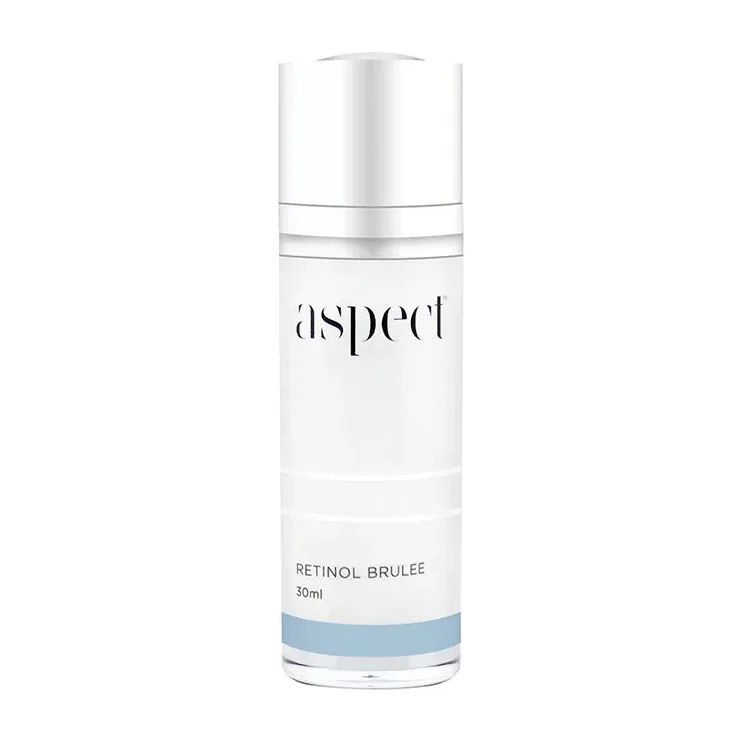
The people who quit retinol almost never quit because it didn't work. They quit because of the first two weeks, the dryness and flaking and that tight, stinging discomfort that turns a promising habit into a small daily punishment. Aspect Dr's Retinol Brulee is engineered squarely against that failure point, and it's the most useful lens for understanding the whole product. The question isn't whether it's the strongest vitamin A on the shelf, because it plainly isn't, but whether it delivers genuine retinol benefits while staying comfortable enough that you actually keep reaching for it. On that narrower and more honest measure, it succeeds.
The vitamin A strategy is layered, which is where the 'brulee' idea comes from. It pairs a gentle retinyl palmitate complex, a mild ester that converts slowly through several steps toward active vitamin A, with a dose of true retinol, which is more direct and far better evidenced for improving texture and softening fine lines. Delivering both in a gradual-release base spreads the activity out over time, so skin receives meaningful vitamin A without a sudden jolt. Retinol is among the best-studied cosmetic anti-aging actives, converting in skin to retinoic acid, the form that binds nuclear receptors to drive cell turnover and collagen synthesis, and that pedigree is what gives this serum its real backbone. Crucially, the retinol is cushioned rather than left exposed: tocopherol and the potent synthetic antioxidant dimethylmethoxy chromanol stabilize the oxidation-prone vitamin A, while a glycerin-and-emollient base carrying calming willowherb and Aphanizomenon algae buffers the dryness retinol tends to cause. A high-polyphenol native-botanical blend adds further antioxidant defense. It reads as a thoughtful, tolerability-first formula rather than a brute-force one.
In use it behaves the way the formulation promises. It's a silky serum-cream that absorbs cleanly into a smooth finish, and most people tolerate the gradual-release vitamin A with at most mild early dryness or a little light flaking, far less of the brutal retinization that drives people away from harsher products. The smart approach is to build slowly, starting at a couple of nights a week and increasing as skin adapts. Expect possible mild dryness in the first week or two, smoother texture by around four to six weeks, and tone and fine-line refinement over roughly twelve weeks of consistent use. For someone easing into retinol for the first time, or someone who wants nightly vitamin A without the drama, it's genuinely well-suited. Aspect Dr has been a clinic staple in this exact role since the product's 2017 launch, and that reputation as the gentle, build-it-up retinol is well earned.
The trade-offs follow the brand's pattern, and the first is a slightly awkward one. It's fragranced, with tangerine and rosemary essential oils contributing allergens like limonene and linalool. That makes it a cautious pick for very sensitive, rosacea-prone, or reactive skin, which is unfortunate, because those are precisely the people most drawn to a gentle retinol in the first place. Anyone in that group should patch test or choose a fragrance-free vitamin A instead. As a retinoid, it carries the standard non-negotiables: it must be avoided during pregnancy and breastfeeding, it demands daily sunscreen because retinol increases photosensitivity, and it isn't fungal-acne-safe thanks to the soybean oil in the base. And there's no getting around the fact that it's gentler and slower than prescription tretinoin, so anyone wanting aggressive resurfacing will eventually outgrow it. That gentleness is a feature for the intended audience and a limitation for the impatient.
On value, it sits in fair territory for a professional, practitioner-distributed brand. You're getting a well-buffered dual-vitamin-A serum with a real antioxidant cushion, vegan and cruelty-free, at a mid-range clinic price of around ninety-five dollars. Cheaper retinols certainly exist, and a purist could argue you can buy more retinol for less elsewhere, but the tolerability engineering and the antioxidant stabilization are worth something, particularly for skin that has tried and abandoned vitamin A before. The main friction on access is the clinic-only distribution, which means you can't simply add it to a cart on a whim; it's sold through skin clinics, and that gatekeeping is a genuine inconvenience even if it reflects the brand's positioning. The feedback that does exist, drawn from a smaller pool of around six hundred and fifty reviews averaging close to four-and-a-half stars, lines up tidily with the formulation's intent: people praise how it smooths texture with minimal irritation and how easily it builds into a nightly habit, which is precisely the comfort-first outcome the gradual-release base was designed to produce. That said, the medium data confidence is honest about the limits here, since the review volume is modest and most of the validation rests on ingredient reasoning rather than a deep clinical record for this specific product.
Where it lands is as a strong, comfortable retinol for normal, combination, or dry skin that's easing into vitamin A or wants consistent, low-drama nightly use, provided the user tolerates a citrus-herbal scent and commits to sunscreen. The buffered base and the dual-form vitamin A approach genuinely reduce the adjustment period that derails so many retinol attempts, and the antioxidant support is a meaningful bonus rather than a marketing flourish. Very sensitive skin that must avoid essential oils, anyone pregnant or breastfeeding, experienced users chasing tretinoin-level strength, and those with fungal acne should look elsewhere. But for the large group of people who've always wanted retinol's results without its first-month misery, this is a smart, well-judged way in, and the kind of product that turns a one-time experiment into a long-term routine.