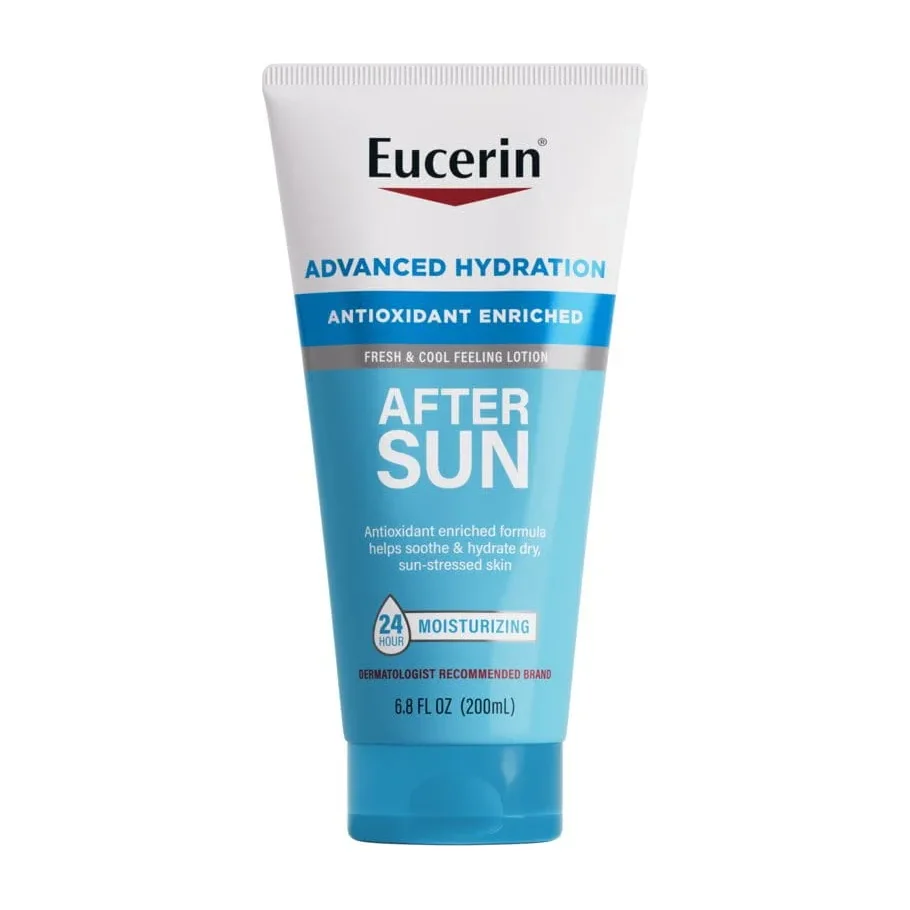
There is a specific moment this product was engineered for: you've spent a few hours longer at the beach than you meant to, your shoulders are radiating heat, and you reach into the cooler for a bottle that's been sitting next to the sodas. The cold gel hits your skin and there's an audible sigh of relief. That sensation — that exact dopamine hit of cool-on-hot — is the entire product. Understanding that reframes how you should judge it, because almost everything people love and everything people get disappointed by traces back to the fact that this is a sensation delivery system more than it is a skincare treatment.
The formula is refreshingly honest about itself once you read the label. Water leads, followed immediately by denatured alcohol, then glycerin. That alcohol is doing the heavy lifting on the cooling front; it flash-evaporates the instant it meets warm skin, which is what produces the cooling rush and the quick non-greasy dry-down. Glycerin trails behind to pull a little water back into sun-parched skin and soften the drying tug the alcohol would otherwise leave. The carbomer and triethanolamine build the clear gel structure, the polysorbate and PEG esters keep everything blended, and then — notably far down the list, below the gelling and solubilizing system — comes the aloe barbadensis leaf juice that the front of the bottle is named after. That ordering tells you most of what you need to know. The aloe is real and it contributes mild soothing polysaccharides, but it is a supporting character, not the star the marketing implies.
Rounding things out are benzophenone-4 (a UV filter used here to protect the formula's color and fragrance from degrading, not to protect your skin), imidazolidinyl urea and iodopropynyl butylcarbamate as preservatives, a generous hit of that unmistakable tropical-suntan fragrance, and the Yellow 5 and Blue 1 dyes that give the gel its faint tint. None of that is alarming for a wash-of-comfort product, but it is the opposite of a minimalist barrier-repair philosophy. If you have reactive skin, you can probably already see the friction points coming.
In use, the experience is genuinely pleasant on intact, merely-pink skin. It spreads thin and slick, cools immediately, and dries down fast without the heavy film a lotion leaves. Refrigerate it first and the effect is even better. The scent is pure summer nostalgia for some people and a bit much for others; it lingers lightly after the gel sets. The honest limitation reveals itself on skin that has crossed from pink into genuinely burned, broken, or blistered territory. There, the alcohol stops feeling refreshing and starts to sting, and the fragrance and dyes become liabilities rather than charm. This is the line where the product stops being appropriate, and it's worth respecting: an alcohol-forward gel is the wrong call for a serious second-degree burn, which is a situation for cool compresses, bland petrolatum-based balms, and possibly a doctor.
Where it earns its keep is as a low-stakes, high-frequency comfort item. It costs almost nothing, it's sold at every drugstore, grocery store, and gas station within range of a coastline, and it does the cooling job convincingly. Nobody is buying this expecting a sophisticated active. They're buying the ritual — the squeeze, the cold, the relief — and on those terms it delivers reliably. The value math is straightforward: a large bottle lasts ages because you only reach for it occasionally, and at this price the few-dollar outlay is trivial.
The part worth being clear-eyed about is the persistent belief that an after-sun gel is doing repair work. It isn't. UV damage happens at the cellular and DNA level the moment the sun hits unprotected skin, and no topical gel applied that evening reverses it. What this product does is manage the surface symptoms of mild overexposure — the heat, the tightness, the superficial dehydration — and make you more comfortable while your skin recovers on its own timeline. Peeling will still peel. The tan-or-burn outcome was decided hours earlier by your sunscreen habits, not by this bottle. Treating it as a soothing afterthought rather than a corrective treatment keeps your expectations honest.
So who is this for? Anyone who wants a cheap, satisfying cooling gel to keep in the beach bag or the fridge for those slightly-overcooked summer afternoons, and who doesn't have particularly reactive skin. It's a feel-good commodity that does its narrow job and asks very little of your wallet. Who should pass? People with sensitive, eczema-prone, rosacea-prone, or genuinely sunburned skin, who will get more sting than soothing from the alcohol-fragrance-dye base, and anyone hoping for a moisturizing or reparative after-sun step — for that, a fragrance-free, alcohol-free aloe gel or a plain ceramide body lotion is the smarter, gentler buy. Judged for what it is rather than what its name suggests, it's a perfectly fine, perfectly cheap summer indulgence.