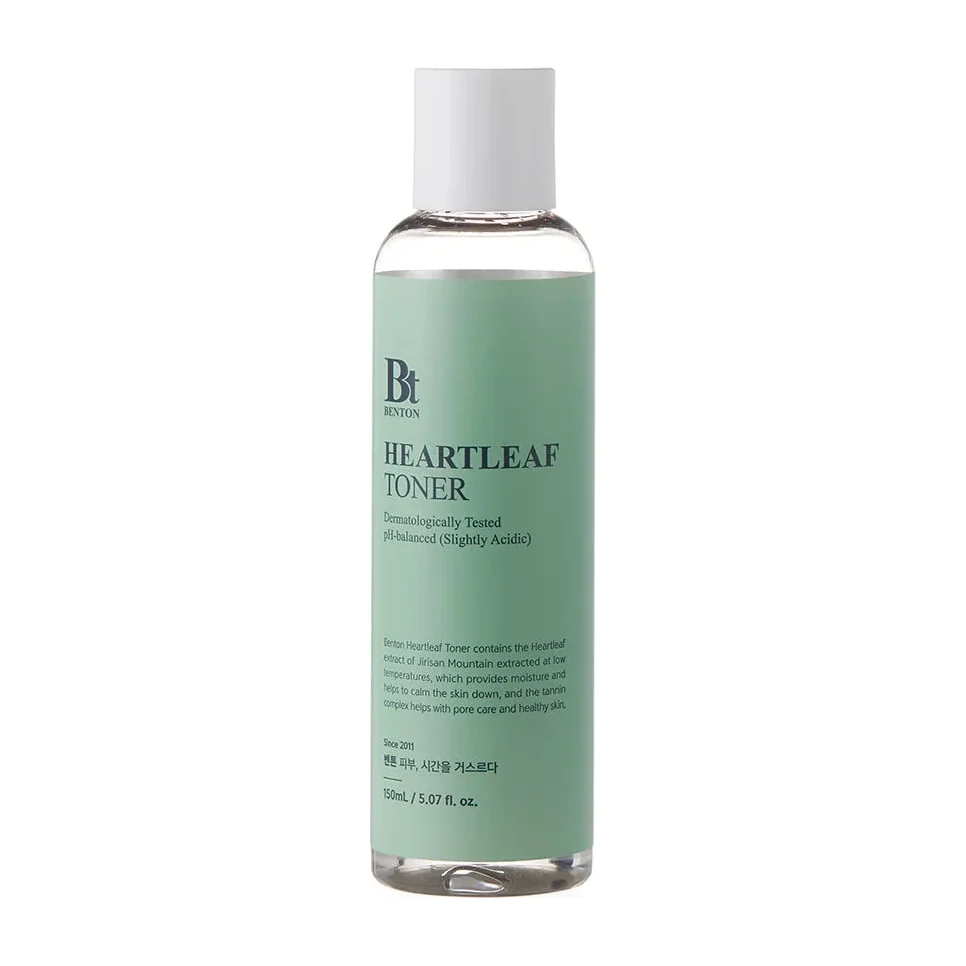
There's a population skincare keeps failing at the intersection: people whose skin is both reactive and fungal-acne-prone. The calming aisle is built for the reactive, but it's built on the oils, esters, and polysorbates that feed Malassezia, so the very products marketed at sensitive skin tend to break out the fungal-acne-prone subset of it — and that subset, told to avoid both irritants and yeast-feeding ingredients, finds the soothing category almost entirely closed. Heartleaf, the calming plant of the moment, mostly arrives in formats that ignore them. Benton's Heartleaf Toner is the rare exception, and it's the toner's most distinguishing feature before a word about the trending plant: a calming deck stripped clean enough to clear the fungal-acne screens, which for the underserved overlap is less a product than a permission slip. The fungal-acne overlap deserves its own moment of dermatological context, because the underservice is structural, not accidental. Malassezia folliculitis and seborrheic dermatitis both flourish on the skin's own sebum and on the fatty acids, esters, and polysorbates that dominate emollient skincare — which means the calming category's favorite tools (soothing plant oils, rich ester emollients, the very ingredients that make a product feel gentle) are precisely the ones that feed the yeast. A reactive face that's also fungal-acne-prone therefore gets told two contradictory things by the same aisle: soothe with emollients, avoid emollients. Most products resolve the contradiction by ignoring the fungal-acne half, because it's the smaller population and the harder formulation constraint. Benton's toner resolves it the other way almost by accident — its minimalist construction, chosen for reaction-source reduction, happens to also strip out every yeast-feeding line — and the result is a product whose narrowest virtue is its most valuable one to the people who need it. Accidental or not, it's the kind of formula that earns lifetime loyalty from a population used to being an afterthought.
The calming chemistry is honest and minimalist. Jirisan-grown Houttuynia cordata sits second — near-neat after water, the trend plant at real concentration — but the formula's wisdom, as with the heartleaf cream, is not betting on it alone. Centella asiatica anchors fourth, the better-documented soother whose madecassoside-and-asiaticoside file carries the verifiable calming the heartleaf supports rather than supplies. Panthenol, sodium PCA, and allantoin build the hydration-and-soothe floor, giving a watery toner genuine conditioning substance at the routine's base, and a modest hyaluronate plumps the surface. This is a stripped, purposeful calming-and-hydration deck — the essentials, undiluted by filler, with the reaction surface a long ingredient list provides deliberately absent. For reactive skin, that minimalism is the feature: fewer ingredients mean fewer culprits if something does go wrong, and a toner this short is one a sensitive routine can adopt with confidence.
The heartleaf evidence is the category's emerging-tier one, framed the same way across the franchise. Houttuynia cordata has traditional use and early anti-inflammatory data — promising, not settled at cosmetic doses — and the toner positions it correctly as a credible lead backed by the proven cica, not as a documented active carrying the formula. The reactive-skin verdict over the first weeks, the settled redness and steadier baseline the review base reports, traces to the cica-panthenol floor with heartleaf as the supporting trend. Honest billing, and the same hedge the smart heartleaf formulas all make.
The fungal-acne clearance is the toner's real edge, and it's worth dwelling on because it's rare and it's verifiable. The deck carries no oils, no esters, no polysorbates — the stripped construction that, almost incidentally, clears the strict Malassezia-cautious screens the calming category routinely fails. For the reactive-and-fungal-acne-prone, this is a calming toner they can actually use, a combination so uncommon that the toner's modest soothing becomes valuable simply by being accessible to a population the aisle abandons. The one note to audit, identical to the cream's, is the aromatic-herb quartet — lavender, oregano, rosemary, thyme, trace and low in the deck, but a fair thing for the genuinely reactive to weigh in a calming formula, warranting the patch-test despite the minimal doses. Otherwise the deck is clean: vegan, fragrance-free, alcohol-free, and free of the Snail Bee line's venom exclusion entirely. A word on the heartleaf-percentage arms race the toner deliberately sits out, since comparison shoppers will encounter it. The dokudami trend's flagship products advertise their heartleaf content as a headline number — seventy-seven percent, eighty percent, the figure itself the marketing — and Benton's toner, leading with heartleaf but not flexing a percentage, reads as understated beside them. The honest framing is that the number is doing less work than it appears: heartleaf's evidence is emerging at any concentration, processed-extract percentages compare labels more than potency, and a toner pairing a moderate heartleaf dose with proven cica may well out-calm one betting everything on a bigger heartleaf figure and nothing else. The percentage war is a marketing format, not a potency ranking, and the buyer who chooses Benton's restraint over a competitor's headline number is making the more evidence-literate call — backing the proven soother plus the credible lead over the trend plant maximized in isolation. Restraint rarely wins the shelf; it more often wins the result.
The recommendation sorts by the overlap it serves. The reactive-and-fungal-acne-prone, abandoned by the calming aisle, get a rare usable option at fifteen dollars — buy it for the accessibility as much as the soothing. The broadly reactive get a clean minimalist calming base that argues with nothing and layers for seven-skin without sting. Heartleaf-line builders get the coordinated first step. And the herb-reactive minority patch-tests the aromatic quartet before committing. The dokudami trend produced a flood of heartleaf toners chasing the broadest audience; Benton's quietly served the narrowest underserved one instead, with a fungal-acne-clean minimalist deck that the population it serves will recognize, correctly, as the rare product built for them rather than at them — which, at fifteen dollars, is the kind of restraint that out-values the maximalism every time the right buyer finds it.