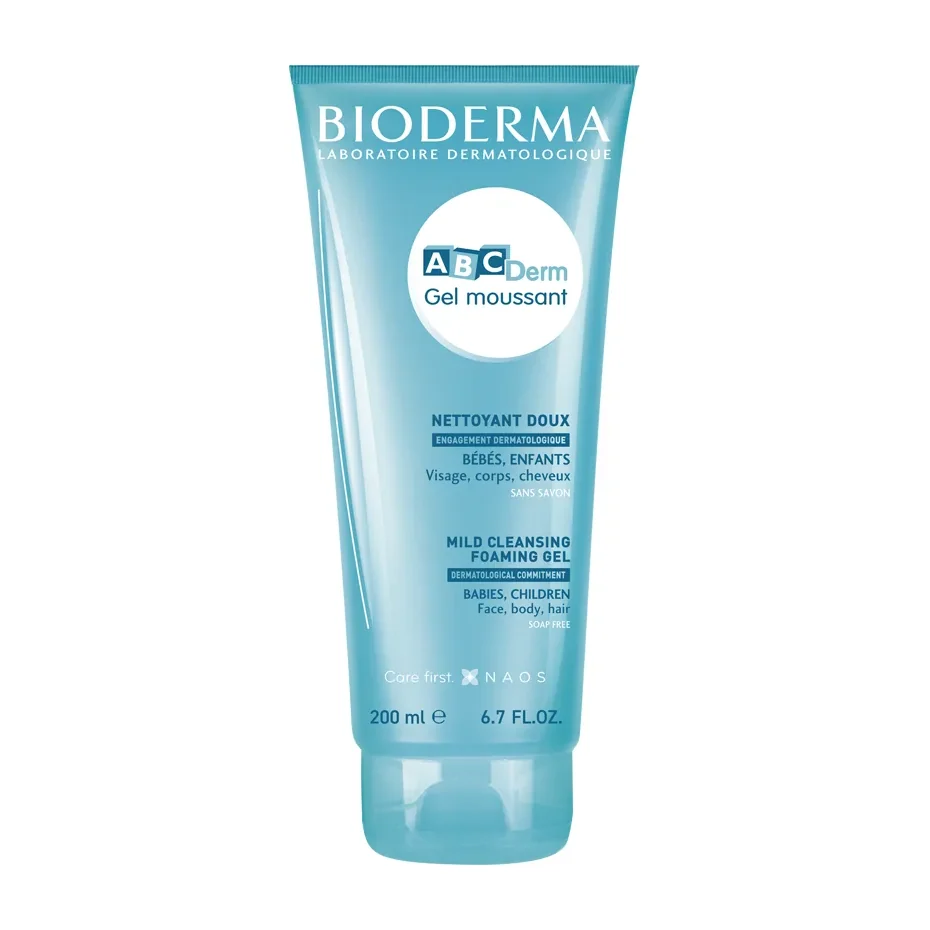
Bioderma ABCDerm Foaming Gel 200 ml white tube with blue label
What makes this different

It is the plain everyday bath wash of the ABCDerm range — a twelve-ingredient sulfate-and-betaine gel, citrate-buffered to infant pH, with a re-fatting agent and a light scent — built for hair and body in one step. Its honesty is in its simplicity; its limitation is that the simplicity includes a sulfate and a fragrance, which is why the range also sells a Cold-Cream cleanser for drier babies.

Bioderma

Bioderma ABCDerm Foaming Gel Review

French Bath-Time Default Body Care gel pharmacy brand Paraben free Fungal-acne safe Vegan Not cruelty free

A well-buffered, betaine-softened sulfate wash that cleans a normal-skinned baby's hair and body in one go without stinging, for $15 a tube. It is the French bath-time default and does that job competently; it is also a scented SLES gel, which is the template modern infant-care guidance has moved away from, and the wrong choice for dry, sensitive or eczema-prone babies — for whom the same range sells a better cleanser.

Price $14.99 200 ml (6.76 fl oz) · more sizes
Shopper rating 4.5 ★★★★★ 80 reviews
On the market 2003 Made in France
Best for normal
Buy at Amazon ♥
Verdicts

How well it fits each concern

The twelve-ingredient formula is fully published and the surfactant chemistry is thoroughly understood, and two decades of French pharmacy use give the gel a long informal safety record — but US retailer reviews are scattered and few, Bioderma's tolerance figures come from its own paediatric panels, and no independent clinical study of the gel exists. Whether a sulfate base suits a particular baby is a question of that baby's skin and bathing frequency rather than of anything the review count can show.

No concern verdicts yet.

The scaleRecommendedGoodSupportingEarly evidenceNot for thisAvoidhow it works

As a body productNot judged: what a body product is for — real substance, not just slip, realistic to use daily — cannot yet be measured from the ingredient list (only fragrance load can).

A verdict is Dermington’s assessment of how well a product’s ingredients fit a concern — never a claim about what the product treats. Evidence dots and collected reviews sit beside it and are never blended in. Rules 0.5.1 · evidence table ev-2026.10-r231 · engine 5.2.0 · how we decide · this product’s receipt

Reader poll · Town SquareQuestion 1 of up to 3

Have you used ABCDerm Foaming Gel?

One tap counts. A couple of optional follow-ups come next.

No account neededOne answer each, change it any timeCounted only in anonymous totalsHow the Square counts →
Assessment

Pros & cons

What it does well 7

  • Betaine-blended, citrate-buffered sulfate that genuinely does not sting the eyes
  • One product for hair, scalp and body — rinses clean from fine baby hair
  • Re-fatting glyceryl isostearate leaves skin soft rather than squeaky
  • Preserved without parabens or isothiazolinones
  • Soft, low-volume foam sized for infant skin rather than adult lather
  • Fair $15 for a tube that lasts two months at recommended frequency
  • Two decades of French maternity-ward and pharmacy use

Where it falls short 6

  • Sodium laureth sulfate at position two — the base modern infant guidance avoids
  • Scented, if lightly and in a rinse-off format
  • Wrong everyday wash for dry, sensitive or eczema-prone babies
  • Daily use tightens drier infant skin
  • No independent study; tolerance figures are Bioderma's own
  • US reviews are few and scattered
Review

The full review

Tear-free is a claim that most parents assume means gentle, and gentle is a word most parents now assume means sulfate-free. ABCDerm Foaming Gel is a useful correction to both assumptions, because it is genuinely tear-free and it has sodium laureth sulfate second on its ingredient list. The trick, which French pharmacy formulators have used for generations, is in what surrounds the sulfate: coco-betaine right behind it, an amphoteric surfactant that forms larger mixed micelles with the sulfate and blunts its ability to irritate an eye or strip a barrier; a citrate buffer holding the wash near the mildly acidic pH of infant skin rather than the alkaline range of soap; a re-fatting agent, PEG-90 glyceryl isostearate, that leaves a trace of lipid behind on rinsing; and dilution, because a baby wash needs a fraction of the detergent load an adult shower gel carries. The result is a soft, creamy, low-volume foam that cleans hair and body together, rinses without film, and does not make a baby cry when it runs into the eyes. That is competent, unglamorous chemistry, and it works.

In use it is exactly the everyday wash it claims to be. A little gel on a wet baby lathers gently, handles a day's milk and sweat and the scalp in one pass, and rinses clean from fine hair without residue; skin feels soft rather than squeaky afterwards, which is the glyceryl isostearate doing its small job. The tube is bath-safe and one-handed, the litre pump exists for home, and $15 for 200 ml is fair — two months of two-or-three-baths-a-week use, which is the frequency Bioderma and most paediatric advice actually recommend, since warm water alone is enough on the days between. Used that way on a healthy, normal-skinned infant, there is little to fault and nothing to fear.

The question is not whether it works but whether the template is still the right one, and here the honest answer has shifted over the two decades this gel has been on the shelf. Infant-care guidance in most of the world — the American Academy of Pediatrics, the European eczema guidelines, most paediatric dermatologists — has converged on soap-free, sulfate-free, fragrance-free cleansers for babies as a default, not because a well-made sulfate wash is harmful to a healthy infant but because a newborn's barrier is thinner and still maturing, detergent exposure is cumulative, and the benefit of sulfate over gentler surfactants is only foam, which a baby does not need. This gel carries both of the ingredients that guidance would remove: the sulfate at position two and a fragrance at position twelve. The fragrance, at least, is rinsed off, which makes it the least exposing scented product in the ABCDerm range; the sulfate is the base.

What that means in practice divides babies rather neatly. A robust infant or toddler with normal skin and no atopic history will be washed perfectly well by this gel two or three times a week, and the scent will be either pleasant or unnoticed. A baby with dry skin, eczema, a parent or sibling with atopy, or a trunk that has already started to feel tight after baths is the wrong customer, and daily use on such a baby is the classic way a family ends up blaming the product for dryness the routine caused. Bioderma seems to know this, because the same range sells a Cold-Cream cleansing cream — soap-free, lipid-rich, the format the guidance prefers — for exactly those babies, and the sensible reading of the ABCDerm shelf is that the Foaming Gel is the wash for normal skin and hair, and the Cold-Cream is the wash for everyone else.

The review record is scattered across US retailers in modest numbers and larger in Europe, and it says what the formula predicts: no stinging, one-step hair and body, soft foam, a bottle that lasts — and, from a minority, surprise at finding a sulfate and a scent in a dermatological baby wash, or tightness on a dry-skinned baby washed daily. Both are fair, and both are avoidable with the label read in advance.

A word on the practical side, because it is where most of the difference between a happy and an unhappy experience with this gel is made. The 'tear-free' tolerance is real but it is not an invitation to let foam sit in the eyes; rinsing well, particularly in the neck and thigh folds where a sulfate residue would otherwise linger, matters as much as the formula. And the emollient afterwards is not optional — every wash, however mild, removes some lipid, and the lotion within a few minutes of towelling is what turns a clean baby into a comfortable one. Followed that way, on the right baby, the gel is a pleasure to use.

So the recommendation is a qualified one. As a bath-time wash for a healthy baby with normal skin, used a few times a week and followed by a lotion, this is a well-made, well-priced, no-sting gel with two decades of French nurseries behind it. As a default for infants in general — and certainly for any baby with dry or eczema-prone skin — a soap-free, fragrance-free cleanser is the better template, and Bioderma's own range is the first place to find one.
The science

The gel is a dilute anionic-amphoteric surfactant system, and its tolerability follows from three well-characterised mechanisms. Sodium laureth sulfate alone is a moderately irritating surfactant with meaningful barrier-disruption potential; combined with an amphoteric co-surfactant such as coco-betaine, it forms larger, more stable mixed micelles with a lower critical micelle concentration and reduced monomer availability, which is the established basis for the reduced skin and ocular irritation of betaine-blended washes — the same architecture used in adult 'gentle' cleansers and in most no-sting baby shampoos. A citrate buffer holds the wash near pH 5.5; infant stratum corneum acidifies over the first weeks of life and a cleanser at physiological pH avoids the enzymatic disruption that alkaline washing causes. PEG-90 glyceryl isostearate is a re-fatting and thickening agent that deposits a small lipid residue on rinsing, partially offsetting the surfactant's lipid removal. The total surfactant load is low relative to adult products, which matters more than the identity of the surfactant for cumulative barrier effects.

The formulation's limitations are the ones guidance identifies. Infant skin is thinner, more hydrated and more permeable than adult skin, with a lower lipid content, and clinical studies of infant bathing consistently favour infrequent cleansing with mild, soap-free, fragrance-free products, particularly in babies at risk of atopic dermatitis; sulfate-based washes, even betaine-blended, remove more lipid per wash than non-ionic or amino-acid-based alternatives. Fragrance mix is the most common cosmetic contact allergen at all ages, though rinse-off exposure is substantially lower than leave-on. Bioderma's ocular and cutaneous tolerance claims derive from in-house paediatric panels; no independent clinical study of the gel has been published. The evidence supports it as a well-tolerated wash for normal infant skin used at recommended frequency, and does not support it as a preferred cleanser for dry or atopic infants.

The clinical view

The clinical consensus on bathing infants is short: warm water is sufficient for most baths, a cleanser two or three times a week is plenty, and when one is used it should be soap-free, mild and ideally fragrance-free, followed by an emollient within minutes — advice that is applied firmly to any baby with dry skin, eczema or an atopic family history. A betaine-blended, pH-buffered sulfate gel like this one would be regarded as acceptable for a healthy, normal-skinned infant at that frequency, with the note that it is not the format a paediatric dermatologist would reach for first, and that its fragrance, though rinsed off, is an avoidable variable. For at-risk babies the recommendation would move to a soap-free cream cleanser — including the one in this same range — and daily foaming washes would be discouraged. Clinicians also point out that no-sting formulations reduce ocular irritation but do not make foam in the eyes desirable, and that thorough rinsing matters as much as the product.

Formula

Key ingredients

  1. Sodium Laureth Sulfate (blended with coco-betaine)

    The cleansing pair, second and third on a twelve-item list: a dilute sulfate for the foam and the actual cleaning, blended with an amphoteric betaine that forms larger mixed micelles and takes most of the sting out of it. This is the classic 'tear-free' architecture — mildness comes from the combination and the dilution, not from the absence of sulfate — and it is why the gel rinses hair and skin clean without leaving either tight.

    Not yet assessed
  2. PEG-90 Glyceryl Isostearate with Laureth-2

    Two mildness-and-thickness aids that give the gel its body and its soft, low-lather foam. The glyceryl isostearate in particular is a re-fatting agent that leaves a trace of lipid behind after rinsing, which is the small mechanism behind the 'leaves skin soft' claim.

    Not yet assessed
  3. Pentylene Glycol with Methylpropanediol

    A humectant-and-antimicrobial pairing that keeps a tube of baby wash microbiologically safe without parabens or isothiazolinones, while adding a little moisture retention to the rinse. Pentylene glycol does the preserving; methylpropanediol improves the feel and the solubility of the fragrance.

    Not yet assessed
  4. Citrate Buffer (Citric Acid, Sodium Citrate)

    Holds the wash close to the mildly acidic pH of infant skin rather than the alkaline range of a soap, which is the second half of what makes a sulfate-based gel tolerable on a newborn — a detergent at the right pH strips far less than one at the wrong pH.

    Not yet assessed
  5. Fragrance (Parfum)

    Last on the list, supplying the range's signature nursery scent. In a rinse-off product the exposure is lower than in the ABCDerm lotion or cleansing water, which is the fairest thing that can be said for it; it remains an ingredient infant-care guidance would rather omit.

    Not yet assessed
Full ingredient list 12 ingredients ShowHide

Aqua/Water/Eau, Sodium Laureth Sulfate, Coco-Betaine, Methylpropanediol, Sodium Chloride, Pentylene Glycol, PEG-90 Glyceryl Isostearate, Laureth-2, Citric Acid, Disodium EDTA, Sodium Citrate, Fragrance (Parfum)

Safety & formulation facts

  • Pregnancy safe
  • Not fragrance free
  • Alcohol free
  • Oil free
  • Silicone free
  • Paraben free
  • Not sulfate free
  • Not cruelty free
  • Vegan
  • Fungal-acne safe
Potential irritants Sodium Laureth SulfateFragrance (Parfum)
Common allergens Fragrance (Parfum)
Compatibility

Skin types & routine

Routine step cleanser
Time of day Night
Best season All year
Finish non-greasy

Layering

A bath-time wash for body and hair, used a few times a week rather than at every bath — water alone is enough on the days in between — and always followed by an emollient within minutes of towelling. On a baby with dry or eczema-prone skin, the range's Cold-Cream cleansing cream or an unscented soap-free wash is the gentler choice, and this gel is best kept for hair and for the days a real clean is needed.

When to expect results

It is a wash; the result is clean, soft skin and hair immediately, with no tightness on normal infant skin. If cheeks or the trunk begin to look dry or rough after a couple of weeks of daily use, that is the signal to cut back to a few baths a week or to move to a soap-free cream wash.

Pairs well with ceramidesglycerinpetrolatum

A routine built around it

Morning

  1. ABCDerm H2O on a pad (no wash)
  2. Moisturizing milk on dry areas

Night

  1. Bath: THIS PRODUCT on body and hair (2-3x a week)
  2. Rinse thoroughly, pat dry
  3. Emollient all over within minutes
Guidance

How to use it, and who it's for

How to use

In a warm bath, wet the baby's body and hair, squeeze a small amount of gel — a coin-sized dose is plenty — into a wet palm or soft cloth and work it into a light foam over the body and scalp, keeping the foam away from the eyes as far as possible even though it is tested not to sting. Rinse thoroughly, especially in the neck, arm and thigh folds and behind the ears, then lift the baby out and pat dry rather than rubbing. Apply an emollient all over within a few minutes while the skin is still slightly damp. Use it two or three times a week, with warm water alone on the other days; daily use is fine for a robust toddler but tends to tighten drier infant skin. If the trunk or cheeks start to look dry or rough, space the washes out or switch to a soap-free cream cleanser, and keep the gel for hair only. Store the tube capped and away from bath heat.

Is it worth the price?

At $14.99 for 200 ml the gel is priced in line with other pharmacy baby washes and well under the boutique sulfate-free brands, and at the recommended two or three baths a week a tube lasts about two months, keeping the monthly cost under eight dollars; the litre pump lowers it further. The formulation is simple and inexpensive to make, so the price reflects Bioderma's pharmacy pedigree and paediatric testing rather than costly ingredients, and that is fair for a robust, normal-skinned baby. For a dry or eczema-prone infant the value calculation changes, since the money would be better spent on a soap-free, fragrance-free cleanser — and Bioderma's Cold-Cream cleansing cream in the same range is one, at a similar price.

Who should buy it

Parents of healthy babies and toddlers with normal skin who want a single mild wash for hair and body at bath time, used a few times a week, and who are comfortable with — or indifferent to — a light nursery scent and a sulfate base. It suits families who like the ABCDerm range and want its bath-time counterpart.

Who should skip it

Any infant with dry skin, eczema, an atopic family history or a trunk that tightens after baths should be washed with a soap-free, fragrance-free cream cleanser instead — including the Cold-Cream cleanser in this same range. Parents wanting a sulfate-free or unscented routine should read the second and twelfth ingredients before buying.

Ready to try it?Bioderma ABCDerm Foaming Gel · $14.99 · 200 ml (6.76 fl oz)
Details

The product, in detail

Texture
A clear, slightly viscous gel that thins in water into a soft, low-volume, creamy foam — nowhere near the mountain of lather an adult shower gel makes, by design.
Scent
The soft, powdery ABCDerm nursery scent, present in the foam and faint on the skin and hair once rinsed.
Packaging
A 200 ml white tube with a flip cap in ABCDerm blue and white — bath-safe, one-handed, and small enough for a changing bag; a litre pump bottle exists for home use.
How long it lasts
About two months of two-to-three-times-weekly baths from the 200 ml tube, or six weeks if used daily on body and hair.
Once opened
Use within 12 months · track your toss-by date →
Size
200 ml (6.76 fl oz) · other sizes available
Made in
France
Launched
2003

What the first two weeks feel like

The first bath with it is easy: a little gel foams gently, cleans hair and body in one go, rinses without film and does not make the baby protest when it reaches the eyes. Normal skin feels soft afterwards. What parents of drier babies notice over the first week or two of daily use is a faint tightness on the trunk, which is the cue to space out the washes or switch to a cream cleanser.

The story behind it

Why it exists

The Gel Moussant has been the bath-time wash in Bioderma's paediatric range since the ABCDerm line launched in the early 2000s, occupying the same shelf in French pharmacies as the cleansing water and the milk. It follows the long French pharmacy habit of building infant washes on dilute sulfates with betaine and a nursery scent — a template that predates the fragrance-free, sulfate-free turn in Anglo-American baby care by a generation.

About Bioderma Legacy Brand (20+ years)

Bioderma, the French dermatological laboratory founded in 1977, has produced the ABCDerm paediatric range since the early 2000s, and its Gel Moussant is the everyday bath wash on French pharmacy shelves and maternity-ward lists. The gel carries the brand's paediatric skin and eye tolerance testing and two decades of mass use; it has no independent published trial, and it is built on a sulfate-and-betaine base with a light fragrance rather than the soap-free, unscented template most infant-care guidance now prefers.

Brand founded 1977 · This product since 2003

Myth vs. reality

What people get wrong about it

MythA 'tear-free' baby wash must be sulfate-free.

RealityTear-free comes from the combination — a dilute sulfate blended with an amphoteric betaine forms larger mixed micelles that barely irritate the eye — and from a citrate buffer that keeps the pH near the eye's own. This gel has sodium laureth sulfate second on the list and still does not sting, which is the chemistry working as intended.

MythBabies need a wash at every bath.

RealityMost infant-care guidance suggests warm water alone is enough for most baths and a cleanser two or three times a week, particularly for dry or eczema-prone skin. Using any foaming wash daily on a baby is the most common cause of the tightness parents then blame on the product.

FAQ

Questions people ask

Does Bioderma ABCDerm Foaming Gel contain sulfates?

Yes — sodium laureth sulfate is the second ingredient, blended with coco-betaine and buffered with citrate to keep it mild and near infant skin's pH. It is a dilute, well-tolerated sulfate wash, but not a sulfate-free one; the range's Cold-Cream cleansing cream is the soap-free, sulfate-free alternative for drier babies.

Is the ABCDerm Foaming Gel tear-free?

In practice, yes — Bioderma tests it for ocular tolerance and the sulfate-betaine blend with a citrate buffer is the standard architecture of no-sting baby washes. It is still a detergent, so rinsing well and keeping foam out of the eyes remains sensible.

Can ABCDerm Foaming Gel be used as a baby shampoo?

Yes, it is designed for hair and scalp as well as body — one product for the whole bath. It rinses cleanly from fine baby hair without residue; on cradle cap, a dedicated cradle-cap wash or an oil-and-comb routine works better than any general gel.

Is ABCDerm Foaming Gel suitable for a baby with eczema or dry skin?

Not as the everyday wash. A scented sulfate gel, even a mild one, is the format eczema guidance steers away from; a soap-free, fragrance-free cream cleanser used two or three times a week, followed by an emollient, is the standard advice. This gel can be reserved for hair on a normal-skinned baby.

How often should a baby be washed with ABCDerm Foaming Gel?

Two or three baths a week with a cleanser is enough for most infants, with warm water alone on the other days. Daily use on body and hair is fine for a robust, normal-skinned toddler, but is the usual reason a baby's trunk starts to feel tight.

Does the ABCDerm Foaming Gel have fragrance?

Yes, a light powdery nursery scent, listed last. In a rinse-off wash the exposure is lower than in the range's leave-on lotion or no-rinse water, but parents who want a fragrance-free routine for an infant should look elsewhere in the range or to an unscented brand.

Reviews

What shoppers tend to say

Recurring themes our editors read across retailer reviews — summaries in our words, not quotations, and not a substitute for a patch test.

Common praise

  • Does not sting the eyes
  • Cleans hair and body in one step
  • Soft foam rinses cleanly

Common complaints

  • Scented and sulfate-based, which some parents did not expect
  • Can leave dry-skinned babies tight if used daily
Notable endorsementsTwo decades as a French maternity-ward and pharmacy bath wash
Next stepCheck it against what you already useClashes, spacing and the right order, with everything on your shelf.