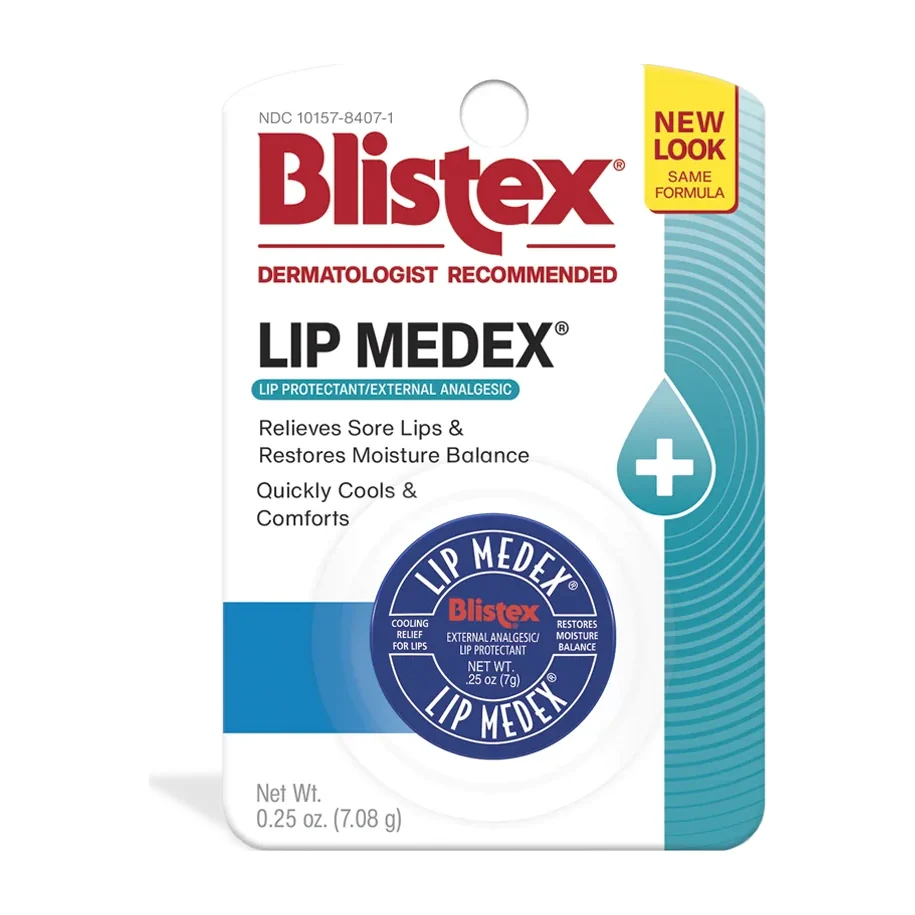
There are products you use daily as part of a considered routine, and there are products you grab in a panic at 2 AM when your lips feel like they are being held together by the thinnest possible thread of dried skin. Blistex Lip Medex is the latter. It is not a daily lip balm. It is not a beauty product. It is a medicated intervention in a small blue pot, and it has been exactly that for over thirty years.
The formula's primary identity is pharmaceutical, not cosmetic. Lip Medex is classified as an external analgesic and lip protectant — an OTC drug product regulated by the FDA, not just a cosmetic lip balm. The active ingredients are camphor at 1%, menthol at 1%, phenol at 0.54%, and petrolatum at 59.14%. Three of those four are pain relievers. One is the most effective occlusive moisturizer known to dermatological science. Together, they create a product that simultaneously numbs your pain and seals in your moisture.
The petrolatum concentration — nearly sixty percent — deserves special attention. This is more petrolatum than most dedicated petroleum jelly products contain after adding their other ingredients. It is an overwhelming, barrier-forming avalanche of occlusive protection. When applied to cracked, painful lips, it creates a seal that stops moisture from escaping and environmental irritants from getting in. If your lips are chapped to the point of bleeding, petrolatum is what your dermatologist would recommend, and Lip Medex delivers it in industrial quantities.
The analgesic trio provides the product's signature experience. Apply Lip Medex and you know immediately that something is happening. The menthol hits first — a sharp, cool blast that activates every cold receptor in your lip tissue. Camphor follows with a deeper, more medicinal cooling. Phenol adds a faint numbing effect that dulls the sting of cracked skin. The sensation is intense, especially if your lips are already raw. It borders on aggressive. Some people love it. Some people wince through it. Nobody ignores it.
This intensity is both the product's greatest strength and its most legitimate criticism. For truly painful lips — the kind that crack when you smile, bleed when you eat citrus, and make you wince in cold wind — the analgesic relief is genuine and immediate. The pain fades. The protective barrier forms. Life becomes bearable again. For this specific use case, Lip Medex is difficult to beat.
But for lips that are merely dry — not damaged, not cracked, just in need of routine moisture — the medicinal cocktail is overkill. Menthol, camphor, and phenol are all mild irritants. Applied repeatedly to sensitive lip tissue, they can create a cycle where the analgesics provide temporary relief while simultaneously causing low-grade irritation that makes the lips feel like they need more product. This is the kernel of truth behind the lip balm addiction myth — it is not true dependence, but it is a real phenomenon of irritant-driven reapplication.
The inactive ingredient list adds more concerns for the ingredient-conscious. Lanolin, while an effective emollient, is a common contact allergen. Fragrance and flavors are present despite having no therapeutic purpose. Benzyl alcohol serves as a preservative and mild anesthetic but can irritate sensitive tissue. Beeswax and lanolin make this unsuitable for vegans. It's not a clean formula by any modern definition. It is a formula that was designed to work, not to win an ingredient-list beauty contest.
Cocoa butter and castor oil provide genuine conditioning benefits beyond the petrolatum base. Cocoa butter's fatty acids nourish and soften dried lip tissue, while castor oil adds protective emollience and a touch of gloss. These ingredients are doing real work underneath the medicinal fireworks happening on the surface.
The iconic blue pot is both charming and frustrating. Charming because it is instantly recognizable — generations of Americans have seen this pot in medicine cabinets, glove compartments, and coat pockets. Frustrating because it requires finger application, which is inherently less hygienic than a stick or tube. Blistex offers a tube version, but the pot remains the classic format.
Value is the product's unassailable strength. At roughly three dollars per pot, with each pot lasting months, Lip Medex costs less per application than almost any other lip product in existence. It is available at every drugstore, grocery store, and gas station in America. Accessibility is complete. For a product that provides genuine OTC drug-level pain relief and the most aggressive occlusive protection available without a prescription, the price is absurdly low.
The absence of SPF is notable, especially compared to its sibling DCT. For daytime outdoor use, Lip Medex provides no sun protection — a significant gap for a lip protectant, given the vulnerability of lip tissue to UV damage. For nighttime or indoor use, this is irrelevant. But anyone using Lip Medex as their sole lip product should be aware that sun protection is not part of the package.
Blistex Lip Medex is not trying to be sophisticated. It is not trying to be clean, or elegant, or Instagram-worthy. It is trying to make your lips stop hurting and start healing, as quickly and cheaply as possible. On those terms, it has been succeeding since before most of today's clean beauty brands existed. The formula is outdated. The ingredient list would give a modern formulator heart palpitations. And when your lips are cracked and bleeding at 2 AM in February, you will reach for the blue pot, and it will work.