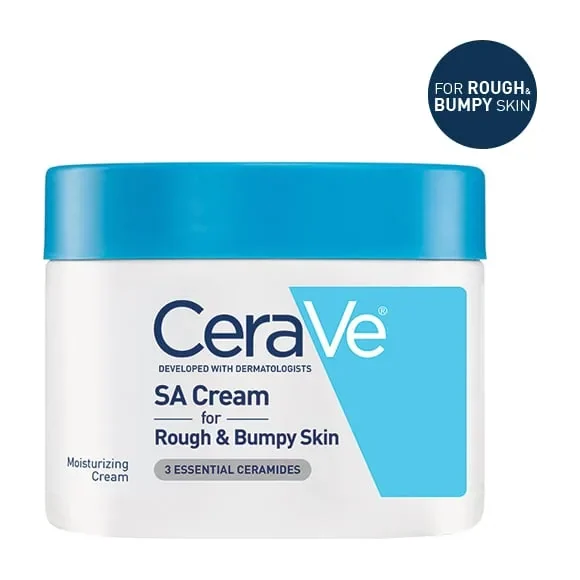
CeraVe SA Smoothing Cream tub with blue branding and screw-off lid
Supporting role for Keratosis Pilaris
What makes this different

This is one of the few drugstore body creams that combines two different keratolytic acids — salicylic acid (BHA) and ammonium lactate (AHA) — with a full ceramide barrier-repair system and MVE sustained-release technology. Most SA creams either exfoliate without moisturizing or moisturize without effectively exfoliating. This does both simultaneously, which is why dermatologists specifically recommend it by name for keratosis pilaris.

CeraVe

CeraVe SA Smoothing Cream Review

KP Gold Standard Body Care cream dermatologist developed Not cruelty free

The definitive drugstore answer to keratosis pilaris and rough body skin. Its dual-acid formula with ceramide barrier repair hits a sweet spot that single-ingredient competitors miss — aggressive enough to visibly smooth bumps within a week, gentle enough to use every day without stripping. At twenty-two dollars for a jar that lasts months, it has earned its spot on dermatologists' handwritten recommendation lists.

Price $21.99 12 oz (340 g) · more sizes
Shopper rating 4.6 ★★★★★ 35,000 reviews
On the market 2013 Made in United States
Buy at Amazon ♥
Verdicts

How well it fits each concern

One verdict per concern. Open a row for the reasoning; the receipt has every source.

The scaleRecommendedGoodSupportingEarly evidenceNot for thisAvoidhow it works

Supporting rolefor Keratosis PilarisSalicylic Acid has early evidence for keratosis pilaris, and emollient hydration is the recognised companion to treating it — a reasonable supporting choice, short of a recommendation.Receipt2 sources on the row · concentration not declared; studied range 5% · row checked Jul 17, 2026 · rule R8a, same reading on 1,509 products · open the receipt

The case for it

  1. Salicylic Acid has early or mechanistic evidence for this concern, not trial-backed standing.
  2. It is plausibly present at a working level, though the concentration is not declared.
  3. The formula carries none of the triggers this concern is sensitive to.

Moderate evidenceGentleNo reviews read yet

What would change this: A declared concentration would move this to a firmer reading of the dose.

Same rule for everyone. “Supporting role” is the verdict on 7,796 of 45,446 concern verdicts across the catalog; rule R8a decided 1,509 of them. Unchanged since September 5, 2026, engine 5.2.0.

Brand or formulator? Disclose a concentration or correct a fact →

The full receipt: rule, row, sources, dates →All keratosis pilaris products →How keratosis pilaris is treated →

Good choicefor Rough TextureSalicylic Acid is a reference standard by mechanism for rough texture; this cream carries it high in the ingredient list.Receipt2 sources on the row · concentration not declared; studied range 0.5–2% · row checked Jul 17, 2026 · rule R5, same reading on 9,843 products · open the receipt

The case for it

  1. Salicylic Acid is a reference standard by mechanism for this concern — an established physical action, not a trial result.
  2. It is present at an effective concentration, declared or high in the ingredient list.
  3. The formula carries none of the triggers this concern is sensitive to.

Limited evidenceGentleNo reviews read yet

Same rule for everyone. “Good choice” is the verdict on 10,340 of 45,446 concern verdicts across the catalog; rule R5 decided 9,843 of them. Unchanged since September 5, 2026, engine 5.2.0.

Brand or formulator? Disclose a concentration or correct a fact →

The full receipt: rule, row, sources, dates →All rough texture products →How rough texture is treated →

Good choicefor DrynessHyaluronic Acid is a reference standard by mechanism for dryness; this cream carries it.Receipt2 sources on the row · rule R5, same reading on 9,843 products · open the receipt

The case for it

  1. Hydrolyzed Hyaluronic Acid is a reference standard by mechanism for this concern — an established physical action, not a trial result.
  2. It is plausibly present at a working level, though the concentration is not declared.
  3. The formula carries none of the triggers this concern is sensitive to.

Limited evidenceGentleNo reviews read yet

What would change this: A declared concentration would move this to a firmer reading of the dose.

Same rule for everyone. “Good choice” is the verdict on 10,340 of 45,446 concern verdicts across the catalog; rule R5 decided 9,843 of them. Unchanged since September 5, 2026, engine 5.2.0.

Brand or formulator? Disclose a concentration or correct a fact →

The full receipt: rule, row, sources, dates →All dryness products →

Unprovenfor DullnessHyaluronic Acid has early or mechanistic evidence for dullness — a reasonable bet, not a recommendation; the other actives here are not yet assessed for it.Receipt1 source on the row · row checked Jul 17, 2026 · rule R9, same reading on 4,156 products · open the receipt

The case for it

  1. Hydrolyzed Hyaluronic Acid has early or mechanistic evidence for this concern, not trial-backed standing.
  2. It is plausibly present at a working level, though the concentration is not declared.
  3. The formula carries none of the triggers this concern is sensitive to.

Limited evidenceGentleNo reviews read yet

What would change this: A declared concentration would move this to a firmer reading of the dose.

Same rule for everyone. “Unproven” is the verdict on 4,156 of 45,446 concern verdicts across the catalog; rule R9 decided 4,156 of them. Unchanged since October 9, 2026, engine 5.2.0.

Brand or formulator? Disclose a concentration or correct a fact →

The full receipt: rule, row, sources, dates →All dullness products →How dullness is treated →

Strong choicefor AcneSalicylic Acid is an approved or monograph active for acne; this cream carries it, though the concentration is not declared.Receipt§ 333.310 Acne active ingredients. (opened Jul 27, 2026) · concentration not declared; studied range 0.5–2% · row checked Jul 27, 2026 · rule R3, same reading on 570 products · open the receipt

The case for it

  1. Salicylic Acid is an approved or monograph active for this concern.
  2. It is plausibly present at a working level, though the concentration is not declared.
  3. The formula carries no trigger this concern is sensitive to, with the cautions noted.

Moderate evidenceStandard tolerabilityNo reviews read yet

Cautions: fungal-acne triggers.

What would change this: A declared concentration would move this to a firmer reading of the dose.

Same rule for everyone. “Strong choice” is the verdict on 1,475 of 45,446 concern verdicts across the catalog; rule R3 decided 570 of them. Unchanged since September 5, 2026, engine 5.2.0.

Brand or formulator? Disclose a concentration or correct a fact →

The full receipt: rule, row, sources, dates →All acne products →How acne is treated →

As a body productNot judged: what a body product is for — real substance, not just slip, realistic to use daily — cannot yet be measured from the ingredient list (only fragrance load can).

A verdict is Dermington’s assessment of how well a product’s ingredients fit a concern — never a claim about what the product treats. Evidence dots and collected reviews sit beside it and are never blended in. Rules 0.5.1 · evidence table ev-2026.10-r231 · engine 5.2.0 · how we decide · this product’s receipt

Reader poll · Town SquareQuestion 1 of up to 3

Have you used SA Smoothing Cream?

One tap counts. A couple of optional follow-ups come next.

No account neededOne answer each, change it any timeCounted only in anonymous totalsHow the Square counts →
Assessment

Pros & cons

What it does well 7

  • Dual keratolytic action with BHA and AHA addresses rough, bumpy skin from two different pathways simultaneously
  • Ceramide MVE technology provides sustained barrier repair that prevents the dryness typical of acid-based body treatments
  • Visible smoothing of keratosis pilaris bumps within one to two weeks of consistent daily use
  • National Eczema Association Seal of Acceptance confirms safety for sensitive and eczema-prone body skin
  • Fragrance-free formulation avoids unnecessary irritation on already-compromised or bumpy skin
  • Niacinamide and vitamin D support long-term skin barrier health alongside the exfoliating acids
  • Exceptional value at approximately twenty-two dollars for a twelve-ounce jar lasting two to three months

Where it falls short 5

  • Tub packaging with screw-off lid is less hygienic than tube or pump alternatives
  • Too occlusive for facial use due to the paraffin and mineral oil base
  • Can sting on broken skin, freshly shaved areas, or severely compromised barriers
  • Contains methylparaben and propylparaben which may concern some consumers
  • Thick texture may feel heavy in humid summer weather or with over-application
Review

The full review

Walk into any dermatology office in America and ask about keratosis pilaris — those persistent, rough, chicken-skin bumps that camp out on upper arms and thighs — and there is a reasonable chance you will walk out with "CeraVe SA Cream" scrawled on a sticky note. Not a prescription. Not a compounded formula. A twenty-two dollar tub from the drugstore aisle. That trajectory, from clinical recommendation to mass-market staple, tells you everything about what this product gets right.

The SA Smoothing Cream launched in 2013 as CeraVe's answer to a problem that had frustrated dermatologists for years: patients with hyperkeratotic skin conditions needed effective chemical exfoliation, but the products available either stripped the barrier (pure acid formulas) or moisturized without actually addressing the keratin buildup (standard body creams). CeraVe's solution was to stop treating exfoliation and hydration as separate steps.

The formula deploys two distinct keratolytic acids. Salicylic acid, the oil-soluble BHA, penetrates into hair follicles and pores to dissolve the keratin plugs from within — the structural cause of KP bumps. Ammonium lactate, an AHA salt, works at the skin surface to loosen the bonds between dead corneocytes, smoothing the rough texture from the outside in. This dual-pathway approach is the formulation's central insight: attacking hyperkeratosis from both directions simultaneously produces faster, more thorough results than either acid alone.

But acids alone would leave the skin dry, irritated, and potentially worse off. This is where CeraVe's ceramide complex earns its place. Three essential ceramides — NP, AP, and EOP — delivered through the brand's patented MVE technology provide sustained barrier repair throughout the day. As the acids dissolve dead skin, the ceramides rebuild the lipid matrix underneath. Niacinamide amplifies this repair by stimulating the skin's own ceramide production, and hydrolyzed hyaluronic acid draws moisture into the newly revealed layers. Cholecalciferol — vitamin D — supports normal cell differentiation, nudging the skin toward healthier keratinization patterns.

The texture is unmistakably a rich body cream. Thick and white, it has the density of a therapeutic moisturizer rather than the lightness of a daily lotion. It spreads more easily than its appearance suggests and absorbs into a satin finish that is not greasy, though heavy-handed application can leave a noticeable film. The key is restraint: a thin, even layer on each affected area, given a minute to sink in before dressing.

Results are genuinely impressive for a drugstore product. Within three to five days of daily use, chronically rough patches on the arms begin to feel smoother under the hand. By the end of the second week, the visible bumps of keratosis pilaris start to flatten, and the redness that often accompanies them fades. Full transformation — from sandpaper to smooth — typically takes four to six weeks, and the improvement is maintained as long as you keep using the cream. Stop, and the bumps return. KP is managed, not cured, and this cream manages it exceptionally well.

There is an important caveat about where to use it. Despite some online advice to the contrary, this cream was not designed for the face. The paraffin and mineral oil base creates an occlusive layer that most facial skin types will find too heavy, and the combination of two exfoliating acids in a leave-on format is more intensity than most faces need or can tolerate daily. CeraVe makes dedicated facial SA products with lighter vehicles — reach for those instead.

The tub packaging is the product's most obvious weakness. Scooping cream from an open jar with fingers introduces bacteria with every use, and the format is awkward in a shower setting. A pump tube would be a meaningful upgrade, and it is surprising that CeraVe has not offered one in the thirteen years since launch. The inclusion of methylparaben and propylparaben as preservatives will bother some consumers, though both remain well within safety guidelines established by regulatory agencies.

A mild stinging sensation on first application is normal, particularly on areas with active KP or compromised skin. It fades within minutes for most users and diminishes over the first week of regular use as the barrier strengthens. Severe or persistent stinging suggests the barrier may need repair time before introducing acids, and switching to a plain ceramide moisturizer for a week before retrying is a sensible approach.

The value equation is straightforward and favorable. A twelve-ounce tub at twenty-two dollars contains enough product for two to three months of daily arm and leg application. The only over-the-counter products that compete in terms of dual-acid keratolytic efficacy are prescription-grade ammonium lactate creams that cost more and lack the ceramide repair system. This cream offers clinical-level results in a consumer-friendly format at a consumer-friendly price.

The SA Smoothing Cream does not try to be everything to every skin concern. It is a specialist — a cream built to solve a specific problem that affects roughly forty percent of the adult population — and it solves that problem with a formulation sophistication that belies its drugstore shelf placement. When dermatologists keep recommending a twenty-two dollar body cream instead of writing prescriptions, the product has earned its reputation on merit.

The science

The SA Smoothing Cream's efficacy for keratosis pilaris rests on a dual keratolytic strategy supported by substantial research. Salicylic acid, a beta-hydroxy acid, is lipophilic and penetrates the oil-filled hair follicles where keratin plugs form. A 2015 study published in Dermatology Research and Practice demonstrated that 5% salicylic acid achieved a 52% mean reduction in KP lesions over 12 weeks, with concurrent improvement in skin barrier function as measured by transepidermal water loss. The same study found that 10% lactic acid — a close relative of the ammonium lactate in this formula — achieved a 66% reduction in KP lesions, suggesting that the combination of both acids in this cream may offer additive benefits.

The ceramide delivery system addresses a critical gap in traditional keratolytic therapy. A 2020 study published in Dermatology and Therapy (the RESTORE Study) demonstrated that CeraVe's MVE ceramide formulations produced statistically significant improvements in skin barrier function in eczema-prone skin, with measurable reduction in transepidermal water loss. The multivesicular emulsion technology creates concentric layers of ceramides that release gradually over time, providing sustained barrier repair rather than a single burst of lipids on application.

A 2017 review in the Journal of Clinical and Aesthetic Dermatology evaluated MVE ceramide-containing moisturizers and confirmed their efficacy in managing common skin disorders involving barrier dysfunction, including atopic dermatitis. A 2020 study in the Journal of Drugs in Dermatology further showed that ceramide-containing moisturizers increased stratum corneum lipid levels in dry leg skin — directly relevant to this cream's primary use case on body areas with rough, depleted skin.

The inclusion of niacinamide is supported by research published in the British Journal of Dermatology (2000) showing that niacinamide increases ceramide biosynthesis 4.1 to 5.5-fold dose-dependently, meaning it amplifies the formula's barrier repair beyond the topically applied ceramides alone. This synergy between applied ceramides and stimulated ceramide production represents a sophisticated approach to maintaining skin barrier integrity during ongoing chemical exfoliation.

References 5 ShowHide
  1. Epidermal permeability barrier in the treatment of keratosis pilaris. — Dermatology Research and Practice (2015)
  2. An Investigation of the Skin Barrier Restoring Effects of a Cream and Lotion Containing Ceramides in a Multi-vesicular Emulsion in People with Dry, Eczema-Prone, Skin: The RESTORE Study Phase 1. — Dermatology and Therapy (2020)
  3. Multivesicular Emulsion Ceramide-containing Moisturizers: An Evaluation of Their Role in the Management of Common Skin Disorders. — Journal of Clinical and Aesthetic Dermatology (2017)
  4. The Effect of a Ceramide-Containing Product on Stratum Corneum Lipid Levels in Dry Legs. — Journal of Drugs in Dermatology (2020)
  5. Nicotinamide increases biosynthesis of ceramides as well as other stratum corneum lipids to improve the epidermal permeability barrier. — British Journal of Dermatology (2000)

The clinical view

Dermatologists consider the CeraVe SA Cream a first-line over-the-counter recommendation for keratosis pilaris, and it appears on more recommendation lists for this condition than arguably any other single product. Clinicians often highlight that the dual keratolytic approach — combining BHA for follicular penetration with an AHA salt for surface smoothing — mirrors the multi-agent strategies used in prescription-grade KP treatments but in a gentler, daily-use format. The National Eczema Association Seal of Acceptance provides additional clinical credibility. Dermatologists commonly advise patients to apply the cream after showering when the skin is warm and slightly damp, and to pair it with the CeraVe SA Cleanser for a comprehensive exfoliation-and-repair body routine.

Formula

Key ingredients

  1. Salicylic Acid

    The primary keratolytic BHA in this leave-on formula, dissolving the keratin plugs that create rough, bumpy texture. Unlike in CeraVe's SA Cleanser, the salicylic acid here remains on the skin for continuous exfoliation, working synergistically with ammonium lactate to address hyperkeratosis from two different chemical pathways.

    Established mechanism for Rough Texture · established mechanism
  2. Ammonium Lactate

    An alpha-hydroxy acid salt that provides complementary exfoliation by loosening the bonds between dead skin cells at the surface, while simultaneously acting as a humectant. When paired with salicylic acid in this formula, it creates a dual keratolytic approach — BHA clears inside pores while the AHA smooths the surface.

    Established mechanism for Rough Texture · established mechanism
  3. Niacinamide

    Calms potential irritation from the dual-acid exfoliation, strengthens the skin barrier alongside the ceramides, and helps reduce the redness associated with keratosis pilaris bumps. Its ability to boost ceramide biosynthesis four to five-fold amplifies the barrier-repair capacity of the formula's ceramide complex.

    Limited for Acne
  4. Ceramides NP, AP, EOP

    CeraVe's signature trio of essential ceramides delivered via MVE technology to provide sustained barrier repair. In a cream containing two exfoliating acids, these ceramides act as a critical counterbalance — they rebuild the lipid barrier as the acids remove dead skin, preventing the dryness and irritation that standalone keratolytic products typically cause.

    Established mechanism for Dryness · established mechanism
  5. Hydrolyzed Hyaluronic Acid

    The hydrolyzed form penetrates more effectively than standard hyaluronic acid, drawing moisture deep into skin that has been exfoliated by the dual-acid system. This provides hydration at the cellular level beneath the occlusive paraffin and mineral oil layer that seals everything in.

    Established mechanism for Dryness · measured
  6. Cholecalciferol (Vitamin D)

    Supports normal skin cell differentiation and turnover in hyperkeratotic conditions like keratosis pilaris, complementing the chemical exfoliation by helping the skin normalize its keratinization process from within.

    Not yet assessed
Full ingredient list 30 ingredients ShowHide

Water, Glycerin, Paraffin, Mineral Oil, Glyceryl Stearate, Cetearyl Alcohol, Triethanolamine, Salicylic Acid, Niacinamide, Cetyl Alcohol, Ammonium Lactate, Behentrimonium Methosulfate, PEG-100 Stearate, Corn Oil, Ceramide NP, Ceramide AP, Ceramide EOP, Carbomer, Dimethicone, Methylparaben, Sodium Lauroyl Lactylate, Cholecalciferol, Cholesterol, Phenoxyethanol, Disodium EDTA, Tocopherol, Propylparaben, Hydrolyzed Hyaluronic Acid, Phytosphingosine, Xanthan Gum

Safety & formulation facts

  • Pregnancy safety unverified
  • Fragrance free
  • Not alcohol free
  • Not oil free
  • Not silicone free
  • Not paraben free
  • Sulfate free
  • Not cruelty free
  • Not vegan
  • Not fungal-acne safe
Pore-clogging (comedogenic) Mineral OilCorn Oil
Potential irritants Salicylic AcidAmmonium Lactate
Compatibility

Skin types & routine

Routine step moisturizer
Time of day Morning & night
Best season fall & winter
Finish satin, non-greasy, lightweight

Layering

Apply to clean, dry skin after showering when the skin is slightly warm and pores are open. Use on body areas with rough or bumpy texture — arms, legs, chest, back. Not recommended for facial use due to the occlusive base. Allow to absorb fully before dressing to avoid transfer.

When to expect results

Skin feels noticeably smoother within 3-5 days of daily use. Keratosis pilaris bumps begin to flatten within 1-2 weeks. Significant texture improvement and reduction in rough patches occurs over 4-6 weeks. Ongoing daily use is needed to maintain results.

Pairs well with CeraVe SA Smoothing CleanserBody sunscreen for treated areasLightweight body lotion in summer as alternative
Don't combine with Other BHA or AHA products on the same body areaPhysical exfoliation on the same areas

A routine built around it

Morning

  1. Body wash or SA cleanser in shower
  2. Pat dry
  3. THIS PRODUCT on rough areas
  4. Sunscreen on exposed treated areas

Night

  1. Body wash or SA cleanser in shower
  2. Pat dry
  3. THIS PRODUCT on rough areas
Guidance

How to use it, and who it's for

How to use

Apply a thin, even layer to clean, dry skin on body areas with rough or bumpy texture — typically upper arms, thighs, chest, or back. Best applied after showering when the skin is warm and slightly damp, as this enhances absorption. Allow one to two minutes for the cream to absorb before dressing. Use once or twice daily for optimal results. Start with once daily if your skin is sensitive to acids, and increase to twice daily as tolerance builds. Avoid applying to broken skin, freshly shaved areas, or open wounds. Pair with sunscreen on treated areas exposed to sunlight, as the exfoliating acids increase photosensitivity.

Is it worth the price?

At approximately twenty-two dollars for twelve ounces, this cream offers clinical-grade keratolytic efficacy at a drugstore price. The dual-acid formula with a full ceramide delivery system, niacinamide, hyaluronic acid, and vitamin D would cost substantially more from a specialty or professional brand. Larger sizes of sixteen and nineteen ounces are available at Walmart and Amazon, offering better per-ounce value for users who apply it extensively on body areas. Given that the primary competitor — prescription ammonium lactate creams — lack the ceramide complex and cost more even with insurance, this cream represents one of the best value propositions in the therapeutic body care category.

Who should buy it

Anyone with keratosis pilaris, rough body skin, or persistent bumpy texture on arms, legs, or torso who wants a single product that exfoliates and moisturizes simultaneously. Particularly valuable for people who have tried moisturizing alone without addressing the underlying keratin buildup, and for those who want dermatologist-recommended efficacy without a prescription.

Who should skip it

People with very sensitive body skin or active eczema flares who cannot tolerate any chemical exfoliants — start with a plain ceramide moisturizer first. Also not suitable for anyone looking for a facial moisturizer, as the occlusive base is too heavy for most facial skin types.

Ready to try it?CeraVe SA Smoothing Cream · $21.99 · 12 oz (340 g)
Details

The product, in detail

Texture
Thick, rich white cream with a medium-to-heavy consistency. Spreads easily despite its density and absorbs reasonably well, leaving a satin-smooth feel without significant greasiness when used in appropriate amounts.
Scent
Fragrance-free with a very faint, slightly medicinal base scent from the salicylic acid and lactic acid components. Most users describe it as essentially unscented.
Packaging
White plastic tub with screw-off lid featuring CeraVe's blue branding. The tub format requires dipping fingers in, which is less hygienic than tube or pump alternatives. Functional pharmacy-style design.
How long it lasts
2-3 months with daily application to arms and legs
Once opened
Use within 12 months · track your toss-by date →
Size
12 oz (340 g) · other sizes available
Made in
United States
Launched
2013
Certifications
National Eczema Association Seal of Acceptance · Allergy tested · Non-comedogenic · Fragrance-free · Hypoallergenic

What the first two weeks feel like

Skin feels immediately smoother and more hydrated after the first application. A mild tingling sensation is normal, especially on areas with active keratosis pilaris or rough patches. This tingling typically subsides within minutes and decreases with regular use. Visible flattening of bumps begins within the first week for most users.

The story behind it

Why it exists

CeraVe launched the SA Cream in 2013 to address a gap that dermatologists had long identified: patients with keratosis pilaris and rough body skin needed a product that could exfoliate aggressively enough to smooth texture but gently enough to use daily without wrecking their moisture barrier. The dual-acid formula with ceramide delivery became such a standard recommendation that it effectively created the category of barrier-friendly exfoliating body cream at the drugstore level.

About CeraVe Legacy Brand (20+ years)

CeraVe was developed with dermatologists in 2005 and has become the number-one dermatologist-recommended skincare brand in the United States. Its patented MVE delivery technology and ceramide-based formulations are backed by peer-reviewed research, and several products carry the National Eczema Association Seal of Acceptance.

Brand founded 2005 · This product since 2013

Myth vs. reality

What people get wrong about it

MythYou should use the SA Cream on your face for acne

RealityWhile some users apply it to acne-prone facial skin, this cream was formulated for body use. The paraffin and mineral oil base is too occlusive for most facial skin and may clog pores. CeraVe offers dedicated facial SA products with lighter bases.

MythKeratosis pilaris can be permanently cured with this cream

RealityKP is a genetic condition that can be managed but not cured. This cream effectively smooths bumps and reduces redness with daily use, but the texture will gradually return if you stop using the product. Consistent application is key to maintaining results.

FAQ

Questions people ask

How long does it take for CeraVe SA Cream to work on keratosis pilaris?

Most users notice smoother skin within the first week of daily use, with visible reduction in KP bumps by week two. The dual keratolytic action of salicylic acid and ammonium lactate in this formula works faster than single-acid alternatives. Full results typically develop over four to six weeks, and continued daily use is necessary to maintain the improvement since KP is a genetic condition that recurs without treatment.

Can I use CeraVe SA Cream on my face?

This cream was formulated specifically for body use. Its base of paraffin and mineral oil is quite occlusive and may clog facial pores, especially for oily or acne-prone skin types. CeraVe offers dedicated facial products with salicylic acid — like the SA Smoothing Cleanser and the SA Lotion — that use lighter, non-comedogenic bases designed for facial skin.

Is the CeraVe SA Cream the same as AmLactin?

They target similar conditions but use different approaches. AmLactin relies primarily on ammonium lactate (an AHA) for exfoliation, while the CeraVe SA Cream combines salicylic acid with ammonium lactate for dual-pathway keratolysis. The CeraVe formula also includes three essential ceramides, niacinamide, and hyaluronic acid for barrier repair — ingredients that AmLactin does not contain. The CeraVe is generally considered the more complete formulation.

Does CeraVe SA Cream contain parabens?

Yes, this formula contains methylparaben and propylparaben as preservatives. While parabens have been the subject of consumer concern, they remain among the most well-studied and effective preservatives in cosmetic chemistry. Regulatory agencies including the FDA and the European Commission's Scientific Committee on Consumer Safety have concluded that parabens at concentrations used in cosmetics are safe.

Can I use CeraVe SA Cream with retinol?

You can, but proceed with caution on body areas where you apply both. The salicylic acid and ammonium lactate in this cream already provide significant exfoliation, so adding retinol increases the risk of irritation and dryness. If combining, consider alternating days or applying retinol in the evening and this cream in the morning. The ceramides and niacinamide in the formula do help buffer irritation.

Why does CeraVe SA Cream sting when I apply it?

Mild stinging on initial application is normal and results from the salicylic acid and ammonium lactate making contact with skin that has micro-disruptions in its barrier — common in areas with KP, dry patches, or recently shaved skin. The sensation typically fades within a few minutes and decreases with regular use as the barrier strengthens. If stinging is severe or persistent, reduce application frequency or consult a dermatologist.

Is CeraVe SA Cream good for body acne?

Yes — the salicylic acid penetrates pores to clear congestion while ammonium lactate smooths the skin surface, making this cream effective for mild to moderate body acne on the chest, back, and shoulders. The ceramide complex helps repair the barrier without adding excess oil. For more severe body acne, pair it with a benzoyl peroxide wash for a dual-treatment approach.

Reviews

What shoppers tend to say

Recurring themes our editors read across retailer reviews — summaries in our words, not quotations, and not a substitute for a patch test.

Common praise

  • Dramatically reduces keratosis pilaris bumps, often within one to two weeks
  • Effective for rough, bumpy skin on arms, legs, and body
  • Moisturizes deeply while exfoliating — a rare combination at this price
  • Fragrance-free and well-tolerated by most skin types
  • Absorbs well for its thickness without leaving a greasy residue
  • Affordable for a therapeutic body cream with multiple actives

Common complaints

  • Thick texture can feel heavy or greasy if over-applied in humid weather
  • Can pill or clump if layered over other products or applied to damp skin
  • Tub packaging is less hygienic than a tube or pump dispenser
  • Stings on broken skin, freshly shaved areas, or compromised barriers
  • Too occlusive for facial use on most skin types
Notable endorsementsNational Eczema Association Seal of AcceptanceNumber-one dermatologist-recommended skincare brandFeatured in HuffPost as a game changer for red, bumpy skinHSA/FSA eligible
Next stepCheck it against what you already useClashes, spacing and the right order, with everything on your shelf.