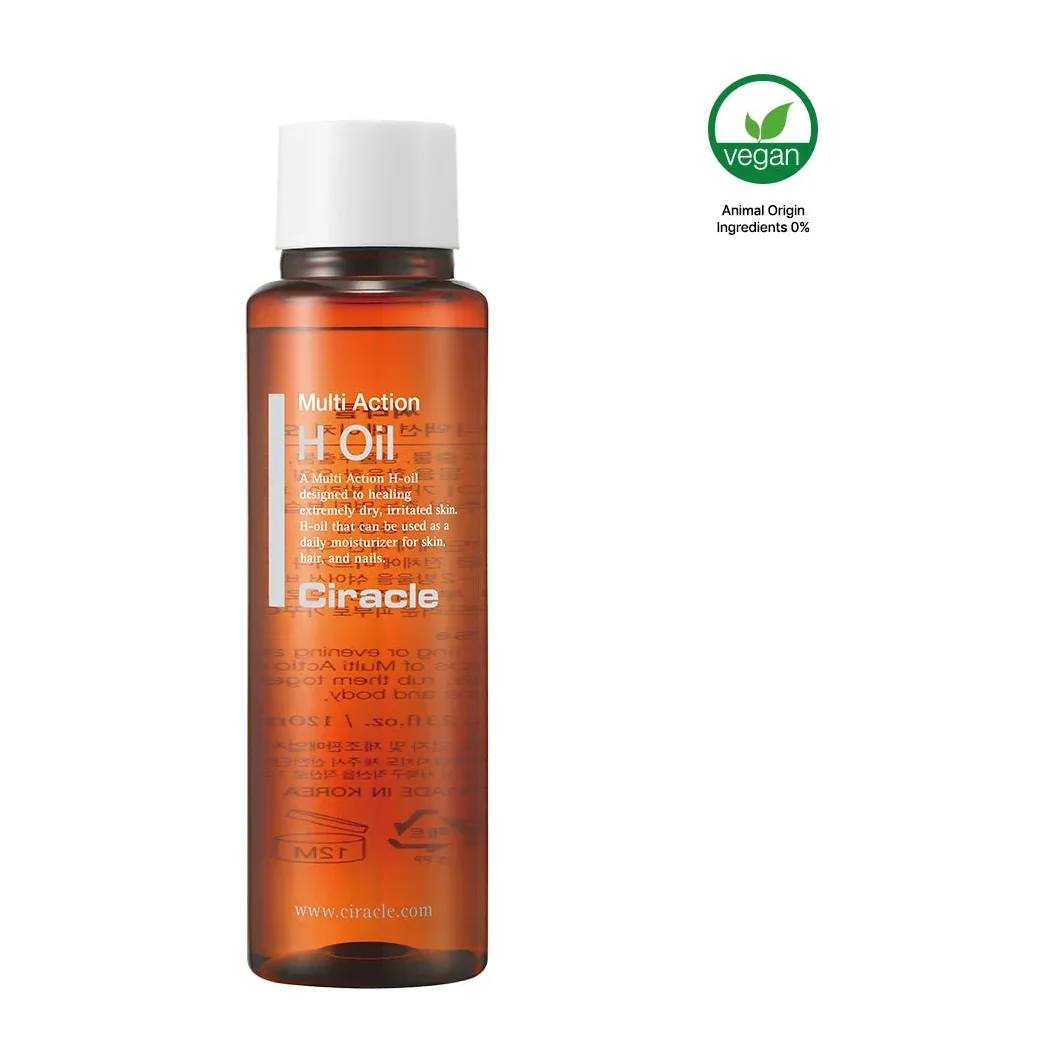
Every household seems to have one bottle that migrates around the bathroom: a little on the elbows after a shower, a drop through someone's split ends, a smear on a cracked thumb cuticle, and occasionally a few drops on a dry face in January. Ciracle's Multi Action H Oil is designed to be exactly that bottle, and the brand says so outright, positioning it as a daily moisturizer for skin, hair and nails. The question worth asking is whether one formula can serve that many masters, and the answer is mostly yes, with one important caveat about the face.
The base is a sensible choice. Sunflower seed oil leads the ingredient list, and it is one of the better plant oils for skin because it is rich in linoleic acid, a fatty acid the skin uses to build its barrier lipids and one that dry skin is often short of. Ciracle's own product page leans on this, citing research on sunflower-derived ingredients in atopic skin. That literature mostly concerns a specialised sunflower distillate rather than the plain seed oil used here, so the link is suggestive rather than direct, but the core idea, that linoleic-rich oils support a stressed barrier, is well grounded.
What makes the oil feel different from pouring sunflower oil straight from the kitchen is the next few ingredients. Triethylhexanoin, cetearyl isononanoate, hydrogenated polyisobutene and cetyl ethylhexanoate are light synthetic emollients that thin the blend, speed up absorption and cut the greasy drag plant oils can have. The result is a dry-touch oil that disappears within a couple of minutes and leaves a soft sheen rather than a slick. Tocopheryl acetate follows, partly to protect all that linoleic acid from oxidising in the bottle, which it is prone to do. Squalane appears a little later for extra slip.
Then come the fragrance-bearing oils, and this is where the multi-surface design runs into trouble. Orange peel oil, eucalyptus leaf oil, lemon peel oil and tea tree oil sit in positions seven, eight, nine and eleven, all above the soothing ingredients the product name is built around. On the body, the hair and the nails, that is largely fine; the scent is bright and pleasant, and skin there is tougher. On the face, and especially on sensitive or rosacea-prone faces, four essential oils represent a real irritation and allergy load. Lemon peel oil is the one worth singling out: cold-pressed citrus peel oils can contain furocoumarins, compounds that make skin more reactive to sunlight. The amount here is unknown and may be small, but it is enough reason to keep this oil to evenings on the face, or at least to skin that is reliably covered with sunscreen.
The centella triterpenes, asiaticoside, madecassic acid and asiatic acid, are the most interesting inclusion on paper. They are the purified active fractions of centella, studied for their wound-healing and anti-inflammatory activity, and it is uncommon to find them in an oil at all. Here they arrive after propanediol and butylene glycol, which suggests small amounts, and the brand does not publish percentages. Bisabolol, the calming compound from chamomile, is likewise present. Together they soften the formula's profile a little, but they cannot fully offset the essential oils sitting above them. The fermented rice filtrate and Sophora flower extract are further supporting players.
In practice, the oil performs well on its non-facial jobs. A drop worked into the cuticles at night leaves nails looking tidier within a couple of weeks. Two drops smoothed through dry hair ends reduce frizz without weighing hair down, thanks to the light esters. On rough shins and elbows after a shower, it spreads far and absorbs quickly enough that you can dress within minutes. For those uses, the scent is part of the pleasure.
On the face, its value depends on your skin. Dry, resilient skin that likes aromatic products can press two or three drops over a moisturizer at night and wake up noticeably softer. Mixing a couple of drops into a cream, which the brand suggests, is a smart compromise, diluting the essential oils while adding richness. Oily skin rarely needs an added oil, and anyone dealing with fungal acne should avoid fatty-acid-rich oils like this one entirely. Sensitive, rosacea-prone or eczema-prone skin is better served by an unscented oil; the soothing extracts here do not make up for the citrus and tea tree.
It is also worth being clear about what an oil can and cannot do. Oils do not hydrate in the sense of adding water; they reduce the rate at which water leaves the skin. This one works best sealed over a watery toner or moisturizer, which is exactly how Ciracle recommends using it, as the last step of a routine.
Product-specific reviews are scattered, so there is no large body of user feedback to consult. What does exist tends to praise the absorption speed, the versatility and the size of the bottle, and to flag the strong citrus-eucalyptus scent and occasional stinging on sensitive skin, all of which matches the formula.
On value, 120ml for around twenty-two dollars is generous, particularly given that a few drops cover the face and the bottle can serve an entire household's worth of dry spots. As a body, hair and cuticle oil, it is an easy recommendation. As a face oil, it is a conditional one, best for dry, non-reactive skin used at night, and a pass for anyone whose face protests at fragrance.