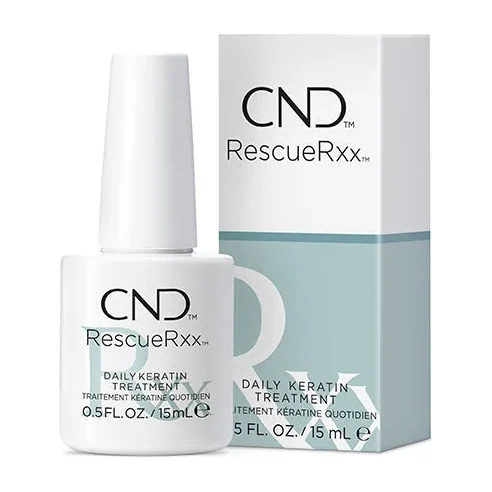
There is something faintly circular about a company that spent the 1980s making hard acrylic nails a mass phenomenon now selling the treatment for what hard acrylic nails do to the plate underneath. That is not a criticism so much as an observation about how the nail industry works, and it does mean CND has spent longer than almost anyone looking at the specific wreckage this product addresses: a natural nail a week after a set comes off, thin from filing, chalky at the surface, lifting in translucent layers at the free edge.
What is in the bottle is more interesting than the marketing suggests. Read the list and you see sweet almond oil, jojoba, sorbitan oleate, water, isopropyl alcohol, modified polyamidoamine, hydrolyzed keratin, fragrance. Read it as a formulator and you see a water-in-oil emulsion with a very deliberate job. The nail plate is a dense, hydrophilic, disulphide-cross-linked barrier that shrugs off bulky lipophilic oils and rinses away water-soluble ingredients within minutes of the next handwash. Solving that means finding a vehicle that can get in and a way to make the payload stay. This formula suspends a water phase carrying protein inside an oil phase led by jojoba — the wax ester most likely to make headway into keratin — and adds a small hit of isopropyl alcohol so that water phase spreads thin and flashes off, depositing its cargo evenly. The faint tack you feel a minute after application is not a flaw. It is the point.
The cargo itself deserves a clear-eyed look. Hydrolyzed keratin cannot rebuild a nail; nothing applied topically can, because the plate was assembled weeks ago at the matrix under your skin and has been dead ever since. What protein fragments can do is adsorb onto the surface and settle into the microscopic gaps where layers have begun to delaminate — filling and binding rather than regenerating. That is genuinely useful for a peeling nail, and it is also exactly why the effect is temporary and needs repeating. The modified polyamidoamine is what stops it being useless: a branched cationic polymer that latches onto the negatively charged nail surface and holds the protein in place through handwashing. It is the least advertised ingredient in the bottle and probably the one doing the most to differentiate it from a jar of protein and hope.
CND publishes figures — a 73 percent decrease in splitting and an 80 percent decrease in peeling at four weeks — and those numbers appear on every retailer page carrying it. They come from company-commissioned testing that has not been published in a peer-reviewed journal or independently replicated, which does not make them false but does mean they should be read as a manufacturer's data rather than as clinical evidence. What can be said is that four weeks matches what users describe, and that a fair amount of the visible improvement in the first days is optical: an even film makes a rough plate reflect light like a smooth one.
In practice it is pleasant to use, which matters for something requiring twice-daily application. It handles like a cuticle oil, absorbs in under a minute, and conveniently softens the nail fold while it works, so it replaces rather than adds to a routine. The brush loads more than a nail needs — wipe it on the neck — and one drop per nail, massaged into the plate, the fold and under the free edge, covers everything. The regimen is the difficult part. Twice a day for a month is a genuine ask, the 15 ml bottle empties in roughly two months at that rate, and the whole thing only works on bare nails, meaning a polish-free stretch at precisely the moment your hands look their worst. There is no way around that: the protein cannot reach the plate through a base coat, and anyone hoping to run this under a manicure is buying an expensive cuticle oil.
The exclusions are worth stating plainly. Sweet almond oil leads the list, so this is off the table with a tree nut allergy. Hydrolyzed keratin is animal-derived, typically from wool or feathers, so it is not vegan. And there is a declared fragrance, applied to skin that around a damaged nail is often already split. None of those are formulation failures; they are just facts that rule out more people than the marketing acknowledges.
On price, twenty-two dollars for half an ounce consumed twice daily works out steeper than it looks — call it eleven dollars a month during an active recovery, which is more than most treatment products in this category and considerably more than a bottle of plain oil. The defence is that plain oil does not contain the protein or the polymer, and that the specific problem here, a plate delaminating after enhancement damage, is not one that conditioning alone addresses. Whether that is worth the premium depends entirely on whether your nails are peeling or merely dry. If they are dry, buy an oil. If they are lifting in layers and you are willing to go bare for two months, this is one of the more thoughtfully built things you can put on them, and the fact that its cleverest ingredient never appears on the front of the box tells you the formulators were solving a real problem rather than writing a claim.