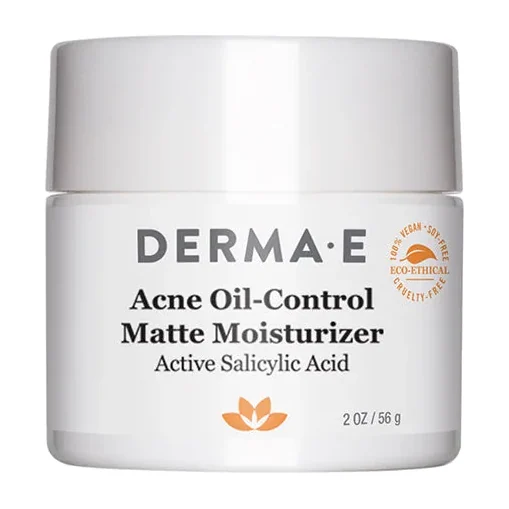
Most of the vegan, natural-positioned acne products you'll see on a Whole Foods shelf are five or ten years old at most, born out of the last decade's clean-beauty moment. Derma E is not one of them. The brand has been making botanical skincare since 1984, back when "vegan" was a fringe diet and "cruelty-free" was a term most shoppers didn't know existed. Forty years of quiet work in the US natural skincare category has earned Derma E a legitimate spot in the conversation, and its Acne Rebalancing Cream is a good example of what the brand does when it focuses: a specific, matte-finish moisturizer aimed at oily and acne-prone skin, built around a labeled OTC active and a cast of plant extracts that pre-date the current tea-tree-obsessed generation of indie acne brands.
The formulation is interesting for what it commits to and what it stops short of. Salicylic acid at 0.53% sits at the top of the ingredient list as the labeled active — a perfectly reasonable maintenance-level BHA concentration for a leave-on moisturizer that you're going to apply twice a day. This is not a spot treatment. It's not trying to be a replacement for a 2% leave-on BHA serum. It's trying to be a daily moisturizer that pulls some modest exfoliating weight, and on that specific brief, the active level makes sense. Below the salicylic acid you find a fairly standard emulsion system — stearic acid, cetyl alcohol, caprylic/capric triglyceride — and then the plant-extract content starts: tea tree oil, white willow bark, organic jojoba, chamomile, aloe, allantoin, panthenol.
Tea tree oil is where this cream gets both its strongest case and its biggest caveat. There's legitimate research supporting tea tree's antimicrobial activity against Cutibacterium acnes, and small studies have shown 5% tea tree oil performing comparably to 5% benzoyl peroxide for mild-to-moderate acne, with fewer side effects. That's a genuine data point in tea tree's favor. The trouble is that tea tree is also one of the more common essential oil sensitizers in the skincare world. Rosewood and lavender oil, also present here, add to the sensitization risk and the overall fragrance load. Users who tolerate essential oils well tend to love this cream and appreciate the herbal, medicinal smell that comes with it. Users who don't tolerate essential oils well will find out quickly, and this is not the cream for them.
The texture is where Derma E has genuinely nailed the brief. This is a lightweight cream that absorbs to a true matte finish — not the sticky, tacky "matte" that cheap acne products leave behind, but a clean, dry, powdery finish that sits well under sunscreen and makeup. For oily and combination skin, that finish is the main reason to buy this cream over a generic botanical moisturizer. Many users describe it as making their skin feel balanced throughout the day, with reduced midday oil break-through and less foundation breakdown in the T-zone. Those are small, concrete improvements that add up over weeks of consistent use.
The brand's own claim is that 87% of testers saw clearer skin after six weeks of use, based on in-house testing whose raw data isn't published. Treat that number with the appropriate grain of salt — it's a marketing figure, not peer-reviewed research. In real-world terms, what users consistently report is a balanced oil feel within the first two to three weeks, a modest reduction in comedone formation and small breakouts over four to eight weeks, and a stable, well-tolerated place in a broader routine if the essential oils don't bother them. It's not a cream that will transform severe cystic acne, and it's not a cream that will outperform a prescription regimen for moderate-to-severe cases. It's a maintenance cream, in the best sense of that word — a product that holds the line on oily, clog-prone skin without causing damage.
Value-wise, Derma E sits in an interesting middle bracket. At around $22 for 2 oz, it's meaningfully more expensive than drugstore acne moisturizers like CeraVe's offerings, but substantially cheaper than premium natural-brand competitors. The vegan and cruelty-free credentials are certified through the Vegan Society and Leaping Bunny rather than self-declared, which is worth something in a category where greenwashing is endemic. For a shopper specifically looking for a vegan, natural-positioned acne moisturizer from a brand with actual longevity, the value case is reasonable. For a shopper just looking for the most effective acne moisturizer at this price, a synthetic-heavy drugstore option is probably a better use of money.
The cream is not pregnancy-compatible — between the salicylic acid and the essential oils, it's a product most dermatologists will tell pregnant patients to skip. It's not fungal-acne safe for the same reasons. And it's not the right choice for rosacea, eczema, or compromised-barrier skin. Within its actual target audience, though, it does what it says on the jar, from a brand that's been doing something like this for forty years. That's a rare thing in the acne category.