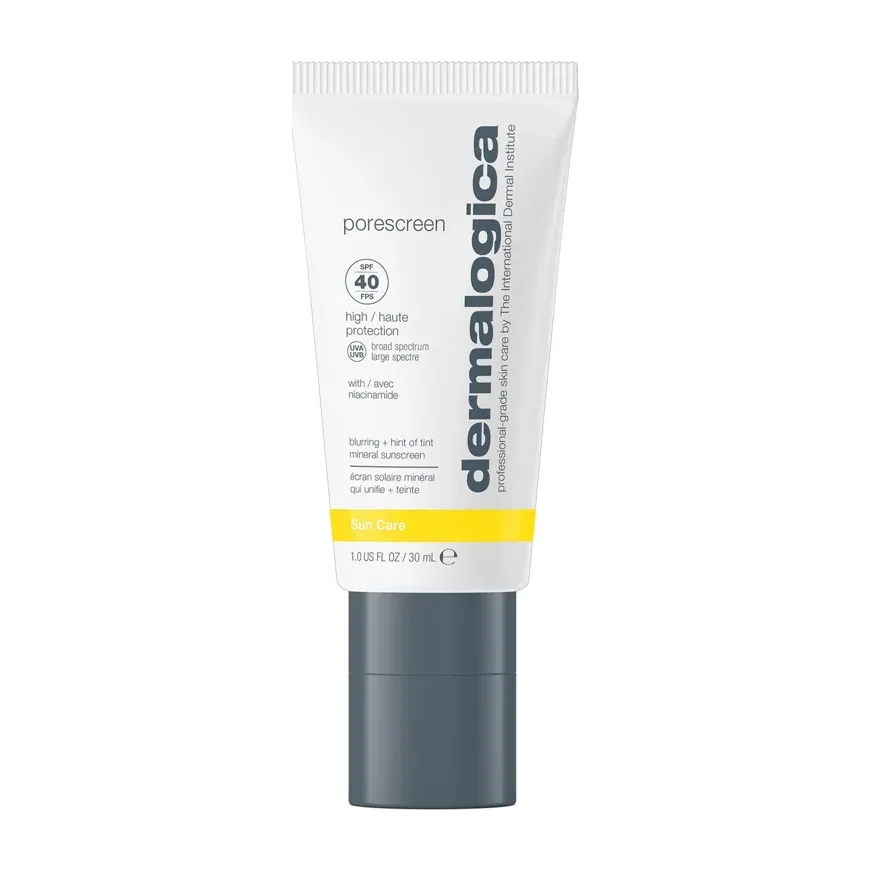
Dermalogica Porescreen SPF 40 tinted mineral sunscreen tube on white background
Unproven for Large Pores
What makes this different

It collapses three steps into one: a broad-spectrum SPF 40 mineral sunscreen, a pore-blurring primer, and a universal-tone tint, all carrying a functional 2% niacinamide. Rather than a sunscreen you tolerate, it is one designed to replace your base makeup, which is why it became a viral hit rather than just another SPF.

Dermalogica

Dermalogica Porescreen SPF 40 Review

Skincare-Makeup Hybrid Sunscreens lotion professional Paraben free Cruelty free

A rare sunscreen people genuinely look forward to using: SPF 40 mineral protection, a pore-blurring primer finish, a flattering universal tint, and a useful 2% niacinamide in one tube. It earns its viral status, with the main caveats being a $57/30ml premium and a tint that suits light-to-medium tones best.

Price $57.00 30 ml · more sizes
Shopper rating 4.6 ★★★★★ 568 reviews
On the market 2023 Made in USA
Buy at Amazon ♥
Verdicts

How well it fits each concern

One verdict per concern. Open a row for the reasoning; the receipt has every source.

The scaleRecommendedGoodSupportingEarly evidenceNot for thisAvoidhow it works

Unprovenfor Large PoresNiacinamide has early or mechanistic evidence for large pores — a reasonable bet, not a recommendation; the other actives here are not yet assessed for it.Receipt3 sources on the row · 2% declared, studied range 4% · row checked Jul 17, 2026 · rule R9, same reading on 4,156 products · open the receipt

The case for it

  1. Niacinamide has early or mechanistic evidence for this concern, not trial-backed standing.
  2. It is present below the studied range.
  3. The formula carries no trigger this concern is sensitive to, with the cautions noted.

Moderate evidenceStandard tolerabilityNo reviews read yet

What would change this: A concentration inside the studied range would raise this a step.

Same rule for everyone. “Unproven” is the verdict on 4,156 of 45,446 concern verdicts across the catalog; rule R9 decided 4,156 of them. Unchanged since September 5, 2026, engine 5.2.0.

Brand or formulator? Disclose a concentration or correct a fact →

The full receipt: rule, row, sources, dates →All large pores products →

Full protectionfor Sun DamageBroad-spectrum SPF 40 with zinc oxide, titanium dioxide: the protection sun damage calls for.Receiptread from the filter list against the regulatory UV-filter rows · rule P1, same reading on 2,280 products · open the receipt

The case for it

  1. Zinc Oxide is an approved or monograph active for this concern.
  2. It is present at an effective concentration, declared or high in the ingredient list.
  3. The formula carries no trigger this concern is sensitive to, with the cautions noted.

Moderate evidenceStandard tolerabilityNo reviews read yet

Cautions: a photosensitising active — use sun protection.

Same rule for everyone. “Full protection” is the verdict on 2,336 of 45,446 concern verdicts across the catalog; rule P1 decided 2,280 of them. Unchanged since September 5, 2026, engine 5.2.0.

Brand or formulator? Disclose a concentration or correct a fact →

The full receipt: rule, row, sources, dates →All sun damage products →

Promisingfor Excess OilinessNiacinamide has trial-level evidence for excess oiliness but no guideline or regulatory standing yet — promising, short of a recommendation; the other actives here are not yet assessed for it.Receipt2 sources on the row · 2% declared, studied range 2% · row checked Jul 17, 2026 · rule R9p, same reading on 4,872 products · open the receipt

The case for it

  1. Niacinamide has at least one trial behind it for this concern but no guideline or regulatory standing yet.
  2. It is present at an effective concentration, declared or high in the ingredient list.
  3. The formula carries no trigger this concern is sensitive to, with the cautions noted.

Moderate evidenceStandard tolerabilityNo reviews read yet

Cautions: fungal-acne triggers.

What would change this: Guideline or regulatory standing for the active on this concern would move this from a promising bet to a recommendation.

Same rule for everyone. “Promising” is the verdict on 4,872 of 45,446 concern verdicts across the catalog; rule R9p decided 4,872 of them. Unchanged since September 5, 2026, engine 5.2.0.

Brand or formulator? Disclose a concentration or correct a fact →

The full receipt: rule, row, sources, dates →All excess oiliness products →

Full protectionfor AgingBroad-spectrum SPF 40 with zinc oxide, titanium dioxide: the protection aging calls for.Receiptread from the filter list against the regulatory UV-filter rows · rule P1, same reading on 2,280 products · open the receipt

The case for it

  1. Lactic Acid & Chamomile/Bisabolol has early or mechanistic evidence for this concern, not trial-backed standing.
  2. It is plausibly present at a working level, though the concentration is not declared.
  3. The formula carries no trigger this concern is sensitive to, with the cautions noted.

Limited evidenceStandard tolerabilityNo reviews read yet

Cautions: a photosensitising active — use sun protection.

What would change this: A declared concentration would move this to a firmer reading of the dose.

Same rule for everyone. “Full protection” is the verdict on 2,336 of 45,446 concern verdicts across the catalog; rule P1 decided 2,280 of them. Unchanged since September 5, 2026, engine 5.2.0.

Brand or formulator? Disclose a concentration or correct a fact →

The full receipt: rule, row, sources, dates →All aging products →

Also listed for Dullness — the actives here (Zinc Oxide, Niacinamide, Lactic Acid, Iron Oxides) are in our research queue for that concern; there is no verdict until their evidence rows are written. That is a gap in our table, not a mark against the product.

Does the jobDoes what a sunscreen is for: UVA coverage, holds up in sunlight. Not measured from the label: pleasant enough to actually use.

A verdict is Dermington’s assessment of how well a product’s ingredients fit a concern — never a claim about what the product treats. Evidence dots and collected reviews sit beside it and are never blended in. Rules 0.5.1 · evidence table ev-2026.10-r231 · engine 5.2.0 · how we decide · this product’s receipt

Reader poll · Town SquareQuestion 1 of up to 3

Have you used Porescreen SPF 40?

One tap counts. A couple of optional follow-ups come next.

No account neededOne answer each, change it any timeCounted only in anonymous totalsHow the Square counts →
Assessment

Pros & cons

What it does well 7

  • Genuine SPF 40 broad-spectrum mineral protection from zinc and titanium dioxide
  • Pore-blurring, primer-like finish that softens texture immediately
  • Universal tint evens tone and adds healthy radiance
  • Functional 2% niacinamide refines pores over time
  • Replaces sunscreen, primer, and light foundation in one step
  • Soothing chamomile, bisabolol, and allantoin keep it comfortable
  • Sheer and wearable for a mineral formula

Where it falls short 5

  • Expensive at $57 for a small 30ml tube
  • Tint can look grey or ashy on the deepest skin tones
  • Easy to under-apply and miss the labeled SPF
  • Contains lavender and rose extracts plus linalool fragrance
  • Empties quickly when applied in proper sunscreen amounts
Review

The full review

The single biggest problem with sunscreen is not chemistry — it is compliance. The best-formulated SPF in the world protects nobody if it sits unused in a drawer because it is greasy, white, or simply unpleasant. Porescreen's quiet genius is that it solves the compliance problem by making sunscreen feel like something else entirely: a pore-blurring, tone-evening complexion base that you would want to put on even if it offered no protection at all. That it also happens to be a legitimate SPF 40 mineral sunscreen is, in a sense, the product's best-kept secret. This is why it went viral, and the hype is, for once, mostly earned.

Start with the protection, because that is the part the cosmetics can distract you from. The active is zinc oxide at 10%, supported by titanium dioxide — a fully mineral filter system delivering broad-spectrum SPF 40. The zinc load is lower than in a pure heavy-duty mineral block, which is a deliberate trade: less zinc means less white cast and a sheerer base that the tint can work with, at the cost of being a daily-protection sunscreen rather than a beach-day fortress. For everyday use — commuting, working, running errands — SPF 40 mineral protection applied properly is genuinely solid. The crucial asterisk, and it is a big one, is application amount. Because the product feels and behaves like a primer, the temptation is to use a thin, makeup-sized layer, which under-applies the sunscreen and drops you well below the labeled SPF. To actually get SPF 40, you have to apply a full, generous sunscreen quantity. Do that, and it protects; treat it as a light primer, and you are fooling yourself about the coverage.

The cosmetic performance is where it shines and where the love comes from. The blurring effect is real and immediate — silica and the soft-focus base genuinely soften the look of pores and texture, giving skin that primer-smoothed, slightly diffused finish. The encapsulated tint, built on iron oxides, releases on application and adjusts to even out skin tone while adding a healthy radiance, and it does double duty by neutralizing any mineral cast so the sunscreen reads as a complexion enhancer rather than a chore. For a lot of people, this becomes their entire base: SPF, primer, and a light foundation alternative in one step. That three-products-in-one efficiency is the practical magic.

And then there is the genuinely useful skincare active that elevates it above a pretty tinted SPF: niacinamide at 2%. This is the 'pore' in Porescreen with substance behind it — niacinamide is one of the best-studied ingredients for refining the appearance of pores, regulating oil, and supporting the skin barrier, and at 2% it is a meaningful, not token, inclusion. So while the silica blurs pores cosmetically in the moment, the niacinamide works on their appearance over time. A touch of lactic acid adds mild surface smoothing to the blur, and a soothing trio of chamomile, bisabolol, and allantoin keeps the formula comfortable. It is a thoughtfully built formula, not just a tint over mineral filters.

The honest limitations are real but narrow. The most significant is the tint's range: like many universal-shade tinted sunscreens, it flatters light-to-medium skin tones beautifully but can look slightly grey or ashy on the deepest skin tones, where the combination of residual mineral cast and a limited tint cannot fully adjust. This is a genuine inclusivity shortfall, and deeper-skinned users should approach with tempered expectations. There is also a modest fragrance consideration — the lavender and rose extracts plus linalool give a faint floral note, so the most fragrance-reactive sensitive skin should patch test, though the soothing botanicals make it gentler than some of the brand's more essential-oil-heavy products.

Value is the predictable friction point. At $57 for 30ml, this is an expensive sunscreen, full stop, and the per-milliliter cost is steep — sharpened by the fact that to get real SPF protection you need to apply generously, which empties the small tube faster than a primer-sized dab would. A larger size exists and improves the math somewhat. The counterargument is the three-in-one logic: if it genuinely replaces your separate sunscreen, primer, and light foundation, the combined value looks more reasonable, and the fact that you will actually reach for it daily has real protective worth. Whether that justifies the price depends on how much you value the cosmetic experience and whether you would otherwise skip sunscreen.

The verdict is straightforwardly positive with eyes open. This is one of the most genuinely useful tinted mineral sunscreens on the market, a clever hybrid that earns its popularity by making daily sun protection something people want rather than tolerate, backed by a real skincare active. It is held back from a top score by the premium price, the limited shade adaptability on deep tones, and the application-amount trap. For the right user — someone with light-to-medium skin who wants their SPF, primer, and tint in one step and will use it properly — it is close to ideal.
The science

The protection combines two mineral filters: zinc oxide at 10% as the primary broad-spectrum agent, supported by titanium dioxide, together rated to SPF 40. Both are inorganic filters with strong safety profiles, and the lower-than-maximal zinc load is a formulation choice that trades some heaviness for sheerness and tint compatibility, which is appropriate for a daily-wear product. The standout skincare active is niacinamide at 2%, a concentration with solid published evidence for improving the appearance of enlarged pores, regulating sebum, and reinforcing the skin barrier, giving the 'pore' claim a legitimate mechanistic basis beyond the cosmetic blurring that silica provides optically. Lactic acid contributes mild alpha-hydroxy surface smoothing that supports the soft-focus finish, while the iron oxide tint adds the practical benefit of tinted sunscreens demonstrated in the literature: iron oxides help shield against visible and blue light, which matters for pigmentation-prone skin in a way clear sunscreens do not. The soothing components — chamomile, bisabolol, and allantoin — are well-established calming agents that improve tolerability. The chief science-relevant caveat is universal to tinted sunscreens: real-world SPF depends on applying an adequate quantity, and a product that doubles as a primer invites under-application, which proportionally reduces the protection delivered.

The clinical view

Tinted mineral sunscreens are increasingly favored in clinical recommendations, particularly for patients with hyperpigmentation, melasma, or post-inflammatory marks, because the iron oxide pigments that provide the tint also help protect against visible and blue light that clear sunscreens do not block. A formula pairing that protection with a meaningful dose of niacinamide aligns well with how clinicians like to layer barrier-supporting, pore-refining actives into daily products. The repeated practical caution from dermatology is application volume: a sunscreen that performs as a cosmetic base is easy to apply too thinly, which undercuts the labeled SPF, so generous, even application and reapplication remain essential. For the most fragrance-sensitive individuals, the botanical extracts warrant a patch test, though the formula is comparatively gentle. Overall it fits the modern clinical preference for sun protection that patients will actually wear consistently.

Formula

Key ingredients

  1. Zinc Oxide (10%) & Titanium Dioxide 10%

    The mineral filter duo that delivers the SPF 40 broad-spectrum protection — zinc oxide does the bulk of the UV work while titanium dioxide assists, kept at a lower zinc load than a pure-mineral block so the formula can stay sheer and pair with the cosmetic tint.

    Regulator-recognised for Sun Damage · limited certainty
  2. Niacinamide (2%) 2%

    The reason this is a 'pore' screen — at 2% it works to refine the look of pores and strengthen the barrier, turning a daily sunscreen into a skincare-active step rather than just UV cover.

    Limited for Large Pores
  3. Encapsulated Tint (Iron Oxides)

    A universal-adjusting hint of tint that releases on application to even skin tone and add radiance, also helping to counter any mineral cast so the sunscreen reads as a complexion enhancer.

    Not yet assessed
  4. Lactic Acid & Chamomile/Bisabolol

    Lactic acid lends mild surface smoothing to the blurring effect, while chamomile, bisabolol, and allantoin soothe — together they support the primer-like, pore-refining finish without making the formula harsh.

    Limited for Aging
Full ingredient list 45 ingredients ShowHide

Water/Aqua/Eau, Zinc Oxide 10%, C12-15 Alkyl Benzoate, Octyldodecyl Neopentanoate, Butyloctyl Salicylate, Caprylic/Capric Triglyceride, Isododecane, Lauryl PEG-8 Dimethicone, Propanediol, Niacinamide, Methylpropanediol, Titanium Dioxide, Silica Silylate, Lactic Acid, Helianthus Annuus (Sunflower) Seed Oil, Lavandula Angustifolia (Lavender) Extract, Chamomilla Recutita (Matricaria) Flower Extract, Rosa Damascena Extract, Chlorella Vulgaris Extract, Sea Salt, Olive Oil Decyl Esters, Squalene, Tocopherol, Caprylyl Glycol, Lecithin, Allantoin, Propylene Glycol Stearate, Glycerin, Bisabolol, Lauryl PEG-10 Tris(Trimethylsiloxy)silylethyl Dimethicone, PEG-10, Silica, Polyglyceryl-4 Diisostearate/Polyhydroxystearate/Sebacate, Magnesium Stearate, Tetrasodium Glutamate Diacetate, Citric Acid, Sodium Hydroxide, Sodium Chloride, Bentonite, Cellulose Acetate, Phenylpropanol, Hydrated Silica, Acrylates/Ammonium Methacrylate Copolymer, Iron Oxides, Linalool

Safety & formulation facts

  • Pregnancy safe
  • Not fragrance free
  • Alcohol free
  • Not oil free
  • Not silicone free
  • Paraben free
  • Sulfate free
  • Cruelty free
  • Not vegan
  • Not fungal-acne safe
Potential irritants Lavandula Angustifolia (Lavender) ExtractRosa Damascena ExtractLinalool
Common allergens Linalool
Compatibility

Skin types & routine

Routine step sunscreen
Time of day Morning
Best season All year
Finish natural, glowy, satin

Layering

Apply as the final morning step after moisturizer; its blurring tint lets it double as a makeup primer or a light foundation alternative. Use a generous amount for full SPF, and reapply over the day for continued protection.

When to expect results

Immediate blurring and a more even, radiant complexion on application. UV protection is immediate with adequate use, while the niacinamide's pore-refining and barrier benefits build over several weeks of daily use.

Pairs well with Hydrating serum underneathVitamin C serum in the AMWorn alone as a no-makeup base

A routine built around it

Morning

  1. Cleanser
  2. Vitamin C serum
  3. Lightweight moisturizer
  4. Dermalogica Porescreen SPF 40this product

Night

  1. Cleanser
  2. Treatment serum
  3. Moisturizer
Guidance

How to use it, and who it's for

How to use

Make it the last step of your morning skincare, after moisturizer, smoothing a generous, even layer across the face and neck — about a quarter-teaspoon for the face — to reach the labeled SPF 40. Blend it in and let the tint adjust and the blur set; it can then stand in as your makeup primer or a light base. Avoid the temptation to use only a thin makeup-sized amount, which under-protects. Reapply over the course of the day during sun exposure, patting it over makeup if needed, to maintain protection.

Is it worth the price?

At $57 for 30ml, this is a premium-priced sunscreen, and on a pure per-milliliter basis it is hard to call cheap, especially since proper sunscreen application empties the small tube relatively quickly. A larger size eases the math for regular users. The stronger value argument is consolidation: if it genuinely replaces a separate sunscreen, primer, and light foundation, the combined cost becomes far more competitive, and the niacinamide adds skincare benefit on top. Crucially, a sunscreen people actually enjoy and use daily has protective value a cheaper, neglected one lacks. For those who will use it as an all-in-one base, it can justify the price; for anyone wanting bare-bones protection, it is more than necessary.

Who should buy it

It is ideal for people with light-to-medium skin tones who want a multitasking daily product that combines sun protection, a pore-blurring primer, a tone-evening tint, and a skincare active in one step. It particularly suits normal, combination, and oily skin, and anyone who skips sunscreen because they find it unpleasant but will happily wear a complexion-enhancing base.

Who should skip it

Those with the deepest skin tones may find the universal tint looks grey or ashy and should consider a wider-shade alternative. Anyone wanting a high-output sunscreen purely for extended deliberate sun exposure, or the most fragrance-reactive sensitive skin, or budget-focused shoppers, will be better matched elsewhere.

Ready to try it?Dermalogica Porescreen SPF 40 · $57.00 · 30 ml
Details

The product, in detail

Texture
A lightweight, slightly cushiony lotion with a soft-focus, semi-matte blurring finish that sets like a primer rather than a heavy sunscreen.
Scent
A faint floral-herbal note from the chamomile, lavender, and rose extracts; light and not heavily fragranced.
Packaging
A squeeze tube with a flip cap, hygienic and easy for daily and on-the-go reapplication.
How long it lasts
Around 6-8 weeks with daily face application in adequate sun-protection amounts; longer if used more sparingly as a primer.
Once opened
Use within 12 months · track your toss-by date →
Size
30 ml · other sizes available
Made in
USA
Launched
2023
Certifications
Cruelty-free (Leaping Bunny)

What the first two weeks feel like

The blurring, tint-adjusting effect is visible right away — pores look softer and skin tone more even on first application. No stinging or adjustment period; most people are immediately struck by how much it works like a complexion product as well as a sunscreen.

The story behind it

Why it exists

Porescreen arrived in 2023 into the booming demand for tinted, skincare-active sunscreens that double as no-makeup-makeup. Its name is a deliberate pun on its dual job — screening UV while screening (blurring) pores — and its rapid viral popularity made it one of Dermalogica's biggest recent launches.

About Dermalogica Legacy Brand (20+ years)

Dermalogica, founded in 1986 by Jane Wurwand, is a professional skin-therapy brand with deep esthetician roots. Porescreen is one of its newer hero launches, reflecting the brand's move into the multitasking tinted-mineral-SPF category that has dominated recent sun care trends.

Brand founded 1986 · This product since 2023

Myth vs. reality

What people get wrong about it

MythA tinted sunscreen can't give real sun protection.

RealityThe tint is cosmetic; the protection comes from the SPF 40 mineral filters underneath, which provide genuine broad-spectrum coverage when applied generously. The tint is a bonus, not a compromise on the UV defense.

MythYou can use a thin layer since it's also a primer.

RealityUsing it as a light primer means under-applying the sunscreen and getting less than the labeled SPF. To get real protection you must apply a full, generous sunscreen amount, then it also happens to look like a primer.

FAQ

Questions people ask

What does Dermalogica Porescreen SPF 40 do?

It is a multitasking tinted mineral sunscreen that combines SPF 40 broad-spectrum protection with a pore-blurring primer finish, a universal-tone tint, and 2% niacinamide to refine pores. It works as a sunscreen, makeup primer, and light base in one step.

Is Porescreen good for deep skin tones?

Its universal tint flatters light-to-medium skin tones best. On the deepest skin tones it can look slightly grey or ashy because the mineral filters and limited tint cannot fully adjust, so deeper-skinned users should approach with tempered expectations.

Can Porescreen replace my foundation?

For many people, yes. Its blurring finish and tone-evening tint let it work as a light foundation alternative or makeup primer. Just remember to apply a full, generous sunscreen amount to get the labeled SPF 40 protection.

Is Porescreen a chemical or mineral sunscreen?

It is a 100% mineral sunscreen, using zinc oxide at 10% supported by titanium dioxide, with no chemical UV filters. This makes it suitable for many people who prefer or need mineral sun protection.

How much Porescreen should I apply?

Use a full, generous sunscreen amount — roughly a quarter-teaspoon for the face — to achieve the SPF 40 protection on the label. Because it doubles as a primer, it is easy to under-apply, which reduces the actual protection you get.

Is Dermalogica Porescreen safe during pregnancy?

Mineral zinc oxide and titanium dioxide sunscreens are generally considered safe, preferred options during pregnancy. It contains mild botanical extracts and a low fragrance level, so patch test and check with your doctor if you have any concerns.

Reviews

What shoppers tend to say

Recurring themes our editors read across retailer reviews — summaries in our words, not quotations, and not a substitute for a patch test.

Common praise

  • Beautiful blurring, primer-like finish
  • Flattering universal tint evens skin tone
  • Doubles as a light base or makeup alternative
  • Sheer for a mineral sunscreen

Common complaints

  • Expensive at $57 for a small 30ml tube
  • Tint shade range is limited for deep tones
  • Can look slightly grey on the deepest skin
  • Runs out fast with daily generous use
Notable endorsementsViral bestseller across TikTok and beauty media since its 2023 launchRegistered OTC sunscreen with disclosed 10% zinc oxide active
Next stepCheck it against what you already useClashes, spacing and the right order, with everything on your shelf.