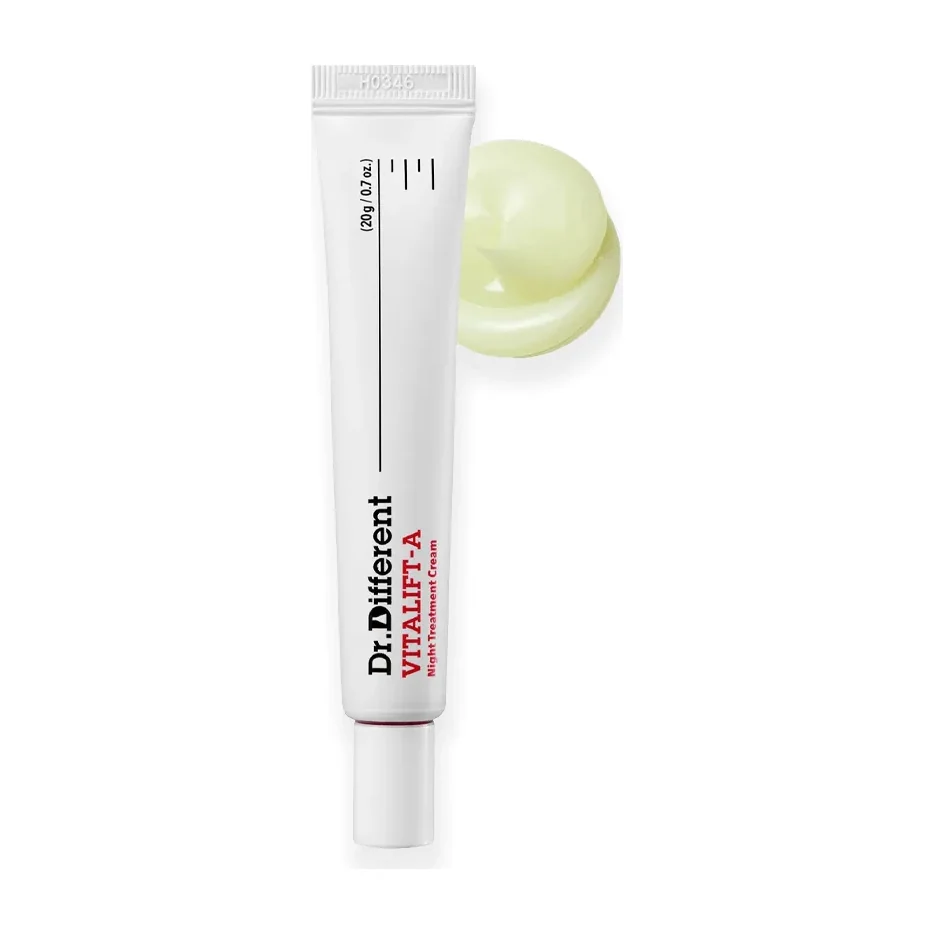
Dr. Different Vitalift-A Forte retinal tube on white background
Unproven for Aging
What makes this different

It pairs a potent 0.1% retinaldehyde — a faster-acting retinoid than retinol — with niosome stabilization and a genuine barrier-lipid complex of ceramide, cholesterol, and phytosterols, all fragrance-free. That combination of real potency and thoughtful barrier buffering, at a budget price, is why it's become a skincare-community favorite.

Dr. Different

Dr. Different Vitalift-A Forte Review

Cult Retinal Standout Retinoids cream k beauty Paraben free Cruelty free

A genuinely excellent, affordable retinaldehyde treatment that earns its cult status — 0.1% retinal, the faster-acting 'sweet spot' retinoid, stabilized in niosomes and buffered by a real ceramide-and-squalane barrier complex, all fragrance-free. It delivers retinoid results faster than retinol while staying more tolerable than tretinoin. Respect its potency with a slow ramp and daily SPF, and it's one of the smartest retinoid buys around.

Price $28.00 20 g
Shopper rating 4.5 ★★★★★ 4,000 reviews
On the market 2018 Made in South Korea
Buy at Amazon ♥
Verdicts

How well it fits each concern

One verdict per concern. Open a row for the reasoning; the receipt has every source.

The scaleRecommendedGoodSupportingEarly evidenceNot for thisAvoidhow it works

Unprovenfor AgingAdenosine has early or mechanistic evidence for aging — a reasonable bet, not a recommendation; the other actives here are not yet assessed for it.Receipt3 sources on the row · concentration not declared; studied range 1% · row checked Jul 17, 2026 · rule R9, same reading on 4,156 products · open the receipt

The case for it

  1. Adenosine has early or mechanistic evidence for this concern, not trial-backed standing.
  2. It is present below the studied range.
  3. The formula carries none of the triggers this concern is sensitive to.

Moderate evidenceGentleNo reviews read yet

What would change this: A concentration inside the studied range would raise this a step.

Same rule for everyone. “Unproven” is the verdict on 4,156 of 45,446 concern verdicts across the catalog; rule R9 decided 4,156 of them. Unchanged since September 5, 2026, engine 5.2.0.

Brand or formulator? Disclose a concentration or correct a fact →

The full receipt: rule, row, sources, dates →All aging products →

Unprovenfor DullnessHyaluronic Acid has early or mechanistic evidence for dullness — a reasonable bet, not a recommendation; the other actives here are not yet assessed for it.Receipt1 source on the row · row checked Jul 17, 2026 · rule R9, same reading on 4,156 products · open the receipt

The case for it

  1. Sodium Hyaluronate & Polyglutamic Acid has early or mechanistic evidence for this concern, not trial-backed standing.
  2. It is plausibly present at a working level, though the concentration is not declared.
  3. The formula carries none of the triggers this concern is sensitive to.

Limited evidenceGentleNo reviews read yet

What would change this: A declared concentration would move this to a firmer reading of the dose.

Same rule for everyone. “Unproven” is the verdict on 4,156 of 45,446 concern verdicts across the catalog; rule R9 decided 4,156 of them. Unchanged since October 9, 2026, engine 5.2.0.

Brand or formulator? Disclose a concentration or correct a fact →

The full receipt: rule, row, sources, dates →All dullness products →How dullness is treated →

Also listed for Rough Texture and Hyperpigmentation — the actives here (Squalane, Hyaluronic Acid, Ceramides, Retinal (Retinaldehyde) are in our research queue for those concerns; there is no verdict until their evidence rows are written. That is a gap in our table, not a mark against the product.

Where our review and the verdict differ. The review below was written on the formulation and the published trials; the verdicts above apply the stricter standing test in our methodology — an active earns a recommendation only with guideline or regulatory standing for the concern. Where the two disagree, the verdict is Dermington’s position.

A verdict is Dermington’s assessment of how well a product’s ingredients fit a concern — never a claim about what the product treats. Evidence dots and collected reviews sit beside it and are never blended in. Rules 0.5.1 · evidence table ev-2026.10-r231 · engine 5.2.0 · how we decide · this product’s receipt

Reader poll · Town SquareQuestion 1 of up to 3

Have you used Vitalift-A Forte?

One tap counts. A couple of optional follow-ups come next.

No account neededOne answer each, change it any timeCounted only in anonymous totalsHow the Square counts →
Assessment

Pros & cons

What it does well 7

  • Potent 0.1% retinaldehyde — faster-acting than retinol
  • Niosome-stabilized for better penetration and tolerability
  • Genuine ceramide-cholesterol-squalane barrier base buffers irritation
  • Fragrance-free, which matters with a retinoid
  • Hyaluronic acid, polyglutamic acid, and adenosine add hydration and support
  • Opaque, air-protective packaging for the fragile active
  • Excellent value versus comparable retinal products

Where it falls short 5

  • Potent — needs careful, gradual introduction
  • Requires diligent daily sunscreen
  • Small 20g size
  • Not for sensitive skin without buffering (start with the 0.05%)
  • Unsuitable during pregnancy; not fungal-acne safe
Review

The full review

There's a quiet hierarchy among over-the-counter retinoids, and retinaldehyde sits near the top of it for a reason. Retinol, the familiar one, has to convert twice in the skin to become active retinoic acid; retinaldehyde converts just once, which makes it work faster and more potently at a given strength — while still being far gentler than prescription tretinoin. It's long been the formulator's 'sweet spot' retinoid, and Dr. Different's Vitalift-A Forte has become a skincare-community favorite by delivering it well, at 0.1%, for the price of a nice lunch. Reviewing it is mostly an exercise in confirming that the enthusiasm is earned — and it is.

What makes this more than just 'a retinal at a good price' is the thoughtfulness around the active. First, the retinal is stabilized in niosomes — tiny lipid vesicles that encapsulate the fragile molecule, improving both its penetration and its tolerability, and the opaque, airless-style tube protects it from the light and air that degrade retinoids. Second, and more importantly, the base is a genuine barrier-repair formula: a skin-mimicking complex of ceramide NP, cholesterol, and plant sterols — the lipid trio that retinoids tend to deplete — plus squalane, shea butter, hyaluronic acid, polyglutamic acid, and adenosine. This isn't a potent active dumped into a basic cream; it's a potent active deliberately buffered against its own irritation. The result is a retinal that delivers real, relatively fast results — smoother texture, softer fine lines, more even tone, often visible within 6 to 12 weeks — while being notably more tolerable than its strength would suggest. And it's fragrance-free, which genuinely matters with a retinoid, since added fragrance only compounds the irritation.

The cream itself gives away its chemistry in small ways. It carries a faint natural yellow tint — that's the retinaldehyde, not a dye — and spreads as a smooth, lightweight cream that settles into a velvety, non-greasy finish, leaving skin feeling conditioned on contact rather than filmed. Safflower seed oil deepens the emollient base, hydrogenated lecithin ties into the vesicle delivery system, and tocopherol guards the oxidation-prone active from inside the formula. The first fortnight tells the retinization story in miniature: mild smoothing can appear within two to four weeks, but so can the dryness, flaking, or light tingling of adjustment — normal, temporary, and much better managed by easing in than pushing through. One quiet housekeeping detail deserves attention: the period-after-opening is six months, shorter than most creams, which suits a fragile aldehyde and argues for actually using the tube rather than saving it.

A few caveats are the universal retinoid ones, applied with respect for retinal's potency. This is a strong active — the 'Forte' is the 0.1% version, a step up from the milder 0.05% Vitalift-A — and the single biggest mistake is going too hard, too fast. Start two to three nights a week, apply to clean dry skin, build up as your skin adjusts through the normal 'retinization' period of possible dryness and flaking, and buffer over moisturizer if you're reactive. Daily sunscreen is non-negotiable, both because retinoids increase sun sensitivity and to protect your results. It shouldn't share an evening with other retinoids or strong acids — benzoyl peroxide is on the do-not-pair list too — it's contraindicated in pregnancy and breastfeeding, freshly post-procedure skin should sit it out, and the oils mean it isn't fungal-acne safe. Sensitive skin should start with the milder 0.05% version rather than the Forte. None of these are flaws in the product; they're the responsibilities that come with an effective retinoid.

The community record is about as strong as OTC retinoids get: roughly four thousand reviews across retailers and forums averaging 4.5 stars, with users consistently reporting results faster than their old retinol, surprise at how tolerable the 0.1% strength proves, and specific credit to the ceramide-and-squalane base. The recurring complaints simply restate the terms of use — it's still potent, the tube is small, and the sunscreen commitment is real.

The value is genuinely excellent. A well-stabilized, barrier-buffered, fragrance-free 0.1% retinaldehyde for a budget price is a standout — retinaldehyde products from Western brands often cost two to four times as much, and many aren't as thoughtfully formulated. The 20g tube is small, but a little goes a long way and it lasts a couple of months.

Where it lands is one of the warmest recommendations of the batch. For normal, combination, and dry skin — and tolerant oily skin — that wants a genuinely effective, faster-acting retinoid without prescription hassle or premium prices, and that will respect the ramp-up and sunscreen, this is a superb buy: potent, smartly stabilized, barrier-supportive, and fragrance-free, the kind of product that over-delivers on its price. Retinoid beginners and sensitive skin should start with the milder 0.05% Vitalift-A and work up; experienced users will appreciate the Forte's strength. Ease in slowly, wear your SPF, skip it if you're pregnant, and this little tube of retinal does exactly what the best retinoids do — just faster, gentler, and cheaper than most. It deserves the cult following.

The science

This is a well-designed retinoid formula with strong evidence behind its core active. Retinaldehyde (retinal) is a retinoid one metabolic step from active retinoic acid (versus two for retinol), and clinical evidence supports that it is more potent and faster-acting than retinol at comparable concentrations while being better tolerated than tretinoin — improving fine lines, texture, tone, and acne through increased cell turnover and collagen stimulation. At 0.1%, this is a meaningful, higher-end OTC dose. The niosome encapsulation is a recognized stabilization-and-delivery strategy that protects the oxidation-prone aldehyde and can enhance penetration while reducing irritation, supported by the opaque, air-limiting packaging that retinoid stability demands. The base is genuinely barrier-supportive and evidence-aligned: a physiologic lipid complex of ceramide NP, cholesterol, and phytosterols replenishes the very lipids retinoids deplete (classic barrier-repair science favors ceramides delivered with cholesterol), while squalane, hyaluronic acid, and polyglutamic acid add validated emollient and humectant support, and adenosine has good evidence as an anti-wrinkle active. The fragrance-free formulation removes a common compounding irritant. The standard retinoid caveats apply scientifically: increased UV photosensitivity mandates daily sunscreen, retinoids are contraindicated in pregnancy, and gradual introduction is evidence-based for minimizing retinization. The honest read: a potent, well-stabilized, thoughtfully buffered retinaldehyde whose formulation reflects genuine understanding of how to make a strong retinoid tolerable.

The clinical view

Dermatologists hold retinaldehyde in high regard as an effective over-the-counter retinoid — more potent and faster-acting than retinol, more tolerable than tretinoin — and would view this formulation favorably: a meaningful 0.1% dose, niosome-stabilized, in a barrier-supportive ceramide-and-squalane base, fragrance-free. The clinical guidance maps directly onto it: introduce gradually (a few nights weekly, building up), buffer over moisturizer if reactive, avoid combining with other retinoids or strong acids simultaneously, and wear daily broad-spectrum sunscreen given increased photosensitivity. Dermatologists stress retinoids are avoided in pregnancy and breastfeeding, and that sensitive skin should start at a lower strength — here, the 0.05% version. They would commend the barrier-buffering approach as exactly what makes a potent retinoid sustainable. Overall, clinicians would consider this an excellent, accessible retinoid choice for appropriate users, used correctly.

Formula

Key ingredients

  1. Retinal (Retinaldehyde, 0.1%)

    The star active — retinaldehyde, a retinoid one step closer to active retinoic acid than retinol, so it works faster and more potently while remaining gentler than prescription tretinoin. At 0.1% and stabilized in niosomes for better penetration and tolerability, it's a genuinely effective anti-aging dose at the higher end of over-the-counter strength.

    Not yet assessed
  2. Ceramide NP, Cholesterol & Phytosterols (Barrier Complex)

    A skin-mimicking barrier-lipid complex — ceramide with cholesterol and plant sterols — that replenishes the lipids retinoids can deplete. This is the thoughtful core of the formula: it buffers the retinal's irritation and supports the barrier, making a potent retinoid far more tolerable.

    Not yet assessed
  3. Squalane

    A lightweight, skin-identical emollient high in the formula that conditions and reinforces the barrier without heaviness, working with the shea butter and safflower oil to keep the retinal cream nourishing rather than drying.

    Not yet assessed
  4. Sodium Hyaluronate & Polyglutamic Acid

    Two humectants that hydrate and plump, countering the dryness retinoids can cause and helping keep skin comfortable through the retinization period.

    Plausible mechanism for Dullness
  5. Adenosine

    A well-evidenced anti-aging active that supports the look of firmness and fine lines, complementing the retinal's cell-turnover action with a gentler, soothing-leaning mechanism.

    Limited for Aging
Full ingredient list 22 ingredients ShowHide

Purified Water, Cetyl Ethylhexanoate, Glycerin, Squalane, Carthamus Tinctorius (Safflower) Seed Oil, Shea Butter, Brassica Campestris (Rapeseed) Sterols, Cholesterol, Phytosteryl/Behenyl/Octyldodecyl Lauroyl Glutamate, 1,2-Hexanediol, Polyglyceryl-10 Oleate, Sodium Hyaluronate, Hydrogenated Lecithin, Polyglutamic Acid, Ceramide NP, Retinal (0.1%), Stearic Acid, Tocopherol, Oleic Acid, Adenosine, Disodium EDTA

Safety & formulation facts

  • Not pregnancy safe
  • Fragrance free
  • Alcohol free
  • Not oil free
  • Silicone free
  • Paraben free
  • Sulfate free
  • Cruelty free
  • Not vegan
  • Not fungal-acne safe
Potential irritants Retinal
Compatibility

Skin types & routine

Routine step treatment
Time of day Night
Best season All year
Finish velvety, non-greasy

Layering

Use at night, starting two to three times a week and building up as tolerated. Apply to clean, dry skin and follow with a moisturizer; buffer over moisturizer if you're reactive. Don't pair it with other retinoids or strong acids the same evening, and wear daily SPF, as retinoids increase sun sensitivity.

When to expect results

Mild smoothing within 2-4 weeks; because retinal converts to retinoic acid in one step, visible improvement in fine lines, texture, and tone often comes faster than with retinol — typically over 6-12 weeks. Some dryness or flaking ('retinization') is normal early on; easing in minimizes it.

Pairs well with Hydrating serumBarrier moisturizerDaily SPF 30+ (essential)
Don't combine with Other retinoids (same night)Strong AHA/BHA exfoliants (same night)Benzoyl peroxide

A routine built around it

Morning

  1. Gentle cleanser
  2. Hydrating serum
  3. Moisturizer
  4. Sunscreen SPF 30+ (essential)

Night

  1. Cleanser
  2. Dr. Different Vitalift-A Forte (2-3x/week to start)this product
  3. Barrier moisturizer
Guidance

How to use it, and who it's for

How to use

Use at night. After cleansing, apply a pea-sized amount to clean, dry skin, starting two to three nights a week and building up as your skin tolerates it. Follow with a moisturizer, or buffer by applying moisturizer first if you're reactive. Don't combine it with other retinoids or strong acids the same evening, and avoid the immediate eye area. Expect some dryness or flaking early on; ease the frequency if it's too much. Apply a broad-spectrum SPF 30+ every morning without exception. Avoid during pregnancy and breastfeeding, and start with the milder 0.05% Vitalift-A if you're new to retinoids or sensitive.

Is it worth the price?

Outstanding value. A well-stabilized, barrier-buffered, fragrance-free 0.1% retinaldehyde at a budget price is genuinely hard to beat — comparable retinal products from Western brands commonly cost two to four times as much, and many are less thoughtfully formulated, lacking the barrier-lipid base that makes this one tolerable. The niosome stabilization and air-protective packaging add real, not cosmetic, value. The 20g size is small, but a pea-sized amount per use means it lasts a couple of months. As an established K-beauty dermocosmetic brand, Dr. Different isn't charging a prestige premium. The value is strongest for those who'll use it correctly with sunscreen; sensitive skin should start with the cheaper, milder 0.05% version. For an effective, well-made retinoid on a budget, it's among the best buys in the category.

Who should buy it

Normal, combination, and dry skin — and tolerant oily skin — wanting a genuinely effective, faster-acting retinoid without prescription hassle or premium prices, especially those with some retinoid experience who'll appreciate the 0.1% strength. It's an excellent, barrier-supportive, fragrance-free choice for anyone targeting fine lines, texture, and tone who'll commit to gradual use and daily sunscreen.

Who should skip it

Sensitive, rosacea-prone, eczema-prone, or compromised skin should start with the milder 0.05% Vitalift-A or a gentler alternative like bakuchiol, since the 0.1% retinal is potent. Retinoids are unsuitable during pregnancy or breastfeeding, those managing fungal acne should note the oils, and anyone unwilling to wear daily sunscreen should pass.

Ready to try it?Dr. Different Vitalift-A Forte · $28.00 · 20 g
Details

The product, in detail

Texture
A smooth, lightweight cream that absorbs to a soft, conditioned finish, with a faint natural yellow tint from the retinaldehyde.
Scent
Fragrance-free, with only a faint neutral base note.
Packaging
A 20 g opaque, airless-style tube that protects the light- and air-sensitive retinaldehyde — appropriate packaging for a fragile retinoid.
How long it lasts
A 20 g tube lasts about 2-3 months with nighttime use a few times a week, building to nightly.
Once opened
Use within 6 months · track your toss-by date →
Size
20 g
Made in
South Korea
Launched
2018
Certifications
Cruelty-Free · Fragrance-Free

What the first two weeks feel like

Skin feels hydrated and conditioned on application thanks to the barrier base. Over the first couple of weeks, some dryness, flaking, or mild tingling ('retinization') is normal as skin adjusts to the potent retinal; easing in two to three nights a week keeps it manageable.

The story behind it

Why it exists

Dr. Different built its reputation on the Vitalift-A line, bringing retinaldehyde — long valued by formulators as the 'sweet spot' retinoid — to an affordable, well-stabilized over-the-counter product. The Forte version steps up the strength to 0.1% retinal for experienced retinoid users.

About Dr. Different Established Brand (5–20 years)

Dr. Different is a Korean dermocosmetic brand known for affordable, actives-focused formulas, particularly its Vitalift-A retinaldehyde line. It has earned a strong reputation in skincare communities for delivering a potent, well-stabilized retinoid in a barrier-supportive base; its credibility rests on transparent, well-formulated products rather than large independent clinical trials.

Brand founded 2017 · This product since 2018

Myth vs. reality

What people get wrong about it

MythRetinol and retinaldehyde are basically the same thing.

RealityThey're related but different. Retinaldehyde (retinal) is one conversion step closer to active retinoic acid than retinol, so it works faster and more potently at a given concentration — while still being gentler than prescription tretinoin. That's why a 0.1% retinal like this can outperform a higher-percentage retinol.

MythA more potent retinoid means you should use it every night from the start.

RealityRetinaldehyde is potent, and diving in nightly is the fastest way to dryness, flaking, and irritation. Starting two to three nights a week and building up lets the skin adjust through 'retinization,' giving better results with less irritation — and this cream's barrier-supportive base helps that process.

FAQ

Questions people ask

How strong is Dr. Different Vitalift-A Forte?

It contains 0.1% retinaldehyde (retinal), a potent over-the-counter retinoid at the higher end of OTC strength. Because retinal is one step closer to active retinoic acid than retinol, it works faster and more powerfully, so it's effective but requires careful introduction, especially for those new to retinoids.

What's the difference between Vitalift-A Forte and the regular Vitalift-A?

The main difference is strength: the Forte contains 0.1% retinaldehyde, while the milder Vitalift-A contains 0.05%. The Forte is aimed at experienced retinoid users who tolerate a stronger dose; beginners or sensitive skin should start with the milder version.

Is retinaldehyde better than retinol?

For many people, yes — retinaldehyde converts to active retinoic acid in one step versus retinol's two, so it tends to work faster and more potently at a given strength while staying gentler than prescription tretinoin. This product also stabilizes it in niosomes and buffers it with ceramides, improving tolerability.

How do I start using Dr. Different Vitalift-A Forte without irritation?

Ease in slowly — two to three nights a week to start, building up as tolerated. Apply to clean, dry skin and follow with a moisturizer, or buffer it over moisturizer if you're reactive. Some dryness or flaking early on is normal, and daily sunscreen is essential since retinoids increase sun sensitivity.

Is Dr. Different Vitalift-A Forte good for sensitive skin?

Approach with caution. The 0.1% retinaldehyde is potent, though the fragrance-free, ceramide-and-squalane base makes it more tolerable than many retinoids. Sensitive skin should start with the milder 0.05% Vitalift-A, buffer over moisturizer, and introduce it very gradually, or choose a gentler alternative.

Is Dr. Different Vitalift-A Forte safe during pregnancy?

No — it contains retinaldehyde, a retinoid, and retinoids are generally advised against during pregnancy and breastfeeding. Consult your healthcare provider and choose a pregnancy-safe alternative such as a bakuchiol or peptide product instead.

Reviews

What shoppers tend to say

Recurring themes our editors read across retailer reviews — summaries in our words, not quotations, and not a substitute for a patch test.

Common praise

  • Visible results faster than retinol
  • Surprisingly tolerable for the strength
  • Barrier-supportive ceramide-and-squalane base
  • Fragrance-free
  • Excellent value for a retinal

Common complaints

  • Still potent — needs careful introduction
  • Small 20g size
  • Requires diligent daily sunscreen
  • Not for sensitive skin without buffering
Notable endorsements0.1% retinaldehyde — a potent OTC retinoidNiosome-stabilized deliveryBarrier-supportive, fragrance-free base
Next stepCheck it against what you already useClashes, spacing and the right order, with everything on your shelf.