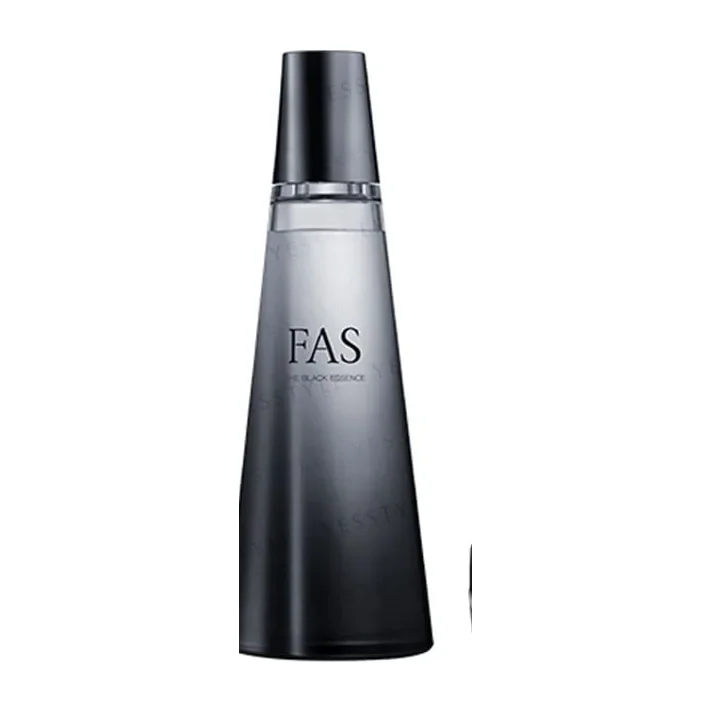
Fermented essences have a special place in Japanese and Korean skincare, thanks largely to one famous product built on a sake-yeast ferment decades ago. FAS's The Black Essence belongs to that tradition, but with a regional twist. The brand, run by Tokyo-based Shiroku Co., Ltd., makes its ferment from ancient black rice grown in Kyotango, in the far north of Kyoto prefecture, using a two-stage fermentation it says took around three years to develop. It claims the resulting liquid contains 738 fermentation-derived components and makes up about 90% of the essence, replacing water. With roughly 2,400 reviews on @cosme, the essence is FAS's founding hero product.
The ingredient list is refreshingly short, just 18 ingredients. Saccharomyces/rice ferment filtrate, the black rice ferment, comes first. Ferments like this contain amino acids, organic acids, sugars, peptides and other by-products of yeast metabolism, many of which are humectants or skin-conditioning agents. A second ferment, lactobacillus/rice ferment, appears fourth. Propanediol, glyceryl glucoside, glycerin and maltitol add proven humectancy. Dipotassium glycyrrhizate, a licorice-derived anti-inflammatory, sits sixth, high enough to contribute a calming effect. Sodium dilauramidoglutamide lysine, a lipid amino acid sometimes described as a pseudo-ceramide, supports the barrier and gives the essence a conditioning feel. Arginine, citric acid and sodium citrate adjust pH, and the formula is preserved with phenoxyethanol and lightly fragranced.
The headline number deserves context. Counting 738 components in a ferment is a measure of chemical complexity, not of active ingredients. Most of those compounds are present in trace amounts, and there is no published independent research showing that this specific ferment produces effects beyond those of a well-formulated humectant essence. Ferments as a category do have some supportive data for hydration and barrier benefits, so the claim is plausible in general terms; it simply has not been demonstrated for this product.
What can be judged is the experience, and here the essence performs well. It is slightly viscous, spreads easily and absorbs within seconds, leaving skin soft, plump and dewy. FAS recommends a two-layer method: a coin-sized amount pressed into the skin, a 30-second pause with the hands cupped over the face, then a second coin-sized layer. Reviewers report that this layering gives a noticeably bouncier, more hydrated feel, which fits the humectant-rich formula. Many describe a healthy glow after a few weeks of regular use.
It suits most skin types. Dry and normal skin get the most comfort, combination skin will appreciate the lightness, and oily skin can use it as its main hydrating step. The formula contains no oils or fatty esters, so it should also be suitable for those managing fungal acne. The main caveat is fragrance: it is light, but anyone with fragrance sensitivity should patch-test.
The comparison with the sake-yeast essences that made this category famous is natural, and it helps clarify what FAS is offering. Those products built their reputations on decades of use and some published research; FAS is new, and its evidence is mostly internal. What it offers instead is a shorter, more modern formula, without the long list of supporting ingredients many essences carry, and a different raw material. Whether black rice has advantages over other ferment substrates is an open question. Anyone choosing between fermented essences should focus on texture, scent and price, since the measurable differences between them are likely to be small.
There are also ways to stretch a bottle. Using one generous layer instead of two on days when skin feels comfortable, applying with hands rather than cotton to avoid waste, and reserving the double layer for the evening routine can extend the bottle by several weeks without losing much benefit.
As with any hydrating essence, the benefits depend on what follows. Humectants pull water into the skin, but without a moisturizer to seal it in, the effect fades. FAS pairs the essence with its own creams; any good moisturizer will do.
Price is the main obstacle. FAS is a prestige brand sold in Japanese department stores, and the essence is priced accordingly. Overseas, it is usually bought through importers, sometimes as a set with a small cream sample, which adds to the cost. With two layers twice daily, the 200 ml bottle lasts six to eight weeks, making the ongoing cost considerable for an essence whose measurable hydration comes largely from inexpensive humectants.
FAS is a young brand, and its story, an ancient grain from a specific Kyoto region turned into a ferment through years of development, is compelling. But a story is not evidence. The Black Essence is a genuinely pleasant, well-formulated hydrating essence with a short ingredient list and a calming active. Whether it is worth its price depends on how much you value the ferment narrative and the sensory experience. For effective hydration alone, far cheaper humectant essences will deliver much of the same result.