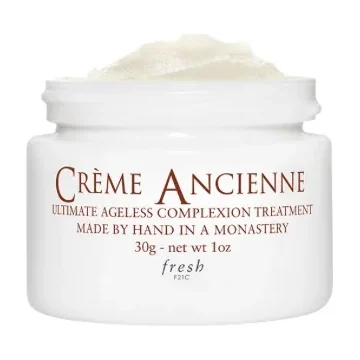
Some products sell you a formula. This one sells you a legend. Crème Ancienne is Fresh's crown jewel, and the story attached to it is irresistible: a cream said to be churned by hand by artisans following a centuries-old apothecary recipe, produced slowly, almost ceremonially, and housed in a heavy, ornate jar that feels less like packaging and more like an heirloom. It is one of the most romantic narratives in luxury skincare, and it is also exactly the kind of story that demands a skeptical, fair-minded look, because at this price you owe it to yourself to ask what you are actually buying. The honest, slightly awkward answer becomes clear the moment you turn the jar over and read the ingredients. The list is astonishingly short. Meadowfoam seed oil, water, beeswax, sweet almond oil, a few flower extracts and waters, vitamin E, and the fragrance components that come with the florals. That is essentially it. There is no retinoid, no peptide complex, no high-percentage vitamin C, no exotic patented active, none of the modern machinery you might expect to find justifying a price tag that runs into the hundreds of dollars. This is, at its core, a very simple, very rich emollient cream. And here is the part that requires intellectual honesty in both directions: simple does not mean bad. The base is genuinely well chosen. Meadowfoam seed oil, the first and dominant ingredient, is a wonderful emollient, exceptionally stable and resistant to oxidation, which softens skin beautifully. Beeswax provides a structural, occlusive seal that locks moisture in and gives the cream its distinctive dense, balm-like body. Sweet almond oil adds extra softening richness. Vitamin E keeps the oil-heavy base from going rancid. As a piece of formulation, it is clean, considered, and effective at exactly one thing: deeply nourishing and protecting dry skin. The experience reflects that. Scoop out a little, warm it between your fingertips, and the firm cream melts into a rich, cushioning layer that you press into the skin. For genuinely dry, tight, winter-stressed skin, the result is immediate and lovely, a feeling of being comforted, sealed, and protected, with the soft old-world scent of chamomile, rose, and osmanthus drifting up as you apply it. People who love this cream are not imagining its benefits; on the right skin, it delivers real, lasting comfort, and the sensorial ritual of using it is a pleasure. If you have dry skin, a generous budget, and you derive joy from a beautiful object and a beautiful experience, that is a legitimate thing to want, and the cream provides it. But the caveats are substantial and they have to be stated plainly. The first is fragrance. The florals that give the cream its apothecary romance also bring lemon peel oil, chamomile oil, and the allergens limonene, citronellol, geraniol, and citral. For resilient skin that is part of the charm; for sensitive, rosacea-prone, or reactive skin, it is a meaningful irritation risk, and no amount of heritage softens that chemistry. The second is fit: this is a rich, occlusive, beeswax-and-oil cream, which makes it wonderful for dry skin and a poor choice for oily or acne-prone skin, where it will feel heavy and the sweet almond oil and beeswax could contribute to congestion. This is a cream for one job, very dry skin, and it does not pretend to be versatile. And then there is the price, which is the entire conversation in the end. This is among the most expensive face creams in mainstream prestige skincare, and the uncomfortable truth is that the formula does not explain that cost. You are not paying for rare actives, because there are none. You are paying for the meadowfoam-and-beeswax base, yes, but mostly you are paying for the story: the hand-churning, the apothecary mythology, the ornate jar, the LVMH brand, and the simple, potent pleasure of owning something positioned as the ultimate. That is not a scam, it is a luxury proposition, and luxury has always charged for craft, scarcity, and feeling rather than raw materials. A handbag costs more than its leather; a watch costs more than its parts. But it does mean that on any rational ingredients-per-dollar basis, the value is poor, and a far less expensive rich cream built on similar emollients and occlusives will protect dry skin essentially as well. There is no way to score this honestly without that pulling the value down hard, and it does. To its credit, the cream is concentrated enough that a small amount goes a long way, so a jar lasts many months, and a smaller size offers a lower entry point for those curious about the experience. The reviews, modest in number because the price keeps volumes low, reflect a clear split: devoted fans who treasure the richness, the comfort, and the ritual, and skeptics who find a simple cream wearing an extravagant price. Both are right, because they are answering different questions. So the recommendation is unusually conditional, and that is the fairest way to handle it. If you have very dry skin, money you are happy to spend on a sensorial luxury, and you genuinely value craft, ritual, and a beautiful object as part of what skincare gives you, this is a lovely, well-made cream that will deliver real comfort and a real pleasure, buy it with open eyes and enjoy it for what it is. If you are looking for active anti-aging results, if your skin is oily, sensitive, or fragrance-reactive, or if you measure a cream by what its ingredients can do per dollar, this is an easy and unembarrassing skip, and your skin will not miss a thing. Judged against its own grand mythology, Crème Ancienne is exactly what it appears to be once you look past the legend: a simple, excellent, wildly expensive rich cream, worth it only to the person buying the story as much as the skincare.