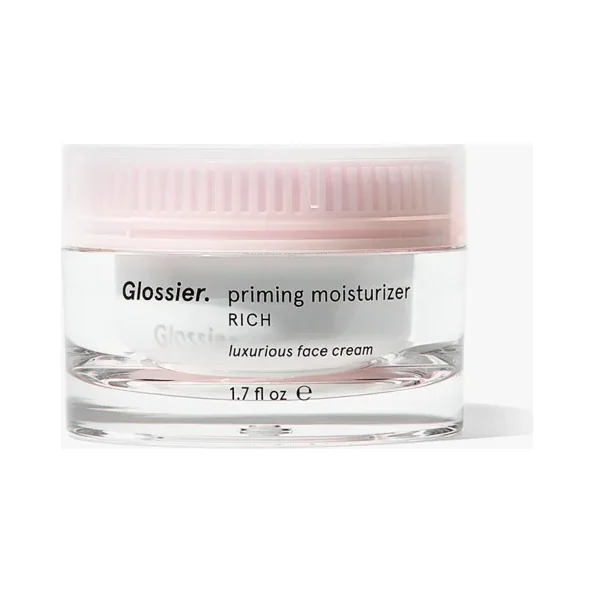
The original Glossier Priming Moisturizer Rich, launched in January 2017, was a product with an identity crisis. It wanted to be a rich, nourishing cream for dry skin, but it also wanted to smell like a lavender field in Provence and contain honey because naturals were having a moment. The result was a cream that dry-skinned customers loved for its texture but that fragrance-sensitive, vegan, and allergy-prone consumers had to reluctantly pass on. It was the skincare equivalent of a restaurant with great food and terrible acoustics — the people who could tolerate the drawbacks were loyal, but a meaningful audience was locked out.
The circa-2023 reformulation fixed this comprehensively. Out went the lavender oil. Out went the honey. Out went the dimethicone and shea butter. In came dual ceramides (NP and AP), cross-linked hyaluronic acid, and a fermented camellia seed oil that reads like Glossier's attempt to bring K-beauty-level fermentation science into an American indie formula. The result is a genuinely different product wearing the same name, and in this case, the changes are almost entirely positive.
The ceramide addition is the headliner. Ceramide NP and Ceramide AP are two of the six ceramide types critical to maintaining the skin's lipid barrier — the microscopic mortar between your skin cells that prevents water from escaping and irritants from entering. Their inclusion moves the Priming Moisturizer Rich from 'pleasant rich cream' territory into 'actual barrier repair' territory. Combined with squalane, which mirrors the skin's own lipids, the formula now has a lipid profile sophisticated enough to support barrier recovery, not just surface hydration.
The texture remains the product's most immediately appealing quality. It's thick in the jar — properly thick, the kind of thick that makes dry skin feel seen — but melts down with surprising speed once it contacts warm skin. Within a minute, the buttery density transforms into a dewy, velvety layer that feels protective without being suffocating. For anyone who's tried rich creams that sit on top of the skin like a waxy mask, this absorbing quality is notable.
The cross-linked hyaluronic acid (sodium hyaluronate crosspolymer) is a smart upgrade over standard HA. The crosspolymer network doesn't collapse as quickly as standard HA molecules, creating a longer-lasting moisture reservoir on the skin surface. It's the difference between a single drink of water and a sustained-release hydration delivery — you stay moisturized longer between applications.
The fermented camellia seed oil is the most exotic ingredient in the formula. Pseudozyma epicola — a yeast — ferments camellia japonica seed oil to produce a filtrate with enhanced bioavailability and additional metabolites from the fermentation process. It's an emerging ingredient without extensive independent clinical data, but the theory is sound: fermentation breaks down large lipid molecules into smaller, more easily absorbed forms while generating additional skin-conditioning compounds. Consider it Glossier's nod to Korean beauty fermentation science.
The fragrance-free reformulation deserves specific praise. The original lavender oil was always a strange choice for a product targeting dry, sensitive skin — lavender essential oil contains linalool and linalyl acetate, both documented sensitizers, and dry skin is often sensitized skin. Removing it wasn't just a vegan-friendly gesture; it was a formulation quality improvement. The current version smells like nothing, which in the rich-cream category is rare and welcome.
The silicone removal is more of a lateral move than an upgrade. Dimethicone was providing the original formula's priming smoothness; without it, the current formula relies on its olive-derived emulsifiers (cetearyl olivate, sorbitan olivate) for a priming base that's more natural-feeling but less silky. Some users who loved the original's smooth makeup application may notice the difference.
For dry skin, performance is excellent. Daily use over two to three weeks produces visibly plumper, calmer, less flaky skin. The ceramides do their structural work gradually — you won't see barrier restoration overnight, but by the six-week mark, skin that was reactive and chronically dry feels meaningfully more resilient. As a primer, it creates a dewy base that works well under most non-silicone foundations. Under silicone-heavy makeup, some pilling is possible — the formula's water-based emulsion system doesn't always play nicely with high-silicone primers or foundations.
The jar packaging remains the most frustrating aspect. In a reformulation that clearly prioritized clean formulation principles — removing potential irritants, going vegan, eliminating fragrance — the choice to keep a jar format feels inconsistent. A pump or tube would protect the ceramides and fermented oils from air oxidation and keep the user's fingers out of the product. The jar looks nice on a shelf. It is not the best home for a barrier-repair cream.
At thirty-five dollars for 1.7 ounces, the value is solid. Dual ceramides, squalane, cross-linked HA, and fermented botanicals in a fragrance-free, silicone-free, vegan formula — that ingredient profile would cost meaningfully more from a luxury brand and roughly the same from pharmacy brands, most of which aren't vegan or cruelty-free. The Leaping Bunny certification adds genuine value for the ethically motivated consumer.
The 3.8 average rating on Space NK reflects the reformulation's double-edged sword: some loyal customers of the original formula feel the product they loved has been changed without their consent. Others — particularly those who couldn't use the original due to the lavender or honey — are discovering the new version for the first time and rating it highly. The truth is that the reformulation made the product objectively better as a skincare formula while changing its character. If you loved the lavender scent, that's gone. If you wanted ceramides and fragrance-free, you got your wish.