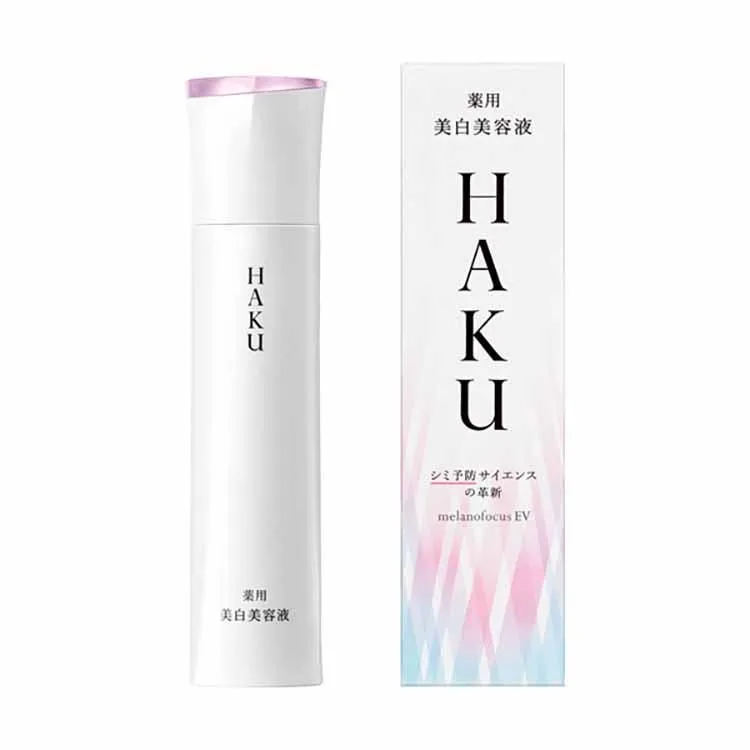
HAKU Melano Focus EV 45g prestige white-and-gold pump bottle
Promising for Hyperpigmentation
What makes this different

Most prestige brightening serums in the global market lean on a single brightening active — typically vitamin C, niacinamide, alpha-arbutin, or tranexamic acid. HAKU Melano Focus EV is built around the dual Japan quasi-drug certified combination of tranexamic acid + Potassium 4-Methoxysalicylate (4MSK). Both ingredients are regulatory-validated at functional concentrations, and they address pigmentation through complementary mechanisms (tranexamic acid inhibits UV-induced melanogenesis upstream; 4MSK inhibits tyrosinase pathway). The dual-active approach is HAKU's brand signature and is rare at any price tier globally.

HAKU

HAKU Melano Focus EV Review

Dual-Active Prestige Brightening Serum Serums serum j beauty Paraben free Fungal-acne safe Vegan Not cruelty free

One of the best-engineered prestige Japanese brightening serums available — dual Japan quasi-drug certified active chemistry (tranexamic acid + Potassium 4-Methoxysalicylate) anchored in 20+ years of HAKU brand heritage, with the broader Shiseido R&D infrastructure behind it. Genuine clinical credibility at prestige Japanese pricing.

Price $95.00 45g · more sizes
Shopper rating 4.6 ★★★★★ 5,500 reviews
On the market 2021 Made in Japan
Buy at Amazon ♥
Verdicts

How well it fits each concern

One verdict per concern. Open a row for the reasoning; the receipt has every source.

The scaleRecommendedGoodSupportingEarly evidenceNot for thisAvoidhow it works

Promisingfor HyperpigmentationTranexamic Acid has trial-level evidence for hyperpigmentation but no guideline or regulatory standing yet — promising, short of a recommendation; the other actives here are not yet assessed for it.Receipt5 sources on the row · concentration not declared; studied range 2–5% · row checked Jul 17, 2026 · rule R9p, same reading on 4,872 products · open the receipt

The case for it

  1. Tranexamic Acid has at least one trial behind it for this concern but no guideline or regulatory standing yet.
  2. It is plausibly present at a working level, though the concentration is not declared.
  3. The formula carries no trigger this concern is sensitive to, with the cautions noted.

Moderate evidenceStandard tolerabilityNo reviews read yet

Cautions: a photosensitising active — use sun protection.

What would change this: A declared concentration would move this to a firmer reading of the dose.

Same rule for everyone. “Promising” is the verdict on 4,872 of 45,446 concern verdicts across the catalog; rule R9p decided 4,872 of them. Unchanged since September 5, 2026, engine 5.2.0.

Brand or formulator? Disclose a concentration or correct a fact →

The full receipt: rule, row, sources, dates →All hyperpigmentation products →How hyperpigmentation is treated →

Good choicefor MelasmaTranexamic Acid is a trial-supported active for melasma; this serum carries it, though the concentration is not declared.Receipt1 source on the row · concentration not declared; studied range 2–5% · row checked Jul 17, 2026 · rule R5, same reading on 9,843 products · open the receipt

The case for it

  1. Tranexamic Acid has trial-supported standing for this concern.
  2. It is plausibly present at a working level, though the concentration is not declared.
  3. The formula carries no trigger this concern is sensitive to, with the cautions noted.

Strong evidenceStandard tolerabilityNo reviews read yet

Cautions: a photosensitising active — use sun protection.

What would change this: A declared concentration would move this to a firmer reading of the dose.

Same rule for everyone. “Good choice” is the verdict on 10,340 of 45,446 concern verdicts across the catalog; rule R5 decided 9,843 of them. Unchanged since September 5, 2026, engine 5.2.0.

Brand or formulator? Disclose a concentration or correct a fact →

The full receipt: rule, row, sources, dates →All melasma products →How melasma is treated →

Unprovenfor DullnessHyaluronic Acid has early or mechanistic evidence for dullness — a reasonable bet, not a recommendation; the other actives here are not yet assessed for it.Receipt1 source on the row · row checked Jul 17, 2026 · rule R9, same reading on 4,156 products · open the receipt

The case for it

  1. Sodium Acetylated Hyaluronate + Sodium Hyaluronate has early or mechanistic evidence for this concern, not trial-backed standing.
  2. It is present at an effective concentration, declared or high in the ingredient list.
  3. The formula carries no trigger this concern is sensitive to, with the cautions noted.

Limited evidenceStandard tolerabilityNo reviews read yet

What would change this: Trial evidence for the active on this concern would move this from a bet to a recommendation.

Same rule for everyone. “Unproven” is the verdict on 4,156 of 45,446 concern verdicts across the catalog; rule R9 decided 4,156 of them. Unchanged since October 9, 2026, engine 5.2.0.

Brand or formulator? Disclose a concentration or correct a fact →

The full receipt: rule, row, sources, dates →All dullness products →How dullness is treated →

Also listed for Dark Spots and Sun Damage — the actives here (4MSK (Potassium Methoxysalicylate) are in our research queue for those concerns; there is no verdict until their evidence rows are written. That is a gap in our table, not a mark against the product.

Where our review and the verdict differ. The review below was written on the formulation and the published trials; the verdicts above apply the stricter standing test in our methodology — an active earns a recommendation only with guideline or regulatory standing for the concern. Where the two disagree, the verdict is Dermington’s position.

A verdict is Dermington’s assessment of how well a product’s ingredients fit a concern — never a claim about what the product treats. Evidence dots and collected reviews sit beside it and are never blended in. Rules 0.5.1 · evidence table ev-2026.10-r231 · engine 5.2.0 · how we decide · this product’s receipt

Reader poll · Town SquareQuestion 1 of up to 3

Have you used Melano Focus EV?

One tap counts. A couple of optional follow-ups come next.

No account neededOne answer each, change it any timeCounted only in anonymous totalsHow the Square counts →
Assessment

Pros & cons

What it does well 7

  • Dual Japan quasi-drug certified brightening actives (tranexamic acid + 4MSK) is genuinely rare
  • Complementary pathway mechanisms produce additive brightening effects
  • Deep multi-botanical supporting cast adds anti-inflammatory and skin-conditioning chemistry
  • Multi-HA hydration chassis prevents typical brightening-serum dehydration
  • Alcohol-free formulation is unusual for prestige Japanese brightening
  • 20-year HAKU brand heritage with continuous reformulation track record
  • Suitable for most skin types including sensitive (with moderate fragrance caveat)

Where it falls short 5

  • Per-bottle price meaningfully above drugstore tranexamic acid alternatives
  • Refill cartridge harder to access outside Japan
  • Sodium metabisulfite is a sulfite-sensitivity consideration
  • Fragrance presence limits applicability for severely fragrance-allergic users
  • Results require 8-12 weeks of patience for visible pigmentation fading
Review

The full review

Brightening serums in the global prestige market follow a consistent pattern: one hero active — usually vitamin C, niacinamide, alpha-arbutin, tranexamic acid, or hydroquinone where regulation permits — supported by humectants and antioxidants, and marketed entirely around that single mechanism. There are good reasons for the convention. It simplifies formulation, it makes the marketing story clean, and it avoids the regulatory headache of validating two actives at once. The exceptions are rare, and they almost always come from houses with enough research infrastructure to walk the multi-active pathway and survive it.

HAKU is one of those exceptions, and Melano Focus EV is the cleanest expression of its dual-active philosophy. The two heroes — tranexamic acid and Potassium 4-Methoxysalicylate, better known as 4MSK — sit at the very top of the INCI, above water, both carrying Japan quasi-drug (医薬部外品) certification. That means each was filed separately with the Ministry of Health, Labour and Welfare at a documented effective concentration. Dual certification in one bottle is genuinely unusual. For anyone who understands the Japanese regulatory framework, it's a signal that the brightening claim rests on filed evidence rather than adjectives.

The mechanism question is what makes the pairing additive rather than redundant, and it's worth being precise about. Tranexamic acid is a synthetic amino-acid derivative — originally an antifibrinolytic drug for heavy bleeding, repurposed for pigment after Asian clinicians in the 1980s noticed melasma fading as a side effect of the oral form. Topically it dampens plasmin-mediated activation of melanogenesis, interrupting the UV trigger *before* the melanin factory switches on. 4MSK works further downstream, inhibiting tyrosinase inside the production cascade itself. One stops the signal; the other stops the manufacturing. That is why the combination outperforms what either could do alone, and why the common worry that stacked brighteners "compete" gets the chemistry backwards — they're operating at different stations on the same line.

The supporting chassis is unmistakably prestige Shiseido. Five botanicals stack behind the actives: Hypericum perforatum (St. John's wort) with its hyperforin and hypericin chemistry, Pyrola japonica carrying arbutin-family compounds with their own modest tyrosinase inhibition, tannin-rich Potentilla erecta, Madonna lily bulb for polysaccharide soothing, and Japanese toki (Angelica acutiloba) root for microcirculation support. Dipotassium glycyrrhizate — the licorice-derived anti-inflammatory that anchors half of Japan's quasi-drug catalog — addresses the inflammatory component of pigmentation, which matters more than it sounds: inflammation and melanin are old collaborators, and calming one restrains the other.

The hydration side is where the formula quietly earns its tolerability. Sodium acetylated hyaluronate — the acetylated form that binds to the skin surface and resists rinse-off — pairs with standard sodium hyaluronate, and underneath both sit glycerin, butylene glycol, xylitol, trehalose and L-serine. That last one is notable: it's a specific amino acid that feeds into the stratum corneum's own natural moisturizing factor. Brightening actives are notoriously drying, and single-active serums routinely leave skin tight and flaky after a few weeks. This one doesn't, and the depth of that humectant bench is the reason.

Two formulation choices draw consumer attention. There's no alcohol, which is uncommon in prestige Japanese brightening serums that typically use ethanol to dissolve lipid-soluble extracts. And there's sodium metabisulfite, which is doing an unglamorous but essential job: tranexamic acid and 4MSK are reducing agents, and without an antioxidant guarding them they would oxidize in the bottle long before they reached your face. It's well tolerated by nearly everyone, and a genuine consideration for the small group with sulfite sensitivity, which tends to cluster among asthmatics and people with specific food allergies.

In use, the experience is straightforward and unspectacular — which, for a treatment product you'll apply twice a day for months, is exactly right. A lightweight white serum, two pumps, spreading smoothly and absorbing inside a minute with no residue. A subtle floral bloom, moderate rather than assertive. Skin feels more hydrated immediately. The brightening accumulates rather than announces itself: tone and surface texture shift around two to three weeks, and visible fading of mild surface pigmentation, post-inflammatory marks and early melasma typically lands somewhere in the eight-to-twelve week window with consistent twice-daily use. It layers cleanly under sunscreen and makeup, which matters, because sunscreen is not optional here. Every morning you skip it, you hand the melanocytes back the trigger the tranexamic acid spent all night suppressing.

Application is worth doing deliberately: two pumps on slightly damp skin after essence, problem areas first — the dark spots, the melasma patch, the marks a breakout left behind — then out across the rest of the face. Thirty to sixty seconds before moisturizer.

Value follows prestige Japanese conventions, meaning it asks for real money. Around $95 for the 45g bottle, stretching two to three months at twice-daily use, works out to roughly $32–48 a month. That is several times what a drugstore tranexamic acid serum costs, and comfortably below what the top prestige Japanese tier commands. The refill cartridge meaningfully improves the per-gram maths and is the obvious choice for anyone committed, though it's harder to source outside Japan. What you're paying for is the dual-active chemistry — genuinely rare at any price — plus twenty years of continuous reformulation behind the HAKU name. If a single well-formulated brightening active would satisfy you, cheaper options deliver that honestly and you should take them. If the dual-mechanism approach is what you actually want, almost nothing else on the global market offers it, and that scarcity is the entire argument for the price.

The science

The dual-active brightening chemistry is the formula's most rigorously validated feature, and worth understanding each ingredient on its own terms.

Tranexamic acid is a synthetic amino-acid derivative — chemically, trans-4-aminomethylcyclohexanecarboxylic acid — originally developed as an antifibrinolytic medication for treating heavy menstrual bleeding and surgical hemorrhage. The dermatological repurposing for pigmentation began in Asia in the 1980s when oral tranexamic acid was observed to reduce melasma pigmentation as a side effect. The published clinical literature on topical tranexamic acid documents meaningful effects on UV-induced pigmentation, post-inflammatory hyperpigmentation, and melasma at topical concentrations of 2-5%, with the mechanism involving inhibition of plasmin-mediated activation of melanogenesis in melanocytes — dampening the UV-trigger that drives melanin production upstream.

Potassium 4-Methoxysalicylate (4MSK) is a salicylate derivative — chemically related to salicylic acid but without BHA exfoliating chemistry — with documented tyrosinase pathway inhibition at cosmetic concentrations. The published literature treats it as a credible brightening active that addresses pigmentation at a different point in the melanin pathway than tranexamic acid, supporting the dual-mechanism rationale for combining the two actives.

The combination of tranexamic acid and 4MSK in a single formula is unusual in the global brightening serum market. Both actives carry separate Japan quasi-drug certifications, meaning each is included at regulatory-validated functional concentration. The Japanese regulatory framework is meaningfully stricter than US cosmeceutical marketing — quasi-drug certification requires Ministry of Health, Labour and Welfare filing of the active at a specified concentration with documented efficacy.

The supporting cast includes Hypericum perforatum extract with documented hyperforin and hypericin chemistry (anti-inflammatory and antimicrobial effects), Pyrola japonica with arbutin-family compounds (modest tyrosinase inhibition), Potentilla erecta with tannin-rich anti-inflammatory chemistry, Lilium candidum bulb extract with polysaccharide humectant contribution, and Angelica acutiloba root extract with coumarin and polysaccharide chemistry supporting microcirculation and skin-conditioning effects.

Dipotassium glycyrrhizate is the water-soluble licorice-derivative anti-inflammatory active used widely across Japanese quasi-drug and prestige skincare. The mechanism involves inhibition of 11-beta-hydroxysteroid dehydrogenase locally in skin, which prolongs endogenous cortisol activity and reduces inflammatory cytokine production. In a brightening serum context, the anti-inflammatory action complements the active brightening chemistry by addressing the inflammatory component of pigmentation.

The hydration chassis (sodium acetylated hyaluronate + sodium hyaluronate + glycerin + butylene glycol + xylitol + trehalose + L-serine + dipropylene glycol) provides the unusually deep humectant load that prevents the typical post-brightening-treatment dehydration. The L-serine inclusion is notable — this is a specific amino acid that contributes to stratum corneum natural moisturizing factor (NMF) chemistry.

Sodium metabisulfite is the standard antioxidant preservative that stabilizes the reducing actives (tranexamic acid, 4MSK) against oxidation in the bottle. At the trace concentrations used in skincare it's generally well-tolerated, but it's a documented allergen for the small subset of users with sulfite sensitivity (more common in patients with asthma or specific food allergies).

The clinical view

Dermatologists working with hyperpigmentation, melasma, and post-inflammatory hyperpigmentation patients frequently single out HAKU as one of the strongest cosmetic brightening serum lines available without prescription — the dual Japan quasi-drug active approach (tranexamic acid + 4MSK) is taken as legitimate clinical chemistry validated by regulatory rigor that exceeds US cosmeceutical standards. For patients with hyperpigmentation concerns who want effective topical brightening without prescription tretinoin or hydroquinone, HAKU Melano Focus EV is a defensible recommendation as part of a broader routine that includes daily SPF and (for more dramatic cases) consideration of prescription options. The fragrance and sodium metabisulfite are the only ingredient considerations worth flagging for the most reactive patients. The pregnancy-safety profile is favorable — tranexamic acid is one of the few cosmetic brightening actives generally considered acceptable during pregnancy at topical concentrations.

Formula

Key ingredients

  1. Tranexamic Acid (Japan Quasi-Drug Brightening Active)

    One of HAKU's two Japan quasi-drug (医薬部外品) registered brightening actives — synthetic amino-acid derivative with documented inhibition of UV-induced melanogenesis through plasmin pathway dampening. Among the best-evidence cosmetic brightening actives for UV-driven pigmentation, post-inflammatory marks, and melasma.

    Clinically supported for Melasma · well-established certainty
  2. Potassium 4-Methoxysalicylate (Japan Quasi-Drug Brightening Active)

    The second Japan quasi-drug (医薬部外品) registered brightening active in HAKU's two-active formulation philosophy — salicylate derivative documented for tyrosinase pathway inhibition. The combined dual-active approach (tranexamic acid + 4MSK) is HAKU's signature differentiation from single-active brightening serums.

    Not yet assessed
  3. Multi-Botanical Skin-Conditioning Stack (Hypericum + Pyrola + Potentilla + Lilium + Angelica)

    Five traditional Japanese and Western medicinal botanicals stacked together for supporting anti-inflammatory, antioxidant, and skin-conditioning effects — characteristic Shiseido prestige formulation house style of pairing well-validated actives with broader botanical chassis. Hypericum (St. John's wort) and angelica root have particularly strong literature support.

    Not yet assessed
  4. Sodium Acetylated Hyaluronate + Sodium Hyaluronate (Multi-HA Stack)

    Two hyaluronic acid forms providing surface humectant action and sustained skin-surface binding — same multi-HA approach used across Shiseido's broader hydration formulations. Important in a brightening-serum context to offset the typical drying impact of tranexamic acid and 4MSK chemistry.

    Plausible mechanism for Dullness
  5. L-Serine + Xylitol + Trehalose (Amino Acid + Sugar Humectant Stack)

    Stacked amino-acid and sugar-alcohol humectants supporting skin barrier function — particularly valuable in a daily-use brightening serum where the active chemistry is applied long-term and barrier support prevents the typical post-treatment dehydration.

    Not yet assessed
Full ingredient list 27 ingredients ShowHide

Potassium 4-Methoxysalicylate, Tranexamic Acid, Water, Glycerin, Butylene Glycol, Xylitol, Dipropylene Glycol, Lauryldimethylaminoacetate Betaine, Sodium Acetylated Hyaluronate, Sodium Hyaluronate, Hypericum Perforatum Extract, Pyrola Japonica Extract, Potentilla Erecta Extract, Lilium Candidum Bulb Extract, Angelica Acutiloba Root Extract, L-Serine, Silica, Trehalose, PEG-60 Hydrogenated Castor Oil, Carbomer, Dipotassium Glycyrrhizate, Disodium EDTA, Phenoxyethanol, Sodium Metabisulfite, Sodium Citrate, Tocopherol, Fragrance

Safety & formulation facts

  • Pregnancy safe
  • Not fragrance free
  • Alcohol free
  • Oil free
  • Silicone free
  • Paraben free
  • Sulfate free
  • Not cruelty free
  • Vegan
  • Fungal-acne safe
Potential irritants FragranceSodium Metabisulfite
Common allergens Fragrance
Compatibility

Skin types & routine

Routine step treatment
Time of day Morning & night
Best season All year
Finish non-greasy, lightweight, fast-absorbing

Layering

Apply 2 pumps after toner/essence step and before moisturizer, both morning and evening. Focus on problem areas (dark spots, melasma patches, post-inflammatory marks) first, then spread across the rest of the face. Daily SPF is non-negotiable to capitalize on the brightening work and prevent UV-induced melanin production.

When to expect results

Hydration and surface tone improvements visible after 2-3 weeks. Visible fading of mild surface pigmentation and post-inflammatory marks typically takes 8-12 weeks of consistent twice-daily use paired with daily SPF.

Pairs well with shiseido-eudermine-activating-essencevitamin-c-serummoisturizerspf

A routine built around it

Morning

  1. Cleanser
  2. Eudermine essence
  3. HAKU Melano Focus EVthis product
  4. Moisturizer
  5. SPF

Night

  1. Cleanser
  2. Eudermine essence
  3. HAKU Melano Focus EVthis product
  4. Moisturizer
Guidance

How to use it, and who it's for

How to use

Apply 2 pumps after cleansing and toner/essence steps on slightly damp skin, both morning and evening. Focus first on problem areas — dark spots, melasma patches, post-inflammatory marks — then spread across the rest of the face. Wait 30-60 seconds for absorption before layering moisturizer. Apply SPF in the morning — non-negotiable to capitalize on the brightening work and prevent UV-induced new melanin production. Suitable for daily indefinite use; brightening contribution accumulates over months.

Is it worth the price?

At roughly $95 for the 45g bottle through Asian-beauty retailers and Shiseido distribution, the per-bottle price sits in the upper-mid prestige Japanese brightening serum tier — meaningfully above drugstore tranexamic acid alternatives (Hada Labo Shirojyun Premium Whitening Milk at $18 — same quasi-drug active, single-active approach) and competitive with prestige alternatives. The 45g bottle stretches 2-3 months at twice-daily use, putting the per-month cost at $32-48. The refill cartridge improves the per-gram value meaningfully and is the right pick for committed users. The argument for the prestige pricing is the dual-active chemistry (genuinely unusual at any price tier) and HAKU's 20-year brand heritage; the argument against is that single-active drugstore alternatives deliver tranexamic acid alone for fraction of the cost. Justified for users specifically wanting the dual-mechanism approach.

Who should buy it

Users with hyperpigmentation, dark spots, melasma, post-inflammatory marks, or general dullness concerns who want prestige Japanese dual-active brightening chemistry with regulatory validation behind both actives. Best for users committed to daily SPF and patient enough to wait 8-12 weeks for visible pigmentation fading.

Who should skip it

Users focused on maximum brightening efficacy per dollar (drugstore tranexamic acid alternatives offer significantly better value), users with documented sulfite sensitivity, users who can't tolerate the moderate fragrance load, and users seeking dramatic immediate results (which would require prescription tretinoin, hydroquinone, or both).

Ready to try it?HAKU Melano Focus EV · $95.00 · 45g
Details

The product, in detail

Texture
Lightweight, slightly viscous white serum that pours easily and spreads smoothly — visibly thinner than typical prestige brightening creams.
Scent
Subtle prestige floral with light green undertones — distinctly HAKU, moderately perfumed.
Packaging
Prestige white-and-gold pump bottle in the HAKU house design language — visually distinctive in the Japanese department-store aisle, refill-compatible.
How long it lasts
Roughly 2-3 months applied morning and evening face application for the 45g bottle.
Once opened
Use within 12 months · track your toss-by date →
Size
45g · other sizes available
Made in
Japan
Launched
2021
Certifications
Japan quasi-drug (医薬部外品) — dual active certification

What the first two weeks feel like

First-use impression is the lightweight texture and the subtle floral fragrance bloom. The serum absorbs in 30-60 seconds without leaving residue, layering cleanly under sunscreen and makeup. Skin feels noticeably more hydrated immediately; the dual-active brightening contribution accumulates over weeks of consistent use rather than showing dramatic immediate effects.

The story behind it

Why it exists

Shiseido launched HAKU in 2005 as the brand's dedicated prestige brightening franchise — built around the dual quasi-drug active philosophy that has anchored the line through multiple generations of reformulation (the original Melano Focus through V, IV, EV, and Z iterations). The Melano Focus EV launched in 2021 as a meaningful chemistry update, retaining the dual-active core while improving the supporting botanical and humectant chassis. The brand has been one of the most-stocked prestige brightening serums in Japanese department stores for nearly two decades.

About HAKU Established Brand (5–20 years)

HAKU is Shiseido's prestige brightening franchise, launched in 2005 with the original Melano Focus serum and continuously reformulated through multiple generations (V → IV → EV → Z). Every HAKU SKU carries the Japan quasi-drug (医薬部外品) designation for documented brightening actives, anchoring the brand's regulatory credibility in the hyperpigmentation skincare category.

Brand founded 2005 · This product since 2021

Myth vs. reality

What people get wrong about it

MythMultiple brightening actives in one serum compete with each other and reduce effectiveness.

RealityThe opposite is typically true for well-formulated brightening combinations. Tranexamic acid and 4MSK address pigmentation through different pathway mechanisms — tranexamic acid inhibits UV-triggered plasmin pathway activation in melanocytes, while 4MSK inhibits tyrosinase activity in the melanin production pathway. The combined approach produces additive (not competitive) brightening effects through complementary mechanisms.

MythJapan quasi-drug certification on brightening products is mostly regulatory marketing.

RealityJapan's 医薬部外品 classification requires manufacturer filing of the active ingredient at a specified concentration with documented efficacy to the Ministry of Health, Labour and Welfare. For HAKU Melano Focus EV, both tranexamic acid and 4MSK carry separate quasi-drug certifications, meaning each is included at regulatory-accepted functional concentration. This is meaningfully stricter than US cosmeceutical marketing language and validates that the formula does the work the marketing claims.

FAQ

Questions people ask

How is HAKU Melano Focus EV different from the newer Melano Focus Z?

Both share the dual Japan quasi-drug active approach (tranexamic acid + 4MSK), but the Z is the newer generation (2024) with updated supporting chemistry and a refined sensorial profile. EV remains widely available with established formulation track record; Z represents Shiseido's latest iteration of the dual-active formulation philosophy. Both produce comparable brightening outcomes; choose based on availability and personal preference for the sensorial signature.

What does the dual-active approach in HAKU Melano Focus EV actually do?

Tranexamic acid and Potassium 4-Methoxysalicylate (4MSK) address pigmentation through complementary mechanisms — tranexamic acid inhibits UV-triggered melanogenesis upstream through plasmin pathway dampening, 4MSK inhibits tyrosinase activity in the melanin production pathway. The combined dual-active approach produces additive brightening effects that single-active products can't match through any single mechanism.

Is HAKU Melano Focus EV worth the prestige price versus drugstore tranexamic acid alternatives?

Depends on whether the dual-active approach matters to you. Hada Labo Shirojyun Premium Whitening Milk delivers Japan quasi-drug certified tranexamic acid for under $20 — comparable brightening for single-active treatment. HAKU adds the 4MSK as a second quasi-drug certified active, plus a deeper botanical and humectant chassis. The premium is justified for users wanting the dual-mechanism approach; drugstore single-active alternatives offer better per-dollar value if you're comfortable with single-active brightening.

Is HAKU Melano Focus EV safe for sensitive skin?

Yes — the formula is alcohol-free, contains documented anti-inflammatory chemistry (dipotassium glycyrrhizate licorice-derivative), and uses well-tolerated humectant chassis. The fragrance presence is the only ingredient worth noting for fragrance-sensitive users; the sodium metabisulfite preservative is a consideration for the small subset with sulfite sensitivity. Most sensitive-skin users tolerate this product well.

Can HAKU Melano Focus EV be used during pregnancy?

Yes — tranexamic acid and 4MSK at cosmetic concentrations are both generally considered pregnancy-safe, and the supporting cast (botanicals, humectants, ceramide-mimetic) is non-restricted. The formula contains no retinoids, salicylates above cosmetic-safe levels, or other pregnancy-restricted ingredients. Many Japanese dermatologists recommend HAKU during pregnancy specifically because of the strong tranexamic acid evidence base.

How long until visible results from HAKU Melano Focus EV?

Hydration and surface tone improvements show after 2-3 weeks of consistent twice-daily use. Visible fading of mild surface pigmentation, post-inflammatory marks, and early melasma typically takes 8-12 weeks. Daily SPF is non-negotiable — the dual-active brightening work depends on simultaneously preventing UV-induced new melanin production through diligent photoprotection.

Reviews

What shoppers tend to say

Recurring themes our editors read across retailer reviews — summaries in our words, not quotations, and not a substitute for a patch test.

Common praise

  • Visible fading of post-inflammatory marks and surface pigmentation over 8-12 weeks
  • Dual-active approach feels meaningfully more comprehensive than single-active brightening
  • Lightweight serum texture absorbs cleanly
  • Pairs naturally with Shiseido prestige routines
  • Fragrance load is moderate compared to typical prestige Japanese brightening

Common complaints

  • Per-bottle price meaningfully above drugstore tranexamic acid alternatives
  • Refill cartridge harder to find outside Japan
  • Sodium metabisulfite is a sulfite-sensitivity consideration
  • Results take 8-12 weeks of patience
Notable endorsementsJapan quasi-drug (医薬部外品) certified for both tranexamic acid and 4MSK brightening activesLong-standing @cosme prestige brightening serum rankerFeatured across Japanese melasma-and-hyperpigmentation editorial coverage
Next stepCheck it against what you already useClashes, spacing and the right order, with everything on your shelf.