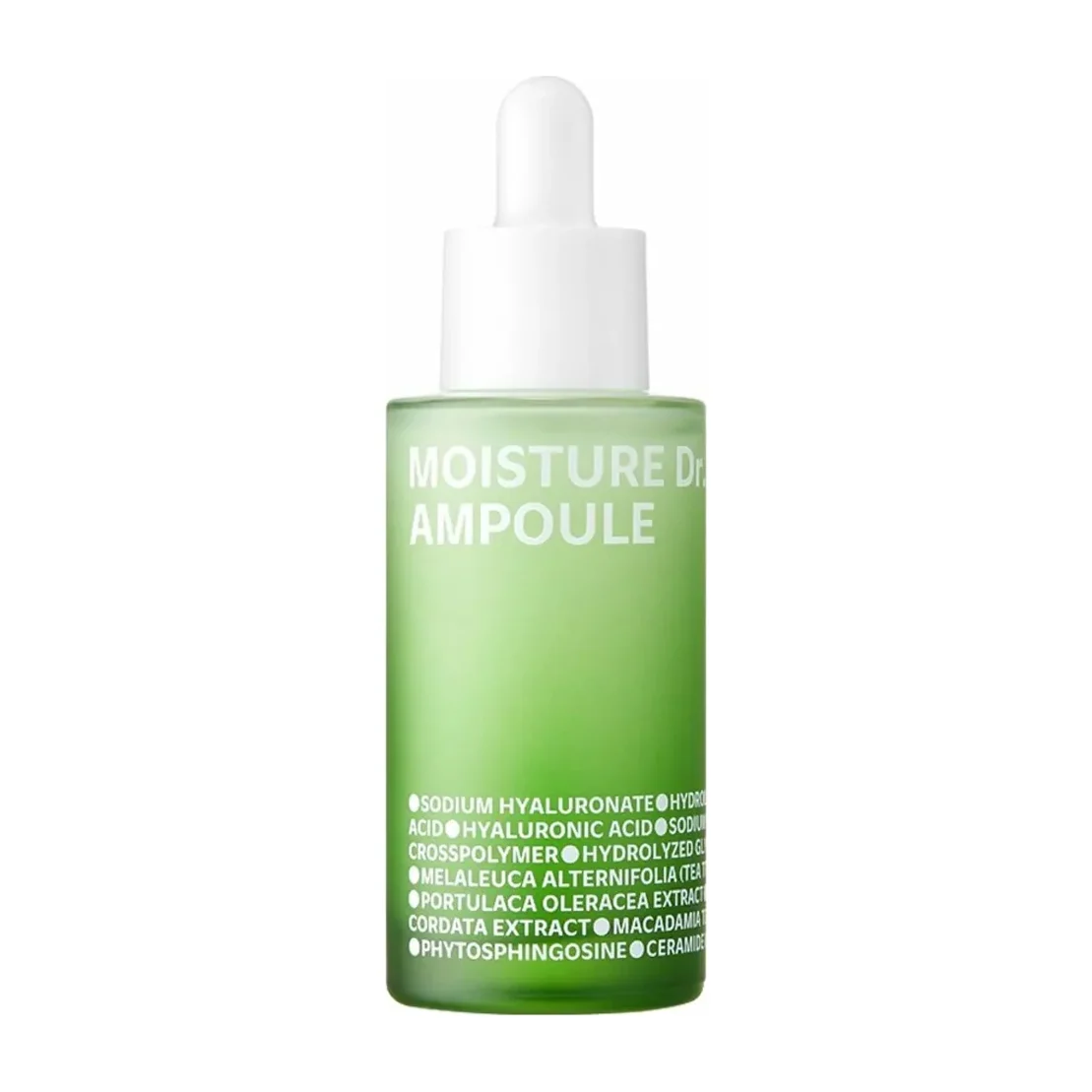
isoi Moisture Dr. Ampoule 40ml green dropper bottle
Good choice for Dehydration
What makes this different

It takes the Moisture Dr. toner's humectant-and-panthenol base and adds squalane, caprylic/capric triglyceride and trehalose, turning a hydrator into a milky serum that both hydrates and softens — a middle step between toner and cream for very dry skin.

isoi

isoi Moisture Dr. Ampoule Review

Cushioning Barrier-Care Ampoule Serums ampoule k beauty Paraben free Not cruelty free

The middle step of isoi's Moisture Dr. routine: a milky ampoule that combines the toner's humectants and panthenol with squalane, light triglycerides and trehalose, so it hydrates and softens at once. It is excellent for dry, dehydrated or retinoid-stressed skin. A touch of grapefruit oil is the only real caveat, and oily skin may find it rich.

Price $29.16 40ml
Best for drynormal
Buy at Amazon ♥
Verdicts

How well it fits each concern

Feedback on this ampoule in English is scarce, so its assessment relies on the fully disclosed formula and established evidence for humectant-emollient hydration and panthenol.

One verdict per concern. Open a row for the reasoning; the receipt has every source.

The scaleRecommendedGoodSupportingEarly evidenceNot for thisAvoidhow it works

Good choicefor DehydrationGlycerin is a reference standard by mechanism for dehydration; this ampoule carries it high in the ingredient list.Receipt1 source on the row · concentration not declared; studied range 20% · row checked Jul 17, 2026 · rule R5, same reading on 9,843 products · open the receipt

The case for it

  1. Glycerin + Betaine + Trehalose is a reference standard by mechanism for this concern — an established physical action, not a trial result.
  2. It is present at an effective concentration, declared or high in the ingredient list.
  3. The formula carries no trigger this concern is sensitive to, with the cautions noted.

Limited evidenceStandard tolerabilityNo reviews read yet

Same rule for everyone. “Good choice” is the verdict on 10,340 of 45,446 concern verdicts across the catalog; rule R5 decided 9,843 of them. Unchanged since September 25, 2026, engine 5.2.0.

Brand or formulator? Disclose a concentration or correct a fact →

The full receipt: rule, row, sources, dates →All dehydration products →

Good choicefor DrynessGlycerin is a reference standard by mechanism for dryness; this ampoule carries it high in the ingredient list.Receipt2 sources on the row · concentration not declared; studied range 2–20% · row checked Jul 17, 2026 · rule R5, same reading on 9,843 products · open the receipt

The case for it

  1. Glycerin + Betaine + Trehalose is a reference standard by mechanism for this concern — an established physical action, not a trial result.
  2. It is present at an effective concentration, declared or high in the ingredient list.
  3. The formula carries no trigger this concern is sensitive to, with the cautions noted.

Limited evidenceStandard tolerabilityNo reviews read yet

Cautions: fragrance.

Same rule for everyone. “Good choice” is the verdict on 10,340 of 45,446 concern verdicts across the catalog; rule R5 decided 9,843 of them. Unchanged since September 25, 2026, engine 5.2.0.

Brand or formulator? Disclose a concentration or correct a fact →

The full receipt: rule, row, sources, dates →All dryness products →

Avoidfor Compromised Skin BarrierThis formula carries fragrance — a known trigger for compromised skin barrier — so it is not a fit however good its actives are.Receiptread from the ingredient list: fragrance · rule R1, same reading on 1,307 products · open the receipt

The case for it

  1. Ceramide NP + Phytosphingosine is a reference standard by mechanism for this concern — an established physical action, not a trial result.
  2. It is plausibly present at a working level, though the concentration is not declared.
  3. The formula carries a known trigger for this concern, which decides the verdict before any efficacy question.

Limited evidenceCarries a triggerNo reviews read yet

Cautions: known irritants.

What would change this: Removing the trigger named above would let the actives be judged on their own.

Same rule for everyone. “Avoid” is the verdict on 1,912 of 45,446 concern verdicts across the catalog; rule R1 decided 1,307 of them. Unchanged since September 25, 2026, engine 5.2.0.

Brand or formulator? Disclose a concentration or correct a fact →

The full receipt: rule, row, sources, dates →All compromised skin barrier products →

Also listed for Winter Skin — the actives here (Glycerin, Squalane, Panthenol (Vitamin B5) are in our research queue for that concern; there is no verdict until their evidence rows are written. That is a gap in our table, not a mark against the product.

A verdict is Dermington’s assessment of how well a product’s ingredients fit a concern — never a claim about what the product treats. Evidence dots and collected reviews sit beside it and are never blended in. Rules 0.5.1 · evidence table ev-2026.10-r231 · engine 5.2.0 · how we decide · this product’s receipt

Reader poll · Town SquareQuestion 1 of up to 3

Have you used Moisture Dr. Ampoule?

One tap counts. A couple of optional follow-ups come next.

No account neededOne answer each, change it any timeCounted only in anonymous totalsHow the Square counts →
Assessment

Pros & cons

What it does well 6

  • Squalane and triglycerides add softening emollience to deep hydration
  • Glycerin, betaine and trehalose provide a strong humectant base
  • Panthenol supports barrier recovery and soothes tight skin
  • Four-form hyaluronic complex gives layered, dewy hydration
  • Excellent cushioning layer for retinoid routines
  • Layers smoothly without pilling

Where it falls short 5

  • Contains grapefruit peel oil and limonene
  • Small amounts of tea tree and cassia may bother very reactive skin
  • May feel rich for oily skin in the daytime
  • Largely overlaps with the Moisture Dr. toner
  • No actives for pigmentation or wrinkles
Review

The full review

If you line up the ingredient lists of isoi's Moisture Dr. Toner and Moisture Dr. Ampoule, the family resemblance is obvious. Both are built on water, glycerin and betaine; both carry panthenol, a four-form hyaluronic complex, ceramide NP, phytosphingosine and the same group of soothing botanicals. So the useful question is what the ampoule adds — and whether a dry-skin routine really needs both steps.

The answer is in positions four to six. The ampoule adds trehalose, a sugar that helps the skin retain water under dry conditions, and then two emollients: squalane and caprylic/capric triglyceride. Those two ingredients change the product's character. Where the toner is a watery, humectant-led hydrator, the ampoule is a milky, lightly emollient serum that softens the skin as well as hydrating it. Carbomer, xanthan gum and a small emulsifier give it a gentle gel body. In practical terms, it sits between toner and cream: more cushioning than the first, lighter than the second.

Panthenol, seventh on the list, remains a highlight. It supports the skin's recovery after irritation and reduces water loss, which is why it appears so often in products for sensitive and barrier-damaged skin. The hyaluronic complex — sodium hyaluronate, hydrolysed hyaluronic acid, hyaluronic acid and a crosspolymer, plus hydrolysed glycosaminoglycans — adds layered hydration. Ceramide NP and phytosphingosine, though present in small amounts, complement the emollients.

The botanical section mirrors the toner: tea tree, purslane, houttuynia, willow bark, oregano, hinoki, a soybean ferment, cassia bark, calendula, skullcap, peony root and licorice. Most of these are included for soothing or antioxidant effects and are present at low levels. As in the toner, a small amount of grapefruit peel oil adds a faint citrus note, bringing limonene with it. Tea tree and cassia bark are also occasional sensitisers. For most people these are insignificant; for those with known fragrance or plant allergies, they are worth noting.

On the skin, the ampoule feels comforting. A few drops pressed into the face after toner spread easily and absorb within a minute, leaving a soft, dewy surface. Dry skin feels noticeably plumper and less tight. Oily skin may find the emollients a little rich for daytime, though it can work well at night. It layers smoothly under moisturiser and sunscreen and does not pill.

The dropper bottle is a practical choice for a product like this. It makes it easy to dispense the three or four drops that are enough for the whole face, which in turn makes the 40ml last longer than you might expect, and it keeps fingers out of the formula. The green-gradient glass matches the toner, with the same running list of highlight ingredients printed down the front, so the two sit neatly together on a shelf. A dropper does let a little air in each time, but nothing in this formula is especially fragile, so it is a minor consideration.

It is also a flexible product. Beyond the face, a drop or two works well on dry lips before balm, on flaky patches around the nose after a cold, or mixed into a body lotion for the backs of the hands in winter. Because it is fragrance-light and mostly humectant, it can serve as a general-purpose comfort serum when the skin feels stressed.

Where it shines is in routines that stress the skin. Retinoid users often find that a cushioning hydrating serum makes the difference between tolerating a retinoid and abandoning it, and this ampoule is well suited to that role. People in cold, dry climates or dealing with barrier damage from over-exfoliation will also appreciate it. It is not a treatment for pigmentation, wrinkles or acne — there are no strong actives — but it does exactly what it promises: comfort and hydration.

So, do you need both toner and ampoule? For very dry or compromised skin, using the toner, then the ampoule, then the Moisture Dr. cream builds hydration in layers, and the combination is genuinely effective. For normal or combination skin, choosing one of the first two steps — the toner if you want lightness, the ampoule if you want softness — is usually enough before a moisturiser.

US availability is through K-beauty retailers, and English-language reviews are scarce, but the formula is fully disclosed and conventional in a good way.

To use it, after cleansing and toning, press a few drops into the face and neck, let it absorb, then follow with moisturiser, plus sunscreen in the morning. On retinoid nights, use it before or after your retinoid as a buffer. On very dry winter nights, a drop of face oil mixed in adds extra richness.

On value, around twenty-nine dollars for 40ml is mid-range for a Korean hydrating serum. The emollient-plus-humectant design and the barrier-support extras justify it for dry skin, but buyers with normal skin may find similar results from cheaper hydrating serums.

The verdict: a well-made, comforting ampoule that bridges the gap between toner and cream for dry, dehydrated skin. If your skin is thirsty and tight, it earns its place; if your skin is merely a little dry, the toner or cream alone may be sufficient.
The science

The ampoule combines humectants with emollients, which is the key to lasting hydration. Glycerin and betaine increase stratum corneum water content, and trehalose, a disaccharide, has been shown to stabilise water and cell membranes under dehydration stress. Humectants alone can leave skin feeling tight as water evaporates; adding emollients such as squalane and caprylic/capric triglyceride helps reduce transepidermal water loss and improves skin softness.

Panthenol, converted to pantothenic acid in the skin, has trial evidence for improving hydration, reducing water loss and accelerating recovery after irritation. The hyaluronic acid complex — including high- and low-molecular-weight forms and a crosslinked polymer — provides humectant activity at different depths of the stratum corneum. Hydrolysed glycosaminoglycans add further water binding.

Ceramide NP and phytosphingosine are skin-identical lipids that, alongside the emollients, support the lipid barrier; barrier repair is most effective when ceramides are combined with cholesterol and fatty acids, as in the Moisture Dr. cream, which is designed to follow.

The botanical extracts, including purslane, houttuynia, calendula, licorice and skullcap, have anti-inflammatory and antioxidant activity in laboratory studies but are present at low concentrations. The formula contains grapefruit peel oil and limonene, a recognised fragrance allergen, plus tea tree and cassia bark extracts, which can sensitise some individuals.

The clinical view

For patients with dry, dehydrated or barrier-compromised skin, clinicians commonly recommend layering a humectant-rich serum under an emollient moisturiser, and this ampoule — combining humectants, panthenol, light emollients and a small amount of ceramide — fits that approach. It can be particularly helpful for patients using retinoids who struggle with dryness. Dermatologists would note that the small amount of grapefruit oil and limonene makes it less ideal for patients with known fragrance allergy, and that a fully fragrance-free alternative may be preferable for very sensitive skin. Hydrating serums support skin comfort but do not replace targeted treatments for conditions such as eczema, which may need prescription therapy.

Formula

Key ingredients

  1. Squalane + Caprylic/Capric Triglyceride

    The key difference from the toner: two light emollients in the top six ingredients turn the ampoule into a milky, cushioning serum that softens skin and slows water loss, not just hydrates it.

    Established mechanism for Dryness · established mechanism
  2. Glycerin + Betaine + Trehalose

    A three-part humectant base; trehalose, a sugar that helps skin hold water under dry conditions, adds staying power to the glycerin and betaine.

    Established mechanism for Dehydration · established mechanism
  3. Panthenol

    Seventh on the list, panthenol supports barrier recovery and soothes dry, tight or retinoid-irritated skin.

    Established mechanism for Dehydration · established mechanism
  4. Hyaluronic Acid Complex (Sodium Hyaluronate, Hydrolyzed, Crosspolymer and Hyaluronic Acid)

    Four hyaluronic forms and hydrolysed glycosaminoglycans provide layered hydration, giving the ampoule its plumping, dewy effect.

    Established mechanism for Dehydration · established mechanism
  5. Ceramide NP + Phytosphingosine

    A small barrier-lipid duo, shared across the Moisture Dr. line, that complements the emollients in supporting a dry, compromised barrier.

    Established mechanism for Dryness · established mechanism
Full ingredient list 38 ingredients ShowHide

Water, Glycerin, Betaine, Trehalose, Squalane, Caprylic/Capric Triglyceride, Panthenol, Sodium Hyaluronate, Hydrolyzed Hyaluronic Acid, Hyaluronic Acid, Sodium Hyaluronate Crosspolymer, Hydrolyzed Glycosaminoglycans, Melaleuca Alternifolia (Tea Tree) Leaf Extract, Portulaca Oleracea Extract, Houttuynia Cordata Extract, Salix Alba (Willow) Bark Extract, Origanum Vulgare Leaf Extract, Chamaecyparis Obtusa Leaf Extract, Lactobacillus/Soybean Ferment Extract, Cinnamomum Cassia Bark Extract, Arginine, Carbomer, Macadamia Ternifolia Seed Oil, Phytosphingosine, Ceramide NP, Xanthan Gum, Citrus Paradisi (Grapefruit) Peel Oil, Sorbitan Sesquioleate, Butylene Glycol, 1,2-Hexanediol, Propanediol, Calendula Officinalis Flower Extract, Scutellaria Baicalensis Root Extract, Paeonia Suffruticosa Root Extract, Glycyrrhiza Glabra (Licorice) Root Extract, Hydrogenated Lecithin, Limonene

Safety & formulation facts

  • Pregnancy safe
  • Not fragrance free
  • Alcohol free
  • Not oil free
  • Silicone free
  • Paraben free
  • Sulfate free
  • Not cruelty free
  • Not vegan
  • Not fungal-acne safe
Potential irritants Citrus Paradisi (Grapefruit) Peel OilLimoneneMelaleuca Alternifolia (Tea Tree) Leaf ExtractCinnamomum Cassia Bark Extract
Common allergens LimoneneCitrus Paradisi (Grapefruit) Peel Oil
Compatibility

Skin types & routine

Routine step serum
Time of day Morning & night
Best season fall & winter
Finish dewy, satin

Layering

Press a few drops into skin after toner and before cream; on very dry nights it can be mixed with a drop of face oil, and on retinoid nights it makes a comfortable cushion before or after the retinoid.

When to expect results

Skin feels softer, plumper and more comfortable immediately. With twice-daily use over 2-4 weeks, dry, flaky patches usually ease and the skin feels more resilient.

Pairs well with ceramidesretinolniacinamide

A routine built around it

Morning

  1. Gentle cleanser
  2. Hydrating toner
  3. isoi Moisture Dr. Ampoulethis product
  4. Moisturizer
  5. Sunscreen

Night

  1. Cleanser
  2. Toner
  3. isoi Moisture Dr. Ampoulethis product
  4. Retinoid (optional)
  5. Rich cream
Guidance

How to use it, and who it's for

How to use

After cleansing and toning, dispense a few drops into your palm and press them gently over the face and neck until absorbed. Follow with a moisturiser, ideally a ceramide cream, and sunscreen in the morning. Use morning and evening. On retinoid nights, apply before or after the retinoid to buffer dryness. On very dry nights, mix in a drop of face oil for extra richness. Patch-test first if you are sensitive to fragrance or citrus oils.

Is it worth the price?

At about twenty-nine dollars for 40ml, the Moisture Dr. Ampoule is mid-priced for a Korean hydrating serum. Its combination of humectants, panthenol, squalane and a touch of ceramide offers genuine benefit for dry skin, though it overlaps substantially with the less expensive toner in the same line. For very dry or retinoid-stressed skin, it is fair value as part of a layered routine; for normal skin, one of the toner or ampoule is usually enough.

Who should buy it

People with dry, dehydrated or barrier-stressed skin — including retinoid users and those in cold climates — who want a cushioning, hydrating serum between toner and moisturiser.

Who should skip it

Oily-skinned users who prefer weightless serums, anyone with fragrance or citrus-oil allergies, and people already using the Moisture Dr. toner who don't need an extra hydration step.

Ready to try it?isoi Moisture Dr. Ampoule · $29.16 · 40ml
Details

The product, in detail

Texture
A soft, milky serum-emulsion with a gentle gel body that spreads easily and absorbs to a cushioned, dewy finish.
Scent
A faint citrus lift from grapefruit peel oil.
Packaging
A 40ml green-gradient glass dropper bottle with a white dropper cap, key ingredients printed down the front.
How long it lasts
About 6-8 weeks with a few drops twice daily.
Once opened
Use within 12 months · track your toss-by date →
Size
40ml
Made in
South Korea

What the first two weeks feel like

Dry skin drinks it in, feeling softer and more comfortable within minutes. Oily skin may find it slightly rich for daytime. Very reactive skin should patch-test because of the small amounts of citrus oil, tea tree and cassia.

The story behind it

Why it exists

The ampoule sits between isoi's Moisture Dr. toner and its fragrance-free cream, designed to give dehydrated and barrier-damaged skin a concentrated layer of hydration and softness before the final moisturiser.

About isoi Established Brand (5–20 years)

isoi is a Korean skincare brand whose Moisture Dr. range targets dry, dehydrated and barrier-weakened skin. Full ingredient lists are published; clinical testing of this ampoule has not been released.

Brand founded 2006

Myth vs. reality

What people get wrong about it

MythAn ampoule is always a high-strength active treatment.

RealityIn Korean skincare, 'ampoule' often just means a concentrated serum. This one is a hydrating, soothing formula with no strong actives — valuable for dry skin, but not a treatment for pigmentation or wrinkles.

MythIf you use the toner, the ampoule is redundant.

RealityThey share humectants and panthenol, but the ampoule adds squalane, caprylic/capric triglyceride and trehalose, giving it an emollient layer the toner lacks. Very dry skin benefits from both; normal skin may need only one.

FAQ

Questions people ask

What's the difference between the isoi Moisture Dr. Ampoule and Toner?

Both use glycerin, betaine, panthenol and a hyaluronic complex, but the ampoule adds squalane, caprylic/capric triglyceride and trehalose, making it a milkier, more emollient serum for dry skin.

Is the isoi Moisture Dr. Ampoule good for dry skin?

Yes. Its humectants draw water in while squalane and light oils help hold it there, and panthenol and ceramide NP support a stressed barrier.

Does the Moisture Dr. Ampoule contain fragrance?

There is no added synthetic fragrance, but it contains a small amount of grapefruit peel oil and limonene, so very sensitive skin should patch-test.

Can I use the isoi ampoule with retinol?

Yes. It is a good cushioning layer on retinoid nights, helping reduce dryness and flaking.

Is the Moisture Dr. Ampoule suitable for oily skin?

It can work at night, but its squalane and triglycerides may feel rich for oily skin during the day. A lighter hydrating serum may suit oily skin better.

Is the isoi Moisture Dr. Ampoule safe during pregnancy?

Its ingredients — humectants, emollients, panthenol, hyaluronic acid and botanicals — are not typically restricted in pregnancy.

Next stepCheck it against what you already useClashes, spacing and the right order, with everything on your shelf.