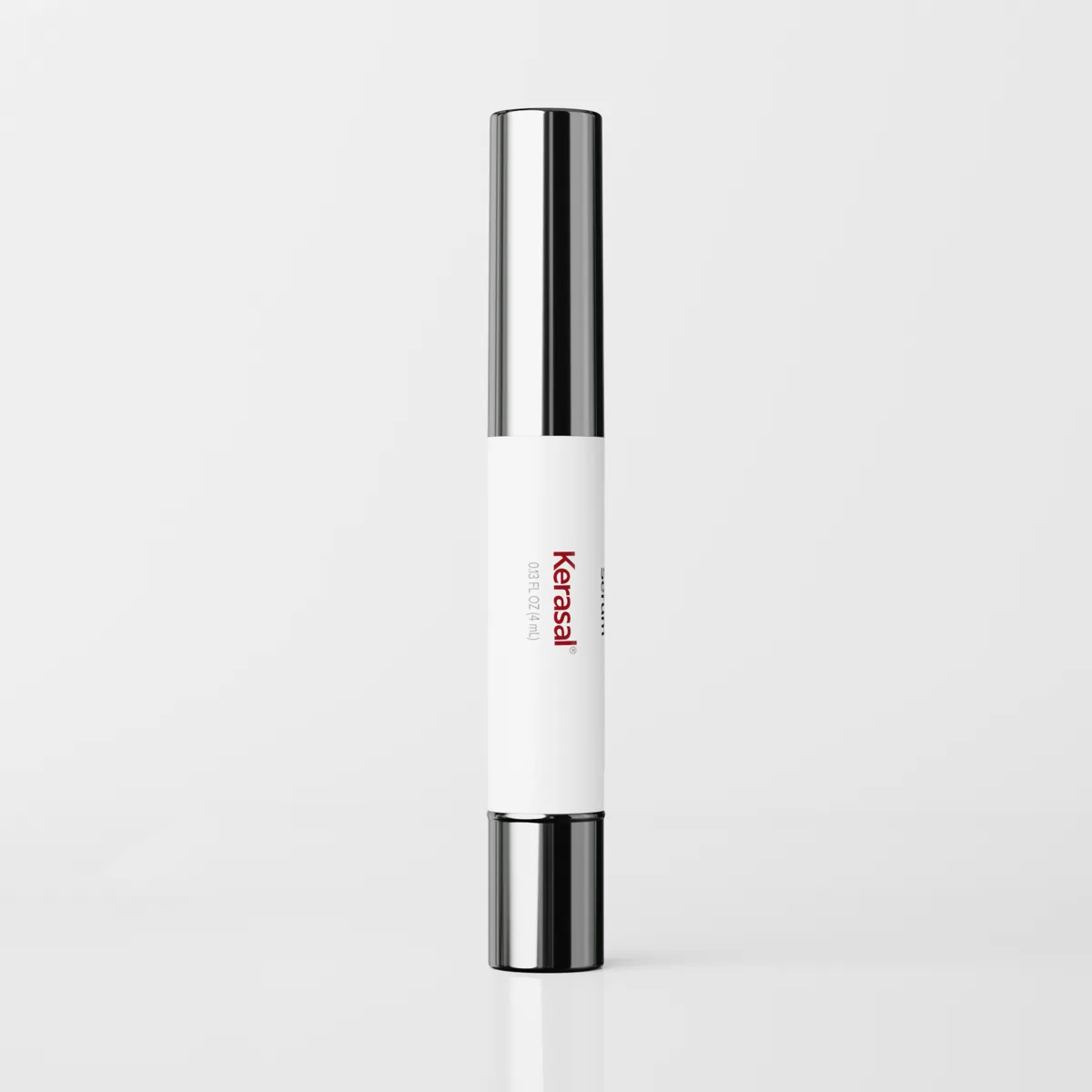
Kerasal Cuticle Cure serum twist pen with cushioned applicator tip
Strong choice for Dryness
What makes this different

The format is the argument. Cuticle care fails on adherence more than on chemistry, and a no-mess twist pen that lives in a pocket gets used on days a dropper bottle of oil does not. Where it parts company with the rest of the aisle is the botanical angle — celery seed extract rather than the usual jojoba and vitamin E — which is a novelty rather than a demonstrated upgrade.

Kerasal

Kerasal Cuticle Cure Review

Desk-Drawer Convenience Nail Care oil pharmacy brand Paraben free Not cruelty free

A tidy, pocketable occlusive pen that keeps cuticles pliable and stops hangnails catching — genuinely useful, genuinely conventional. The marketing sells vitamin C and celery seed science; the ingredient list is mineral oil, esters and a heavy fragrance load. Buy it for the format and the barrier effect, not for the botany, and skip it entirely if your hands react to scent.

Price — 0.13 fl oz (4 ml)
On the market 2026 launched
Buy at Amazon ♥
Verdicts

How well it fits each concern

This is a 2026 arrival with no meaningful independent review base yet, and no US retail price we could confirm against a retailer while writing, so the value discussion here is structural rather than specific. The assessment rests on the ingredient list published by the brand and on how these ingredient classes behave; expect the picture to sharpen once the product has been in enough hands to generate real feedback.

One verdict per concern. Open a row for the reasoning; the receipt has every source.

The scaleRecommendedGoodSupportingEarly evidenceNot for thisAvoidhow it works

Strong choicefor DrynessMineral Oil is an approved or monograph active for dryness; this oil carries it high in the ingredient list.Receipt§ 347.50 Labeling of skin protectant drug products (indications for § 347.10 actives, incl. mineral oil) (opened Jul 27, 2026) · concentration not declared; studied range 1–100% · row checked Jul 27, 2026 · rule R2, same reading on 905 products · open the receipt

The case for it

  1. Mineral Oil is an approved or monograph active for this concern.
  2. It is present at an effective concentration, declared or high in the ingredient list.
  3. The formula carries no trigger this concern is sensitive to, with the cautions noted.

Limited evidenceStandard tolerabilityNo reviews read yet

Cautions: fragrance.

Same rule for everyone. “Strong choice” is the verdict on 1,475 of 45,446 concern verdicts across the catalog; rule R2 decided 905 of them. Unchanged since September 5, 2026, engine 5.2.0.

Brand or formulator? Disclose a concentration or correct a fact →

The full receipt: rule, row, sources, dates →All dryness products →

A verdict is Dermington’s assessment of how well a product’s ingredients fit a concern — never a claim about what the product treats. Evidence dots and collected reviews sit beside it and are never blended in. Rules 0.5.1 · evidence table ev-2026.10-r231 · engine 5.2.0 · how we decide · this product’s receipt

Reader poll · Town SquareQuestion 1 of up to 3

Have you used Cuticle Cure?

One tap counts. A couple of optional follow-ups come next.

No account neededOne answer each, change it any timeCounted only in anonymous totalsHow the Square counts →
Assessment

Pros & cons

What it does well 7

  • Mineral oil base is the most reliable occlusive for cuticle dryness
  • Twist pen meters the dose and stops the usual dropper mess
  • Sinks in fast enough to use at a desk without greasy fingers
  • Small enough to carry, which is what drives daily compliance
  • One or two twists covers all ten nails
  • Immediate suppleness with no adjustment period
  • Comes from a brand with genuine credibility in medicated nail care

Where it falls short 6

  • Heavy fragrance load including four commonly reported contact allergens
  • Contains no ascorbic acid despite marketing vitamin C prominently
  • Celery seed extract sits below the preservative, so contributes little
  • Under four millilitres empties within a couple of months
  • Camphor and tea tree add sting risk on torn hangnail skin
  • Does nothing for the nail plate itself — cuticles only
Review

The full review

There is a particular kind of product that arrives wearing borrowed authority. Kerasal earned its shelf position in American pharmacies the hard way, on ointments for cracked heels and a nail solution that went through a genuine placebo-controlled trial, and that reputation now sits behind a chrome-cased cuticle pen launched in 2026. The pen is fine. It is, in fact, a perfectly sensible thing to own. But the distance between what the box implies and what the ingredient list says is wide enough to be worth walking, because it is the whole story of this product.

Start with what is actually inside, since the brand publishes it plainly: mineral oil, isopropyl myristate, fragrance, caprylic/capric triglyceride, celery seed extract, two preservatives, a glycol, tea tree oil, a violet dye, and then geraniol, linalool, camphor, limonene, lavender and linalyl acetate. What that describes is a light occlusive oil with a substantial perfume. Notably absent is any form of vitamin C — no ascorbic acid, no ascorbyl phosphate, no tetraisopalmitate — despite vitamin C being named on the front as one of three hero ingredients. The charitable and probably correct reading is that celery seed contains some vitamin C naturally, so the claim technically survives. It survives the way calling a bread roll a source of protein survives.

The irritation of that aside, the formula works, and it works for reasons worth respecting. Cuticle dryness is fundamentally a transepidermal water loss problem in a patch of skin that is thin, constantly wet, constantly dried, and regularly assaulted by handwashing, sanitiser, acetone and teeth. The correct intervention for that is occlusion, and mineral oil is the most reliable occlusive ingredient in cosmetic chemistry — inert, non-sensitising, and better at slowing water loss than any of the fashionable botanical oils that cost twenty times as much. Isopropyl myristate thins it so it flows off a felt tip and sinks in rather than sitting greasily. Caprylic/capric triglyceride softens the whole thing. If you designed a cuticle oil from first principles and cared only about outcomes, you would build something close to this.

The format deserves the same credit. Cuticle care is a compliance problem, not a chemistry one, and everyone who has ever bought a beautiful glass dropper bottle of cuticle oil knows exactly where it is: in a drawer, three-quarters full, from 2023. A twist pen with a cushioned tip that meters its own dose and lives in a bag gets used at a desk, on a train, in front of the television. That is not a small advantage; it is arguably the entire advantage. Priming it takes patience — expect a lot of twisting before anything reaches the tip — but afterwards one or two clicks covers all ten fingers.

Where the enthusiasm has to stop is the fragrance. This pen carries a declared fragrance plus geraniol, linalool, limonene, camphor, tea tree oil and lavender oil, and that is a genuinely loaded roster to apply to periungual skin. The skin around a nail is where people pick, where hangnails tear, where the barrier is broken more often than not, and fragrance allergens applied to broken skin is the classic setup for a contact dermatitis nobody connects to the cuticle pen they have been using twice a day. The brand describes the formula as clean and ten-free, which is a claim about what has been excluded rather than a statement about tolerability, and the two are easily confused by exactly the shopper that phrasing is aimed at. If your hands are reactive, if you have hand eczema, if you already know that scented hand creams make your fingers itch — this is not your product, and the mechanism you want is available fragrance-free for a few dollars in a tube.

The celery seed extract is the interesting oddity and the least defensible inclusion. It is a real botanical with real aromatic chemistry and some antioxidant activity, and it makes the formula distinctive in a category that has been jojoba and vitamin E for thirty years. But it sits below the preservative on the list, which is a fair proxy for a fraction of a percent, and there is no body of work showing celery seed does anything specific for cuticles. It is a story ingredient. Stories are not disqualifying — plenty of excellent products carry one — but when the story is the reason for the price premium and the base is mineral oil, the buyer deserves to know which half is doing the work.

On results, be realistic about the shape of them. Softness is instant and entirely tactile, which is the oil film rather than any change to your skin. Cuticles that stop splitting and lifting take a week or two of daily use, and they revert within days of stopping, because occlusion is a maintenance strategy rather than a repair one. Nothing here penetrates the nail plate, so peeling, ridging or brittleness of the nail itself is outside its remit entirely, whatever the proximity of the two on your finger.

We could not verify a US retail price at the time of writing, which limits how firmly the value question can be answered. What can be said is that the ingredients are inexpensive and the vessel is small — four millilitres — so the price is being set by format and brand rather than by formula, and the honest comparison is not other cuticle oils but a plain occlusive balm, which does the same job for less and without the perfume. This is a convenience purchase, and a reasonable one. Just buy it knowing which of the three hero ingredients on the front is actually holding up the roof.
The science

There is no published work on this particular combination, so the useful evidence is at the level of what each class does on periungual skin. The occlusive case is the strong one: mineral oil remains among the most effective agents for reducing transepidermal water loss, and the nail fold — thin-skinned, chronically wet-and-dried, mechanically traumatised — is exactly the tissue where sealing water in outperforms trying to add anything. That is why the ordering of this list matters more than its botanicals; a formula led by an inert barrier oil will keep cuticles pliable whether or not anything else in it does a thing. The tea tree component has the next-best support, with a real literature behind its activity against common skin flora, though the concentration implied by its position here is far below what those studies used, and the same oil is a well-documented contact sensitiser whose oxidised degradation products are more allergenic than the fresh material. Celery seed extract is the piece with the thinnest file. Apium graveolens is chemically interesting — a source of phthalides, flavonoids and furocoumarins — and furocoumarins are worth naming, since as a plant family celery is a recognised cause of phytophotodermatitis at high exposure; at fractional-percent inclusion in a cuticle pen that is a footnote rather than a warning, but it is the reason a celery-derived extract is a curious choice for a leave-on product on sun-exposed hands. What no literature supports is the framing of this as an antioxidant treatment. Antioxidant activity in a cuticle is not a demonstrated benefit, the vitamin C being referenced is not present as a stabilised active, and the improvement people will notice comes from a barrier film doing barrier work.

The clinical view

Clinical advice on cuticle care is unglamorous and fairly consistent: keep the area moisturised, stop pushing and cutting the cuticle itself, and treat hangnails by trimming rather than tearing. The cuticle forms a seal against the nail matrix, and breaching it — through aggressive manicuring or habitual picking — is the common route to paronychia, the painful bacterial infection of the nail fold that fills a good share of nail-related appointments. Emollients and occlusives are recommended precisely because supple skin tears less. Where clinicians tend to add a caveat is fragrance: hand and periungual dermatitis is among the more frequent presentations in patch-testing clinics, fragrance mix and linalool are recurring culprits, and skin that is already fissured absorbs sensitisers far more readily than intact skin does. Standard guidance for anyone with reactive hands is a bland, unfragranced ointment used consistently, with scented formats treated as a preference rather than a therapeutic upgrade. Persistent redness, swelling or pus around a nail warrants an appointment rather than another product.

Formula

Key ingredients

  1. Mineral Oil

    First on the list and the honest engine of the whole pen — a pure occlusive that seals water into the thin, frequently torn skin of the nail fold. Cuticle dryness is a water-loss problem more than a nutrient problem, so leading with an inert barrier oil is mechanically the right call, whatever the front of the box says.

    Regulator-recognised for Dryness · established mechanism
  2. Isopropyl Myristate

    The reason this glides off a felt tip instead of beading like a heavy oil — it thins the mineral oil enough to spread along a cuticle line in one pass and gives the finish its dry-touch feel rather than a greasy slick you have to wait out.

    Not yet assessed
  3. Celery Seed Extract (Apium Graveolens)

    The formula's point of difference and its least-supported piece: an aromatic botanical positioned here as the source of antioxidant activity and, by implication, the vitamin C on the marketing. It sits below the preservative in the list, which caps how much work it can realistically be doing.

    Not yet assessed
  4. Tea Tree Oil (Melaleuca Alternifolia)

    Included for its mild antimicrobial reputation on skin that gets picked, bitten and hangnailed — a defensible idea for a cuticle product, though at this position in the list it is contributing scent and sensitising potential at least as much as antisepsis.

    Not yet assessed
Full ingredient list 16 ingredients ShowHide

Mineral Oil, Isopropyl Myristate, Fragrance, Caprylic/Capric Triglyceride, Apium Graveolens (Celery) Seed Extract, Caprylyl Glycol, Phenoxyethanol, Hexylene Glycol, Melaleuca Alternifolia (Tea Tree) Leaf Oil, D&C Violet No. 2, Geraniol, Linalool, Camphor, Limonene, Lavandula Oil/Extract, Linalyl Acetate

Safety & formulation facts

  • Pregnancy safe
  • Not fragrance free
  • Alcohol free
  • Not oil free
  • Silicone free
  • Paraben free
  • Sulfate free
  • Not cruelty free
  • Not vegan
  • Not fungal-acne safe
Pore-clogging (comedogenic) Isopropyl MyristateMineral Oil
Potential irritants FragranceMelaleuca Alternifolia (Tea Tree) Leaf OilCamphorLavandula Oil/ExtractGeraniolLinaloolLimonene
Common allergens FragranceGeraniolLinaloolLimoneneTea tree oilLavender oil
Compatibility

Skin types & routine

Routine step treatment
Time of day Morning & night
Best season fall & winter
Finish non-greasy, fast-absorbing

Layering

Occlusives belong last, so this goes on after hand cream rather than under it — a pen full of mineral oil applied first will block whatever you put on top. Keep it off the nail plate itself if you are also running a penetrating nail treatment, since an oil film over dense keratin works against that.

When to expect results

Softness is immediate and largely tactile — the film does that within seconds. Genuinely more pliable cuticles that stop catching and splitting take a week or two of consistent daily use, and the improvement lasts only as long as you keep reapplying, since nothing here changes the skin's own barrier chemistry.

Pairs well with hand cream applied firstgentle cuticle pushback after softeningnightly hand masks or cotton gloves
Don't combine with penetrating nail-plate treatments applied to the same surfacepolish or gel application immediately after use

A routine built around it

Morning

  1. Wash and dry hands
  2. Hand cream
  3. THIS PRODUCT — twist, trace along each cuticle line, massage in

Night

  1. Cleanse and dry hands
  2. Hand cream or overnight hand mask
  3. THIS PRODUCT — apply last, massage into nail folds
  4. Optional cotton gloves overnight
Guidance

How to use it, and who it's for

How to use

Prime it first — several twists, more than feels reasonable, until the felt tip is visibly saturated. Then apply to clean, dry hands as the last step of the routine, after hand cream rather than before, since an occlusive film applied first will block whatever follows. Trace the tip along the base of each nail and up the side walls, then massage in with the opposite thumb for a few seconds per finger; one or two twists should cover all ten. Once daily is the practical baseline, ideally at night, with a second pass during winter or after heavy handwashing. Keep it off the nail plate on days you plan to polish, and let it absorb fully before touching fabric. Re-cap promptly so the tip does not dry out.

Is it worth the price?

No US retail price could be confirmed while writing, which itself says something about how new this is. The shape of the deal is clear enough: four millilitres of mineral oil, esters and fragrance in a twist pen. Formula cost is negligible, so what you are buying is the applicator and the daily habit it makes possible. That can be worth real money — a pen you actually use beats a better oil you never open — but weigh it against a plain occlusive balm that costs a few dollars, carries no fragrance, and does the identical barrier job in duller packaging. Anyone drawn in by the celery seed or the vitamin C on the front is paying for the story.

Who should buy it

Anyone with dry, splitting cuticles and a track record of abandoning dropper-bottle oils in a drawer — the pen format is the real product here, and daily use is what delivers results. It suits desk workers, frequent hand-washers and people maintaining natural nails between manicures who want something they can actually carry.

Who should skip it

Skip it if you have hand eczema, known fragrance sensitivity, or cuticles you routinely pick until they bleed, because this puts several common allergens onto broken skin. Anyone hoping to fix peeling, ridged or brittle nails should also look elsewhere — this treats the skin around the nail, not the nail itself.

Ready to try it?Kerasal Cuticle Cure · 0.13 fl oz (4 ml)
Details

The product, in detail

Texture
A light, slippery oil that leaves a thin satin film rather than the heavy shine a jojoba-style cuticle oil gives
Scent
Distinctly perfumed — herbal lavender and tea tree over a sweet floral base, closer to a spa product than a pharmacy one
Packaging
A slim chrome-capped twist pen with a cushioned felt tip that meters the dose; it needs priming with several twists out of the box, and the pale tip picks up the formula's violet tint with use
How long it lasts
Roughly 2 months of once-daily use across all ten fingers
Once opened
Use within 12 months · track your toss-by date →
Size
0.13 fl oz (4 ml)
Launched
2026

What the first two weeks feel like

Priming takes longer than expected — several twists before anything reaches the tip, which reads as a dud until it saturates. Once flowing, one or two twists covers all ten nails, and the scent arrives well before the effect does. Cuticles feel supple immediately, but that is the oil film talking; a mild warmth or tingle from the camphor and tea tree is common and should settle within a minute or two.

The story behind it

Why it exists

This is a line extension into cosmetics from a brand whose reputation was built on medicated foot and nail care, arriving in 2026 alongside the nail-strengthening and base-coat SKUs that pushed Kerasal from the pharmacy aisle toward the manicure one. The pen format follows a broader move in nail care toward single-hand, no-drip applicators aimed at people maintaining natural nails between salon visits.

About Kerasal Legacy Brand (20+ years)

The Kerasal name carries real weight in American pharmacies, built over decades on cracked-heel ointments and nail solutions that podiatrists actually name out loud, and its flagship nail formula is one of the few in the category with placebo-controlled data behind it. That track record belongs to the medicated end of the line, though — a fragranced cuticle pen launched in 2026 inherits the shelf position and the trust, not the evidence file.

This product since 2026

Myth vs. reality

What people get wrong about it

MythThis is a vitamin C treatment for cuticles.

RealityThe ingredient list published by the brand contains no ascorbic acid or ascorbyl derivative. Any vitamin C present rides in as a trace natural constituent of the celery seed extract — unquantified, unstabilised, and sitting below the preservative in the list. Judge this as a well-made occlusive oil, because that is what it is.

MythA clean, 10-free formula means a low-irritation formula.

RealityThose claims describe a list of excluded ingredients, not a risk profile. This pen contains fragrance plus geraniol, linalool, limonene, camphor, tea tree and lavender oil — several of the most commonly reported contact allergens in skincare — applied to periungual skin that is often already torn.

MythCuticle oil makes cuticles grow back healthier.

RealityThe cuticle is a dead keratin seal produced by the nail matrix; nothing applied on top changes how it is made. What an oil does is keep it pliable so it stops splitting, catching and lifting away from the plate — a genuine benefit, and one that disappears within days of stopping.

FAQ

Questions people ask

Does Cuticle Cure really contain vitamin C?

Not as an added active. The brand's own ingredient list runs mineral oil, isopropyl myristate, fragrance, caprylic/capric triglyceride and celery seed extract with no ascorbic acid or ascorbyl derivative anywhere in it. Whatever vitamin C is being referenced comes along naturally inside the botanical extract, in an amount nobody has published.

How often should I use the Kerasal cuticle pen?

Once daily is the sensible baseline, ideally at night after hand cream so the oil film seals everything in overnight. Because the benefit is purely occlusive it does not accumulate — twice daily helps during winter or after frequent handwashing, and stopping reverses the improvement within a few days.

Can I use it before applying polish?

No — apply it after, and keep it off the plate. Oil on the nail surface is exactly what prevents polish from adhering, so use it on days you are not painting, or trace it strictly along the skin of the nail fold once the polish is fully dry.

Is this pen a problem if I have sensitive skin or hand eczema?

It is worth thinking twice about. Fragrance, geraniol, linalool, limonene, camphor, tea tree and lavender all appear in the list, and the skin around a nail is thin and frequently broken from hangnails or picking — a combination that raises contact dermatitis risk. A plain, unfragranced ointment is the safer route for reactive hands.

Will this fix nails that peel and split, or only the cuticles?

Only the skin around them, really. An occlusive oil keeps the nail fold supple and reduces the tearing that drives hangnails, but peeling of the nail plate itself comes from within the plate and from water and solvent exposure. This does not penetrate keratin in any meaningful way.

What does the celery seed extract actually do here?

In practical terms, less than the packaging implies. It supplies aromatic compounds and some antioxidant activity, and it is what makes the formula distinctive on a shelf, but it appears after the preservatives in the list and has no dedicated clinical evidence for cuticle health. The mineral oil ahead of it is doing the visible work.

Is the Kerasal Cuticle Cure safe during pregnancy?

Applied to a few square millimetres of skin around each nail, systemic exposure is negligible and there is nothing in the list that raises a specific pregnancy flag. The fragrance and essential oils are the only realistic concern, and that concern is contact sensitivity rather than anything reaching the pregnancy itself.

Reviews

What shoppers tend to say

Recurring themes our editors read across retailer reviews — summaries in our words, not quotations, and not a substitute for a patch test.

Common praise

  • Twist pen applies cleanly without mess or waste
  • Absorbs faster than a traditional cuticle oil
  • Pocket-sized enough to actually carry and use

Common complaints

  • Noticeably fragranced for a product used on broken skin
  • 0.13 fl oz empties quickly with daily use
  • Marketing leans on a vitamin C that is not in the list
Notable endorsementsBrand states the formula is dermatologist tested
Related conditions Dryness
Next stepCheck it against what you already useClashes, spacing and the right order, with everything on your shelf.