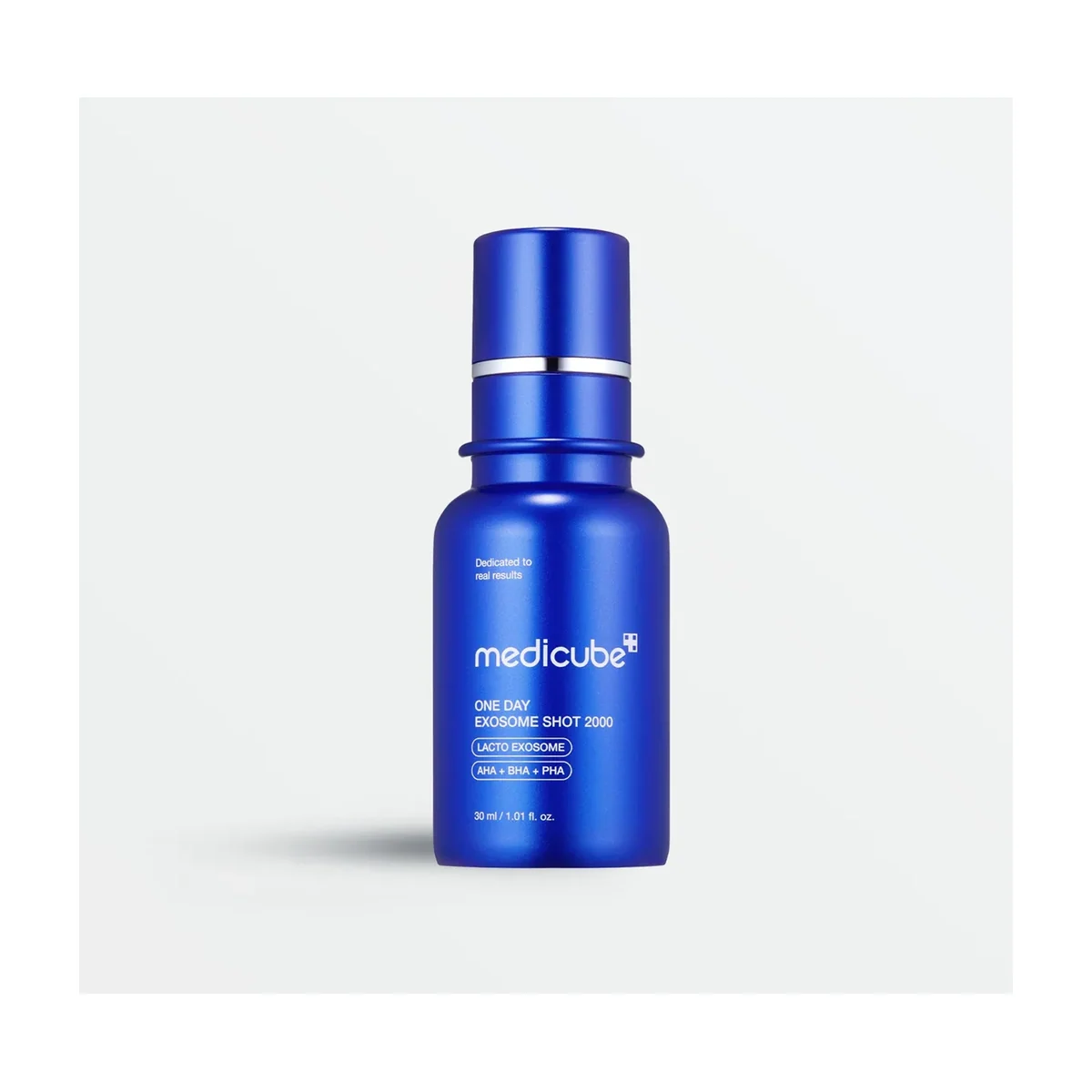
Medicube Zero Exosome Shot 2000 30ml blue pump bottle
Promising for Large Pores
What makes this different

It is a home version of the Korean clinic spicule treatment: silica needles from freshwater sponge, rubbed into the skin to open microchannels for a day or two, carrying niacinamide and a Lactobacillus-derived 'exosome' at a labelled ppm. The delivery mechanism is real and studied; the exosome branding borrows from an injectable clinic category it does not belong to.

Medicube

Medicube Zero Exosome Shot Review

Liquid Microneedling, Lite Spot Treatments ampoule k beauty Paraben free Cruelty free

A home spicule treatment with a real mechanism, sponge silica needles that open microchannels for a day, carrying a real active, niacinamide, and a bacterial 'exosome' that borrows a clinic word it has not earned. It prickles for hours, smooths texture over a few sessions, and suits resilient oily skin that wants a treatment to feel like one. It is not for sensitive faces, and the ppm on the box is the least important number on it.

Price $22.00 30ml / 1.01 fl oz (Mild 2000) · more sizes
Shopper rating 4.6 ★★★★★ 18 reviews
On the market 2024 Made in South Korea
Buy at Amazon ♥
Verdicts

How well it fits each concern

Two and a half years of sales and a small, positive retailer record of 18 Ulta reviews, with the Amazon listing unreadable this session, give a thin read on real-world results, and the efficacy figures come from a twenty-person brand survey and a self-test. The spicule delivery mechanism is supported by independent research; the exosome claims and the pore percentages are not, so this assessment leans on the ingredient order and the published spicule literature.

One verdict per concern. Open a row for the reasoning; the receipt has every source.

The scaleRecommendedGoodSupportingEarly evidenceNot for thisAvoidhow it works

Promisingfor Large PoresNiacinamide has trial-level evidence for large pores but no guideline or regulatory standing yet — promising, short of a recommendation; the other actives here are not yet assessed for it.Receipt3 sources on the row · concentration not declared; studied range 4% · row checked Jul 17, 2026 · rule R9p, same reading on 4,872 products · open the receipt

The case for it

  1. Niacinamide has at least one trial behind it for this concern but no guideline or regulatory standing yet.
  2. It is plausibly present at a working level, though the concentration is not declared.
  3. The formula carries none of the triggers this concern is sensitive to.

Moderate evidenceGentleNo reviews read yet

What would change this: A declared concentration would move this to a firmer reading of the dose.

Same rule for everyone. “Promising” is the verdict on 4,872 of 45,446 concern verdicts across the catalog; rule R9p decided 4,872 of them. Unchanged since September 25, 2026, engine 5.2.0.

Brand or formulator? Disclose a concentration or correct a fact →

The full receipt: rule, row, sources, dates →All large pores products →

Promisingfor Excess OilinessNiacinamide has trial-level evidence for excess oiliness but no guideline or regulatory standing yet — promising, short of a recommendation; the other actives here are not yet assessed for it.Receipt2 sources on the row · concentration not declared; studied range 2% · row checked Jul 17, 2026 · rule R9p, same reading on 4,872 products · open the receipt

The case for it

  1. Niacinamide has at least one trial behind it for this concern but no guideline or regulatory standing yet.
  2. It is plausibly present at a working level, though the concentration is not declared.
  3. The formula carries none of the triggers this concern is sensitive to.

Moderate evidenceGentleNo reviews read yet

What would change this: A declared concentration would move this to a firmer reading of the dose.

Same rule for everyone. “Promising” is the verdict on 4,872 of 45,446 concern verdicts across the catalog; rule R9p decided 4,872 of them. Unchanged since September 25, 2026, engine 5.2.0.

Brand or formulator? Disclose a concentration or correct a fact →

The full receipt: rule, row, sources, dates →All excess oiliness products →

Also listed for Rough Texture and Dullness — the actives here (Niacinamide, hydrolyzed sponge, Panthenol (Vitamin B5) are in our research queue for those concerns; there is no verdict until their evidence rows are written. That is a gap in our table, not a mark against the product.

Where our review and the verdict differ. The review below was written on the formulation and the published trials; the verdicts above apply the stricter standing test in our methodology — an active earns a recommendation only with guideline or regulatory standing for the concern. Where the two disagree, the verdict is Dermington’s position.

A verdict is Dermington’s assessment of how well a product’s ingredients fit a concern — never a claim about what the product treats. Evidence dots and collected reviews sit beside it and are never blended in. Rules 0.5.1 · evidence table ev-2026.10-r231 · engine 5.2.0 · how we decide · this product’s receipt

Reader poll · Town SquareQuestion 1 of up to 3

Have you used Zero Exosome Shot?

One tap counts. A couple of optional follow-ups come next.

No account neededOne answer each, change it any timeCounted only in anonymous totalsHow the Square counts →
Assessment

Pros & cons

What it does well 6

  • Sponge spicules are a real, studied transdermal delivery mechanism
  • Niacinamide in sixth place is the right water-soluble active for spicule channels
  • Noticeable smoothing of texture after a few sessions
  • Fragrance-free with panthenol to settle the flush
  • Pump doses small amounts for the T-zone rather than the whole face
  • Mild version is the cheapest and, on the evidence, the sensible buy

Where it falls short 6

  • Hours of prickling and flushing by design; not for sensitive or reactive skin
  • 'Exosomes' are bacterial vesicles with preliminary evidence, not clinic biologics
  • Three ppm strengths are an upsell on the least proven ingredient
  • Efficacy data is a twenty-person survey and a self-test
  • Cannot share a night with retinoids, acids or vitamin C
  • Grainy residue if not rubbed in fully
Review

The full review

Rub it in and wait. Within a minute the skin starts to prickle, then warm, then feel faintly like fine sandpaper, and for the next few hours you are aware of your face in a way skincare rarely makes you. That is not an allergic reaction and it is not the exosomes. It is hydrolyzed sponge, the eleventh ingredient, which is the cosmetic name for microscopic silica spicules harvested from freshwater sponge and the same material Korean clinics have been rubbing into faces as 'liquid microneedling' for most of this decade. Medicube, whose business is turning clinic procedures into things you can buy on Amazon, released the Zero Exosome Shot in March 2024 as its home version of that treatment, and it is worth taking the two halves of the name separately, because one of them is a genuine technology and the other is a marketing decision. The spicules first. When a spicule-containing gel is massaged into skin, the needles, a fraction of a millimetre long, lodge in the outer epidermis and stay there for a day or two, creating channels that let water-soluble molecules pass into the living layers far more efficiently than intact skin allows; the peer-reviewed work on this, from a 2017 Molecular Pharmaceutics study through a 2026 lidocaine paper in Drug Delivery and Translational Research, shows delivery increases of an order of magnitude or more for the right molecule, with skin disruption that resolves on its own. So the prickle really does mean something is open. What passes through is the more interesting question, and here the list is instructive. Niacinamide is sixth, a working dose of the one ingredient with strong evidence for sebum and pore appearance, and it is water-soluble, which is exactly the kind of molecule spicule channels help. Panthenol is sixteenth, a soothing counterweight. Then, seventeenth, come the Lactobacillus extracellular vesicles, which is what the 2,000, 7,500 or 25,000 ppm on the label refers to. These are membrane particles shed by a bacterial ferment; they share a name and a size range with the human stem-cell exosomes used in Korean clinic injections and almost nothing else, and their topical evidence amounts to in-vitro work and small cosmetic studies. Medicube is not lying, the word is technically defensible, but the sales pitch invites a comparison with clinic biologics that the ingredient cannot support, and the three-strength pricing turns that invitation into an upsell. The honest reading is that this is a spicule-delivered niacinamide ampoule with a light BHA-PHA tail, betaine salicylate and gluconolactone at the very end, and a bacterial vesicle of uncertain value along for the ride. Judged on that reading it is a reasonable product for a specific person. Oily, combination and resilient skin that wants texture smoothed and pores less obvious will notice the morning-after smoothness after two or three sessions, partly the mild exfoliation of shedding spicules and partly the tightness that follows a day of low-grade irritation, and over six to eight weeks of use two or three nights a week the niacinamide has a plausible path to a real reduction in congestion. Medicube's self-test claims fifteen to twenty percent improvements in pore measures and a large jump in what it calls dead-skin-cell improvement, which is consistent with that mechanism and is also a self-test, alongside a twenty-person survey in which everyone said it felt like professional care. The people it is not for are easy to name. Sensitive, rosacea-prone, eczema-prone and barrier-compromised skin should not be deliberately puncturing itself with silica, and anyone on a retinoid or acid routine has to clear the night, because a spicule channel does not discriminate about what it lets through. Active acne is a poor site for it. And the brand's warning against combining it with its own devices on a first bottle should be read as a rule rather than a suggestion. In use the practical notes are few. Apply to bare skin first after cleansing, a few drops to the zones that need it rather than the whole face on early attempts, rub and press for a minute so the spicules seat rather than sit on top as grit, then a plain toner and a bland moisturizer and nothing clever. The flush fades within an hour or two; the prickle can outlast it, and on the first few uses it may still be there in the morning. It is fragrance-free, which given everything else going on is a mercy, and the small pump makes zone dosing easy. At twenty-two dollars for the Mild version, twenty-four for Strong and twenty-six for Intense, a bottle is about three months at two or three uses a week, which is fair for a spicule product and an argument for buying the cheapest one, since the only thing the higher prices buy more of is the least proven ingredient and a harsher session. Two and a half years on, its retailer record is small and warm, and that matches the experience: for the right skin, a treatment that feels like one; for the wrong skin, a self-inflicted problem with a clinical name.

The science

The mechanism worth crediting is the spicule. Hydrolyzed sponge is the INCI name for siliceous spicules from freshwater sponges of the Spongilla family, needle-shaped silica bodies roughly one to two hundred micrometres long. Massaged into skin they penetrate the stratum corneum and embed in the epidermis, where, unlike a microneedle array that is withdrawn and whose channels close within hours, they persist for one to two days and keep the channels open. A 2017 study in Molecular Pharmaceutics showed that sponge spicules increased skin delivery of a hydrophilic macromolecule by tens of fold over passive application and several-fold over a dermaroller, with transepidermal water loss rising and then recovering, and a 2026 paper in Drug Delivery and Translational Research reported near-tenfold increases in lidocaine absorption by the same route. That literature supports the idea that spicules can substantially increase penetration of water-soluble actives, and it also documents the irritation, flushing and transient barrier disruption that users of this ampoule describe. What is being delivered matters more than the channel. Niacinamide, sixth in the list, is hydrophilic and small, exactly the class of molecule spicules favour, and its sebum-regulating and pore-appearance evidence from controlled trials, summarised in a 2021 review in Antioxidants, gives the formula its most credible efficacy claim. Lactobacillus extracellular vesicles, the labelled 'exosomes' at 2,000 to 25,000 ppm across the three versions, are bacterial membrane vesicles; they are structurally distinct from the mesenchymal-stem-cell exosomes studied in regenerative dermatology, their topical evidence is confined to in-vitro and small cosmetic studies, and no controlled data supports a dose-response across the ppm range the brand sells. Betaine salicylate and gluconolactone at the tail contribute mild keratolytic and pH effects, and panthenol provides modest soothing. The product is therefore best understood as a spicule-enhanced niacinamide treatment with an unproven vesicle additive, and its irritation profile follows directly from the mechanism that makes it work.

References 3 ShowHide
  1. Skin Delivery of Hydrophilic Biomacromolecules Using Marine Sponge Spicules — Molecular Pharmaceutics (2017)
  2. Topical delivery of Lidocaine using spicules for local anesthesia — Drug Delivery and Translational Research (2026)
  3. Mechanistic Basis and Clinical Evidence for the Applications of Nicotinamide (Niacinamide) to Control Skin Aging and Pigmentation — Antioxidants (2021)

The clinical view

Spicule products occupy an unusual place in clinical opinion: the delivery mechanism is genuine and has peer-reviewed support, but it works by deliberately disrupting the barrier, and dermatology guidance is cautious about home products that do so without supervision. For resilient, oily, non-inflamed skin the transient irritation is generally self-limiting and the niacinamide it delivers is a sensible payload; for rosacea, atopic dermatitis, active inflammatory acne, recently treated or sensitised skin, a product that embeds silica needles is contraindicated in practice, and the brand's own warnings about tingling, redness and heat should be taken as a screening tool. The exosome claim is viewed sceptically: the bacterial vesicles listed bear no established relationship to the stem-cell-derived exosomes investigated in regenerative medicine, and no clinical evidence supports the three-tier ppm marketing. Standard advice would be to use the mildest version on a small area first, keep it away from retinoids and acids on the same night, never combine it with a device or manual needling, and stop at any sign of persistent redness or breakouts. Patients seeking durable pore improvement would still be pointed to consistent niacinamide, retinoids and, where warranted, in-clinic procedures.

Formula

Key ingredients

  1. Hydrolyzed Sponge (spicules)

    Eleventh in the list, these are the freshwater-sponge silica needles that make the ampoule prickle: rubbed in, they lodge in the outer epidermis and open microchannels for a day or two, which is a genuine, studied delivery mechanism and the only thing here that separates the product from a niacinamide serum.

    Not yet assessed
  2. Lactobacillus Extracellular Vesicles ('exosomes') 0.2%

    The 2,000ppm exosomes in the Mild version are bacterial membrane vesicles from a Lactobacillus ferment, seventeenth in the list; they are not the human stem-cell exosomes of clinic injections, and their topical evidence is a handful of in-vitro and small cosmetic studies, so the number on the box describes a dose of a poorly characterised material.

    Not yet assessed
  3. Niacinamide

    Sixth on the list, the one active with strong evidence on pore appearance and sebum; the spicule channels plausibly increase how much of it reaches the living epidermis, which makes this the ingredient most likely to be responsible for the brand's pore-density figures.

    Limited for Large Pores
  4. Betaine Salicylate & Gluconolactone (BHA/PHA)

    The last three ingredients are a gentle BHA-PHA pair with citric acid, present at exfoliant-adjacent trace levels; they support the dead-skin-cell claim in the brand's self-test but are far below the doses in the line's One-day Serum, and their main effect is on pH.

    Not yet assessed
  5. Panthenol

    Sixteenth, sitting just before the exosomes, it is the soothing counterweight to the spicule irritation; a modest dose that helps the redness settle within the hour rather than anything barrier-rebuilding on its own.

    Not yet assessed
  6. Zero-line botanical blend (Pueraria, Ulmus, Pinus, Oenothera, Campsis extracts)

    The same kudzu, elm, pine, evening primrose and trumpet-creeper extracts that run through the Zero Pore line, listed after the exosomes at trace levels; they carry the line's 'patented pore care' language and no dose-relevant evidence.

    Not yet assessed
Full ingredient list 28 ingredients ShowHide

Water, Dipropylene Glycol, Glycerin, Butylene Glycol, 1,2-Hexanediol, Niacinamide, Sodium Polyacrylate, Ethylhexyl Palmitate, C12-14 Alketh-12, Hydrogenated Polydecene, Hydrolyzed Sponge, Ethylhexylglycerin, Adenosine, Caprylyl/Capryl Glucoside, Disodium EDTA, Panthenol, Lactobacillus Extracellular Vesicles, Campsis Grandiflora Flower Extract, Pueraria Lobata Root Extract, Pinus Palustris Leaf Extract, Oenothera Biennis (Evening Primrose) Flower Extract, Ulmus Davidiana Root Extract, Calcium Silicate, Sodium Silicate, Betaine Salicylate, Citric Acid, Gluconolactone

Safety & formulation facts

  • Pregnancy safe
  • Fragrance free
  • Alcohol free
  • Not oil free
  • Silicone free
  • Paraben free
  • Sulfate free
  • Cruelty free
  • Not vegan
  • Not fungal-acne safe
Pore-clogging (comedogenic) ethylhexyl palmitate
Potential irritants hydrolyzed sponge spiculesbetaine salicylate
Compatibility

Skin types & routine

Routine step treatment
Time of day Night
Best season All year
Finish matte, fast-absorbing

Layering

Apply as the first step after cleansing on bare skin, rub and press in for a minute until the prickle sets, then follow with a plain hydrating toner and a bland moisturizer; keep retinoids, acids and vitamin C off the face that night, and do not use it under a microcurrent or needling device.

When to expect results

The prickle and mild flush last an hour or two and a faint roughness can persist for a day as the spicules shed; texture feels smoother after two or three sessions, and any change in pore appearance from the niacinamide and light acids takes six to eight weeks of two or three uses a week.

Pairs well with niacinamidepanthenolhyaluronic-acidceramides
Don't combine with retinoltretinoinglycolic-acidsalicylic-acidvitamin-cbenzoyl-peroxide

A routine built around it

Morning

  1. Gentle cleanser
  2. Hydrating toner
  3. Moisturizer
  4. Sunscreen SPF 50

Night

  1. Oil cleanser
  2. Foam cleanser
  3. THIS PRODUCT (2-3x weekly, first step)
  4. Hydrating toner
  5. Bland moisturizer
Guidance

How to use it, and who it's for

How to use

Two or three evenings a week, on clean, dry skin and before anything else, pump a small amount onto the fingertips and dot it onto the areas of concern, the nose, cheeks and forehead, or the whole face once you know how your skin responds, keeping well clear of the eyes and lips. Rub and then press with the fingertips for about a minute until the gritty feel gives way to a prickle, which means the spicules have seated. Follow with a plain hydrating toner and a bland moisturizer, and nothing active: no retinoids, acids, vitamin C or benzoyl peroxide that night. Expect tingling, warmth and some flushing for an hour or more, and a faint roughness for a day. Patch test behind the ear first, start with the Mild version, do not use it with a device, and skip it entirely on broken, sunburned, freshly exfoliated or inflamed skin.

Is it worth the price?

Twenty-two dollars for 30ml of the Mild version, used two or three times a week, is about three months of a spicule treatment, which compares well with the price of a single clinic spicule session and fairly with other home spicule ampoules. The value case rests on the spicules and the niacinamide, and both are identical across the three strengths; what the Strong and Intense versions add, at twenty-four and twenty-six dollars, is more of a bacterial vesicle with preliminary evidence and a rougher session, so the cheapest bottle is the rational one and the bundle is an upsell. Against a plain niacinamide serum it is expensive and uncomfortable; against the clinic treatment it imitates it is cheap. Medicube's brand premium here buys a well-executed format from an established name with no published trials, and the value holds only for skin robust enough to use it regularly.

Who should buy it

Oily, combination or resilient normal skin with rough texture and visible pores, whose owner wants a home treatment that feels like a clinic one and does not mind an evening of prickling, will find this delivers noticeable smoothing and a plausible longer-term niacinamide benefit. It suits experienced users who already keep retinoids and acids to separate nights.

Who should skip it

Skin that is sensitive, rosacea-prone, eczema-prone or barrier-compromised, and anyone with active inflammatory acne, should not be embedding silica needles in their face. It is also the wrong buy for anyone purchasing the higher ppm versions for the exosomes, which are the least proven part of the formula, or for anyone expecting a comfortable serum.

Ready to try it?Medicube Zero Exosome Shot · $22.00 · 30ml / 1.01 fl oz (Mild 2000)
Details

The product, in detail

Texture
A slightly viscous, translucent gel-serum with a faint grittiness you feel more than see, which turns into a fine prickle as it is rubbed in and dries to a smooth, matte skin.
Scent
None; a faint raw-ingredient note that vanishes on application.
Packaging
A 30ml airless pump bottle in the Zero line's blue livery, sold as Mild 2000, Strong 7500 and Intense 25000 ppm exosome strengths; a pump doses a small, controlled amount that is easy to confine to a zone rather than the whole face.
How long it lasts
About three months at a full face two or three times a week; longer used only on the T-zone.
Once opened
Use within 6 months · track your toss-by date →
Size
30ml / 1.01 fl oz (Mild 2000) · other sizes available
Made in
South Korea
Launched
March 2024

What the first two weeks feel like

Expect a prickling, warming sensation that starts within a minute of rubbing it in, peaks over the first quarter-hour and can linger as a faint sandpaper feel for several hours or, on the first few uses, into the next morning; some flushing is normal, and skin feels tight then smooth as the spicules shed over a day or two. It is not comfortable and is not meant to be.

The story behind it

Why it exists

Spicule 'shots' became a Seoul clinic staple in the early 2020s, and Medicube, whose whole business is bringing clinic procedures home, released this in March 2024 as the Zero line's take on it, with three exosome ppm strengths and a name that rode the exosome boom in Korean aesthetics. Pink PDRN and azelaic acid variants followed the same year in the brand's other lines.

About Medicube Established Brand (5–20 years)

Medicube, part of APR Corporation since 2018, sells home devices and skincare designed to mimic clinic procedures, and the Exosome Shot is its take on the Korean clinic 'spicule' treatment. The brand cites a twenty-person consumer survey and a self-test report for this ampoule; no independent trial of the product exists, though sponge-spicule delivery itself has a small peer-reviewed literature.

Brand founded 2018 · This product since 2024

Myth vs. reality

What people get wrong about it

MythThe exosomes in the shot are the same stem-cell exosomes used in clinic treatments.

RealityThe label ingredient is Lactobacillus extracellular vesicles, membrane particles from a bacterial ferment, at 2,000 to 25,000 ppm depending on the version; they share a name and a size range with human-cell exosomes and little else, and their topical evidence is preliminary.

MythThe tingling means the actives are absorbing.

RealityThe tingling is the physical sensation of silica spicules lodging in the outer skin; it does indicate the microchannels have opened, but the amount of niacinamide or vesicle that then passes through is not something the prickle measures, and stronger stinging is not stronger treatment.

FAQ

Questions people ask

Why does the Medicube Zero Exosome Shot tingle and sting?

Because it contains hydrolyzed sponge, microscopic silica needles from freshwater sponge, that lodge in the outer skin as you rub the ampoule in. The prickle is mechanical, not chemical, and can last for hours; it is expected, but it is also why sensitive and reactive skin should stay away.

Which Medicube Exosome Shot strength should I start with, 2000, 7500 or 25000?

Mild 2000. The numbers are the ppm of Lactobacillus-derived vesicles, and the higher versions also feel more intense in use; since the vesicles' benefit is the least proven part of the formula, there is no reason to pay for more of them before knowing how your skin handles the spicules.

Are the exosomes in the Medicube Zero Exosome Shot real exosomes?

They are extracellular vesicles from a Lactobacillus ferment, listed seventeenth on the INCI, not the human stem-cell-derived exosomes used in clinic injections. The word is technically defensible and commercially borrowed; treat the spicules and the niacinamide as the working parts.

How often can I use the Medicube Zero Exosome Shot?

Two or three times a week is sensible, on nights without retinoids, acids or vitamin C, and never on broken or freshly exfoliated skin. Medicube's own routine puts it first after cleansing, followed by a plain toner and a bland moisturizer; daily use just keeps the skin in a state of low-grade irritation.

Can I use the Medicube Exosome Shot with the AGE-R Booster Pro?

Medicube says beginners should not, and it is right: driving a spicule product deeper with a device compounds the irritation. Its 'pro tip' for experienced users is to apply the shot after the device's air-shot mode, not under it; on a first bottle, skip the device entirely.

Does the Medicube Zero Exosome Shot shrink pores?

The brand's self-test reports roughly fifteen to twenty percent improvements in pore measures, which are consistent with niacinamide delivered more efficiently plus the smoothing that mild exfoliation and a day of tightness produce. Pores do not close; expect a smoother, less congested look with regular use rather than a structural change.

Reviews

What shoppers tend to say

Recurring themes our editors read across retailer reviews — summaries in our words, not quotations, and not a substitute for a patch test.

Common praise

  • Skin feels noticeably smoother the next morning
  • The tingle makes it feel like a treatment
  • Pores look tighter for a few days
  • No fragrance

Common complaints

  • Stings and stays prickly for hours
  • Redness on sensitive skin
  • Hard to know which strength to buy
  • Grainy residue if not rubbed in fully
Next stepCheck it against what you already useClashes, spacing and the right order, with everything on your shelf.