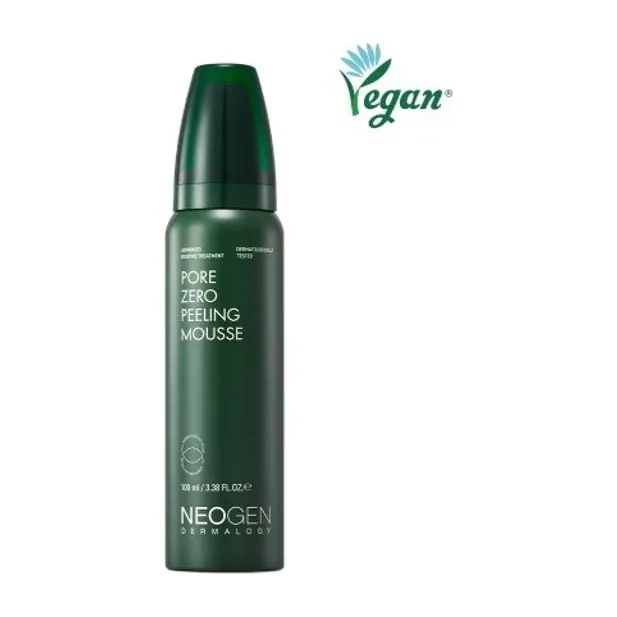
Neogen Pore Zero Peeling Mousse aerosol can
Not yet assessed for Large Pores
What makes this different

Unlike the algae-based Pore Tight, this vegan reformulation builds on willow bark water and papain for actual enzymatic and salicylate-driven exfoliation, then adds charcoal and plantago seed to adsorb sebum. It is the more genuinely active member of Neogen's mousse duo.

Neogen

Neogen Pore Zero Peeling Mousse Review

Enzyme Pore Vacuum Exfoliants foam k beauty Paraben free Cruelty free Vegan

The more genuinely exfoliating of Neogen's two viral mousses, pairing papain enzyme and willow bark salicylates with charcoal for a brighter, visibly de-gunked finish. It is a vegan upgrade with real action, but a heavy load of essential oils makes it tingly and best reserved for resilient, oily skin.

Price $29.95 100ml
Shopper rating 4.3 ★★★★★ 4,200 reviews
On the market 2023 Made in South Korea
Buy at Amazon ♥
Verdicts

How well it fits each concern

One verdict per concern. Open a row for the reasoning; the receipt has every source.

The scaleRecommendedGoodSupportingEarly evidenceNot for thisAvoidhow it works

Not for thisfor BlackheadsThe actives here have been researched for blackheads and the evidence does not support the claim.Receipt1 source on the row · rule R10, same reading on 489 products · open the receipt

The case for it

  1. Charcoal Powder & Plantago Asiatica Seed Extract has been researched for this concern and the evidence does not support it.
  2. It is plausibly present at a working level, though the concentration is not declared.
  3. The formula carries no trigger this concern is sensitive to, with the cautions noted.

Not from a trial rowStandard tolerabilityNo reviews read yet

What would change this: A declared concentration would move this to a firmer reading of the dose.

Same rule for everyone. “Not for this” is the verdict on 489 of 45,446 concern verdicts across the catalog; rule R10 decided 489 of them. Unchanged since September 5, 2026, engine 5.2.0.

Brand or formulator? Disclose a concentration or correct a fact →

The full receipt: rule, row, sources, dates →All blackheads products →How blackheads is treated →

Also listed for Large Pores, Excess Oiliness, Dullness and Rough Texture — the actives here (Activated Charcoal, Papain (Papaya Enzyme) are in our research queue for those concerns; there is no verdict until their evidence rows are written. That is a gap in our table, not a mark against the product.

A verdict is Dermington’s assessment of how well a product’s ingredients fit a concern — never a claim about what the product treats. Evidence dots and collected reviews sit beside it and are never blended in. Rules 0.5.1 · evidence table ev-2026.10-r231 · engine 5.2.0 · how we decide · this product’s receipt

Reader poll · Town SquareQuestion 1 of up to 3

Have you used Pore Zero Peeling Mousse?

One tap counts. A couple of optional follow-ups come next.

No account neededOne answer each, change it any timeCounted only in anonymous totalsHow the Square counts →
Assessment

Pros & cons

What it does well 7

  • Willow bark salicylates add genuine keratolytic exfoliation
  • Papain enzyme brightens and smooths dull skin
  • Charcoal and plantago seed visibly lift oil and debris
  • Vegan-certified formula
  • Centella and licorice soothe and brighten
  • Generous 100ml can at a fair price
  • More active than the algae-based Pore Tight version

Where it falls short 6

  • Heavy essential-oil load risks irritation
  • Cooling tingle is fragrance, not efficacy
  • Denatured alcohol high in the formula
  • Unsuitable for sensitive or reactive skin
  • Pore-refining effect is temporary
  • Aerosol can isn't refillable and dislikes heat
Review

The full review

If the Pore Tight Peeling Mousse was a satisfying piece of skincare theater, the Pore Zero is what happens when Neogen decided the sequel should actually do something. On the surface they look like twins — same aerosol can, same massage-and-rinse ritual, same viral 'watch the gunk lift off' appeal. But pour over the ingredient lists and they are different products with different philosophies, and the Pore Zero, the vegan Dermalogy reformulation, is the one with genuine exfoliating chemistry behind the spectacle.

The tell is right at the top of the INCI. Where the Pore Tight leads with algae extract, the Pore Zero's entire water phase is willow bark water. That matters because willow bark carries naturally occurring salicylates — cousins of salicylic acid — which give this mousse a gentle keratolytic edge its sibling simply does not have. Loosening the bonds between dead surface cells is the kind of mechanism that actually addresses dullness and congestion rather than just degreasing. Layered on top of that is papain, a papaya-derived enzyme that digests the keratin proteins gluing flaky cells to the surface. Between the salicylates and the enzyme, you have a real, if mild, two-pronged exfoliating step instead of a purely mechanical rinse. Charcoal and plantago asiatica seed extract handle the adsorption side — charcoal binds surface sebum, plantago swells to clump oil and debris into larger, easier-to-rinse particles — which is the part responsible for that oddly gratifying sense that the foam is physically vacuuming your skin.

In use, this reads as more active than the Pore Tight, and the difference is noticeable. After massaging it in and rinsing, skin looks brighter and feels smoother in a way that goes a little beyond the temporary matte finish of a degreasing foam. For oily and combination skin fighting dullness alongside congestion, that brightening enzyme angle is a genuine point in its favor. Neogen also earned vegan certification on this version and leaned into a cleaner positioning, which will matter to some shoppers.

And now the part that has to be said plainly, because it is the formula's defining flaw: the essential-oil load is heavy. Bergamot, lavender, spearmint, geranium, wintergreen, and rose oils all appear in here, and they are why the mousse smells like an herbal-floral spa and delivers that cool, prickly tingle on contact. Here is the crucial reframe — that tingle is not the exfoliation working. It is the spearmint and wintergreen, full stop. People routinely misread the sensation as proof of deep cleaning, when in reality it is the single most likely thing in the formula to provoke irritation. Combined with the denatured alcohol high on the list, this is a product that resilient, oily skin will enjoy and that dry, sensitive, rosacea-prone, or barrier-compromised skin should approach with real caution, if at all. Even as a rinse-off, that many fragrant botanicals is a lot to put on the face.

The practical realities mirror the Pore Tight. It is an aerosol can — convenient, not refillable, and unhappy in heat — and at $29.95 for 100ml used a couple of times a week, it stretches to a few months at a fair mid-range price. The honest expectation-setting also carries over: the enzyme, salicylates, and charcoal make pores look clearer and skin brighter right after rinsing, but pore size is largely genetic, and the effect fades as your skin rebuilds oil. That is why this wants to be a two-to-three-times-a-week habit rather than a daily one, and why stacking it with other acids or retinoids on the same day is asking for over-exfoliation.

It is also worth appreciating what the reformulation signals about where K-beauty is heading. Swapping a marine base for willow bark water and earning vegan certification is exactly the kind of move brands make when 'clean' and 'plant-powered' positioning starts driving sales as much as efficacy does. The irony is that in chasing that positioning, the formula leaned hard on natural fragrant oils — the least 'clean' thing about it from a sensitivity standpoint. There is a genuine lesson buried in that contradiction: natural does not mean gentle, and an ingredient list full of botanical essential oils can be considerably harder on reactive skin than a fragrance-free synthetic one. If you read 'vegan, plant-based exfoliator' and instinctively assume soothing, this product is a useful reminder to read the actual list rather than the front of the can. The exfoliating chemistry is the real upgrade; the botanical perfume is the part to scrutinize.

Where does that leave it? The Pore Zero is the better-formulated of the two mousses on paper — it actually exfoliates and brightens rather than just degreasing — and for oily skin that tolerates fragrance well, it is the one I would point to. But the essential-oil load is a real and avoidable liability that costs it points and narrows its audience considerably. It is a genuinely good product trapped in a slightly self-sabotaging formula: all the smart exfoliating chemistry is there, wrapped in more botanical perfume than sensitive skin can safely handle.
The science

This formula's exfoliation rests on two mechanisms with reasonable support. Willow bark (Salix alba) contains salicin and related salicylates that the skin can convert toward salicylic-acid-like activity; while a willow bark water base delivers far lower and less predictable levels than a standardized BHA, the keratolytic rationale is sound and the ingredient is valued for being gentler than synthetic salicylic acid. Papain is a cysteine protease from papaya with documented proteolytic activity against keratin, the basis for its use as an enzymatic exfoliant — though its stability and activity in a rinse-off, alcohol-containing aerosol are inherently variable. The adsorption story leans on charcoal's large surface area for binding surface sebum and on plantago and moringa-type seed extracts marketed for their particulate-gathering properties, claims that are more functional than clinically proven. The soothing counterweights are better evidenced: Centella asiatica's triterpenes (asiaticoside, madecassoside) have published anti-inflammatory and wound-healing data, and dipotassium glycyrrhizate from licorice is a well-documented anti-irritant and brightening agent. The formulation's weak point scientifically is its fragrant botanical oils — bergamot, lavender, spearmint, wintergreen — which contribute no exfoliating benefit and carry documented sensitizing potential, working against the very soothing actives included to balance them.

The clinical view

Enzyme-and-willow-bark exfoliants are typically regarded in clinical settings as mild alternatives to standardized acids: useful for gentle brightening and surface smoothing, but lower and less predictable in potency than a formulated salicylic or glycolic product. Papain and willow salicylates are generally well tolerated in rinse-off formats, and clinical guidance tends to favor them for people who find traditional acids too aggressive. The notable caution with this particular formula is its essential-oil content — bergamot, lavender, spearmint, geranium, and wintergreen are recognized contact sensitizers, and the cooling tingle they create is often misinterpreted by users as evidence of efficacy. For anyone with rosacea, eczema, or sensitive skin, that fragrance load is the main reason this kind of product is approached cautiously. On resilient, oily skin used a few times weekly, it is considered a reasonable, low-commitment exfoliating step.

Formula

Key ingredients

  1. Willow Bark Water (Salix Alba)

    Standing in as the entire water phase rather than a tail-end extract, willow bark water supplies naturally occurring salicylates that give this mousse a gentle keratolytic edge its predecessor lacked. It loosens the bonds between dead surface cells so the foam can sweep them away on rinse.

    Not yet assessed
  2. Papain

    A papaya-derived proteolytic enzyme that digests the keratin proteins binding dull, flaky cells to the surface. Paired with the willow salicylates here, it adds a true enzymatic exfoliating step to what would otherwise be a purely mechanical mousse.

    Not yet assessed
  3. Charcoal Powder & Plantago Asiatica Seed Extract

    The adsorbent duo: charcoal binds excess surface sebum while plantago asiatica seed extract swells to clump oil and debris into larger particles that lift off more easily. Together they are what make the rinse-off feel like it physically pulls gunk from the skin.

    No qualifying study for Blackheads
  4. Centella Asiatica & Licorice (Dipotassium Glycyrrhizate)

    A soothing pair meant to offset the irritation potential of the enzyme, salicylates, and the formula's heavy botanical-oil load. Centella calms while licorice's glycyrrhizate brightens, both trying to keep this exfoliating step from leaving skin red.

    Not yet assessed
Full ingredient list 43 ingredients ShowHide

Salix Alba (Willow) Bark Water, Butane, Propane, Alcohol Denat, Quaternium-60, Propylene Glycol, Carbomer, 1,2-Hexanediol, Glycerin, Water, Hydroxyacetophenone, Dipropylene Glycol, Glycereth-25 PCA Isostearate, Caprylyl Glycol, Charcoal Powder, Ethylhexylglycerin, Citrus Aurantium Bergamia (Bergamot) Fruit Oil, Sodium Lactate, Sodium Gluconate, Gardenia Florida Fruit Extract, Lavandula Angustifolia (Lavender) Oil, Dextrin, Theobroma Cacao (Cocoa) Extract, Betaine, Trehalose, Anthemis Nobilis Flower Oil, Butylene Glycol, Maltodextrin, Pelargonium Graveolens Flower Oil, Mentha Viridis (Spearmint) Leaf Oil, Dipotassium Glycyrrhizate, Chaenomeles Sinensis Fruit Extract, Rose Flower Oil, Papain, Gaultheria Procumbens (Wintergreen) Leaf Extract, Hydroxystearic Acid, Centella Asiatica Extract, Perilla Frutescens Leaf Extract, Plantago Asiatica Seed Extract, Hordeum Vulgare Seed Extract, Polygonum Cuspidatum Root Extract, Xanthan Gum

Safety & formulation facts

  • Pregnancy safety unverified
  • Not fragrance free
  • Not alcohol free
  • Not oil free
  • Silicone free
  • Paraben free
  • Sulfate free
  • Cruelty free
  • Vegan
  • Not fungal-acne safe
Potential irritants Alcohol DenatBergamot OilLavender OilSpearmint Leaf OilWintergreen Leaf ExtractGeranium Flower OilRose Flower Oil
Common allergens Essential oils (bergamot, lavender, geranium, rose, spearmint)Linalool/limonene from botanical oils
Compatibility

Skin types & routine

Routine step treatment
Time of day Morning & night
Best season summer
Finish non-greasy

Layering

Use in place of your cleanser, massage briefly, and rinse before the rest of your routine. Cap it at 2-3 times a week and skip it on the same day as other acids or retinoids.

When to expect results

Skin looks brighter and feels smoother immediately after the first rinse thanks to the enzyme and charcoal. Reduced surface congestion and a clearer look build over 2-3 weeks of regular use; pore size itself is not permanently changed.

Pairs well with hyaluronic-acidniacinamidecentella-asiatica
Don't combine with retinoidsexfoliating-acids

A routine built around it

Morning

  1. Neogen Pore Zero Peeling Moussethis product
  2. Soothing toner
  3. Niacinamide serum
  4. Moisturizer
  5. Sunscreen

Night

  1. Oil cleanser
  2. Neogen Pore Zero Peeling Moussethis product
  3. Centella toner
  4. Moisturizer
Guidance

How to use it, and who it's for

How to use

Shake the can well, dispense a generous dollop of foam into your palm, and massage gently over dry or damp skin for 30 to 60 seconds, concentrating on oily, congested zones. Rinse thoroughly with lukewarm water and follow with a soothing toner and moisturizer. Keep it to two or three times a week rather than daily, and avoid using it on the same day as other exfoliating acids or retinoids to prevent over-exfoliation. Patch test first if your skin is fragrance-sensitive, and always wear sunscreen afterward.

Is it worth the price?

At $29.95 for 100ml, this is fairly priced and, used two to three times a week, lasts a few months — a slightly better size-to-price ratio than the smaller Pore Tight mousse. You are getting more genuine exfoliating chemistry for nearly the same money, which makes it the better value of the two if your skin tolerates fragrance. It comes in one size with no bulk option. From an established K-beauty brand with real distribution, the price reflects a competent, vegan-certified reformulation rather than pure hype, though a dedicated salicylic acid product offers more predictable exfoliation for similar money.

Who should buy it

This suits oily and combination skin that wants real, gentle exfoliation and brightening from an enzyme-and-willow-bark formula, plus the satisfying ritual of a rinse-off pore mousse. If you tolerate fragrant botanicals well and want the more active of Neogen's two mousses, this is the one to choose.

Who should skip it

Steer clear if your skin is sensitive, reactive, rosacea-prone, or barrier-compromised, because the bergamot, lavender, spearmint, and wintergreen oils are genuine irritation triggers. It is also a poor fit if you want predictable, standardized exfoliation, where a dedicated salicylic or glycolic acid product will serve you far better.

Ready to try it?Neogen Pore Zero Peeling Mousse · $29.95 · 100ml
Details

The product, in detail

Texture
A firm, pressurized foam that pipes out dense and collapses into a slightly gritty, slick massage layer as charcoal and botanicals disperse.
Scent
A pronounced herbal-floral aroma from bergamot, lavender, spearmint, and rose oils that lingers briefly before rinsing.
Packaging
A pressurized aerosol can with a dispensing nozzle; effective and travel-restricted, and it must be stored away from heat.
How long it lasts
Roughly 2-3 months at two to three uses per week.
Once opened
Use within 12 months · track your toss-by date →
Size
100ml
Made in
South Korea
Launched
2023
Certifications
Vegan-certified

What the first two weeks feel like

The first use feels active — a cool tingle from the spearmint and wintergreen, a gritty massage, and visibly brighter, smoother skin after rinsing. That tingle is the signal sensitive skin should scale back or avoid it entirely.

The story behind it

Why it exists

When Neogen reworked its viral pore mousse into the Dermalogy line, the brand swapped the marine base for willow bark water and a papain enzyme and earned vegan certification, repositioning it as a brightening exfoliator rather than a purely mechanical degreaser.

About Neogen Established Brand (5–20 years)

Neogen launched in 2000 and built its name on physical exfoliation and pore care, with wide US distribution and a string of viral products. Its Dermalogy line leans on botanical and enzyme actives marketed for clean, vegan positioning rather than published clinical studies.

Brand founded 2000 · This product since 2023

Myth vs. reality

What people get wrong about it

MythThe tingle means it's working harder to clean your pores.

RealityThe tingle comes from spearmint and wintergreen essential oils, not from the exfoliation. It is a sensory effect and, for reactive skin, a sign of potential irritation rather than a measure of efficacy.

FAQ

Questions people ask

What's the difference between Neogen's Pore Zero and Pore Tight mousses?

Pore Tight uses an algae-and-charcoal base for mechanical degreasing, while Pore Zero is the vegan Dermalogy reformulation built on willow bark water and papain enzyme, giving it more genuine exfoliating and brightening action.

Why does the Pore Zero mousse tingle on my skin?

The cool tingle comes from spearmint and wintergreen essential oils, not from the exfoliation. It is a sensory effect, and for sensitive or reactive skin it can signal irritation rather than effectiveness.

Is the Neogen Pore Zero Peeling Mousse vegan?

Yes, the Dermalogy version is vegan-certified. It exfoliates using plant-derived papain enzyme and willow bark salicylates rather than any animal-derived ingredients.

How often should I use the Pore Zero mousse?

Two to three times a week is the sweet spot. Because it combines an enzyme, willow salicylates, and denatured alcohol, daily use risks over-exfoliating; oily skin handles the higher end better than dry skin.

Does the Pore Zero mousse get rid of blackheads permanently?

It clears surface oil, debris, and loosened dead cells so blackheads and congestion look reduced after rinsing, but the effect is temporary. Consistent use keeps pores looking clearer, but it cannot permanently change pore size.

Reviews

What shoppers tend to say

Recurring themes our editors read across retailer reviews — summaries in our words, not quotations, and not a substitute for a patch test.

Common praise

  • Visibly de-gunks skin in seconds
  • Brighter, smoother finish from the enzyme
  • Vegan-certified formula
  • Generous 100ml can
  • Genuinely exfoliates more than expected

Common complaints

  • Strong essential-oil scent
  • Too tingly for sensitive skin
  • Contains drying alcohol
  • Pore effect is temporary
Notable endorsementsCovered by Well+GoodViral on TikTok as a 'pore vacuum'
Next stepCheck it against what you already useClashes, spacing and the right order, with everything on your shelf.